
CRE-211 · Lesson 12 of 12 · 25 min
Monetization, sponsorships, workflow and capstone
Long-form video can be a hobby, a side income or a full-time business. Turning it into sustainable income requires understanding how long-form earns money, working professionally with sponsors, disclosing paid relationships honestly, and running production efficiently enough to keep publishing. This final lesson covers the YouTube Partner Program, advertising revenue, other revenue streams, sponsorships and integrations, disclosure rules in Canada and the United States, pricing sponsorships, budgeting and production workflow, building a team, and the capstone project. Revenue rules and thresholds change, so the details below are stated as they stand at the time of writing; always check current platform terms.
The YouTube Partner Program
The YouTube Partner Program (YPP) lets eligible channels earn money from their content. At the time of writing, it has two levels of eligibility. A first level, which unlocks fan funding features such as channel memberships, Super Chat, Super Stickers and Super Thanks, as well as shopping features, requires 500 subscribers, three public uploads in the last 90 days, and either 3,000 valid public watch hours on long-form videos in the last 12 months or 3 million valid public Shorts views in the last 90 days. Full monetization, including a share of advertising and YouTube Premium revenue, requires 1,000 subscribers and either 4,000 valid public watch hours in the last 12 months or 10 million valid public Shorts views in the last 90 days. Channels must also follow YouTube's monetization policies, live in an eligible country, have no active Community Guidelines strikes, use two-step verification and link an AdSense account. YouTube reviews applications, and its policies on inauthentic and mass-produced content, including repetitive or low-effort AI-generated material, can make channels ineligible.
| Requirement (at the time of writing) | Fan funding level | Full monetization |
|---|---|---|
| Subscribers | 500 | 1,000 |
| Recent uploads | 3 public uploads in 90 days | Not separately required |
| Long-form path | 3,000 watch hours in 12 months | 4,000 watch hours in 12 months |
| Shorts path | 3 million Shorts views in 90 days | 10 million Shorts views in 90 days |
| Revenue unlocked | Memberships, Super features, shopping | Plus ad and Premium revenue |
Advertising revenue
For long-form videos, YouTube pays partners 55 % of the net advertising revenue from ads shown on or around their videos, and a share of YouTube Premium subscription revenue based on Premium members' watch time. Creators see this as RPM, revenue per thousand views, which differs from CPM, the price advertisers pay per thousand ad impressions, because not every view shows an ad and YouTube keeps its share (CRE-202). Videos longer than eight minutes can include mid-roll advertisements, which increase revenue but should be placed at natural breaks to avoid annoying viewers. Advertising revenue varies with the audience's location, the subject's appeal to advertisers, the time of year (rates are typically higher in the fourth quarter before the holidays and lower in January), and whether content is suitable for all advertisers under YouTube's advertiser-friendly guidelines; videos with heavy profanity, violence or controversial subjects may earn limited or no ads.
Other revenue streams
Most professional creators combine several income sources, which reduces dependence on any one platform or advertiser:
- Sponsorships and brand integrations: paid segments or dedicated videos for brands (below).
- Fan funding: channel memberships with perks, Super Chat and Super Thanks, and external platforms such as Patreon.
- Affiliate marketing: commissions on sales through tracked links to products shown or recommended.
- Products and merchandise: clothing, digital products, courses, books, presets, templates and physical goods.
- Licensing: selling rights to use footage to media companies, advertisers or other creators.
- Services: consulting, speaking, teaching, production work for clients.
- Grants and funding: arts councils, cultural funds and foundations that support documentary and educational content in some countries.
Diversification makes income steadier; a channel earning from five sources is far less vulnerable to an advertising downturn or a policy change than one relying on ads alone.
Sponsorships and integrations
Sponsorships are often the largest income source for long-form channels. The most common form is an integration: a 60- to 90-second segment within a video in which the creator presents the sponsor's product, usually placed after the opening (Lesson 5). Other forms include dedicated videos about a product, product placements, series sponsorships and affiliate-plus-flat-fee deals. A professional sponsorship process includes evaluating whether the sponsor fits the audience and the creator's values; agreeing the brief, deliverables, talking points, approval process, deadlines and payment terms in a written contract; negotiating usage rights, such as whether the brand can reuse the segment in its advertising, and exclusivity, such as not working with competitors for a period; scripting the segment in the creator's own voice; submitting drafts for approval; and reporting results (CRE-202). Creators should decline sponsors whose products they would not recommend to a friend, since viewer trust is the asset sponsors are paying for.
Worked problem
Pricing an integration
A channel's last 15 long-form videos have a median of 40,000 views in the first 30 days. A sponsor offers 1,200 dollars for a 60-second integration. The creator uses an effective CPM of 25 to 40 dollars per thousand views as a guide for their niche. Is the offer reasonable?
Show solution
- Expected views: 40,000, using the median rather than the average to avoid outliers.
- Range at 25 to 40 dollars CPM: 40 × 25 = 1,000 dollars to 40 × 40 = 1,600 dollars.
- The offer of 1,200 dollars falls within the range, toward the lower end.
- If the sponsor wants usage rights or exclusivity, the creator should ask for more.
Answer: The offer is within the 1,000 to 1,600 dollar range; reasonable for a basic integration, but rights or exclusivity justify a higher fee.
Disclosure
Sponsored content must be disclosed clearly so that viewers know when a creator has been paid or received something of value. YouTube requires creators to tick the paid promotion box for videos with paid product placements, endorsements or sponsorships, which displays a notice to viewers, and the law in both Canada and the United States requires clear disclosure as well.
In the United States, the Federal Trade Commission Act prohibits deceptive practices, and the FTC's Guides Concerning the Use of Endorsements and Testimonials in Advertising, updated in 2023, require clear and conspicuous disclosure of material connections between creators and brands. In videos, the FTC advises disclosing in the video itself, both spoken and on screen, rather than only in the description, and the FTC's rule against fake reviews and testimonials, in effect since October 2024, allows civil penalties for certain deceptive endorsement practices.
In practice, disclose at the start of the sponsored segment, both verbally and on screen, using clear words such as "this video is sponsored by" or "paid partnership", tick the platform's paid promotion setting, and disclose affiliate links in descriptions. Never pretend that a sponsored opinion is independent.
Budgeting and production workflow
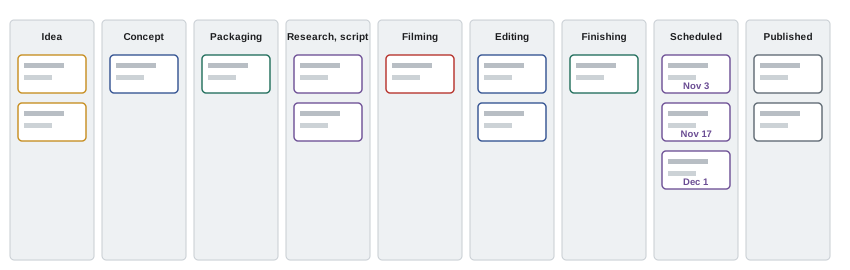
Running a long-form channel like a production company means planning costs and time. A video budget might include equipment and software (spread across many videos), music and stock licenses, travel and locations, props and materials, guest fees, editing, graphics and thumbnail design, and captioning or translation. Comparing expected revenue from advertising, sponsorships and other sources with the cost of each video shows which formats are sustainable. A production workflow, often managed in a project management tool, tracks every video through stages: idea, concept approved, packaging designed, research, script or outline, filming, editing (rough cut, fine cut), finishing, packaging finalized, scheduled, published and reviewed. Deadlines work backward from the publishing date, with buffers for delays and sponsor approvals.
Building a team
As a channel grows, the creator's time becomes the main constraint. Common first hires are a video editor, a thumbnail designer, and a manager or agent who handles sponsorships; later roles include researchers, writers, producers, camera operators, community managers and business managers. Hiring well involves defining the role and the results expected, testing candidates with paid trial projects, agreeing terms in writing, including rates, deadlines, revisions, credit and ownership of work, and building documentation such as style guides, checklists and templates so that quality stays consistent. Freelancers may be paid per video or per hour; employees involve employment law obligations that vary by province and state. CRE-330 and CRE-401 cover contracts, business structures and building a media company.
Capstone: a complete long-form video
The capstone asks you to plan, produce and publish (publicly or unlisted) a long-form video of at least eight minutes, applying the skills of this course. Submit:
- A concept statement, demand and competition research, and a rights log (Lesson 2).
- Packaging development: at least ten title options, three thumbnail concepts and the final pair, with reasons (Lessons 3 and 9).
- A segment outline with purposes, timings, re-hooks and a B-roll coverage list (Lessons 4, 5 and 7).
- The finished video, filmed with a planned setup and edited through rough and fine cuts, with clean sound around −14 LUFS, consistent color, accurate captions, chapters, a description and an end screen (Lessons 6, 8 and 10).
- A one-page channel strategy explaining where the video fits, with positioning, pillars and cadence (Lesson 11).
- A short business plan for the channel: revenue streams, a sample sponsorship rate calculation and a disclosure plan (Lesson 12).
- After at least two weeks, a reflection of about 600 words reviewing retention, click-through rate and comments, and what you would change.
Present the capstone as a portfolio piece suitable for showing to collaborators, sponsors or employers.
Taxes, records and business structure
Income from long-form video is taxable, and creators need good records from the start: income from each platform and sponsor, expenses such as equipment, software, travel and contractors, and any sales taxes collected. Platforms may withhold taxes on income from other countries, and creators may need to submit tax forms to platforms to reduce withholding under tax treaties. As income grows, many creators consult an accountant about business structures, such as sole proprietorships or corporations in Canada, or sole proprietorships, LLCs or S corporations in the United States, and about sales tax registration. CRE-330 covers creator business, contracts and taxes in depth.
Contracts and rights
Contracts protect creators and collaborators. Key agreements include sponsorship contracts specifying deliverables, approvals, payment terms, usage rights, exclusivity and cancellation; contractor agreements with editors and designers covering rates, deadlines, revisions, confidentiality and ownership of work; collaboration agreements covering revenue sharing and publishing; and releases from people appearing in videos. Read contracts carefully, watch for broad clauses granting brands perpetual rights to your content or likeness, and seek legal advice for significant deals.
Planning a year of long-form
Putting the course together, a creator might plan a year with a sustainable cadence, such as two videos a month; a mix of evergreen tutorials, browse-friendly stories and one or two tentpole projects; a recurring series; sponsor slots in a share of videos; regular reviews of analytics and packaging; and planned breaks. A one-page annual plan, revisited quarterly, keeps the channel moving toward its goals while leaving room for opportunities and change.
Measuring the business
Track the business side of the channel as carefully as views. Useful measures include revenue per video and per hour of work, revenue by source, cost per video, profit margin, sponsor renewal rate, and the share of income from the largest source. Reviewing these quarterly reveals which formats and revenue streams are sustainable and where to invest, such as hiring an editor to free more time for high-value work, or developing a product that serves the audience.
Ethics of monetization
Monetization choices affect viewers. Avoid sponsorships that exploit vulnerable audiences, such as high-risk financial products or gambling promoted to young viewers; be cautious with affiliate links that push products for commission rather than merit; and keep editorial independence, telling viewers honestly when a sponsored product has flaws. Trust earned over years can be lost with a single misleading endorsement.
Common mistakes
MistakeRelying only on advertising revenue.
InsteadDiversify across sponsorships, fan funding, affiliates and products.
MistakePricing sponsorships on average views inflated by outliers.
InsteadUse median views and a niche CPM range.
MistakeDisclosing sponsorships only in descriptions.
InsteadDisclose verbally and on screen, and tick paid promotion.
MistakeAccepting sponsors you would not recommend.
InsteadProtect viewer trust by choosing aligned brands.
MistakeGrowing without documentation.
InsteadBuild style guides, checklists and written agreements.
Summary and key terms
- At the time of writing, YPP has a fan funding level and a full monetization level.
- Long-form partners receive 55 % of net ad revenue; RPM varies by audience and season.
- Diversified income includes sponsorships, fan funding, affiliates, products and licensing.
- Professional sponsorships use contracts covering deliverables, rights and exclusivity.
- Canadian and US law require clear disclosure of paid relationships.
- Budgets and production boards keep long-form sustainable.
- Teams need clear roles, trials, agreements and documentation; the capstone integrates the course.
- YouTube Partner Program
- Program allowing eligible channels to earn revenue.
- Fan funding
- Revenue from memberships, Super Chat and similar features.
- Revenue share
- Portion of ad revenue paid to creators.
- CPM
- Cost per thousand ad impressions paid by advertisers.
- Advertiser-friendly guidelines
- Rules on content suitable for ads.
- Integration
- Sponsored segment within a video.
- Usage rights
- Permission for a brand to reuse creator content.
- Exclusivity
- Agreement not to work with competitors for a period.
- Material connection
- Relationship such as payment that must be disclosed.
- Production board
- Tool tracking videos through production stages.
Practice problems
Work each problem on paper first, then reveal the answer to check.
Full monetization requirements at the time of writing?
Show answer
1,000 subscribers and 4,000 watch hours in 12 months or 10 million Shorts views in 90 days.
What does the fan funding level unlock?
Show answer
Memberships, Super Chat, Super Stickers, Super Thanks, shopping.
Long-form ad revenue share?
Show answer
55 % of net ad revenue.
When are ad rates typically highest?
Show answer
In the fourth quarter.
Name four revenue streams besides ads.
Show answer
Sponsorships, fan funding, affiliates, products, licensing, services.
Typical integration length?
Show answer
60–90 seconds.
Price range for 30,000 views at 20–30 dollars CPM?
Show answer
600–900 dollars.
How should sponsorships be disclosed?
Show answer
Verbally and on screen at the segment start, plus paid promotion setting.
What is exclusivity?
Show answer
Not working with competitors for a period.
Name three common first hires.
Show answer
Editor, thumbnail designer, manager.
Lesson quiz · 5 questions
Score 60% or more to complete this lesson.
Create a free account to save your progress, take quizzes and earn a certificate.