
CRE-240 · Lesson 6 of 12 · 25 min
Interviewing for audio
Interviews are the backbone of podcasting. A good interview reveals stories, ideas and emotions that the guest has rarely shared elsewhere; a poor one recycles the guest's standard talking points or becomes a monologue by the host. CRE-220 covered interviewing guests on camera; this lesson focuses on the particular demands of long-form audio interviews: booking guests, research and preparation, designing an interview arc, asking questions that produce good audio, listening and following up, managing time and difficult moments, getting stories rather than opinions, recording consent and releases, and editing interviews fairly.
Booking guests
Booking good guests is a skill and a system. Start with people who fit the show's concept and audience: experts, practitioners, people with remarkable stories, and listeners themselves. Early in a show's life, approach people who are accessible and enthusiastic rather than the most famous names; well-known guests are more likely to say yes once a show has a track record. A booking request should be short and specific: who you are, what the show is and who listens, why this guest, what topic you would discuss, the format, length and recording method, and a few suggested times. Personal connections and introductions work far better than cold messages. Keep a booking tracker with contact details, status, recording date and follow-ups. After the episode, send the guest the link and assets to share, which helps future bookings.
Worked problem
A booking email
Draft a concise booking request to an urban planner whose article on winter cycling was widely shared, for a city-life podcast with about 2,000 listeners per episode.
Show solution
- Subject line: Podcast invitation: winter cycling in Canadian and American cities.
- Opening: "I host [show], a weekly podcast about how cities work, heard by about 2,000 people per episode."
- Why them: "Your article on winter cycling infrastructure sparked a lot of discussion among our listeners."
- Logistics: "A 45-minute remote conversation, recorded in your browser with a link I'd send; any weekday afternoon in the next three weeks."
- Close: a simple ask and thanks, with a link to a recent episode.
Answer: A short, specific message covering the show, audience, reason, topic, logistics and a clear ask.
Research and preparation
Preparation is the main difference between a mediocre and an excellent interview. Read or watch the guest's work, previous interviews and social media, noting the questions they are always asked and the answers they always give, so you can avoid repeating them or take them further. Look for stories, contradictions, turning points and topics they have rarely discussed. A short pre-interview, a 10- to 15-minute call before the recording, helps you understand their stories, check facts and pronunciations, agree on any topics that are off limits, and let the guest relax. Prepare a run sheet with themes and key questions (Lesson 3), but treat it as a map, not a script.
Designing the interview arc
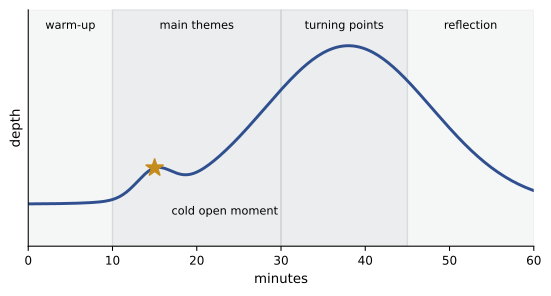
Long interviews benefit from an arc, a shape that builds over time. A common pattern is to start with easy, concrete questions that warm the guest up and establish who they are; move into the main themes, often chronologically through a story or in order of increasing depth; reach the most personal, difficult or surprising material in the middle to later part, once trust is established; and end with reflection, forward-looking questions and a lighter closing question. Front-load at least one compelling exchange so that the episode has strong material for a cold open. Plan more questions than you need and prioritize them, so that you can cut lower-priority questions if time runs short.
Questions that produce good audio
Audio interviews depend on answers that are vivid, specific and spoken in full sentences. Questions that help include:
- Open questions beginning with how, what, why or tell me about, which invite stories rather than one-word answers.
- Story prompts: "Take me back to the moment you…", "Walk me through what happened next", "What did the room look like?"
- Specificity: "Can you give me an example?", "What did you actually say to her?"
- Feeling and meaning: "What was going through your mind?", "Why did that matter so much to you?"
- Short, single questions: one idea at a time, rather than long, multi-part questions that let the guest choose the easiest part.
Avoid leading questions that put words in the guest's mouth, unless deliberately testing a claim, and avoid long preambles where the host talks more than the guest. Because listeners cannot see visual references, ask guests to describe objects, places and gestures in words.
| Weak question | Stronger question |
|---|---|
| Was it hard? | What was the hardest moment of that first year? |
| Do you like your job? | What part of your day would surprise people most? |
| So you must have felt betrayed, right? | How did you feel when you found out? |
| Can you talk about your career, your challenges and your advice for beginners? | How did you get your first job in the field? |
| Is that important? | Why does that matter to the people you work with? |
Listening and following up
The best questions often are not on the run sheet; they come from listening. Follow-up questions such as "What do you mean by that?", "Why?", "And then?" and simply repeating a key phrase back ("You said you were terrified") draw out depth. Silence is a powerful tool: after an answer, waiting two or three seconds before speaking often prompts the guest to add something more honest or interesting. Avoid filling pauses with verbal affirmations such as "yeah" and "mm-hmm" over the guest's words, which clutter the track; nod or use visual cues on video calls instead. Note interesting threads to return to rather than interrupting, and resist the urge to share your own similar story at length.
Managing time and difficult moments
Agree on the length in advance and keep an eye on the clock, gently steering back to the plan when a tangent runs long: "That's fascinating; I want to make sure we get to your work on…". If a guest gives very long answers, a polite interruption is acceptable and often helps listeners. If a guest gives very short answers, switch to story prompts and more concrete questions. Difficult questions about failures, controversies or claims should be asked respectfully and factually, with the evidence, giving the guest a fair chance to respond. If a guest becomes upset, pause, check in and offer a break; decide together whether to continue. Never trick or ambush guests in ways that misrepresent the conversation.
Stories, not just opinions
Listeners remember stories more than opinions. When a guest offers a general statement, such as "leadership is about trust", ask for the story behind it: "When did you learn that?" Scenes with people, places, tension and change make audio come alive. Specific details, such as the color of a door, the words someone used or the time on the clock, make stories vivid for listeners who cannot see them. CRE-220 covers story structure; in audio interviews, the host's job is to find and draw out the stories hidden in the guest's experience.
Consent, releases and recording law
Guests must know that they are being recorded and how the recording will be used. Good practice includes telling guests clearly when recording starts, explaining that the conversation will be edited and published, agreeing in advance on any off-limits topics and on whether the guest can review the episode (many shows do not offer approval of the edit, but may allow fact checks), and obtaining a simple written release or agreement, often by email or in the booking form, granting permission to publish, edit and promote the recording in all formats.
In the United States, federal law and most states allow recording a conversation with the consent of one party, but several states, including California, Florida, Illinois, Maryland, Massachusetts, Pennsylvania and Washington, generally require all parties to consent to recording a private conversation. When participants are in different states, follow the strictest applicable rule. Get clear consent from every participant on the recording itself and in writing. Using a person's name, voice or likeness for advertising may also require consent under state right-of-publicity laws.
Where minors appear, releases should be signed by a parent or guardian, and special care is needed with vulnerable people, people discussing crimes or health, and people who could face harm if identified.
Editing interviews fairly
Editing shapes how a guest is perceived. Cutting tangents, repetition and false starts improves listening; rearranging answers so that a guest appears to say something they did not mean, or removing important context, is unethical and can be defamatory. Good practice includes keeping answers attached to the questions that prompted them, or making clear when a question has been rephrased; preserving the meaning of what was said; avoiding cuts that make a guest seem to agree with a statement they disputed; and keeping the raw recording in case of disputes. Lesson 8 covers editing techniques, and Lesson 12 covers defamation and other legal risks.
Panels and multiple guests
Interviews with two or more guests need extra planning. Introduce each guest clearly and use names frequently, since listeners cannot see who is speaking; prepare questions directed to specific guests as well as open questions for discussion; manage turn-taking so that one guest does not dominate; and record each guest on a separate microphone and track. Choosing guests with distinct voices and perspectives helps listeners follow the conversation. A moderator who summarizes and moves the discussion forward is essential.
Interviewing experts
Experts can be fascinating but sometimes speak in jargon, qualify every statement or assume knowledge listeners lack. Prepare by learning enough to ask informed questions, and during the interview ask for definitions, examples and analogies: "How would you explain that to a 12-year-old?" or "What does that look like in practice?" Ask about uncertainty and disagreement in the field, which helps listeners understand the limits of knowledge. For health, legal and financial topics, make clear that general information is not personal advice, and check that guests have appropriate qualifications.
Interviewing people about difficult experiences
Guests who share experiences of trauma, grief, illness, discrimination or crime deserve particular care. Explain in advance what topics you will cover, give them control over what they share and the option to pause or stop, avoid pressing for graphic details that do not serve the story, and consider whether identifying details should be changed or omitted to protect them or others. After the interview, check in with the guest and let them know when the episode will be published. Trauma-informed interviewing guidance from journalism organizations such as the Dart Center offers useful practices.
Remote interview technique
Remote interviews lose some of the cues of being in the same room. Use video during the conversation even for audio-only shows, so that you can see reactions and signal with gestures rather than words; agree on how to handle delays and interruptions; and keep questions concise to reduce overlaps. Begin with a few minutes of informal conversation to build rapport and check sound, and ask the guest to keep their phone silent and notifications off. If the connection drops, pause, reconnect and repeat the last question so the editor has a clean answer.
After the interview
Thank guests promptly, confirm the expected release date, and send them the published episode with clips, a quote graphic and suggested text for sharing. Correct any errors they point out in show notes quickly. Keep a record of the release and recording details. Good relationships with guests lead to referrals, return appearances and a reputation that makes future booking easier.
Off the record and embargoes
Sometimes guests ask to say something off the record or request that parts of an interview be held until a certain date. Agree on terms clearly before such material is shared, honor the agreement, and remove any off-the-record material from the recording before it is shared with editors. If you cannot honor a request, say so before the guest speaks.
Common mistakes
MistakeAsking the questions every other show asks.
InsteadResearch past interviews and go further.
MistakeLong, multi-part questions.
InsteadAsk one short, open question at a time.
MistakeFilling every pause.
InsteadUse silence to invite deeper answers.
MistakeRecording without clear consent.
InsteadTell guests and get a written release.
MistakeRearranging answers to change their meaning.
InsteadEdit for clarity while preserving meaning and context.
Summary and key terms
- Book guests who fit the show with short, specific requests.
- Research previous interviews and use pre-interviews.
- Design an arc from warm-up to depth to reflection.
- Open, specific, single questions produce good audio.
- Listening, follow-ups and silence uncover the best material.
- Manage time and difficult moments respectfully.
- Get consent and releases, and edit fairly.
- Booking
- Arranging guests for episodes.
- Pre-interview
- Short call to prepare before recording.
- Interview arc
- The planned shape of an interview over time.
- Open question
- Question inviting a full answer.
- Leading question
- Question suggesting its own answer.
- Follow-up
- Question responding to a previous answer.
- Story prompt
- Question inviting a narrative.
- Release
- Written permission to publish a recording.
- One-party consent
- Recording allowed with one participant's consent.
- All-party consent
- Recording requiring every participant's consent.
Practice problems
Work each problem on paper first, then reveal the answer to check.
What should a booking request include?
Show answer
Show, audience, why the guest, topic, logistics, a clear ask.
Why research previous interviews?
Show answer
To avoid repeating questions and go further.
What is a pre-interview?
Show answer
A short preparatory call before recording.
Where do difficult questions usually fit in the arc?
Show answer
Middle to later, once trust is built.
Rewrite "Was it hard?"
Show answer
What was the hardest moment?
Why wait after an answer?
Show answer
Silence prompts deeper answers.
Why avoid verbal affirmations over the guest?
Show answer
They clutter the track.
How do you turn an opinion into a story?
Show answer
Ask when they learned it, for the scene behind it.
Which consent rule applies across states?
Show answer
Follow the strictest applicable rule.
What is unfair editing?
Show answer
Rearranging or cutting to change meaning or context.
Lesson quiz · 5 questions
Score 60% or more to complete this lesson.
Create a free account to save your progress, take quizzes and earn a certificate.