
CRE-310 · Lesson 2 of 12 · 27 min
How brands plan creator campaigns
To sell to brands, it helps to understand how they buy. A creator who knows how a campaign is planned, budgeted and judged can pitch at the right time, speak the brand's language, propose deliverables that serve the brand's goal and report results the brand can use internally. This lesson walks through a brand's campaign planning process from the brand's side of the table: objectives, audiences, budgets, creator selection, timelines, measurement and the internal pressures that shape what a brand manager can say yes to.
The marketing plan and the calendar
Most brands plan marketing around an annual calendar. Budgets are usually set for a fiscal year, then divided by quarter, product line and channel. Key moments, such as product launches, back-to-school, Black Friday and the December holidays, Valentine's Day, Mother's Day and seasonal changes, get their own campaigns. Influencer budgets are often committed to these moments weeks or months ahead.
This has practical consequences for creators. A brand planning a November holiday campaign may be choosing creators in August or September; by November the budget is spent and the shortlist is closed. Pitching three to four months before a seasonal moment usually works better than pitching the week before. At the other end, unspent budget near the end of a quarter or fiscal year sometimes leads to quick, short-notice deals, which can be lucrative if you can deliver fast.
Budgets also vary by company size. A large consumer brand may run dozens of creator campaigns a year with agency support; a small start-up may have a few thousand dollars and a founder who handles marketing personally. Both are legitimate clients, but they need different pitches and processes. A small business may value speed, simplicity and a creator who can advise on what works; a large brand may value reliability, compliance and documentation.
Campaign objectives and the funnel
Marketers often describe the customer journey as a funnel. At the top, awareness: people learn that a product exists. In the middle, consideration: they compare options and research. At the bottom, conversion: they buy, subscribe or install. After purchase, loyalty and advocacy: they buy again and recommend it. Each stage has typical metrics and suits different creator content.
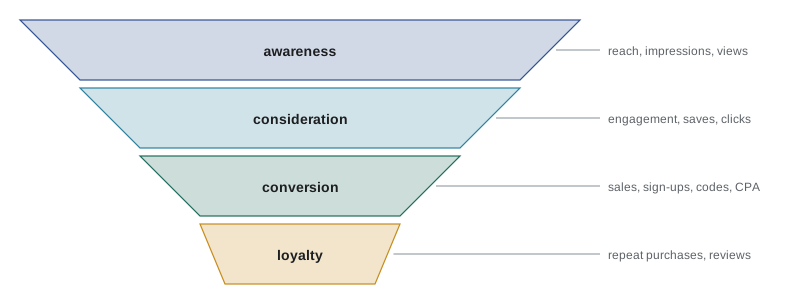
| Objective | Typical metrics | Content that suits it |
|---|---|---|
| Awareness | Reach, impressions, views, video completion | Broad short-form content, launches, reveals |
| Consideration | Engagement, saves, shares, clicks, watch time | Reviews, comparisons, tutorials, demos |
| Conversion | Sales, sign-ups, installs, code redemptions, CPA | Offers, links, codes, clear calls to action |
| Loyalty and advocacy | Repeat purchases, reviews, community growth | Ambassadorships, long-term use stories |
A good brief names the main objective. If it does not, ask. A creator who knows a campaign is judged on clicks will build the content around a strong call to action and a link in an easy-to-find place; one who knows it is judged on reach will prioritize a broad hook and shareability. Mismatches between the content and the metric are a common reason brands do not renew.
Key performance indicators
Brands translate objectives into key performance indicators (KPIs) with targets. Common KPIs include cost per thousand impressions (CPM), cost per view (CPV), engagement rate, cost per engagement (CPE), click-through rate (CTR), cost per click (CPC), conversion rate, cost per acquisition (CPA) and return on ad spend (ROAS). You will meet the calculations throughout this course.
Brands often have internal benchmarks: a target CPM for awareness campaigns, a maximum CPA for performance campaigns, or a ROAS threshold below which a channel is considered unprofitable. When you know these benchmarks, you can frame your price in terms the brand already uses. A creator who can say "based on my last three campaigns, partners saw an average CPA of $18" is speaking the brand manager's language.
Worked problem
Working back from a brand's target CPA
A subscription meal-kit brand will pay up to $40 per new customer. A creator's past campaigns delivered about 0.8 % of viewers clicking through and 12 % of clicks converting. The creator expects 75,000 views. What is the most the brand should rationally pay for the post based on CPA alone?
Show solution
- Clicks: 75,000 × 0.008 = 600.
- New customers: 600 × 0.12 = 72.
- Maximum fee at the target CPA: 72 × $40 = $2,880.
Answer: About $2,880; a fee below that meets the brand's CPA target if past performance holds.
Remember that a brand may value effects it cannot measure directly, such as awareness that leads to purchases weeks later through other channels. Many brands accept a higher measured CPA from creators for this reason, but some performance-focused brands judge creators purely on tracked sales. Ask how the campaign will be judged.
Defining the target audience
Brands describe their target customers in terms of demographics (age, gender, location, income), psychographics (interests, values, lifestyle) and behavior (what they buy, where they shop, how they use the product). A skincare brand might target "women aged 25 to 40 in Canada interested in clean beauty and willing to pay for premium products". The brand then looks for creators whose audiences overlap strongly with that description.
Audience overlap is checked using the creator's analytics, third-party tools that estimate follower demographics, and judgment about the content. Location is often critical: a brand that only ships within Canada or the United States gains little from an audience mostly in other countries. This is why accurate audience data in your media kit, covered in Lesson 4, matters so much.
Choosing creators
Once objectives and audience are set, the brand or agency builds a shortlist. Typical selection criteria include:
- Audience fit: demographics, location and interests that match the target.
- Content fit: style, tone, quality and topics compatible with the brand.
- Performance: reach, views, engagement rate and, where available, past conversion results.
- Authenticity: real followers and organic engagement rather than purchased or inflated numbers.
- Brand safety: a history free of content the brand would find risky.
- Reliability: professionalism, responsiveness and a record of delivering on time.
- Cost: whether the creator's price fits the budget and expected return.
Brands increasingly use software to screen for fake followers and unusual engagement patterns, such as sudden follower spikes, comment pods or high follower counts with very low views. Authentic growth is therefore a commercial asset, and buying followers or engagement can disqualify a creator from deals as well as break platform rules.
Campaign structures
Brands combine creators in different ways depending on objectives and budget.
- One hero creator: a single large creator for maximum reach and impact, often for launches.
- A creator mix: one or two larger creators for reach plus many smaller creators for depth and authenticity.
- Always-on programs: ongoing relationships with a stable group of creators posting regularly through the year.
- Seeding programs: sending products to many creators with no guaranteed post, hoping for organic mentions.
- Affiliate and ambassador programs: creators earn commission or retainers for continuing promotion.
- Content-only programs: paying creators to make UGC for the brand's own ads.
Knowing the structure helps you position yourself. In a creator mix, a micro creator is chosen for niche credibility and engagement, so emphasize those; in an always-on program, emphasize reliability and consistency.
Budgets and how they are allocated
A brand's campaign budget usually covers more than creator fees. It may include agency fees, product and shipping costs, content production, paid amplification (spending to boost creator posts as ads), software and measurement. Paid amplification is now common: brands often spend an amount comparable to the creator fees boosting the best-performing posts. This is one reason usage and whitelisting rights, covered later, have become so valuable.
Worked problem
Splitting a campaign budget
A brand has $60,000 for a campaign. It allocates 15 % to agency fees, 10 % to product and shipping, 35 % to paid amplification and the rest to creator fees. It wants one mid-tier creator at $9,000 and as many micro creators as possible at $1,500 each. How many micro creators can it hire?
Show solution
- Creator fees: 100 % − 15 % − 10 % − 35 % = 40 % of $60,000 = $24,000.
- After the mid-tier creator: $24,000 − $9,000 = $15,000.
- Micro creators: $15,000 ÷ $1,500 = 10.
Answer: Ten micro creators, alongside one mid-tier creator.
For creators, the lesson is that the fee you are offered is shaped by the brand's whole budget structure. A brand with a large amplification budget may pay more for usage rights; a brand with a fixed creator-fee pool may prefer more creators at lower fees. Asking about the overall campaign can reveal room to negotiate.
Timelines
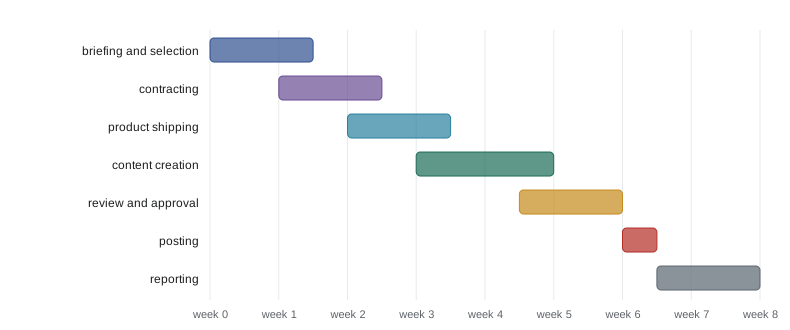
Even simple campaigns take time. A typical sequence runs from briefing and creator selection, through contracting, product shipping, content creation, review and approval, posting, amplification and reporting. For a mid-sized campaign, four to eight weeks from first contact to posting is common; large or regulated brands may take longer because of legal review. Build these timelines into your planning so that you do not overcommit, and confirm dates in writing.
Internal pressures on the brand side
A brand manager answers to their own bosses. They must justify spending, show results, avoid embarrassing the company and meet deadlines. Their legal team may insist on contract terms they cannot change; their procurement team may require supplier registration, tax forms and long payment terms. Understanding these pressures makes negotiation easier. A brand manager who cannot change a standard payment term may still be able to add a fee for an extra deliverable, or a creator who makes approval easy may become the first call for the next campaign.
Brand managers also change jobs often. A relationship built with one person can disappear when they move on, so relationships should be built with the brand, through good work and records, as well as with individuals. Keep in touch when contacts move: they may hire you at their new company.
Regulated and sensitive categories
Some product categories carry extra advertising rules that affect campaign planning. Alcohol, cannabis, gambling, financial products, health products, prescription drugs, food for children and products for young audiences all face additional restrictions in both countries. Brands in these categories often require creators to meet age-audience thresholds, avoid certain claims and use specific disclaimers, and their approval processes are longer. CRE-320 covers these rules; for now, expect more paperwork and plan extra time.
In the United States, examples include alcohol industry codes that require audiences to be mostly of legal drinking age, state rules on sports betting advertising, FDA and FTC rules on health claims, financial regulators' rules on investment promotion, and COPPA rules affecting content directed at children under 13.
Questions to ask a brand about its plans
When a brand approaches you, a few planning questions reveal a great deal: Is this part of a larger campaign, and how many other creators are involved? What worked or did not work in previous creator campaigns? Is there paid amplification planned? Who else needs to approve the content? What would make the brand want to continue after this campaign? The answers help you pitch the right deliverables and position yourself for renewal.
Brand size and decision speed
Decision speed varies with brand size. A founder-led start-up may approve a deal in a day by email; a multinational may need weeks for legal review, supplier onboarding and approval from several departments. Ask early about the brand's process so you can plan your calendar, and avoid holding a valuable slot for a brand that may take a month to confirm.
Common mistakes
MistakePitching seasonal campaigns at the last minute.
InsteadPitch three to four months before key dates.
MistakeCreating content without knowing the main KPI.
InsteadAsk how the campaign will be judged and build to it.
MistakeAssuming the creator fee is the whole budget.
InsteadRemember agency, product and amplification costs.
MistakeBuying followers to look bigger.
InsteadGrow authentically; brands screen for fake engagement.
MistakeRelying on one contact at a brand.
InsteadBuild records and relationships with the company too.
Summary and key terms
- Brands plan campaigns around annual budgets and seasonal moments.
- Objectives follow the funnel: awareness, consideration, conversion and loyalty.
- KPIs such as CPM, CPE, CPA and ROAS turn objectives into targets.
- Brands choose creators by audience fit, content fit, performance, authenticity, safety, reliability and cost.
- Campaign structures range from one hero creator to always-on programs.
- Budgets include agency, product, amplification and measurement as well as fees.
- Understanding brand-side pressures and timelines makes creators easier to hire.
- Funnel
- The stages from awareness to conversion and loyalty.
- KPI
- A key performance indicator with a target.
- CPE
- Cost per engagement.
- CPA
- Cost per acquisition, such as a sale or sign-up.
- ROAS
- Return on ad spend: attributed revenue divided by cost.
- Paid amplification
- Spending to boost creator content as ads.
- Always-on program
- An ongoing relationship with creators across the year.
- Seeding
- Sending products to creators without a guaranteed post.
- Psychographics
- Audience interests, values and lifestyle.
- Fiscal year
- The twelve-month period a company budgets for.
Practice problems
Work each problem on paper first, then reveal the answer to check.
When should a creator pitch a holiday campaign?
Show answer
About three to four months ahead.
Name the four funnel stages.
Show answer
Awareness, consideration, conversion, loyalty.
CPA for $2,000 and 50 sales?
Show answer
$40.
ROAS for $9,000 revenue on $3,000 spend?
Show answer
3.
Name four creator selection criteria.
Show answer
Audience fit, content fit, performance, authenticity, safety, reliability, cost.
What is a seeding program?
Show answer
Sending products without a guaranteed post.
Why are usage rights valuable to brands?
Show answer
They allow paid amplification of creator content.
Typical time from first contact to posting for a mid-sized campaign?
Show answer
About four to eight weeks.
Max fee for 50 expected customers at a $30 CPA target?
Show answer
$1,500.
Why build relationships with the company as well as individuals?
Show answer
Brand contacts change jobs often.
Lesson quiz · 5 questions
Score 60% or more to complete this lesson.
Create a free account to save your progress, take quizzes and earn a certificate.