
CRE-310 · Lesson 6 of 12 · 27 min
Pitching brands, agencies and marketplaces
Many creators wait for brands to contact them. Inbound offers do arrive as an audience grows, but creators who pitch proactively choose their partners, fill their calendars more evenly and often earn more because they approach brands with a clear idea rather than responding to a generic request. This lesson covers how to find and research prospects, the routes into brands (direct, agencies, talent managers and marketplaces), how to write a pitch that gets answered, how to follow up and how to manage a pipeline of opportunities.
Inbound and outbound
Inbound deals start when a brand or agency contacts you. They are convenient but come on the brand's terms: the brand has already decided on the budget, the format and often the timeline, and you are one of many creators contacted. Outbound deals start when you approach a brand. They take effort, and most pitches receive no reply, but successful ones are often better matched and better paid because you shaped the idea.
A healthy partnership business usually combines both. Inbound volume grows with audience size and visibility; outbound effort fills gaps, targets dream brands and helps smaller creators get started. Treat outbound as a regular habit, such as a set number of researched pitches each week, rather than an occasional burst.
Finding prospects
The best prospects are brands your audience already uses, asks about or would benefit from. Useful sources include:
- Products you already use and genuinely like, which make the most credible partnerships.
- Brands your audience mentions in comments, questions and messages.
- Brands sponsoring creators similar to you, visible through paid partnership labels and disclosures.
- Brands advertising heavily to your audience, which shows they have budget and want that customer.
- New companies launching products in your niche, often found through trade shows, crowdfunding sites and industry news.
- Local and regional businesses, especially for nano and micro creators with geographically concentrated audiences.
Keep a prospect list with the brand, why it fits, the relevant contact, any evidence of influencer spending, and notes on timing such as product launches or seasonal peaks.
Routes into brands
There are four main routes. Each has advantages and suits different creators and brands.
| Route | How it works | Pros | Cons |
|---|---|---|---|
| Direct to brand | Pitch the brand's influencer, social or marketing manager | Builds direct relationships; no middle commission | Hard to find the right person; slow |
| Brand's agency | Pitch the agency that runs the brand's creator programs | Agencies hire many creators repeatedly | Agency negotiates for the brand; may have set budgets |
| Talent manager | A manager pitches and negotiates for you | Expertise, contacts and time saved | Commission, often 10–20 %; quality varies |
| Marketplace | Apply to campaigns or list yourself on a platform | Easy access to many brands | Competition, platform fees, lower prices |
Platform marketplaces include YouTube BrandConnect, TikTok One (formerly TikTok Creator Marketplace) and Instagram's creator marketplace, each with eligibility requirements that change over time. Independent marketplaces and influencer platforms also list campaigns. Marketplaces are useful for gaining first deals and case studies, but prices are often lower because brands can compare many creators side by side.
Finding the right person at a brand matters. For a small company, it may be the founder or head of marketing. For a large one, look for titles such as influencer marketing manager, social media manager, creator partnerships lead or brand manager for the specific product. Professional networking sites, the brand's press page and industry events are common ways to find names. A pitch sent to a generic inbox has much lower odds than one sent to the person who owns the budget.
Talent managers
A good talent manager can raise fees, bring in better deals and handle negotiation and admin, freeing you to create. A poor one may lock you into a long contract, take a large share and deliver little. Before signing, check the manager's roster and references, the commission rate and what it applies to (all brand income, or only deals they source), the contract length and how to end it, whether payments flow through the manager's account, and how often you will receive statements. CRE-330 covers management agreements in detail; the basic rule is never to sign a long exclusive agreement without understanding it and getting advice.
Worked problem
Is a manager worth the commission?
A creator earns $40,000 a year from brand deals alone. A manager charging 20 % expects to raise average fees by 30 % and bring in 25 % more deals. If those estimates are right, is the creator better off?
Show solution
- New gross: $40,000 × 1.30 × 1.25 = $65,000.
- Commission: $65,000 × 0.20 = $13,000; net: $52,000.
- Compared with $40,000 alone, the creator gains $12,000 plus saved time, if the estimates hold.
Answer: Yes, net income would rise to about $52,000, but only if the manager actually delivers the higher fees and volume.
Writing the pitch
A pitch email should be short, specific and about the brand's goals rather than your needs. A busy manager decides within seconds whether to read further. Effective pitches usually follow a structure like this:
- Subject line: specific and relevant, for example "Spring trail campaign idea: 40k runners in Ontario and BC".
- Opening: one sentence showing you know the brand, such as a product you use or a recent campaign you noticed.
- Who you are: one or two sentences on your audience and why it matches their customers.
- The idea: a concrete content concept tied to their goals, timing and product.
- Proof: one or two key metrics and a relevant past result.
- Call to action: a simple next step, such as a short call or sending the media kit.
Keep the pitch to about 150 to 200 words, attach or link the media kit, and personalize every pitch. Mass emails with generic praise are easy to spot and usually ignored.
The idea is the most important part. A brand receives many emails saying "I would love to work with you"; very few propose a specific, well-matched concept. For example: "Your new insulated bottle launches in October. I am planning a three-part series on winter trail running in November; I would feature the bottle in the cold-weather kit episode, showing how it keeps tea hot over a 20 km run, with a short version for Reels." That gives the brand something to say yes to.
Following up
Most pitches that eventually succeed need at least one follow-up. Managers are busy, emails get buried and timing may be wrong. A polite follow-up after about a week, and perhaps one more a week or two later, is normal. Add something new each time, such as a recent result, a refined idea or a relevant date, rather than simply asking whether they saw your email. After two or three follow-ups without reply, move on and note the brand for a future season.
Worked problem
Pipeline arithmetic
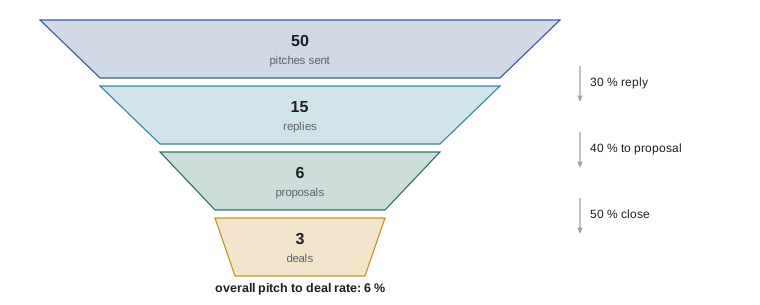
A creator's records show that 30 % of researched pitches get a reply, 40 % of replies lead to a proposal, and 50 % of proposals become deals. Their average deal is $1,800. How many pitches do they need to send each month to earn $5,400 a month from outbound deals?
Show solution
- Deals needed: $5,400 ÷ $1,800 = 3.
- Overall pitch-to-deal rate: 0.30 × 0.40 × 0.50 = 0.06, or 6 %.
- Pitches needed: 3 ÷ 0.06 = 50 a month, about 12 a week.
Answer: About 50 researched pitches a month; improving any stage of the funnel reduces the number needed.
Managing a pipeline
A pipeline is a list of opportunities at different stages: prospect, pitched, in discussion, proposal sent, contracted, in production, delivered, paid. Tracking each opportunity in a spreadsheet or customer relationship management (CRM) tool helps you follow up on time, forecast income and spot bottlenecks. Record the date of each contact, the person, the stage, the expected value and the next action.
A pipeline also shows seasonality. Many creators find that deals cluster before major shopping periods and dry up in January and early summer. Seeing this in advance lets you pitch earlier for busy periods and plan other income, such as products or affiliate content, for quiet ones.
Responding to inbound offers
When a brand approaches you, reply promptly and professionally, even if you decline. Before quoting, ask questions: what are the campaign's objectives and main KPI, what deliverables and platforms are wanted, what are the timeline and posting dates, what usage rights and exclusivity are expected, and what is the budget range. Many brands will not reveal a budget, but some will, and it saves time. Then send a clear proposal with options rather than a single number.
Be alert for scams. Fake brand offers are common: messages that ask you to pay for products upfront, click suspicious links, download files, share login codes or move to unusual messaging apps. Legitimate brands use company email domains, do not ask for passwords or payment from creators, and can be verified through their official website. When in doubt, contact the brand through its official channels to confirm.
Gifted collaborations as a starting point
Smaller creators often begin with gifted collaborations: free products in exchange for a post, or with no obligation. These can build a portfolio of brand content and relationships, but they are not free for the creator, who spends time and audience attention. Accept gifts only from brands that fit, be clear about whether a post is expected, and disclose any gifted product you mention. As your audience grows, move from gifting toward paid deals, and use results from gifted posts as case studies.
Researching the brand before pitching
Before sending a pitch, spend fifteen to thirty minutes researching the brand. Look at its recent social media posts, advertising, product launches and any creators it already works with. Note its tone, its target customers, its key messages and the formats it seems to prefer. Check whether it ships to your audience's countries. This research lets you write a pitch that shows you understand the brand and proposes an idea that fits its plans, rather than a generic request.
Pitching agencies
Agencies run campaigns for many brands, so a relationship with one agency can lead to repeated work. Agency staff value creators who are reliable, responsive, easy to work with and honest about their numbers. When pitching an agency, introduce yourself and your audience, list the categories you work in, attach your media kit and rate card, and ask to be added to their creator database for relevant campaigns. Follow up when you have a notable result. Once you have worked with an agency, deliver flawlessly: agency staff remember which creators made their job easier.
Timing your outreach
Timing affects response rates. Pitch seasonal ideas three to four months ahead, pitch new product launches as soon as they are announced, and avoid the busiest weeks of a brand's year, such as the days before Black Friday, when staff are fully occupied. Some creators also find that pitches sent early in the working week get more replies than those sent on Friday afternoons.
Building a pitch template without sounding generic
A template can save time if it is used as a structure rather than a script. Keep standard blocks for your introduction, audience summary and proof, and write the opening and the idea fresh for each brand. Before sending, read the pitch as if you were the brand manager: would you know within ten seconds why this creator, this idea and this moment make sense for your brand?
Finally, review your pipeline every week: who needs a follow-up, which proposals are waiting for answers and which seasonal pitches should go out next. Regular review keeps opportunities from slipping away.
A well-structured pitch email has six parts in order: a specific subject line, an opening that shows you know the brand, a short description of who you are, the idea, the proof and a simple call to action. If any part is missing, the pitch is weaker; if any part runs long, the reader may stop before reaching the idea.
Common mistakes
MistakeWaiting only for inbound offers.
InsteadPitch proactively on a regular schedule.
MistakeSending generic mass emails.
InsteadResearch each brand and propose a specific idea.
MistakeGiving up after one unanswered email.
InsteadFollow up once or twice, adding something new.
MistakeSigning a long exclusive manager contract unread.
InsteadCheck commission scope, term and exit; get advice.
MistakeTrusting every brand message.
InsteadVerify offers; never pay or share login codes.
Summary and key terms
- Combine inbound offers with regular, researched outbound pitching.
- The best prospects are brands your audience already uses or needs.
- Routes include direct, agency, talent manager and marketplace, each with trade-offs.
- A good pitch is short, personalized and built around a specific idea.
- Follow up politely and track every opportunity in a pipeline.
- Pipeline conversion rates show how many pitches you need.
- Verify inbound offers and treat gifting as a stepping stone.
- Inbound deal
- A deal that starts when a brand contacts the creator.
- Outbound deal
- A deal that starts with the creator's pitch.
- Prospect
- A brand identified as a potential partner.
- Pitch
- A short proposal to a brand for a partnership.
- Pipeline
- Opportunities tracked through stages to payment.
- CRM
- Customer relationship management software.
- Talent manager
- A representative who pitches and negotiates for creators.
- Marketplace
- A platform where brands and creators find each other.
- Gifted collaboration
- Free product in exchange for, or without, a post.
- Conversion rate
- The share of opportunities that reach the next stage.
Practice problems
Work each problem on paper first, then reveal the answer to check.
Name three sources of prospects.
Show answer
Products you use, audience mentions, peers' sponsors, advertisers, new launches.
Name the four routes into brands.
Show answer
Direct, agency, talent manager, marketplace.
Ideal pitch email length?
Show answer
About 150–200 words.
What is the most important part of a pitch?
Show answer
A specific idea tied to the brand's goals.
When should you follow up?
Show answer
After about a week, adding something new.
Overall rate for 25 %, 40 % and 50 % stage conversions?
Show answer
5 %.
Pitches needed for 2 deals at a 5 % overall rate?
Show answer
40.
Name two warning signs of a scam offer.
Show answer
Upfront payment, login codes, odd links, unusual apps.
What should you ask before quoting an inbound offer?
Show answer
Objectives, deliverables, timeline, rights, exclusivity, budget.
Why are marketplace prices often lower?
Show answer
Brands compare many creators side by side.
Lesson quiz · 5 questions
Score 60% or more to complete this lesson.
Create a free account to save your progress, take quizzes and earn a certificate.