
CRE-401 · Lesson 12 of 12 · 32 min
Exits, acquisitions, succession and capstone
Every company eventually faces the question of what happens next. A founder might sell the business, merge it with another, buy other channels, bring in a partner, hand it to a new leader or wind it down. Even founders with no plans to sell benefit from building a company that could be sold, because the same qualities, such as documented systems, diversified revenue, clean finances and a team that does not depend on one person, make it more resilient and more valuable. This lesson covers how media companies are valued, how sales and acquisitions work, how to plan succession, and finishes with a capstone company plan that brings the course together.
Selling a company has major legal and tax consequences, so involve experienced advisers early.
How creator companies are valued
Buyers value a business by estimating the cash it will produce in future and how risky that cash is. In practice, small and mid-sized media companies are often valued using multiples: the price as a multiple of a measure such as revenue, EBITDA or seller's discretionary earnings (profit plus the owner's pay and personal expenses run through the business). Multiples vary widely by size, growth, margins, revenue quality and market conditions, so treat any published range as a rough guide, not a price.
Factors that tend to raise a multiple include:
- Diversified revenue across platforms, sponsors and products, with low concentration.
- Recurring revenue, such as memberships, subscriptions and multi-year partnerships.
- Growth in audience and revenue, with strong margins.
- Owned audience relationships, such as large email lists and communities.
- Intellectual property the company clearly owns: formats, characters, brands and content libraries.
- A capable team and documented systems, so the business runs without the founder.
Factors that lower a multiple include dependence on one personality, one platform or one sponsor, declining views, messy books, unclear ownership of content and accounts, and legal or reputational risks.
Worked problem
Valuing with multiples
A company has revenue of $2,000,000 and EBITDA of $500,000. A buyer offers between 4× and 6× EBITDA. A comparable sale was priced at 1.2× revenue. What valuation range do these suggest?
Show solution
- EBITDA multiples: 4 × $500,000 = $2,000,000; 6 × $500,000 = $3,000,000.
- Revenue multiple: 1.2 × $2,000,000 = $2,400,000.
Answer: Roughly $2.0 million to $3.0 million, with the comparable sale at $2.4 million falling inside the range. The final price depends on negotiation, terms and how much risk the buyer sees.
Worked problem
The key-person discount
A buyer would pay 5× EBITDA of $600,000 for a company whose revenue does not depend on the founder. Because 70 % of revenue depends on the founder appearing on camera, the buyer applies a 30 % discount unless the founder signs a three-year contract to keep presenting. What are the prices with and without the contract?
Show solution
- Base value: 5 × $600,000 = $3,000,000.
- With discount: $3,000,000 × 0.70 = $2,100,000.
- With the founder's contract the buyer may pay close to $3,000,000, though often with part of the price tied to the founder staying.
Answer: The founder's continued involvement is worth about $900,000 to the buyer, which is why many creator company deals include employment contracts and earn-outs.
Types of exit
- Sale to a strategic buyer, such as a media group, brand or larger creator company that values the audience, content or team for strategic reasons and may pay more.
- Sale to a financial buyer, such as a private equity fund or a holding company that buys and operates creator businesses.
- Management buyout, where the existing team buys the company, often with loans and seller financing.
- Merger with a similar company to gain scale.
- Partial sale or recapitalization, where the founder sells a stake and keeps running the business.
- Succession within the family or to a chosen successor.
- Orderly wind-down, closing the business and selling or licensing its assets, such as the content library.
Structuring a deal
The headline price is only part of a deal. Key terms include how much is paid in cash at closing, how much is deferred, and what conditions apply.
- Asset sale or share sale: in an asset sale the buyer buys specific assets, such as the channel, content library, trademarks and contracts; in a share sale the buyer buys the company itself, including its history and liabilities. Buyers often prefer asset sales; sellers often prefer share sales for tax reasons.
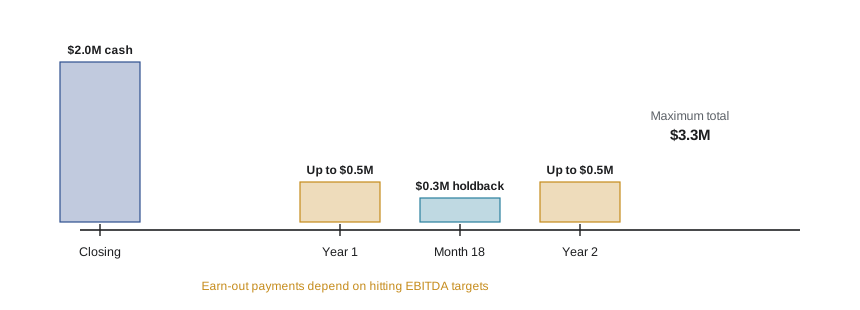
- Earn-out: part of the price is paid later if the business hits targets, such as revenue or EBITDA, over one to three years. Earn-outs bridge disagreements on value but can cause disputes about how results are measured.
- Seller financing: the seller lends part of the price to the buyer, to be repaid over time.
- Holdback or escrow: part of the price is held back to cover claims if the seller's promises about the business turn out to be untrue.
- Employment or consulting agreements: the founder agrees to stay for a period, often with non-competition and non-solicitation terms that are more readily enforced in a sale of business than in ordinary employment.
Worked problem
Earn-out value
A buyer offers $2,000,000 at closing plus an earn-out of up to $500,000 at the end of each of the next two years if EBITDA exceeds $550,000. The seller thinks there is a 70 % chance of hitting the target in year 1 and 50 % in year 2. What is the expected total price, ignoring the time value of money?
Show solution
- Expected year 1 payment: 0.70 × $500,000 = $350,000.
- Expected year 2 payment: 0.50 × $500,000 = $250,000.
- Expected total: $2,000,000 + $350,000 + $250,000 = $2,600,000.
Answer: The deal is worth about $2.6 million in expectation, versus a headline maximum of $3.0 million. A seller comparing offers should compare expected and guaranteed amounts, not maximums.
Due diligence
Before buying, a buyer investigates the business in a process called due diligence. For a creator company, expect requests for financial statements and tax filings, platform analytics and revenue reports, contracts with sponsors, agencies, staff and freelancers, proof of ownership of content, music licenses, trademarks and accounts, employment records and classification of workers, privacy and email consent records, pending disputes, and evidence of compliance with advertising disclosure rules. Sellers who have kept good records from the start find this process far easier and often get better prices.
Common problems discovered in diligence include freelancers who never assigned copyright, channels registered to the founder personally rather than the company, unlicensed music in old videos, missing sponsorship disclosures and misclassified workers.
Tax on a sale
In the US, gains on the sale of qualified small business stock may be partly or fully excluded from federal tax under Section 1202. For stock issued after July 4, 2025, the exclusion is 50 % after three years, 75 % after four and 100 % after five, up to a cap of $15 million per issuer for most holders. Only C corporations qualify, and businesses in certain service fields, including performing arts and those whose principal asset is the reputation or skill of their employees, are excluded, which may rule out some creator companies. Asset and share sales are taxed differently, and state taxes also apply.
Acquiring other channels and companies
Growth can also come from buying. Creator companies sometimes acquire other channels, newsletters, podcasts or small brands to add audiences or capabilities. Before buying, check that the audience is real and engaged, that the content and accounts can legally transfer, that platform rules allow the transfer, and that the acquired audience will accept new ownership. Integration, meaning combining teams, systems and brands, is where many acquisitions succeed or fail.
Worked problem
Payback on an acquisition
A company can buy a newsletter with 80,000 subscribers for $240,000. The newsletter earns $110,000 a year in sponsorships, with $30,000 of running costs. The buyer expects to add $20,000 a year by cross-selling its products. How long until the purchase pays back?
Show solution
- Annual contribution: $110,000 − $30,000 + $20,000 = $100,000.
- Payback: $240,000 ÷ $100,000 = 2.4 years.
Answer: About two and a half years, which is attractive if subscriber engagement holds after the change of ownership.
Succession
Not every exit is a sale. Founders may want to step back while keeping ownership, or plan for illness or accidents. Succession planning means identifying who could lead the company, what each key person's backup would be, and how ownership would pass. Practical steps include developing a second in command, documenting systems and passwords securely, holding key-person insurance, writing a shareholders' agreement that covers death, disability and departure of owners, and having a will and powers of attorney that address the business.
Capstone: a company plan
The capstone brings the course together. Imagine a creator, Maya, who runs a cooking channel with 900,000 subscribers, a weekly newsletter of 50,000 readers and a small range of kitchen tools. Last year the business earned $780,000 in revenue: $260,000 from ads, $320,000 from sponsorships, $140,000 from products and $60,000 from memberships. Maya works with three freelancers and wants to build a company that could eventually run without her on camera every week.
A strong company plan for Maya would cover:
- Strategy: a mission focused on helping busy people cook healthy weeknight meals, a goal to cut platform concentration below 40 % within three years, and a portfolio of the main channel, a shorts channel, the newsletter and a product line.
- Organization: first hires of a full-time editor and a producer, then an operations manager, with a RACI chart for sponsor approvals and final cuts.
- People: written role scorecards, fair pay ranges, correct classification of each worker, IP assignment for all creative work and a 30-60-90-day onboarding plan.
- Systems: a mapped pipeline, SOPs for filming, editing, packaging and publishing, a kanban board and the 3-2-1 backup rule.
- Growth: a second presenter for a spin-off series, and repurposing each long video into shorts and a newsletter issue.
- Finance: a budget built from drivers, a KPI dashboard and a monthly cash forecast with a three-month cash buffer.
- Capital and exit: bootstrapping for now, a line of credit for inventory, and clean records so the company could raise money or be sold later.
Worked problem
Capstone: can Maya afford two hires?
Maya's business has contribution of 70 % on its $780,000 revenue and fixed costs of $180,000, including her own salary. An editor and a producer would together cost $150,000 a year fully loaded. Together they are expected to raise output so revenue grows 25 % with the same contribution margin. Compare operating profit before and after the hires.
Show solution
- Before: contribution 0.70 × $780,000 = $546,000; profit $546,000 − $180,000 = $366,000.
- After: revenue $780,000 × 1.25 = $975,000; contribution 0.70 × $975,000 = $682,500.
- New fixed costs: $180,000 + $150,000 = $330,000.
- Profit after: $682,500 − $330,000 = $352,500.
Answer: Profit falls slightly, from $366,000 to $352,500, in the first year. The hires make sense if they free Maya to grow the business further, reduce burnout and key-person risk, and build a more valuable company; if revenue grew 30 % instead, profit would rise to about $379,800.
Use this structure for your own capstone: describe your company today, set its mission and three-year goals, design its team, systems and portfolio, build a budget and cash forecast, and explain how you would fund growth and protect the company's long-term value.
Common mistakes
MistakeWaiting until a sale to clean up records.
InsteadKeep contracts, IP assignments and finances in order from the start.
MistakeComparing offers by maximum headline price.
InsteadCompare guaranteed and expected amounts, terms and risks.
MistakeBuilding a company that depends entirely on the founder.
InsteadDevelop other hosts, leaders and systems to reduce key-person risk.
MistakeIgnoring tax planning until the deal is signed.
InsteadPlan years ahead with advisers for exemptions and deal structure.
MistakeBuying a channel without checking transferability.
InsteadConfirm ownership, platform rules and audience engagement first.
Summary and key terms
- Buyers value media companies with multiples of revenue, EBITDA or owner earnings, adjusted for risk.
- Diversified, recurring revenue, owned audiences, clear IP and strong teams raise value.
- Exits include strategic or financial sales, buyouts, mergers, partial sales, succession and wind-downs.
- Deal terms such as earn-outs, holdbacks and asset or share structure shape the real price.
- Due diligence checks finances, contracts, IP, workers, privacy and compliance.
- Tax rules on sales differ greatly between countries and structures.
- A company plan ties together strategy, people, systems, finance, capital and long-term value.
- Valuation multiple
- A company's price expressed as a multiple of revenue or earnings.
- Seller's discretionary earnings
- Profit plus the owner's pay and personal costs run through the business.
- Strategic buyer
- A buyer that values a company for strategic benefits beyond its cash flow.
- Earn-out
- Part of a sale price paid later if targets are met.
- Holdback
- Part of the price held back to cover possible claims.
- Asset sale
- A sale of specific business assets rather than the company itself.
- Share sale
- A sale of the company's shares, including its liabilities.
- Due diligence
- A buyer's investigation of a business before purchase.
- Key-person risk
- The risk that a business depends too heavily on one individual.
- Succession planning
- Preparing for leadership and ownership changes.
Practice problems
Work each problem on paper first, then reveal the answer to check.
EBITDA $400,000 at 5×. Value?
Show answer
$2,000,000.
Revenue $1,500,000 at 1.1×. Value?
Show answer
$1,650,000.
Earn-out of $300,000 with a 60 % chance. Expected value?
Show answer
$180,000.
Purchase $150,000 earning $60,000 a year. Payback?
Show answer
2.5 years.
Value $2,500,000 with a 20 % key-person discount. Price?
Show answer
$2,000,000.
Name three factors that raise a multiple.
Show answer
Diversified revenue, recurring revenue, growth, owned audience, clear IP, strong team.
What does a holdback protect?
Show answer
The buyer, against untrue promises about the business.
Name two common diligence problems for creator companies.
Show answer
Unassigned freelancer copyright, personal account ownership, unlicensed music, missing disclosures, misclassified workers.
Name two succession planning steps.
Show answer
Develop a second in command, document systems, key-person insurance, shareholders' agreement, wills.
What tax relief may apply to selling small business shares?
Show answer
The Section 1202 exclusion for qualified small business stock, if the company qualifies.
Lesson quiz · 5 questions
Score 60% or more to complete this lesson.
Create a free account to save your progress, take quizzes and earn a certificate.