
CRE-401 · Lesson 3 of 12 · 30 min
Organization design and roles
Once a creator decides to build a team, the next question is what that team should look like. Who does what? Who reports to whom? Which jobs need full-time staff and which can stay with freelancers or agencies? This lesson covers the main roles in a creator-led media company, how they fit together, how to plan capacity, and how organization design changes as a company grows from three people to thirty.
Principles of organization design
Organization design is the deliberate arrangement of roles, responsibilities and reporting lines. In a small company it can feel unnecessary, since everyone talks every day. But unclear roles cause real problems even in teams of four: two people doing the same task, nobody doing an important one, and the founder becoming a bottleneck because every decision flows through them. A few principles help:
- Design around the work, not around people you happen to know. Start by listing the work that must happen, then group it into roles.
- Give every important outcome a single owner. Many people can help, but one person should be accountable.
- Keep spans of control manageable. One manager can usually support four to eight direct reports, depending on how experienced they are.
- Separate creative and business decisions where it helps, so neither side overrules the other by default.
- Revisit the design as the company grows; the right structure for five people is wrong for fifty.
Core roles in a creator-led company
Titles vary widely across the industry, and in small companies one person often holds several roles. The following are common building blocks:
- Editor: assembles footage into finished videos, often also handling color, sound and graphics. Usually the first hire.
- Producer: plans and coordinates shoots, schedules, budgets, guests, locations and equipment. In larger companies, producers may own whole shows.
- Writer or researcher: develops scripts, outlines, facts and story structure.
- Thumbnail and packaging designer: creates thumbnails, titles and channel art, often working closely with data on click-through rates.
- Community manager: moderates comments and community spaces, answers messages and reports audience feedback to the team.
- Channel or growth manager: tracks analytics, plans publishing, tests titles and formats and manages platform relationships.
- Brand partnerships or sales lead: finds, negotiates and manages sponsorships and brand deals.
- Operations manager: handles contracts, payroll, invoices, software, scheduling and the many tasks that keep the business running.
- General manager or chief operating officer: runs the business day to day so the founder can focus on creative work or strategy.
- Head of content or showrunner: owns the creative quality and output of one or more shows.
Typical hiring sequence
There is no universal order, but many creator companies hire in roughly this sequence, guided by where the founder's time is most constrained:
| Stage | Typical hires | Why |
|---|---|---|
| 1 to 2 people | Freelance editor, virtual assistant | Free the founder from the most time-consuming tasks |
| 3 to 5 people | Full-time editor, producer, part-time sales or manager | Increase output and professionalize brand deals |
| 6 to 12 people | Second editor, writer, community manager, operations manager | Support more formats and handle growing admin |
| 13 to 30 people | General manager, head of content, finance lead, sales team | Layer management so the founder is no longer the bottleneck |
| 30+ people | Department heads, HR, legal, product teams | Run several brands or product lines |
Many companies use freelancers longer than they expect, especially for specialized work such as motion graphics, music, legal advice and accounting. Lesson 4 covers the legal difference between employees and contractors, which matters a great deal for tax and employment law.
Structures
As a company grows, it needs a structure. Three common forms appear in media companies:
- Functional structure: people are grouped by function, such as editing, production, sales and operations. This builds deep skills and shared standards, but can slow down shows that need people from every function.
- Show-based or brand-based structure: each show or brand has its own small team, often including an editor, producer and writer. This speeds decisions and builds ownership but can duplicate work and weaken shared standards.
- Matrix structure: people belong to a function but are assigned to shows. An editor might report to the head of post-production while working day to day for a showrunner. This balances skills and speed but needs clear rules on priorities.
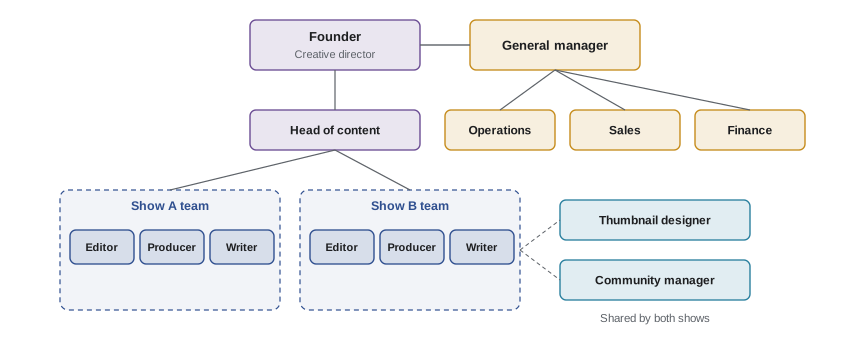
Decision rights and RACI
A frequent source of conflict in growing creator companies is unclear decision rights. Who approves a sponsor? Who decides the final cut? Who can spend $2,000 on equipment? A RACI chart lists key decisions and marks who is Responsible (does the work), Accountable (makes the final call), Consulted (gives input before) and Informed (told after). There should be exactly one A for each decision.
| Decision | Founder | Head of content | Sales lead | General manager |
|---|---|---|---|---|
| Accept a sponsor | C | C | R | A |
| Final cut of a video | A | R | I | I |
| Hire an editor | C | A | I | R |
| Equipment purchase over $2,000 | I | C | I | A |
| Launch a new show | A | R | C | C |
Capacity planning
Capacity planning answers a simple question: do we have enough people, with the right skills, to produce the planned output? It starts with how long each type of content takes, then compares total demand with available hours. Most people are not productive for every paid hour; meetings, admin, training and breaks take time, so planners use a utilization rate, often 70 % to 85 % for creative staff.
Worked problem
How many editors?
A company plans 6 long videos a month at 28 editing hours each and 40 shorts at 2.5 hours each. An editor works 160 hours a month at 75 % utilization. How many editors are needed?
Show solution
- Long videos: 6 × 28 = 168 hours.
- Shorts: 40 × 2.5 = 100 hours.
- Total: 268 hours a month.
- Productive hours per editor: 160 × 0.75 = 120.
- Editors needed: 268 ÷ 120 ≈ 2.23.
Answer: About 2.2 full-time editors. The company could hire two full-time editors and use a freelancer for overflow, or hire a third editor if output is expected to grow.
Worked problem
Finding the bottleneck
A show needs, per episode, 6 hours of research, 10 hours of producing, 30 hours of editing and 3 hours of thumbnail design. The team has 1 researcher, 1 producer, 2 editors and 1 designer, each with 120 productive hours a month. How many episodes a month can the team make, and where is the bottleneck?
Show solution
- Researcher: 120 ÷ 6 = 20 episodes.
- Producer: 120 ÷ 10 = 12 episodes.
- Editors: 240 ÷ 30 = 8 episodes.
- Designer: 120 ÷ 3 = 40 episodes.
Answer: Editing limits output to 8 episodes a month. Adding research or design capacity would not help; another editor or faster editing workflows would.
The bottleneck idea comes from operations management: a system can only move as fast as its slowest step. In creator companies, editing is often the bottleneck, but sometimes it is the founder's availability for filming or approvals. Finding and easing the true bottleneck is usually the cheapest way to increase output.
Remote, hybrid and in-person teams
Many creator companies are fully remote, with editors and designers spread across cities or countries. Remote teams widen the talent pool and cut rent, but they require clear written communication, shared tools and deliberate efforts to build relationships. Studio-based companies benefit from easier collaboration and spontaneous ideas but carry rent and commuting costs. Hybrid models combine a small studio for filming with remote post-production. Lesson 6 covers managing remote teams.
Hiring people in other provinces, states or countries brings legal obligations, such as registering as an employer there, following local employment standards and handling payroll taxes. Some companies use an employer of record service to employ staff in other jurisdictions on their behalf.
Agencies, managers and outsourcing
Not every function must be in-house. Talent managers, multi-channel networks and agencies can handle brand sales; accountants and lawyers handle specialized advice; production companies can make whole series. Outsourcing turns fixed costs into variable ones and brings expertise, at the price of less control and often a percentage of revenue. A sensible rule is to keep in-house the work that is core to your competitive advantage and outsource the rest until volume justifies a hire.
Worked problem
In-house or agency sales?
A company earns $400,000 a year in sponsorships through a talent agency that takes 20 %. An in-house sales lead would cost $95,000 a year fully loaded, plus $10,000 in tools and travel. If in-house sales brings in the same revenue, which is cheaper?
Show solution
- Agency cost: 20 % × $400,000 = $80,000.
- In-house cost: $95,000 + $10,000 = $105,000.
Answer: At $400,000 the agency is cheaper by $25,000. In-house becomes cheaper above $525,000 of sponsorship revenue ($105,000 ÷ 0.20), or sooner if an in-house lead raises rates or wins more deals.
Job levels and career paths
As a team grows past a handful of people, it helps to define job levels, such as junior, intermediate, senior and lead, for each role family. Each level describes the expected skills, independence and scope. A junior editor might cut videos from a detailed brief with close review; a senior editor might shape the story, mentor others and own a show's editing standards; a lead might manage a post-production team. Clear levels make pay ranges, promotions and hiring decisions more consistent and show people how they can grow without leaving.
Levels also help with organization design. When a show needs more capacity, leaders can decide whether to add another junior editor or promote someone to lead a small team, rather than simply adding people at random.
Common organization design problems
- The founder as bottleneck: every approval waits for one busy person. Fix it with delegation levels and decision rights.
- Hidden roles: important work, such as rights clearance or sponsor reporting, has no owner and is done by whoever notices. Fix it by listing outcomes and assigning owners.
- Too many managers too early: a team of eight with three managers adds meetings without adding output. Keep the structure flat until spans of control become too wide.
- Overloaded generalists: one person handles editing, thumbnails, community and admin, and all of it suffers. Split roles as volume grows.
Worked problem
Span of control
A head of content directly manages 11 people: 4 editors, 3 producers, 2 writers, a designer and a community manager. The company wants spans of no more than 6. Propose a structure.
Show solution
- Create two show leads, each managing 2 editors, 1 or 2 producers and 1 writer: about 5 people each.
- The head of content then manages the 2 show leads plus the designer and community manager: 4 direct reports.
Answer: Promoting two show leads brings every span to 6 or fewer and frees the head of content to focus on quality and strategy.
Whatever structure you choose, write it down in a simple chart, share it with the team and update it whenever roles change, so new hires, freelancers and partners know who to ask about what.
Common mistakes
MistakeDesigning roles around friends rather than the work.
InsteadList the work first, then group it into roles.
MistakeLetting every decision flow through the founder.
InsteadSet decision rights with a RACI chart and one accountable owner.
MistakePlanning capacity at 100 % utilization.
InsteadUse a realistic utilization rate such as 70 % to 85 %.
MistakeAdding staff to a step that is not the bottleneck.
InsteadFind the slowest step and ease it first.
MistakeHiring in another jurisdiction without checking obligations.
InsteadRegister as an employer there or use an employer of record.
Summary and key terms
- Organization design groups work into roles with clear ownership and reporting lines.
- Common roles include editors, producers, writers, designers, community, growth, sales and operations.
- Many companies hire editors first, then producers, sales and operations, then managers.
- Functional, show-based and matrix structures each trade skills against speed.
- RACI charts make decision rights explicit, with one accountable owner per decision.
- Capacity planning divides total hours of work by productive hours per person.
- Outsource non-core work until volume justifies a hire.
- Organization design
- The deliberate arrangement of roles, responsibilities and reporting lines.
- Span of control
- The number of people reporting directly to one manager.
- Functional structure
- A structure that groups people by type of work.
- Matrix structure
- A structure in which people report to a function but work on shows or projects.
- RACI
- A chart showing who is responsible, accountable, consulted and informed for decisions.
- Decision rights
- Clear rules on who can make which decisions.
- Utilization
- The share of paid hours spent on productive work.
- Bottleneck
- The slowest step that limits a system's output.
- Employer of record
- A service that legally employs staff in another jurisdiction on a company's behalf.
- Showrunner
- The person responsible for the creative output of a show.
Practice problems
Work each problem on paper first, then reveal the answer to check.
Work totals 300 hours a month; each person gives 120 productive hours. Staff needed?
Show answer
2.5.
An editor works 150 hours at 80 % utilization. Productive hours?
Show answer
120.
Steps take 5, 12, 24 and 4 hours per episode, one person each at 120 hours. Bottleneck?
Show answer
The 24-hour step, limiting output to 5 episodes.
How many accountable owners should a decision have?
Show answer
Exactly one.
An agency takes 15 %; in-house costs $90,000. Break-even revenue?
Show answer
$600,000.
Name one advantage of a show-based structure.
Show answer
Faster decisions and stronger ownership.
Name one drawback of a functional structure.
Show answer
Shows that need several functions can move slowly.
What is a typical span of control?
Show answer
Four to eight direct reports.
Name a role often hired first.
Show answer
An editor.
Why use an employer of record?
Show answer
To employ staff legally in another jurisdiction without setting up there.
Lesson quiz · 5 questions
Score 60% or more to complete this lesson.
Create a free account to save your progress, take quizzes and earn a certificate.