
CRE-401 · Lesson 6 of 12 · 30 min
Managing people and building culture
Hiring good people is only the start. Keeping them motivated, growing their skills and helping them work well together is the daily job of management. Many creators become managers suddenly, without training, and discover that the habits that made them great creators, such as perfectionism, doing everything themselves and working through the night, can make them difficult managers. This lesson covers the basics of managing a small creative team: setting expectations, giving feedback, running meetings, managing performance, leading remote teams, building culture and protecting wellbeing.
What managers do
Management in a small media company comes down to a few recurring tasks:
- Set direction: make sure each person knows the goals, priorities and standards for their work.
- Remove obstacles: get people the tools, information and decisions they need.
- Give feedback: tell people what is working and what is not, early and often.
- Develop skills: help people grow through coaching, stretch assignments and training.
- Make decisions and own them, especially hard ones about priorities and performance.
A useful mindset shift is that a manager's output is the output of their team. A founder who spends the day re-editing videos is not managing; they are doing the editor's job and teaching the editor that their work does not matter.
Setting clear expectations
Most performance problems start with unclear expectations. Make standards explicit. For an editor, that might include a style guide with examples of pacing, captions, music and color; delivery deadlines for first and final cuts; how many revision rounds to expect; and what quality checks to complete before handing over. Written standards let people succeed without guessing and make feedback more objective.
Delegation also needs clarity. A common framework describes levels of delegation, from "do exactly this" through "research and recommend" and "decide and tell me" to "decide, no need to report". Saying which level applies to each task avoids frustration on both sides.
Feedback
Creative people often care deeply about their work, which makes feedback both important and sensitive. Good feedback is specific, timely, focused on the work rather than the person, and balanced between what to keep and what to change. One simple model is situation, behavior, impact: describe the situation, the specific behavior and its impact, then discuss what to do next. For example: "In Tuesday's video (situation), the intro ran 50 seconds before the main topic (behavior), and retention dropped 30 % in that section (impact). Can we try getting to the topic within 15 seconds?"
Feedback should flow both ways. Ask team members regularly what you could do better as a manager, and act on what you hear.
One-on-ones and team meetings
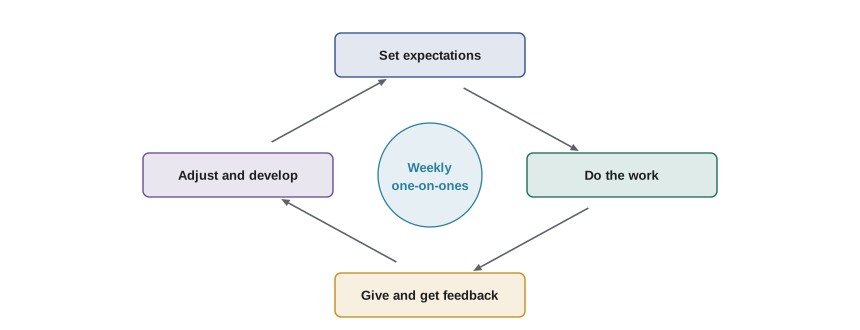
Regular one-on-one meetings between a manager and each direct report are among the most effective management habits. A weekly or fortnightly 30-minute meeting gives space to discuss progress, obstacles, feedback, workload and development. The agenda should belong mainly to the team member.
Team meetings keep everyone aligned, but too many meetings eat creative time. Many creator companies use a short weekly planning meeting, a content review where finished work is discussed, and asynchronous updates in a shared channel for everything else.
Worked problem
The cost of a meeting
A weekly one-hour team meeting includes 8 people whose average fully loaded cost is $45 an hour. What does the meeting cost per year over 48 weeks? If it were cut to 30 minutes with a written update beforehand, how much would be saved?
Show solution
- Cost per meeting: 8 × $45 × 1 hour = $360.
- Annual cost: $360 × 48 = $17,280.
- Half-hour meeting: $8,640 a year.
- Saving: $17,280 − $8,640 = $8,640, before counting time to write the update.
Answer: The meeting costs about $17,280 a year; halving it frees roughly $8,600 of team time for creative work.
Performance management
When someone is struggling, act early. Start by checking the basics: are expectations clear, does the person have the tools and training, and is the workload realistic? Many problems are fixed by clearer direction or better tools. If performance stays below standard, write down specific gaps, agree on a plan with clear goals and a timeline, offer support, and check in often. Keep notes of these discussions.
If performance does not improve, you may need to end the employment relationship. Termination rules vary widely.
In the US, most employment is at will, meaning either side can end it at any time for any lawful reason, with or without notice. Montana is an exception, requiring good cause after a probationary period. Employers still cannot fire people for discriminatory or retaliatory reasons, and some contracts, policies or union agreements limit at-will termination. The federal WARN Act requires notice for large layoffs at bigger employers, and some states have their own notice and final paycheck rules. Get legal advice before dismissing someone.
Managing remote and hybrid teams
Remote work suits many creator companies, but it needs deliberate practices:
- Write things down: decisions, briefs, style guides and processes should live in shared documents, not in someone's memory.
- Choose default tools: one place for chat, one for tasks, one for files, so information is not scattered.
- Set response-time norms, such as replying to messages within four working hours, so people are not expected to be online constantly.
- Overlap working hours: agree on a few hours when everyone is available, especially across time zones.
- Make time for connection: regular video calls, informal chats and occasional in-person gatherings build trust.
Worked problem
Finding overlap across time zones
An editor in Vancouver works 9 a.m. to 5 p.m. Pacific time, a producer in Toronto works 9 a.m. to 5 p.m. Eastern time (three hours ahead), and a designer in Lisbon works 10 a.m. to 6 p.m. local time, eight hours ahead of Pacific in autumn. How many hours a day overlap for all three?
Show solution
- Convert to Pacific time: Toronto 9 a.m. to 5 p.m. Eastern is 6 a.m. to 2 p.m. Pacific.
- Lisbon 10 a.m. to 6 p.m. is 2 a.m. to 10 a.m. Pacific.
- Vancouver 9 a.m. to 5 p.m. Pacific.
- Common window: from 9 a.m. (latest start) to 10 a.m. (earliest finish) Pacific.
Answer: One hour, 9 to 10 a.m. Pacific. The team should keep that hour for live meetings and handle everything else asynchronously.
Culture
Culture is how people in a company actually behave, especially when no one is watching. It grows from what leaders do, reward and tolerate, more than from what they say. In creator companies, culture is often shaped by the founder's personality and the brand's tone. A playful channel may have a playful team; that is fine, as long as playfulness does not turn into harassment or exclusion.
Practical ways to build healthy culture include writing down values and using them in hiring and feedback, celebrating good work publicly, being open about company performance, treating mistakes as chances to learn, and dealing quickly with behavior that breaks the values, even from star performers. Every employer also has legal duties to prevent harassment and discrimination at work, which apply to remote work and online channels too.
Title VII and state laws make employers responsible for preventing and addressing workplace harassment, and some states, such as California and New York, require harassment prevention training.
Wellbeing and sustainable pace
Creative industries have a reputation for long hours and crunch. Constant overwork leads to burnout, mistakes and turnover, all of which cost the company money. CRE-350 covered creator wellbeing in depth; the same principles apply to teams. Plan realistic workloads using the capacity methods from lesson 3, avoid making overtime the norm, protect time off, and watch for warning signs such as missed deadlines, irritability or withdrawal. Employment standards also limit hours and require overtime pay for many employees, depending on their role and jurisdiction.
Worked problem
Turnover cost
A company of 10 people loses 3 staff a year. Replacing each costs about 30 % of a $60,000 salary in recruiting, training and lost output. If better workload planning and management cut departures to 1 a year, how much would the company save?
Show solution
- Cost per departure: 0.30 × $60,000 = $18,000.
- Current annual cost: 3 × $18,000 = $54,000.
- Improved: 1 × $18,000 = $18,000.
- Saving: $36,000 a year.
Answer: About $36,000 a year, more than half a salary, which helps justify investment in management and wellbeing.
Developing people
Small companies cannot always offer promotions, but they can offer growth. Ask each person where they want to go, then look for stretch assignments, such as leading a new format or mentoring a junior colleague, training budgets, conference attendance and chances to appear on camera or credit their work publicly. Clear career paths, even simple ones such as junior, intermediate and senior editor with defined skills at each level, help people see a future in the company.
Recognition and motivation
Research on motivation suggests that creative people are driven strongly by autonomy, mastery and purpose: some control over how they work, the chance to get better at their craft and a sense that the work matters. Pay must be fair, or it becomes a source of resentment, but beyond that, recognition and growth often matter more than small raises. Simple practices include crediting editors, writers and designers publicly, sharing audience comments that praise their work, giving people ownership of a format or segment, and celebrating milestones as a team.
Conflict between creative and business goals
Creator companies often face tension between creative ambitions and business needs: an editor wants another week to perfect a video that a sponsor needs on Friday, or a writer objects to a sponsor segment. Managers can reduce this conflict by agreeing standards in advance, involving creative leads in sponsor decisions, explaining the business reasons behind deadlines and protecting some time for creative experiments that are not tied to revenue.
Worked problem
Absence and coverage
A team of 9 people each takes 15 vacation days and an average of 5 sick days a year, out of about 250 working days. How many person-days of absence does the team have each year, and what share of capacity is that?
Show solution
- Absence per person: 15 + 5 = 20 days.
- Team absence: 9 × 20 = 180 person-days.
- Total capacity: 9 × 250 = 2,250 person-days.
- Share: 180 ÷ 2,250 = 8 %.
Answer: About 8 % of capacity, roughly the equivalent of one person for most of the year, which capacity plans and publishing schedules should allow for.
Handling departures well
People will leave, for better offers, new challenges or personal reasons. A good departure protects relationships and the business. Ask for enough notice to hand over work, document what the person knows, transfer account access and files, conduct an exit interview to learn what could be improved, and part on good terms. Former team members often become freelancers, referrals or future hires.
Managers also need support. New managers benefit from training, a mentor or peer group of other managers, and regular feedback from their own teams, so they do not have to learn every lesson the hard way.
Common mistakes
MistakeRedoing team members' work instead of managing.
InsteadGive feedback and let people improve their own work.
MistakeLeaving expectations unwritten.
InsteadWrite style guides, deadlines and quality checks.
MistakeGiving vague feedback such as "make it better".
InsteadUse situation, behavior and impact, with a next step.
MistakeWaiting too long to address poor performance.
InsteadAct early with a clear, supported plan.
MistakeTreating constant crunch as normal.
InsteadPlan realistic workloads and protect time off.
Summary and key terms
- Managers set direction, remove obstacles, give feedback, develop skills and make decisions.
- Clear, written expectations prevent most performance problems.
- Situation, behavior and impact make feedback specific and fair.
- Regular one-on-ones and lean meetings keep teams aligned without wasting time.
- Termination rules differ greatly between jurisdictions, so get advice first.
- Remote teams need written processes, default tools, response norms and overlap hours.
- Culture grows from what leaders do, reward and tolerate.
- Delegation level
- How much authority a person has over a task, from following instructions to deciding alone.
- One-on-one
- A regular private meeting between a manager and a team member.
- Situation, behavior, impact
- A feedback model describing context, specific action and effect.
- Performance plan
- A written plan with goals, support and a timeline to fix performance gaps.
- Reasonable notice
- Common-law notice of dismissal owed to many Canadian employees.
- At-will employment
- Employment that either side can end at any time for any lawful reason.
- Asynchronous communication
- Communication that does not require people to be online at the same time.
- Culture
- How people in an organization actually behave.
- Turnover
- The rate at which employees leave and are replaced.
- Stretch assignment
- A task slightly beyond a person's current skills, used for development.
Practice problems
Work each problem on paper first, then reveal the answer to check.
A 6-person, 1-hour weekly meeting at $40 an hour. Annual cost over 50 weeks?
Show answer
$12,000.
Name the three parts of the feedback model in this lesson.
Show answer
Situation, behavior, impact.
A Toronto worker 9 to 5 Eastern and a Vancouver worker 9 to 5 Pacific. Overlap?
Show answer
9 a.m. to 2 p.m. Pacific, or 5 hours.
Replacing an employee costs 25 % of a $56,000 salary. Cost per departure?
Show answer
$14,000.
Name two practices for remote teams.
Show answer
Written processes, default tools, response norms, overlap hours, connection time.
What should come first when someone underperforms?
Show answer
Check expectations, tools, training and workload.
Why is constant crunch costly?
Show answer
It causes burnout, mistakes and turnover.
What is a stretch assignment?
Show answer
A task slightly beyond current skills, used for growth.
Whose agenda is a one-on-one mainly?
Show answer
The team member's.
What notice rules apply to dismissal?
Show answer
Mostly at-will, with limits for discrimination, retaliation, contracts and WARN Act layoffs.
Lesson quiz · 5 questions
Score 60% or more to complete this lesson.
Create a free account to save your progress, take quizzes and earn a certificate.