
CRE-420 · Lesson 1 of 12 · 33 min
Choosing and evaluating a niche
A niche is the specific topic, audience and style that a creator becomes known for. Earlier courses treated content, audience growth, monetization and the law in general terms. This course applies those skills to the major niches where creators actually work: gaming, entertainment, beauty and fashion, fitness, health, personal finance, food and drink, travel, family content and expertise-based channels. Each niche has its own audience habits, sponsors, formats and, in many cases, its own rules. A creator who understands those differences can choose a niche deliberately, earn more from it and stay out of trouble.
This first lesson gives you a method for choosing and evaluating a niche. The rest of the course looks at individual niches in turn and ends with a capstone in which you write a niche strategy and compliance plan for a channel of your own. Throughout, the figures for audience size, revenue per thousand views and sponsor rates are illustrative. They vary widely by platform, country, season and year, so treat them as a way of thinking rather than as benchmarks to rely on.
What makes a good niche
A good niche sits where four things overlap: real demand from an audience, a level of competition you can realistically break into, ways to earn money, and a genuine fit with your own knowledge, interests and circumstances. Missing any one of these makes a channel hard to sustain. A topic with huge demand but thousands of well-funded competitors may leave no room for a newcomer. A topic you love but that few people search for may never pay the bills. A lucrative topic you have no interest in will be hard to keep up for years, and audiences notice when a creator is going through the motions.
- Demand: are people searching for, watching and talking about this topic, and is interest growing, stable or fading?
- Competition: how many established creators serve this audience, how good is their work, and what gaps do they leave?
- Monetization: which revenue streams fit, such as ads, sponsorships, affiliates, memberships, products or services, and how valuable is the audience to advertisers?
- Personal fit: do you have knowledge, access, credibility or a perspective others lack, and can you produce this content consistently?
Personal fit also includes risk. Some niches carry legal and ethical responsibilities that others do not. Giving investment opinions, promoting supplements or showing your children on camera all bring rules and duties that a creator must accept as part of the job. Those responsibilities are not reasons to avoid a niche, but they belong in the evaluation from the start.
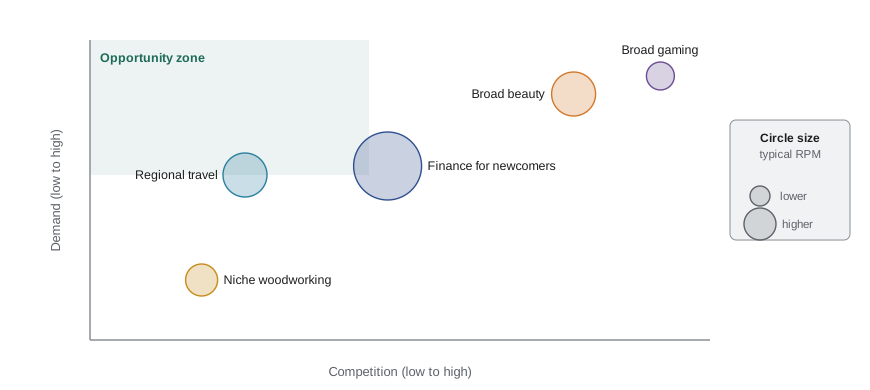
Researching demand
Demand research starts with what people already look for. Search tools show how often a topic or question is searched and whether interest is rising. Platform search bars suggest popular phrasings as you type. Look at the view counts on recent videos from creators of different sizes, not just the largest channels, because a small channel with strong views signals demand that is not tied to one celebrity. Forums, subreddits, comments and community groups reveal questions people ask repeatedly and complaints about existing content.
Seasonality matters in many niches. Gift guides and tech reviews peak before the holidays, fitness content in January, travel planning in late winter and spring, outdoor gear in spring and summer, and tax and budgeting content early in the year. Back-to-school, Halloween and major game releases create predictable spikes. A niche with strong seasonal swings can still work well, but you need a plan for the quiet months and a calendar that gets content published before the peak rather than during it.
Demand also depends on country and language. A topic that is crowded in English may be underserved in French, and a question that is common in the United States may have a different answer in Canada because of different laws, prices or products. Personal finance, health, legal topics and many consumer reviews need country-specific versions, which can be an opening for a creator who serves one market well.
Assessing competition
Competition is not only the number of channels. It is the quality and freshness of their content, how well they serve particular sub-audiences, and how loyal their viewers are. A useful exercise is to list the ten most relevant creators in a niche and record, for each, their audience size, posting frequency, typical views, formats, strengths and weaknesses. Patterns quickly appear: perhaps everyone makes long reviews and nobody makes quick comparisons, or every channel targets experts and beginners feel left out.
Gaps can be about audience, format, depth, perspective or place. A cooking niche crowded with elaborate recipes may lack fast weeknight meals for students. A fitness niche dominated by young athletes may underserve older adults or people with disabilities. A tech niche may lack content in French, or content that tests products in a Canadian winter. Finding a gap you can fill is often more effective than competing head-on with the largest channels.
Watch for niches where competition is unhealthy rather than just strong. Some niches reward sensational claims, rage bait or risky stunts, and creators who refuse to play that game can struggle to keep up. Others are dominated by brands or affiliate sites that publish huge volumes of thin content. Understanding how a niche's leading creators earn and behave tells you what you would be competing against.
Estimating monetization
Different niches earn very different amounts from the same number of views. Advertisers pay more to reach audiences who are about to make expensive decisions, such as choosing a bank, buying software or booking a trip, than audiences watching for pure entertainment. As a result, revenue per thousand views, or RPM, tends to be higher in finance, business, technology and some education niches, and lower in gaming, comedy and general entertainment. Sponsorship rates show similar patterns, and some niches have rich affiliate programs while others have few.
| Niche (broad) | Illustrative ad RPM | Typical sponsors | Affiliate potential |
|---|---|---|---|
| Personal finance and investing | $8–$20 | Banks, fintech apps, brokerages, budgeting tools | High, but heavily regulated |
| Technology and software | $5–$12 | Software, hardware, online services | High |
| Beauty and fashion | $3–$8 | Cosmetics, skin care, retailers | High |
| Food and cooking | $3–$7 | Kitchen tools, grocery, meal kits | Moderate |
| Travel and outdoors | $3–$8 | Gear, tourism boards, travel services | Moderate to high |
| Gaming | $1.50–$4 | Games, peripherals, energy drinks | Moderate |
| Entertainment and commentary | $1–$4 | Apps, consumer products | Low to moderate |
The table is a starting point, not a forecast. A gaming channel with a loyal audience and strong sponsorships can out-earn a finance channel with low engagement, and RPM in any niche rises in the fourth quarter when advertisers spend heavily. RPM also differs by viewer country: audiences in Canada, the United States, the United Kingdom and Australia usually earn more per view than audiences in countries where advertisers spend less. What matters is the full revenue mix you can build, which CRE-302 covered in detail.
Worked problem
Sizing a niche's revenue potential
You are comparing two niches. In niche A you expect 60,000 views a month at an ad RPM of $3, plus two sponsorships a month at $900 each. In niche B you expect 25,000 views a month at an RPM of $12, plus one sponsorship a month at $1,500 and $400 in affiliate commissions. Estimate monthly revenue for each.
Show solution
- Niche A ads: 60,000 ÷ 1,000 × $3 = $180.
- Niche A sponsorships: 2 × $900 = $1,800. Total A = $1,980.
- Niche B ads: 25,000 ÷ 1,000 × $12 = $300.
- Niche B sponsorships and affiliates: $1,500 + $400 = $1,900. Total B = $2,200.
Answer: Niche B earns about $2,200 a month against $1,980 for niche A, despite having fewer than half the views. Sponsorships dominate both, so the size and value of the audience to sponsors matters more than raw view counts.
Personal fit and credibility
Personal fit is the factor creators most often skip, and it is the one that decides whether a channel lasts. Ask yourself what you know that others do not, what access you have, what perspective you bring and what you would happily make content about for five years. A nurse has credibility in health content that a hobbyist lacks. A long-time competitive player understands a game's community in a way an outsider cannot fake. A newcomer to Canada can explain banking or housing to other newcomers with an authenticity that a lifelong resident cannot match.
Credibility also comes with obligations. If you present yourself as an expert, audiences rely on you more, and so do regulators. Professionals in regulated fields such as medicine, nursing, law, accounting, engineering and financial advice must follow their professional bodies' rules when they create content, as later lessons explain. Creators without credentials must avoid implying expertise they do not have, which is both an ethical problem and, in some fields, a legal one.
Think too about the practical demands of a niche. Travel content needs money and time to travel. Fitness content needs you on camera and in good form. Gaming needs a capable computer and access to new releases. Beauty and fashion need a steady supply of products. Family content needs your children's ongoing consent and protection. A niche that fits your life is far easier to sustain than one that constantly strains your budget, health or relationships.
Niche, sub-niche and positioning
Most successful creators start narrow and widen later. Being the go-to channel for one specific audience, such as budget mechanical keyboards, Indigenous cooking traditions, beginner rock climbing in Ontario, or tax basics for gig workers, is easier than being one of thousands of general channels. A narrow niche makes it easier for the right viewers to find you, for the algorithm to understand whom to show you to, and for sponsors to see the value of your audience.
Positioning describes how you want your audience to see you compared with alternatives. A simple positioning statement fills in this template: for a specific audience who need or want something, my channel is the type of content that offers a key benefit, unlike alternatives, because of a reason to believe. For example: for Canadian students who want to eat well on a tight budget, my channel offers fast recipes under five dollars a serving, unlike glossy cooking channels, because I cook in a shared residence kitchen with student-priced ingredients.
Adjacent niches let you widen over time without losing your audience. A budget cooking channel can move into meal planning, grocery budgeting and kitchen equipment. A beginner climbing channel can expand into hiking, outdoor safety and travel. Each step should still serve the audience you built, and each new area may bring new rules, such as claims about nutrition or safety, that you need to learn first.
A niche scorecard
A weighted scorecard brings the factors together so that you can compare options honestly. Choose criteria, give each a weight that reflects its importance to you, score each niche from 1 to 5 on each criterion, and multiply. The result is not a mechanical answer, but it forces you to think about every factor and makes trade-offs visible.
| Criterion | Weight | Niche A score | Niche B score |
|---|---|---|---|
| Demand | 25 % | 4 | 3 |
| Competition (higher = easier) | 20 % | 2 | 4 |
| Monetization | 20 % | 3 | 5 |
| Personal fit and credibility | 25 % | 4 | 4 |
| Compliance burden (higher = lighter) | 10 % | 5 | 2 |
Worked problem
Scoring two niches
Using the weights and scores in the table above, calculate the weighted score for each niche out of 5.
Show solution
- Niche A: 0.25 × 4 + 0.20 × 2 + 0.20 × 3 + 0.25 × 4 + 0.10 × 5 = 1.00 + 0.40 + 0.60 + 1.00 + 0.50 = 3.50.
- Niche B: 0.25 × 3 + 0.20 × 4 + 0.20 × 5 + 0.25 × 4 + 0.10 × 2 = 0.75 + 0.80 + 1.00 + 1.00 + 0.20 = 3.75.
- Check that the weights add to 100 %: 25 + 20 + 20 + 25 + 10 = 100.
Answer: Niche B scores 3.75 against 3.50 for niche A. Niche B wins on competition and money but carries a heavier compliance burden, which the creator must be willing to manage.
Including a compliance criterion is deliberate. A niche such as personal finance, supplements or alcohol may score highly on money but require careful disclosures, evidence for claims, age restrictions or, in some cases, registration with a regulator. Weighing that burden at the start avoids unpleasant surprises later.
Testing before committing
Research only goes so far. The best evidence comes from publishing. Before committing fully, make a small batch of content, perhaps six to ten pieces, across two or three candidate niches or angles, and track the results. Compare click-through rate, average view duration, comments, shares, subscriber gains and the quality of audience questions. Look for content that not only performs but that you enjoyed making and could repeat.
Set a clear test window and decision rule in advance, such as eight weeks and a commitment to the angle with the best average view duration and growth. Without a rule, it is easy to keep chasing whatever happened to perform last week. Remember that early results are noisy, especially on small channels, so look at patterns across several posts rather than one viral hit.
Worked problem
Comparing test results
Over eight weeks you publish five videos on budget cooking and five on kitchen gadget reviews. Budget cooking averages 2,400 views, 48 % average view percentage and 22 comments per video. Gadget reviews average 3,100 views, 31 % average view percentage and 9 comments. Which angle shows stronger audience fit?
Show solution
- Gadget reviews win on raw views by 3,100 − 2,400 = 700 views a video.
- Budget cooking holds viewers far better: 48 % versus 31 % average view percentage.
- Budget cooking also generates more conversation: 22 comments versus 9.
- Engagement and retention tend to predict long-term growth better than early views.
Answer: Budget cooking shows stronger audience fit despite lower views. A reasonable decision is to focus on budget cooking and fold occasional gadget content into it, for example by reviewing affordable kitchen tools.
The rules that come with a niche
The general rules from CRE-320 apply in every niche: disclose material connections clearly, do not make claims you cannot support, protect children and respect privacy. Many niches add their own layers on top. Health and fitness claims bring food and drug laws. Investing content brings securities law. Alcohol, cannabis and gambling bring age limits and strict advertising codes. Beauty brings cosmetic and drug rules. Travel can bring park permits and drone rules. Family content brings child protection and, in some US states, laws about children's earnings.
In the United States, these rules come from federal agencies such as the Federal Trade Commission, the Food and Drug Administration, the Securities and Exchange Commission and the Alcohol and Tobacco Tax and Trade Bureau, from self-regulatory bodies such as FINRA and BBB National Programs, from industry codes, and from state laws on topics such as gambling, child performers and privacy. Because states regulate many areas, the same content can be lawful in one state and restricted in another.
The goal of the following lessons is not to make you a lawyer, but to help you recognize the main rules in each niche, ask the right questions and know when to get professional advice. This course describes the law at the time of writing (October 2026).
Common mistakes
MistakeChoosing a niche only because it has the highest RPM.
InsteadWeigh demand, competition, monetization, personal fit and compliance burden together.
MistakeCopying the largest channel in a niche.
InsteadLook for gaps in audience, format, depth, perspective or place that you can fill better.
MistakeIgnoring seasonality and publishing during peaks.
InsteadBuild a calendar that publishes seasonal content before demand peaks and plans for quiet months.
MistakeJudging a niche from one viral video.
InsteadTest several pieces over a set window and compare retention, engagement and growth patterns.
MistakeForgetting the rules that come with a niche.
InsteadIdentify niche-specific laws, codes and professional rules before committing.
Summary and key terms
- A good niche combines demand, manageable competition, monetization and genuine personal fit.
- Demand research uses search data, platform suggestions, view counts across channel sizes and community questions.
- Competition analysis looks for gaps in audience, format, depth, perspective, language and place.
- RPM and sponsor value vary widely by niche, country and season; sponsorships often matter more than ad revenue.
- Narrow positioning makes it easier to be found and to attract sponsors, with adjacent niches for later growth.
- A weighted scorecard and a planned test period make niche decisions deliberate rather than reactive.
- Many niches carry specific legal and professional rules that belong in the evaluation from the start.
- Niche
- The specific topic, audience and style a creator becomes known for.
- Sub-niche
- A narrower segment within a broader niche.
- RPM
- Revenue per thousand views after the platform's share.
- Seasonality
- Predictable rises and falls in interest at certain times of year.
- Positioning
- How a creator wants the audience to see them compared with alternatives.
- Positioning statement
- A short sentence describing audience, benefit, alternative and reason to believe.
- Adjacent niche
- A related topic that lets a channel grow without losing its audience.
- Weighted scorecard
- A comparison tool that multiplies criterion scores by importance weights.
- Compliance burden
- The effort and risk involved in following a niche's legal and professional rules.
- Average view percentage
- The average share of a video that viewers watch.
Practice problems
Work each problem on paper first, then reveal the answer to check.
Name the four overlapping factors of a good niche.
Show answer
Demand, competition, monetization and personal fit.
40,000 views at an RPM of $5 earn how much in ads?
Show answer
40,000 ÷ 1,000 × $5 = $200.
Why might a finance channel earn more per view than a gaming channel?
Show answer
Advertisers pay more to reach viewers making valuable financial decisions.
Give two examples of seasonal peaks.
Show answer
Fitness in January, gift guides before the holidays, tax content early in the year, travel planning in spring.
What does a positioning statement include?
Show answer
Audience, need, content type, key benefit, alternatives and reason to believe.
Weights 50 %, 30 % and 20 % with scores 4, 3 and 5 give what weighted score?
Show answer
2.0 + 0.9 + 1.0 = 3.9.
Why include compliance burden in a niche scorecard?
Show answer
Regulated niches need disclosures, evidence, age limits or registration that add effort and risk.
What is one way to find gaps in a crowded niche?
Show answer
List leading creators and look for underserved audiences, formats, languages or places.
Why set a decision rule before testing niches?
Show answer
To avoid chasing whichever post happened to perform last.
Name a niche where Canadian and US content may need separate versions.
Show answer
Personal finance, health, legal topics or consumer product availability.
Lesson quiz · 5 questions
Score 60% or more to complete this lesson.
Create a free account to save your progress, take quizzes and earn a certificate.