
CRE-430 · Lesson 7 of 12 · 26 min
Apologies and accountability
The apology video has become a genre of its own, complete with parodies and checklists. Audiences have seen enough apologies to recognize ones that feel scripted, self-pitying or evasive, and they react strongly to them. Yet a genuine apology, backed by real action, remains one of the most effective ways to repair trust after a creator has done something wrong. This lesson covers what research says about effective apologies, the common patterns that make apologies fail, when an apology is appropriate and when it is not, and why actions matter more than words.
When an apology is appropriate
An apology is appropriate when you did something wrong that affected other people: you caused harm, broke a promise, misled your audience, treated someone badly, or made content that hurt people. It is not appropriate, and can be harmful, when a claim against you is false, when you are apologizing simply to make criticism stop, or when the apology would accept responsibility for something you did not do.
Many situations are mixed: part of the criticism is fair and part is based on misunderstanding. In those cases, apologize clearly for the part you got wrong and correct the misunderstanding separately and calmly. Blending the two, for example by saying you are sorry if anyone misunderstood, tends to satisfy nobody.
What research says about effective apologies
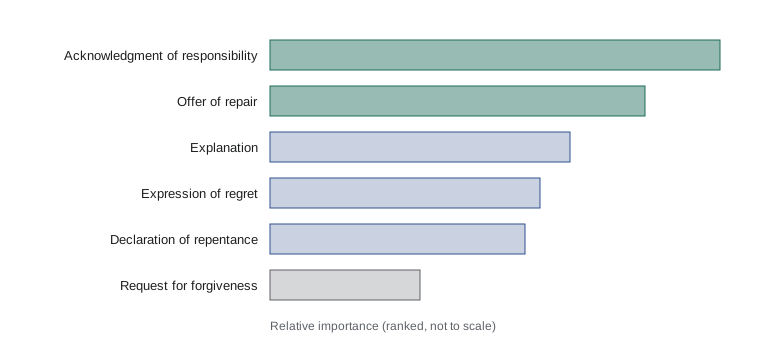
Research on apologies, much of it from psychology and negotiation studies, finds that apologies with more components are generally seen as more effective, and that some components matter more than others. A frequently cited 2016 study by Roy Lewicki and colleagues at Ohio State University tested six components of an apology.
- Expression of regret: saying you are sorry.
- Explanation of what went wrong.
- Acknowledgment of responsibility: clearly owning the mistake.
- Declaration of repentance: committing not to repeat it.
- Offer of repair: offering to fix the harm.
- Request for forgiveness.
In that research, acknowledgment of responsibility was rated the most important component, followed by an offer of repair. A request for forgiveness was rated least important. The findings come from experiments using written scenarios, so they are a guide rather than a guarantee, but they match what creators see in practice: audiences respond most to clear ownership and concrete action.
The non-apology
A non-apology uses the language of apology while avoiding responsibility. Audiences recognize these patterns quickly, and a non-apology often does more damage than saying nothing, because it adds a new reason for criticism.
| Pattern | Example phrasing | Why it fails |
|---|---|---|
| Conditional apology | I'm sorry if anyone was offended | Questions whether harm happened and shifts focus to the audience's feelings |
| Passive voice | Mistakes were made | Hides who made the mistakes |
| Minimizing | It was just a joke | Dismisses the impact on people who were hurt |
| Blaming others | My editor added that | Avoids responsibility for one's own content and team |
| Self-focus | This has been the hardest week of my life | Centers the creator's pain over those harmed |
| Whataboutism | Other creators do much worse | Changes the subject instead of addressing it |
| Vague apology | I'm sorry for everything | Does not show understanding of what went wrong |
Many non-apologies come from defensiveness rather than bad intentions. Being criticized is painful, and people instinctively protect themselves. That is why it helps to draft an apology, wait, and have a trusted person read it before posting.
Elements of a strong creator apology
Putting the research and practice together, a strong creator apology usually includes the following, in roughly this order.
- A specific description of what you did, in plain words.
- Clear ownership, using I statements and active voice.
- Recognition of who was affected and how, without speaking for them.
- A brief explanation of how it happened, if useful, without turning it into an excuse.
- Concrete actions you have taken or will take to repair harm and prevent a repeat.
- A way to check: how and when you will report back on those actions.
Length should match the issue. A minor mistake may need two sentences in a pinned comment; a serious harm may need a longer statement and direct contact with the people affected. Format matters too: a video can convey sincerity, but highly produced apology videos with sad music or staged settings often read as performative. Many creators find that a simple, direct format works best.
Worked problem
Scoring an apology with a rubric
A creator's team uses a weighted rubric to review a draft apology before posting. Each element is scored 0 to 2. Weights: ownership 30 %, specific description 20 %, action and repair 25 %, recognition of impact 15 %, follow-up commitment 10 %. The draft scores: ownership 1, description 2, action 1, impact 2, follow-up 0. What is the weighted score out of 2, and what should be improved?
Show solution
- Ownership: 0.30 × 1 = 0.30.
- Description: 0.20 × 2 = 0.40.
- Action: 0.25 × 1 = 0.25.
- Impact: 0.15 × 2 = 0.30.
- Follow-up: 0.10 × 0 = 0.
- Total: 0.30 + 0.40 + 0.25 + 0.30 + 0 = 1.25 out of 2, or 62.5 %.
Answer: The draft scores 1.25 out of 2. The biggest gains come from stronger ownership, worth 0.30 more if raised to 2, and concrete action, worth 0.25 more. Adding a follow-up commitment adds another 0.20. Revising those three elements could raise the score to 2.
Actions over words
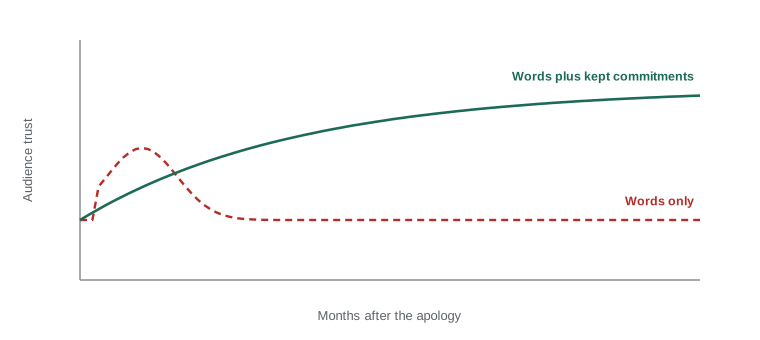
An apology without changed behavior quickly loses credibility. Audiences watch what happens next. Actions might include removing harmful content, refunding customers, changing who you work with, donating to or working with affected communities, getting training or education, changing moderation policies, hiring different team members, or stepping back from content for a period. The right actions depend on the harm.
Actions should be proportionate and genuine. A large donation announced in an apology video can seem like an attempt to buy forgiveness if it is not connected to the harm or followed by other changes. Small, specific, verifiable actions often carry more weight than grand gestures.
Apologizing to individuals
When specific people were harmed, such as a collaborator who was mistreated, a fan who was mocked or customers who lost money, a private apology to them may matter more than a public statement. Public apologies are often addressed to the audience at large and can feel like they are for show. Contact affected people privately first if it is safe and welcome, listen to what they need, and respect their wishes about whether they want to be named or involved. Never pressure someone you harmed to publicly accept your apology or appear in your content.
When not to apologize
Apologizing for things you did not do can cause problems. It can be taken as an admission in legal disputes, encourage further false claims, and confuse your audience. If a claim is false, say so calmly, provide evidence if you have it, and avoid attacking the people who believed it. If you are unsure, use a holding statement and investigate before deciding.
In the United States, many states have apology laws, but most protect only expressions of sympathy or regret, mainly in medical settings, and do not protect admissions of fault. In most situations an apology that admits responsibility could be used as evidence in a lawsuit. Creators facing possible legal claims should get legal advice before making detailed public statements, while recognizing that silence or legalistic language can also harm reputation.
Repeated apologies
Audiences notice patterns. A creator who apologizes for similar behavior again and again loses credibility with each apology. If you find yourself apologizing repeatedly, the problem is not the wording of the apologies but the underlying behavior or systems. That calls for deeper change, such as getting outside help, restructuring how content is made, or stepping back.
Writing the apology
Many creators find it helpful to write an apology in stages. First, write down privately everything you feel, including defensiveness and frustration; this draft is not for publishing. Next, list the facts: what you did, who was affected and how. Then draft the public apology using the elements in this lesson, and set it aside for a few hours. Finally, ask one or two trusted people, ideally including someone who understands the perspective of those harmed, to read it and tell you honestly how it lands.
- Read it aloud. Phrases that sound defensive or self-pitying are easier to hear than to see.
- Remove words such as if, but and unfortunately where they weaken ownership.
- Check every promise: can you actually do it, and when will you report back?
- Cut anything that explains your intentions at length; impact matters more than intent.
- Make sure the apology is about the people affected, not about your career.
Worked problem
Comparing two apology drafts
Two drafts are scored on the 0 to 2 rubric with weights ownership 30 %, description 20 %, action 25 %, impact 15 % and follow-up 10 %. Draft A: 2, 1, 1, 2, 1. Draft B: 1, 2, 2, 1, 2. Which scores higher?
Show solution
- Draft A: 0.6 + 0.2 + 0.25 + 0.3 + 0.1 = 1.45.
- Draft B: 0.3 + 0.4 + 0.5 + 0.15 + 0.2 = 1.55.
- Draft B scores higher by 0.10.
Answer: Draft B scores higher overall because of stronger action and follow-up, but Draft A has stronger ownership, the most heavily weighted element. The best final version combines Draft A's ownership with Draft B's concrete actions.
Apologies in different cultures and languages
Creators with international audiences should be aware that expectations around apologies vary across cultures and languages. In some contexts, a formal written apology is expected; in others, a personal video is preferred. Bowing, specific phrases or the presence of a senior person can carry meaning in some cultures. Translating an apology word for word can change its tone. If a significant part of your audience speaks another language, consider having the apology translated and reviewed by a fluent speaker who understands the culture.
Finally, remember that an apology is the start of repair, not the end. Lesson 11 covers how to follow through over the months after a crisis.
Measuring whether an apology worked
After posting an apology, track the same indicators used for monitoring: the sentiment ratio, the volume of negative mentions, comments from people who were affected, and partner reactions. A good apology does not make criticism disappear overnight, but it usually slows the growth of new criticism and shifts the conversation from what happened toward what the creator is doing about it. If criticism grows after the apology, read the responses carefully: they often point to a specific weakness, such as vague wording or a missing action, that a short follow-up can address without a second full apology.
Common mistakes
MistakeSaying sorry if anyone was offended.
InsteadName what you did and own it directly, without conditions.
MistakeFocusing the apology on your own pain.
InsteadCenter the people affected and the harm they experienced.
MistakeBlaming an editor or team member for your content.
InsteadTake responsibility for your channel and team, then fix the process.
MistakeApologizing to make criticism stop when the claim is false.
InsteadCorrect false claims calmly with evidence and get advice if they are seriously damaging.
MistakeMaking promises without follow-through.
InsteadCommit to specific actions and report back on them.
Summary and key terms
- Apologize when you did something wrong that affected others, not to make false criticism go away.
- In a 2016 study, acknowledgment of responsibility and an offer of repair were the most important apology components.
- Non-apologies such as conditional, passive or self-focused apologies often cause more damage.
- A strong apology is specific, owns the mistake, recognizes impact, explains briefly and commits to action.
- Actions and follow-through matter more than the wording of an apology.
- People who were directly harmed may deserve a private apology first, on their terms.
- Apology laws differ: Canadian provinces generally protect apologies from being admissions, while US protection is narrower.
- Apology
- An expression of regret that takes responsibility for wrongdoing and its effects.
- Non-apology
- A statement that sounds like an apology but avoids responsibility.
- Conditional apology
- An apology framed with if, such as sorry if anyone was offended.
- Acknowledgment of responsibility
- Clearly owning that you did something wrong.
- Offer of repair
- A concrete offer to fix or compensate for harm.
- Declaration of repentance
- A commitment not to repeat the wrongdoing.
- Whataboutism
- Deflecting criticism by pointing to others' wrongdoing.
- Performative apology
- An apology that seems aimed at appearances rather than genuine accountability.
- Apology legislation
- Laws limiting how apologies can be used as evidence of liability.
- Follow-through
- Carrying out and reporting on the actions promised in an apology.
Practice problems
Work each problem on paper first, then reveal the answer to check.
List the six components tested in the 2016 apology study.
Show answer
Regret, explanation, acknowledgment of responsibility, repentance, offer of repair, request for forgiveness.
Which component was rated most important?
Show answer
Acknowledgment of responsibility.
Which was rated least important?
Show answer
Request for forgiveness.
Rewrite: mistakes were made.
Show answer
I made a mistake when I ... (active voice, clear ownership).
Why can a self-focused apology backfire?
Show answer
It centers the creator's pain instead of the people harmed.
Ownership 0.3 × 2, action 0.25 × 2, others 0. Weighted score?
Show answer
1.1.
Name two actions that can follow an apology.
Show answer
Refunding customers and changing moderation policies.
Why might a private apology matter more?
Show answer
It addresses the people harmed directly rather than performing for an audience.
When should a creator not apologize?
Show answer
When the claim is false or they would accept responsibility for something they did not do.
What do repeated apologies for similar behavior suggest?
Show answer
The underlying behavior or systems need deeper change.
Lesson quiz · 5 questions
Score 60% or more to complete this lesson.
Create a free account to save your progress, take quizzes and earn a certificate.