
CRE-430 · Lesson 8 of 12 · 26 min
Working with brands, platforms and media in a crisis
A creator's audience is only one of the groups watching during a crisis. Sponsors decide whether to pause, continue or end partnerships. Agencies decide whether to keep recommending the creator to clients. Platforms may review content against their policies. Journalists and commentary channels decide how to frame the story. Collaborators decide whether to stand by the creator or distance themselves. How a creator communicates with each group can matter as much as the public statement. This lesson covers partner communications, the economics of sponsor exits, handling press inquiries and interviews, and coordinating with collaborators.
Brief partners early and directly
Sponsors and agencies hate surprises. A brand manager who learns about a controversy from a colleague, a journalist or a trending topic is in a weak position with their own bosses, and they are more likely to protect their brand by ending the relationship quickly. A brand manager who hears directly from the creator's team, with clear facts and a plan, has information to share internally and is more likely to pause and wait than to cut ties immediately.
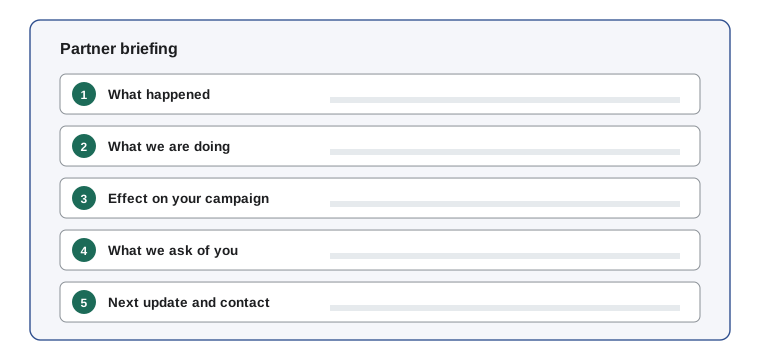
A partner briefing should be short and factual.
- What happened, in plain language, including what you know and do not yet know.
- What you are doing about it, including any public statement and its timing.
- How it might affect their campaign, such as content that should be paused.
- What you are asking of them, such as patience while you investigate.
- When they will hear from you next, and who to contact.
Brief partners before or at the same time as any public statement, and send them the statement text in advance if possible. Never ask a sponsor to keep information from their own legal or communications teams, and never mislead them about the facts: a partner who later discovers they were misled is far less forgiving.
What sponsors will consider
Brands make decisions based on their own risk. Common questions include whether the issue conflicts with the brand's values or customers, whether their logo appears in or near the controversial content, whether customers or employees are complaining, whether competitors or media are linking the brand to the issue, and what their contract allows. Many brands default to pausing campaigns while they assess, which is often a reasonable outcome to accept.
Contracts shape what happens next. Morals clauses, covered in lesson 3, may allow termination. Other terms decide whether already published content must be removed, whether fees are refunded, and whether kill fees apply. A kill fee is a payment owed when a project is canceled after work has started, often a percentage of the total fee.
The economics of sponsor exits
Losing sponsors affects income over many months, not just the current campaign. Renewals, upcoming campaigns and introductions to other brands may all be lost. Estimating revenue at risk helps the team prioritize which relationships need the most attention and plan cash flow.
Worked problem
Estimating revenue at risk from sponsor exits
A creator has four sponsors for the next 12 months. Sponsor A: $60,000, likely to exit (estimated 80 % probability). Sponsor B: $40,000, may pause (40 % probability of exit). Sponsor C: $25,000, unlikely to exit (10 %). Sponsor D: $15,000, has already ended the deal but owes a 50 % kill fee on a canceled $10,000 campaign included in its total. What is the expected revenue loss?
Show solution
- Sponsor A expected loss: 0.80 × $60,000 = $48,000.
- Sponsor B: 0.40 × $40,000 = $16,000.
- Sponsor C: 0.10 × $25,000 = $2,500.
- Sponsor D: the full $15,000 is lost, but the kill fee returns 50 % × $10,000 = $5,000, so the net loss is $10,000.
- Total expected loss: $48,000 + $16,000 + $2,500 + $10,000 = $76,500.
Answer: The expected loss is about $76,500 out of $140,000 in planned sponsorship income. Sponsor A is the top priority for direct, honest communication, and the creator should plan cash flow assuming much of that income will not arrive.
Expected-value estimates are only as good as the probabilities behind them, which are judgment calls. Their value is in forcing the team to think about each relationship separately and to plan for a realistic range of outcomes rather than the best case.
Platforms during a crisis
Platforms usually become involved only when content or conduct may break their rules. They may remove content, add age restrictions, limit monetization or recommendations, issue strikes, or suspend accounts. Lesson 9 covers enforcement and appeals in detail. During a crisis, creators should avoid posting content that could itself break rules, such as revealing private information about critics, encouraging fans to harass people, or misleading claims. Some creators have partner managers at platforms who can explain policies or escalate errors, but these contacts cannot overturn enforcement just because a creator is under pressure.
Handling media inquiries
Journalists and commentary channels often contact creators before publishing a story to ask for comment. These requests usually come with a deadline. Responding thoughtfully gives you a chance to correct errors and present your perspective; ignoring them often leads to a line such as did not respond to a request for comment, which readers can interpret as evasion.
- Log every request: who, which outlet, what they asked and their deadline.
- Ask what the story is about and what claims they plan to include, if not already clear.
- Decide whether to respond, and who will respond.
- Prepare a written statement rather than an unplanned phone call if the issue is sensitive.
- Correct factual errors with evidence; avoid speculation and personal attacks.
- Keep a record of what you sent.
| Situation | Typical approach |
|---|---|
| Reputable outlet with a clear deadline | Provide a concise written statement and any factual corrections |
| Commentary channel known for fair coverage | Consider a short statement or correction of facts |
| Outlet or channel known for distortion | Consider a brief written statement only, or decline politely |
| Request for an on-camera interview during a crisis | Usually decline until facts are clear; offer a written statement |
| Story contains clear factual errors before publication | Send corrections with evidence, and get legal advice if they are seriously damaging |
Interviews
Interviews can help when a creator has a clear, honest account and the interviewer is fair, because they let audiences hear the creator's voice and see their sincerity. They can hurt when the creator is unprepared, emotional or tempted to say more than they know. If you do an interview, prepare three key messages, anticipate difficult questions, avoid speculating about other people, and do not say anything off the record that you would not want published. Remember that live interviews cannot be edited, while recorded ones can be edited in ways you do not control.
Collaborators and peers
Other creators connected to you, such as frequent collaborators, members of a creator group or friends who appear in your content, may be asked about the controversy by their own audiences. Give them a heads-up and the facts, and do not ask them to defend you publicly. Pressuring friends to take sides can damage relationships and spread the controversy to their audiences. Accept that some collaborators may choose to distance themselves, at least for a while.
Team members
Team members, including editors, moderators and assistants, may face questions, criticism or even harassment because of their association with you. Tell them what is happening, give them guidance on what to say and what not to say, and make clear that they should not engage with critics on your behalf. If team members were involved in the issue, handle that through your normal employment or contract processes, fairly and privately, rather than publicly blaming them.
Coordinating messages
All of these audiences talk to each other. A sponsor reads your public statement; a journalist sees what your collaborator posted; a platform reviewer reads the comments. Inconsistency between what you tell different groups is one of the fastest ways to lose credibility. Keep a single factual summary that every communication draws from, and have the coordinator check that partner briefings, public statements and media responses match.
Agencies, managers and networks
Many creators work through talent managers, agencies or multi-channel networks. These partners often have existing relationships with brands and journalists and can help with communications, but their interests are not identical to the creator's. An agency may want to protect its relationships with brands across many creators; a network may be concerned about its own reputation. Creators should stay closely involved in decisions, make sure statements reflect their own voice, and read any agreements that give partners authority to speak on their behalf.
Brand statements about you
Sometimes a brand issues its own public statement, such as announcing that it has paused or ended a partnership. Creators usually cannot control these statements, but they can ask to see them in advance and request factual corrections. Do not respond publicly with anger toward a brand that leaves; that is likely to deter other brands. A short, gracious acknowledgment, if any response is needed, is usually best.
Worked problem
Planning cash flow through a sponsor pause
A creator's monthly expenses are $9,000. Normally, monthly income is $14,000, including $7,000 from sponsors. Two sponsors worth $5,000 a month in total pause for three months. Other income dips by 10 %. The creator has $12,000 in savings. Can they cover expenses during the pause?
Show solution
- Non-sponsor income normally: $14,000 − $7,000 = $7,000; after a 10 % dip: $6,300.
- Remaining sponsor income: $7,000 − $5,000 = $2,000.
- Monthly income during the pause: $6,300 + $2,000 = $8,300.
- Monthly shortfall: $9,000 − $8,300 = $700; over three months: $2,100.
- Savings after three months: $12,000 − $2,100 = $9,900.
Answer: Yes. The creator can cover expenses with $9,900 of savings left, but should review costs and avoid new commitments until sponsors decide. Without savings, a pause of this size would force difficult choices quickly, which is why an emergency fund is part of crisis preparedness.
Media corrections after publication
If a published article or video contains factual errors, contact the outlet with specific corrections and evidence. Reputable outlets have corrections policies and press councils or ombudspersons in some places. Ask for a correction, clarification or update rather than removal, which outlets rarely grant. Keep the tone professional; public attacks on journalists can generate further coverage and look like an attempt to intimidate the press.
Briefing the team before the public
Team members should hear about a crisis from the creator or manager, not from social media. A short internal note before any public statement, covering what happened, what will be said publicly and what each person should do or avoid, keeps everyone consistent and reduces the chance of a well-meaning team member posting something that contradicts the official response.
Common mistakes
MistakeLetting sponsors learn about a crisis from the news.
InsteadBrief partners directly before or alongside public statements.
MistakeMisleading a partner to keep a deal alive.
InsteadShare accurate facts; partners who discover deception rarely forgive it.
MistakeIgnoring media requests for comment.
InsteadLog requests and send at least a concise written statement where appropriate.
MistakeDoing an unprepared interview at the height of a crisis.
InsteadWait until facts are clear, prepare key messages or offer a written statement.
MistakeAsking friends and collaborators to defend you publicly.
InsteadGive them facts and a heads-up, and respect their choices.
Summary and key terms
- Sponsors, agencies, platforms, media, collaborators and team members all react to a crisis alongside the audience.
- Brief partners early and directly with facts, actions, campaign effects, requests and next steps.
- Contracts, including morals clauses and kill fees, shape what happens when sponsors pause or exit.
- Expected-value estimates of sponsor exits help prioritize relationships and plan cash flow.
- Platforms act only on rule-breaking, so avoid posting content during a crisis that could itself violate policies.
- Respond to media requests thoughtfully, usually in writing, correcting errors with evidence.
- Keep every message consistent by drawing from a single factual summary.
- Partner briefing
- A direct, factual update to sponsors or agencies about a crisis.
- Kill fee
- A payment owed when a project is canceled after work has begun.
- Expected value
- The probability of an outcome multiplied by its value, summed across outcomes.
- Request for comment
- A journalist's invitation to respond before a story is published.
- On the record
- Statements that may be published and attributed to the speaker.
- Off the record
- Information shared on the understanding it will not be published, which is never guaranteed.
- Key messages
- The few points a spokesperson aims to communicate in every response.
- Partner manager
- A platform employee who supports a creator or group of creators.
- Campaign pause
- A temporary halt to sponsored content while a brand assesses a situation.
- Single source of truth
- One agreed factual summary used for all crisis communications.
Practice problems
Work each problem on paper first, then reveal the answer to check.
List the five parts of a partner briefing.
Show answer
What happened, what you are doing, effect on their campaign, what you ask and next update.
A $50,000 sponsor has a 60 % chance of exiting. Expected loss?
Show answer
$30,000.
What is a kill fee?
Show answer
A payment owed when a project is canceled after work has started.
A $8,000 campaign is canceled with a 25 % kill fee. How much is paid?
Show answer
$2,000.
Why respond to a reputable journalist's request?
Show answer
To correct errors and avoid appearing evasive.
What format is safest for sensitive media responses?
Show answer
A prepared written statement.
Give one rule for interviews.
Show answer
Prepare key messages and do not say anything off the record you would not want published.
How should collaborators be treated during a crisis?
Show answer
Give them facts and a heads-up without asking them to defend you.
Why keep a single factual summary?
Show answer
So all communications are consistent across audiences.
What should a creator avoid posting during a crisis?
Show answer
Private information about critics or calls for fans to harass people.
Lesson quiz · 5 questions
Score 60% or more to complete this lesson.
Create a free account to save your progress, take quizzes and earn a certificate.