
ECON-101 · Lesson 10 of 12 · 27 min
Monopoly and price discrimination
At the opposite end of the spectrum from perfect competition is monopoly: a market with a single seller of a product without close substitutes. A monopolist is not a price taker; it is a price maker. Because it faces the whole market demand curve, it can raise its price without losing all its customers. This lesson explains how a monopolist chooses price and output, why monopoly is inefficient, how monopolies arise, why some are tolerated or even encouraged, and how governments regulate them. It also examines price discrimination, the practice of charging different prices to different customers for the same product, which firms with market power use widely.
Why monopolies arise
The fundamental cause of monopoly is barriers to entry: something prevents other firms from entering the market and competing. There are four main sources. First, control of a key resource: historically, De Beers controlled most of the world's diamond supply. Second, government-created barriers: patents and copyrights give inventors and authors exclusive rights for a period (20 years from filing for a patent in both Canada and the United States), licenses restrict entry into some occupations and industries, and governments sometimes grant exclusive franchises. Third, natural monopoly: when economies of scale are so large that a single firm can supply the whole market at lower average cost than two or more firms could, as for water mains, electricity distribution or natural gas pipelines. Fourth, network effects and strategic behavior: a product becomes more valuable as more people use it, as with social media platforms, payment networks and operating systems, so a leading firm can become entrenched; firms may also deter entry by aggressive pricing or by controlling essential infrastructure.
In the United States, examples of legal monopolies include the US Postal Service's exclusive right to deliver letters to mailboxes and regulated electric, gas and water utilities that hold exclusive service territories. Patents create temporary monopolies on new drugs; the Inflation Reduction Act of 2022 allowed Medicare to negotiate the prices of some high-cost drugs, with the first negotiated prices taking effect in 2026.
Revenue for a monopolist
Because a monopolist faces a downward-sloping demand curve, it must lower its price to sell more, assuming it charges the same price to every customer. This means its marginal revenue is less than the price. When it lowers the price to sell one more unit, it gains the price of that unit but loses revenue on all the units it would have sold at the higher price. For a straight-line demand curve \( P = a - bQ \), total revenue is \( aQ - bQ^2 \), and marginal revenue is \( MR = a - 2bQ \): a line with the same price intercept and twice the slope.
| Quantity | Price | Total revenue | Marginal revenue |
|---|---|---|---|
| 0 | $100 | $0 | — |
| 1 | $90 | $90 | $90 |
| 2 | $80 | $160 | $70 |
| 3 | $70 | $210 | $50 |
| 4 | $60 | $240 | $30 |
| 5 | $50 | $250 | $10 |
| 6 | $40 | $240 | −$10 |
Note that marginal revenue becomes negative after five units: selling a sixth unit at $40 lowers total revenue. This is where demand becomes inelastic, as lesson 4 showed. A profit-maximizing monopolist never operates where marginal revenue is negative, so it always produces on the elastic part of its demand curve.
Profit maximization
Like any firm, the monopolist maximizes profit by producing where \( MR = MC \). It then charges the highest price buyers will pay for that quantity, read from the demand curve. Because marginal revenue is below price, the monopolist's price exceeds marginal cost. The gap between price and marginal cost, relative to price, is a measure of market power called the Lerner index.
Worked problem
A monopolist's price and output
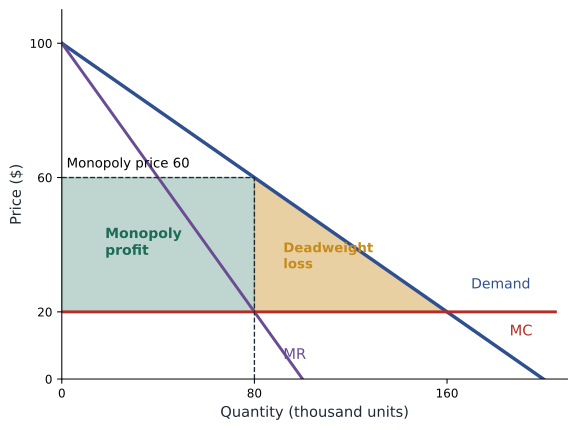
A firm holds a patent on a medical device. Demand is \( P = 100 - 0.5Q \) (thousand units, dollars), and marginal cost is constant at $20. Find the monopoly output and price, and compare them with the competitive outcome.
Show solution
- Marginal revenue: \( MR = 100 - Q \).
- Set MR = MC: \( 100 - Q = 20 \), so \( Q_m = 80 \) thousand units.
- Price: \( P_m = 100 - 0.5(80) = 60 \), or $60.
- Competitive outcome, where P = MC: \( 100 - 0.5Q = 20 \), so \( Q_c = 160 \) thousand units at $20.
Answer: The monopolist produces half the competitive quantity (80 thousand instead of 160 thousand) and charges three times marginal cost ($60 instead of $20).
# Monopoly vs competition with linear demand P = a - bQ and constant marginal cost
a, b, mc = 100, 0.5, 20       # demand intercept ($), slope ($ per thousand units), MC ($)
q_c = (a - mc) / b            # competitive: P = MC
q_m = (a - mc) / (2 * b)      # monopoly: MR = a - 2bQ = MC
p_m = a - b * q_m
cs_c = 0.5 * q_c * (a - mc)
cs_m = 0.5 * q_m * (a - p_m)
profit_m = (p_m - mc) * q_m
dwl = 0.5 * (q_c - q_m) * (p_m - mc)
print(f"competition: Q = {q_c:.0f}k, P = ${mc:.0f}, consumer surplus = ${cs_c:,.0f}k")
print(f"monopoly:    Q = {q_m:.0f}k, P = ${p_m:.0f}, consumer surplus = ${cs_m:,.0f}k, profit = ${profit_m:,.0f}k")
print(f"deadweight loss of monopoly = ${dwl:,.0f}k  ({dwl / cs_c:.0%} of competitive surplus)")
print(f"Lerner index = {(p_m - mc) / p_m:.2f}")competition: Q = 160k, P = $20, consumer surplus = $6,400k monopoly: Q = 80k, P = $60, consumer surplus = $1,600k, profit = $3,200k deadweight loss of monopoly = $1,600k (25% of competitive surplus) Lerner index = 0.67
The welfare cost of monopoly
The example shows why economists regard monopoly as inefficient. Compared with competition, the monopolist produces less and charges more. Part of the consumer surplus that would exist under competition is transferred to the monopolist as profit; this transfer is a distributional issue, not an efficiency loss. But another part disappears entirely: the deadweight loss on units that buyers value above marginal cost but that the monopolist chooses not to produce. In the example, the deadweight loss is $1.6 million, a quarter of the total surplus available under competition. The source of the loss is that the monopolist restricts output to keep the price high.
Monopoly can impose other costs. A monopolist protected from competition may have weak incentives to control costs or innovate, sometimes called X-inefficiency. Firms may spend resources on rent seeking, lobbying for or defending their monopoly position, which wastes resources without producing anything. On the other hand, the prospect of monopoly profits is what motivates much innovation. The patent system deliberately trades a temporary monopoly, with its deadweight loss, for the incentive to invest in research. Drug development is the clearest case: discovering and testing a new drug can cost more than a billion dollars, and without patent protection competitors could copy it at little cost once it is approved. Economist Joseph Schumpeter argued that the competition that matters most is not price competition among identical firms but the 'creative destruction' by which new products and technologies displace old monopolies.
Regulating natural monopolies
Natural monopolies pose a dilemma. Breaking them up would raise costs, because a single firm can serve the market most cheaply. But left alone, a natural monopolist would restrict output and charge high prices. Governments respond in three ways. Public ownership, common in Canada for electricity and transit, puts the firm under government control. Price regulation, the standard approach for privately owned utilities in the United States and for gas pipelines in both countries, has a regulator set prices. And in some cases governments do nothing, accepting the monopoly because regulation itself is costly.
Regulation is harder than it sounds. Setting the price equal to marginal cost would be efficient, but for a natural monopoly with large fixed costs, marginal cost is below average cost, so the firm would make losses and need a subsidy. Regulators therefore usually set prices close to average cost, allowing a fair return on investment (rate-of-return regulation). This approach weakens incentives to cut costs, because lower costs lead to lower allowed prices. Price-cap regulation, which limits price increases to inflation minus an efficiency factor, is designed to preserve incentives. Provincial energy boards in Canada, such as the Ontario Energy Board, and state public utility commissions in the United States carry out this work.
Price discrimination
So far we have assumed the monopolist charges everyone the same price. Many firms with market power instead practice price discrimination: charging different customers different prices for the same good when the price differences are not due to cost differences. Three conditions are needed. The firm must have some market power. It must be able to identify or sort customers with different willingness to pay. And it must prevent resale, otherwise customers who buy cheaply could resell to those charged more.
Economists distinguish three types. Perfect (first-degree) price discrimination charges each customer exactly her willingness to pay; it captures all consumer surplus as profit but, interestingly, produces the efficient quantity, because every unit worth more than its cost is sold. It is rare in pure form, though personalized online pricing based on data moves in that direction. Second-degree price discrimination charges different prices for different quantities or versions, letting customers sort themselves: bulk discounts, loyalty programs, basic and premium software versions, or economy and business class seats. Third-degree price discrimination charges different prices to identifiable groups: student and senior discounts, cheaper matinee tickets, lower drug prices in poorer countries. A firm practicing third-degree discrimination sets a higher price in the market where demand is less elastic.
Worked problem
Third-degree price discrimination
A theater company has a marginal cost of $10 per seat (programs, cleaning, ticketing). For adults, the price elasticity of demand at current prices is 1.5; for students, 3.0. Using the rule that the profit-maximizing price satisfies \( (P - MC)/P = 1/E_d \), what prices should it charge each group?
Show solution
- Adults: \( (P - 10)/P = 1/1.5 = 0.667 \), so \( P = 10/(1 - 0.667) = 30 \), or $30.
- Students: \( (P - 10)/P = 1/3 \), so \( P = 10/(1 - 0.333) = 15 \), or $15.
- Check: the less elastic adult market pays the higher price.
Answer: The theater should charge about $30 for adults and $15 for students. Student discounts are not merely generosity; they reflect students' more elastic demand.
Is price discrimination good or bad? It transfers surplus from consumers to the firm, which many people find unfair. But it can also raise output and efficiency compared with a single monopoly price, because it lets the firm serve low-value customers it would otherwise price out. Lower drug prices in developing countries and discounted fares on off-peak flights are examples where price discrimination expands access. Competition law generally permits price discrimination unless it is used to harm competition, though consumer protection rules may restrict practices that are deceptive.
Common mistakes
MistakeA monopolist can charge any price it wants.
InsteadIt is constrained by demand: a higher price means fewer sales, so it picks the profit-maximizing point on the demand curve.
MistakeA monopolist produces where demand is inelastic.
InsteadIt always produces on the elastic part of demand, because marginal revenue is negative where demand is inelastic.
MistakeAll monopoly profit is a deadweight loss.
InsteadProfit is largely a transfer from consumers; the deadweight loss is the surplus on units not produced.
MistakeNatural monopolies should be broken up into many firms.
InsteadSplitting them raises average costs; regulation or public ownership is the usual response.
MistakePrice discrimination always reduces efficiency.
InsteadIt can increase output and access; perfect price discrimination produces the efficient quantity.
Summary and key terms
- A monopoly is a single seller of a product without close substitutes, protected by barriers to entry.
- Barriers include key resources, government protections such as patents, natural monopoly and network effects.
- A single-price monopolist's marginal revenue is below price; for linear demand, MR has twice the slope.
- The monopolist produces where MR = MC and charges the demand price, so P > MC.
- Monopoly reduces output, raises price and creates a deadweight loss; profit is a transfer from consumers.
- Patents trade temporary monopoly for incentives to innovate.
- Natural monopolies are publicly owned or regulated through rate-of-return or price-cap rules.
- Price discrimination requires market power, sorting and no resale; higher prices go to less elastic groups.
- Monopoly
- A market with a single seller of a product without close substitutes.
- Barrier to entry
- Anything that prevents new firms from entering a market.
- Natural monopoly
- A market in which one firm can supply total demand at lower cost than several firms.
- Network effect
- An increase in a product's value as more people use it.
- Price maker
- A firm that can influence the price of its product.
- Lerner index
- The markup of price over marginal cost as a share of price, a measure of market power.
- Rent seeking
- Spending resources to obtain or protect economic profits without creating value.
- Rate-of-return regulation
- Setting prices so that a regulated firm earns a fair return on its investment.
- Price-cap regulation
- Limiting price increases to inflation minus an efficiency factor.
- Price discrimination
- Charging different prices to different customers for the same product, not because of cost differences.
Practice problems
Work each problem on paper first, then reveal the answer to check.
Name four sources of barriers to entry.
Show answer
Key resources, government protections, natural monopoly and network effects or strategic behavior.
Demand is \( P = 60 - 2Q \). Write marginal revenue.
Show answer
MR = 60 − 4Q.
With MC = $12 in the previous question, find monopoly output and price.
Show answer
60 − 4Q = 12 gives Q = 12; P = 60 − 24 = $36.
Find the competitive output and the deadweight loss in that market.
Show answer
P = MC gives Q = 24; DWL = ½ × 12 × $24 = $144.
Why does a monopolist never produce where demand is inelastic?
Show answer
Marginal revenue is negative there, so cutting output raises revenue and lowers cost.
What is the Lerner index if P = $50 and MC = $30?
Show answer
0.4.
Why might a regulator not set price equal to marginal cost for a natural monopoly?
Show answer
MC is below ATC, so the firm would lose money without a subsidy.
List the three conditions for price discrimination.
Show answer
Market power, ability to sort customers, and no resale.
Give one example each of second- and third-degree price discrimination.
Show answer
Second: bulk discounts or software versions. Third: student discounts or matinee prices.
Portfolio task: identify a product you buy whose seller practices price discrimination and explain how it sorts customers and prevents resale.
Show answer
Answers vary.
Lesson quiz · 5 questions
Score 60% or more to complete this lesson.
Create a free account to save your progress, take quizzes and earn a certificate.