
FILM-210 · Lesson 1 of 12 · 28 min
What screenwriting is and how scripts become films
A screenplay is one of the strangest documents in the arts. It is written to be read by perhaps a few dozen people, and then it disappears into something else: a film. Nobody frames a shooting script on the wall the way a novelist frames a first edition. Yet almost every narrative film and television series begins as words on a page, and the quality of those words sets a ceiling on everything that follows. Directors, actors, cinematographers and editors can lift a good script and rescue a weak one, but they rarely turn an empty one into a masterpiece. This course teaches you to write those pages and to think about how they become images. This first lesson looks at what a screenplay is, who reads it, how it travels through development and production, and why screenwriting is best understood as visual storytelling rather than literature.
The screenplay as a blueprint
People often call a screenplay a blueprint, and the comparison is useful. An architect's drawing is not a building, but it decides what the building will be: how many rooms, where the light comes in, how people move through the space. A screenplay decides what happens, to whom, in what order and in which places. It also suggests rhythm, tone and point of view. Like a blueprint, it is a working document written for professionals who will use it to make decisions. The producer budgets from it, the first assistant director schedules from it, the production designer builds from it, the actors find their characters in it and the director turns it into a plan of shots.
The comparison has limits. A blueprint gives precise measurements; a screenplay leaves room for interpretation. Good screenwriters write what the audience will see and hear, and they leave camera angles, line readings and edits to the people whose job those are. A script that tries to direct every shot usually reads badly and annoys collaborators. A script that leaves too much vague gives them nothing to work with. Learning where that balance sits is one of the main skills of this course.
Who reads a script, and why it matters
A script has many readers, and each reads it differently. Understanding them explains many of the conventions you will learn.
- Story editors and readers: at studios, broadcasters, agencies and funding bodies, readers write coverage, a short report summarizing the story and recommending pass, consider or recommend. Many scripts are judged on the first ten pages.
- Producers: they read for story, audience and cost. Every night exterior, crowd scene, stunt or new location costs money, and producers notice.
- Directors: they read for the visual and emotional journey and begin imagining how scenes will play.
- Actors: they read for character, look for a clear want and a strong arc, and notice whether dialogue sounds speakable.
- Department heads: designers, the cinematographer, costume, makeup and sound read for what they must create.
- Financiers and funders: they read for viability, track record and, for public funds, eligibility such as national content rules.
Because a script must work for all these readers, clarity matters more than literary flourish. A reader must be able to picture the film quickly and accurately. Standard format, which you will study in lesson 8, exists so that every professional can find what they need and estimate screen time from page count.
From idea to screen: the development pipeline
Most screenplays go through a long and often messy development process before anyone shoots them. The stages vary by country, company and medium, but a typical path looks like this.
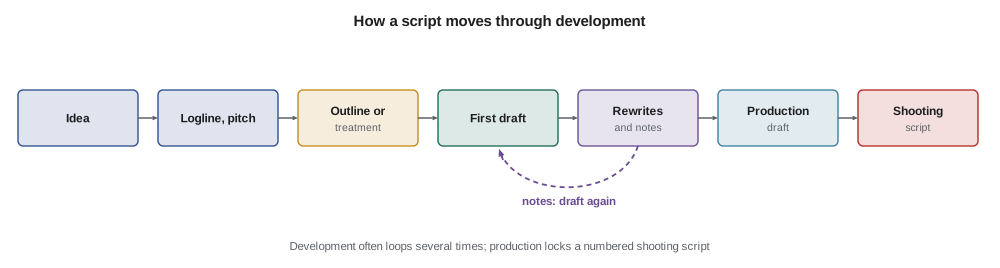
- Idea and logline: the concept is reduced to one or two sentences that capture the protagonist, the goal and the conflict.
- Pitch, outline or treatment: a spoken pitch or a written document of a few pages describes the story from beginning to end in present-tense prose.
- First draft: the writer produces the full screenplay. Professional writers often call this a vomit draft because its job is to exist, not to be perfect.
- Notes and rewrites: producers, story editors, directors and sometimes funders give notes. The writer revises, sometimes many times.
- Production draft and shooting script: once financed and scheduled, the script is locked, scenes are numbered and later changes are issued on colored revision pages with the changes marked.
In television the process differs. A creator writes a pilot and a series bible describing characters, world and future seasons. Once a series is ordered, a writers' room breaks stories together and individual writers draft episodes, which a showrunner then rewrites. You will study series writing in lesson 5.
Worked problem
How long will this script run?
A short film script is 14 pages long. A feature script is 104 pages. Using the industry rule of thumb that one formatted page equals about one minute of screen time, estimate both running times and say why the rule is only approximate.
Show solution
- Short: \( 14 \times 1 = 14 \) minutes.
- Feature: \( 104 \times 1 = 104 \) minutes, about 1 hour 44 minutes.
- The rule assumes standard format: 12-point Courier, set margins and a typical mix of action and dialogue.
- Pages of fast dialogue often play quicker than a minute; pages describing a long, wordless sequence such as a chase or a montage often play slower.
Answer: About 14 minutes and about 104 minutes. The rule works on average across a whole script, which is why producers and schedulers use it, but individual pages vary widely, so real timings come from a table read or a timing pass by the script supervisor.
Screenwriting is visual storytelling
A novelist can tell us what a character is thinking. A screenwriter usually cannot, unless they use voice-over, which most writers use sparingly. Film shows behavior, and audiences infer thoughts and feelings from what characters do, say and avoid saying. This is why screenwriting teachers repeat the advice to show, not tell. If a character is lonely, we might see her set two places at the dinner table out of habit, then slowly put one plate back. That image does the work of a paragraph of description and gives the actor something to play.
Screenwriting also works with time differently from prose. A novel can linger for pages on a single moment. A film moves forward at 24 frames per second, and every scene costs screen time. The screenwriter must constantly choose what to show, what to skip and what to imply between scenes. A cut can jump ten years or ten seconds. Much of the art lies in those choices.
Finally, screenplays are collaborative. A novel is finished when the writer finishes it. A screenplay is finished when the film is finished, and by then many people have shaped it. Writers who succeed tend to be those who can hold on to the heart of their story while staying open to good ideas from others.
Kinds of screenwriting work
Screenwriting is not one job. Writers work in several forms, each with its own conventions.
| Form | Typical length | Notes |
|---|---|---|
| Short film | 1 to 30 pages | Often a calling card or festival film; one strong idea |
| Feature film | about 90 to 120 pages | Usually one writer or a small team; long development |
| Half-hour series episode | about 25 to 35 pages | Comedy or drama; often written in a room |
| One-hour series episode | about 50 to 65 pages | Act breaks for advertising or streaming chapters |
| Animation | varies | May start from outlines and storyboards rather than full scripts |
| Documentary | varies | Treatments, interview plans and paper edits rather than dialogue scripts |
| Interactive and games | varies | Branching scripts, barks and cinematics |
Many writers move between forms. Shorts teach economy, features teach structure over length, and series writing teaches collaboration and speed. In this course you will work mostly with shorts, which you can actually write, board and shoot as a student, while learning the feature and series conventions you will need professionally.
Writers, directors and authorship
Who is the author of a film? Critics of the 1950s and 1960s popularized the idea of the director as author, the auteur, and you met that idea in FILM-101. Screenwriters have long pushed back, pointing out that story, structure, character and dialogue usually come from the script. In practice authorship is shared. Some directors write their own scripts; others work closely with a writer; still others are hired to direct a script developed by a producer. In television, the showrunner, usually a writer, is the main creative authority.
Credit rules reflect this. Writing credits on guild productions are decided by the writers' guilds according to detailed rules, not by the producer's preference. You will meet those rules in lesson 12, together with copyright, contracts and funding.
In the United States, the studio and streaming system relies heavily on specialist screenwriters working under the Writers Guild of America's Minimum Basic Agreement, alongside writer-directors in independent film and showrunners in television.
Reading scripts as training
The best way to learn screenwriting, after writing, is reading screenplays. Many produced scripts are published, posted by studios during awards season or held in libraries and archives. When you read, compare the script with the finished film. Look at what changed, what was cut, what an actor or director added, and how the writer described images without directing the camera. Keep a reading log with page counts, the page where the main conflict begins, and lines of description you admire.
- Read at least one feature script and one short script a week during this course.
- Time yourself; professional readers often read a feature script in about an hour.
- Write a one-paragraph coverage note for each: logline, strengths, weaknesses and a recommendation.
- Watch the film afterward and list three changes between page and screen.
Worked problem
Planning a reading schedule
You plan to read one feature script of about 110 pages and one short of about 12 pages each week for 12 weeks. At a reading speed of about 2 pages per minute, how many hours will this take in total?
Show solution
- Pages per week: \( 110 + 12 = 122 \).
- Minutes per week: \( 122 \div 2 = 61 \) minutes.
- Total minutes: \( 61 \times 12 = 732 \) minutes.
- Hours: \( 732 \div 60 \approx 12.2 \) hours.
Answer: About 12 hours across the course, roughly one hour a week. That is a small investment for the vocabulary and instinct it builds, and it mirrors how professional readers work.
How this course works
Each lesson combines ideas, examples and short exercises. You will develop one short film project across the course: a logline in lesson 2, characters in lesson 3, an outline in lesson 4, scenes and dialogue in lessons 6 and 7, a formatted draft in lesson 8, and a breakdown, shot list and storyboard in lessons 10 and 11. Lesson 12 brings everything together in a capstone: a polished short script of 8 to 12 pages with a storyboard of its key scene and a short note on rights.
Throughout, all sample scenes are original to this course. When we discuss produced films, we describe them in our own words rather than quoting them. You should do the same in your own work: learn from films, but write your own.
Common mistakes
MistakeTreating the script as a novel with dialogue
InsteadWrite only what can be seen and heard, and leave thoughts to behavior and subtext
MistakeDirecting every shot on the page
InsteadDescribe the action clearly and leave camera choices to the director unless an image is essential to the story
MistakeBelieving the first draft is the script
InsteadExpect several rounds of notes and rewrites before a production draft
MistakeIgnoring who will read the script
InsteadWrite clearly for readers, producers, actors and crew who must picture and budget the film
MistakeAssuming the page-a-minute rule is exact
InsteadUse it as an average and confirm timing with a table read
Summary and key terms
- A screenplay is a working blueprint that decides what happens, to whom, where and in what order.
- Scripts are read by story readers, producers, directors, actors, department heads and funders, so clarity matters more than literary style.
- Development usually runs from idea and logline to treatment, drafts, notes, rewrites and a locked shooting script.
- One formatted page is about one minute of screen time on average, but individual pages vary.
- Screenwriting is visual storytelling: thoughts and feelings are shown through behavior, images and sound.
- Writers work in shorts, features, series, animation, documentary and interactive forms, each with its own conventions.
- Authorship is shared among writers, directors and showrunners, and guilds determine writing credits on covered productions.
- Screenplay
- The written script of a film, setting out scenes, action and dialogue in standard format
- Coverage
- A reader's report summarizing a script and recommending pass, consider or recommend
- Logline
- A one- or two-sentence summary of a story's protagonist, goal and conflict
- Treatment
- A prose description of a story from beginning to end, written in the present tense
- Development
- The process of turning an idea into a script ready to be financed and produced
- Shooting script
- The locked production version of a script with numbered scenes
- Revision pages
- Changed pages issued after a script is locked, printed on colored paper with changes marked
- Series bible
- A document describing a series' characters, world, tone and future story lines
- Showrunner
- The writer-producer with overall creative control of a television series
- Show, don't tell
- The principle of revealing character and feeling through action and image rather than explanation
Practice problems
Work each problem on paper first, then reveal the answer to check.
Why is a screenplay compared to a blueprint?
Show answer
Because it is a working document professionals use to plan and build the film, deciding what happens without being the finished work.
Estimate the running time of a 96-page feature script.
Show answer
About 96 minutes, using one page per minute.
Name three readers of a script other than the director.
Show answer
For example, a story reader, a producer and an actor.
What is coverage?
Show answer
A reader's summary and recommendation on a script.
Why does a script avoid describing a character's thoughts directly?
Show answer
Because film shows behavior; thoughts must be revealed through action, image, sound or subtext.
What document accompanies a television pilot?
Show answer
A series bible.
Who usually has creative control of a television series?
Show answer
The showrunner.
Why are locked script changes printed on colored pages?
Show answer
So everyone can see which pages changed and work from the current version.
How many minutes would 12 hours of script reading give you at 2 pages per minute?
Show answer
720 minutes, or about 1,440 pages.
Why might a page of dialogue play faster than a minute?
Show answer
Quick exchanges take less screen time than the space they use on the page.
Lesson quiz · 5 questions
Score 60% or more to complete this lesson.
Create a free account to save your progress, take quizzes and earn a certificate.