
FILM-210 · Lesson 10 of 12 · 30 min
From page to screen: breakdowns, shot lists and coverage
Once a script is finished, it becomes a production document. Departments read it for different purposes, and the director turns it into a plan of shots. Screenwriters who understand this process write scripts that are easier to produce, and writer-directors need these skills to make their own films. This lesson follows a script into preproduction: the script breakdown, scheduling by pages and locations, how script choices affect cost, the director's shot list and coverage plan, and how floor plans show camera positions. It prepares you to break down and shot-list your own short.
The script breakdown
A script breakdown lists everything each scene requires so that departments can budget and schedule. The first assistant director or a line producer usually leads it, marking up the script by category: cast, extras, props, wardrobe, makeup, vehicles, animals, special effects, stunts, locations and special equipment. Traditionally each category had its own color of highlighter; today, scheduling software uses tags. Each scene gets a breakdown sheet summarizing its needs, length in eighths, location and time of day.
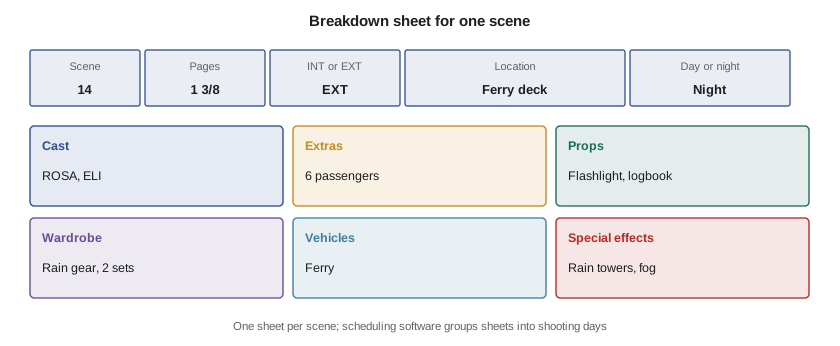
| Category | What it includes | Example from an original short |
|---|---|---|
| Cast | Speaking roles | ROSA, ELI |
| Extras | Non-speaking background people | 6 ferry passengers |
| Props | Objects characters handle | Flashlight, logbook, radio handset |
| Wardrobe | Costumes, including duplicates | Rosa's wet-weather gear (2 sets for rain) |
| Vehicles | Cars, boats and other vehicles | Ferry, pickup truck |
| Special effects | Practical effects on set | Rain towers, fog |
| Stunts | Physical action needing a coordinator | Slip on wet deck |
| Locations | Where it will be shot | Ferry deck, terminal office |
Scheduling: pages, locations and days
Productions schedule by grouping scenes that share locations, cast and time of day, not by shooting in story order. All scenes in the terminal office might be shot on one day, even if they fall at the beginning, middle and end of the story. Night scenes are often grouped because they require night shoots with different crew hours. Child actors, animals and special effects all add scheduling constraints.
Worked problem
Estimating shooting days for a short
A 12-page short has 9 scenes in 3 locations: 6 pages in a kitchen, 4 pages on a beach at dusk and 2 pages in a car at night. The crew can shoot about 4 pages a day in a simple interior, but only about 2 pages a day at a dusk or night exterior because of limited light windows. How many days are needed?
Show solution
- Kitchen: \( 6 \div 4 = 1.5 \) days.
- Beach at dusk: \( 4 \div 2 = 2 \) days, since only a short window of usable light each day.
- Car at night: \( 2 \div 2 = 1 \) day.
- Total: \( 1.5 + 2 + 1 = 4.5 \) days, rounded up to 5.
Answer: About five days. The dusk and night scenes, only half the pages, take more than half the schedule. Writers who know this can make informed choices about how much of a short happens at magic hour or at night.
How script choices affect cost
Screenwriters do not need to write cheaply, but they should know what costs money. Producers often ask writers to adjust scripts to fit a budget, and a writer who understands production can make cuts that protect the story.
- Locations: every new location means a company move, permits, set dressing and lost shooting time.
- Night and exterior scenes: night shoots cost more in lighting and crew time; exteriors depend on weather.
- Cast and extras: more speaking roles and crowds mean more fees, wardrobe and coordination.
- Children and animals: limited working hours and supervision requirements.
- Stunts, effects, vehicles and water: specialists, safety planning and insurance, which CINE-340 covers.
- Period settings: costumes, vehicles and locations from another era.
Worked problem
Illustrative cost of a script choice
In an illustrative low-budget plan, each extra costs about 150 dollars a day including wardrobe and meals. A scene set in a busy restaurant needs 25 extras for one day. The writer considers moving the scene to a quiet diner with 5 extras. What is the saving on extras alone?
Show solution
- Busy restaurant: \( 25 \times 150 = 3750 \) dollars.
- Quiet diner: \( 5 \times 150 = 750 \) dollars.
- Saving: \( 3750 - 750 = 3000 \) dollars.
- Story check: if the scene is a private confession, an almost empty diner may even improve it.
Answer: About 3,000 dollars in this illustrative example, before savings on location fees, sound and crowd management. Good rewrites find versions that cost less and play better.
The shot list
A shot list is the director's plan of every shot needed for each scene, usually prepared with the cinematographer. Each entry gives a shot number, the shot size (such as wide, medium or close-up), the angle, any camera movement, the lens if known, a brief description and sometimes notes on sound or effects. Shots are usually grouped by set-up: each time the camera and lights move to a new position, the crew must re-light and re-rehearse, so set-ups, not shots, drive the schedule.
| Shot | Size and angle | Movement | Description |
|---|---|---|---|
| 1A | Wide, high angle | Static | Rain on the deck; Rosa enters frame left and crosses |
| 1B | Medium, eye level | Slow push in | Rosa reaches the sign and stops |
| 1C | Insert | Static | The sign: AUTOMATED DOCKING - COMING SOON |
| 1D | Close-up | Static | Rosa's face, rain running down; she does not move |
| 1E | Close-up | Static | Her hand tightens on the rail |
Worked problem
Shooting time from set-ups
A scene needs 11 shots that can be grouped into 5 set-ups. The crew estimates 45 minutes to light and rehearse each set-up and 20 minutes to shoot each shot. How long will the scene take?
Show solution
- Set-up time: \( 5 \times 45 = 225 \) minutes.
- Shooting time: \( 11 \times 20 = 220 \) minutes.
- Total: \( 225 + 220 = 445 \) minutes, about 7.4 hours.
Answer: About 7.4 hours, almost a full shooting day for one scene. Reducing set-ups, for example by covering two shots from one camera position, is often the fastest way to save time.
Coverage strategies
Coverage is the set of shots that gives the editor enough material to assemble a scene. A common approach for dialogue scenes starts with a master shot covering the whole action, then moves in for medium shots and close-ups of each character, plus inserts of important details. Other approaches include shooting a scene in a single take (a oner), using two cameras at once, or planning a minimal, precise set of shots. More coverage gives the editor flexibility but costs time.
- Master shot: a wide shot of the whole scene, establishing geography.
- Singles and over-the-shoulder shots: each character's lines from their side of the line of action.
- Inserts: close shots of objects and details.
- Cutaways: shots of something outside the main action, useful for editing.
- Oner: a scene played in one continuous shot, which demands rehearsal and saves editing time.
Floor plans and camera positions
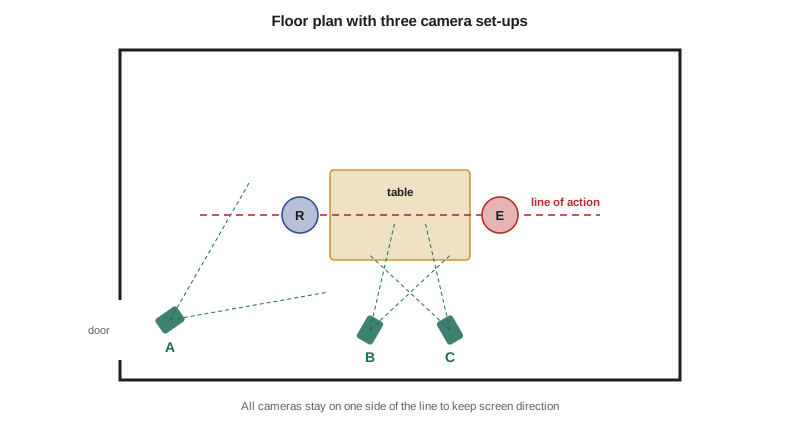
A floor plan, also called an overhead, shows the set from above, with the positions of actors, furniture, the camera and its direction for each set-up. It helps the director, cinematographer and gaffer plan lighting and avoid crossing the 180-degree line, which you studied in FILM-101. Overheads mark camera positions as A, B, C and so on, with lines showing the field of view and arrows for movement.
The writer's role in production
On many productions, especially features, writers are not on set. On television, writers often are, because showrunners and episode writers supervise production. Writer-directors carry the script through every stage. In all cases, scripts keep changing: locations fall through, actors improvise, scenes are cut for time. Script supervisors track what is shot against the script, noting changes and continuity, and their notes go to the editor.
In the United States, many series writers are expected to produce their episodes on set, and guild rules and showrunner practice determine how involved writers are during shooting and post-production.
Location scouting and the writer
Locations are often found after a script is written, and the real places available may change the script. A scene written in a lighthouse might move to a harbor office if no lighthouse is available; a city street might become a laneway because permits are cheaper. Writers who stay involved can adapt scenes to locations while protecting their purpose. Writer-directors often visit locations before final drafts and rewrite scenes to use what a place offers, such as a window with a striking view or a corridor perfect for a long walk-and-talk.
Continuity and the script supervisor
The script supervisor tracks continuity and changes during shooting. They note which shots were taken, how long each take ran, which takes the director preferred, dialogue changes, and details such as which hand held a cup. Their notes, called the lined script and daily reports, guide the editor and protect the production from continuity errors.
| Item | Why it matters |
|---|---|
| Lined script | Shows which shots cover which lines of the script |
| Take notes | Records duration, quality and director's preferences |
| Dialogue changes | Tells the editor what was actually said |
| Continuity details | Props, costume, hair and actions matched across shots |
| Timing | Estimates whether the film is running long or short |
Worked problem
Tracking running time during a shoot
After 6 shooting days, the script supervisor's timings show that scenes covering 48 script pages have been shot, and their timed length totals 54 minutes. If the remaining 52 pages run at the same rate, how long will the finished film run?
Show solution
- Rate: \( 54 \div 48 = 1.125 \) minutes per page.
- Remaining pages: \( 52 \times 1.125 = 58.5 \) minutes.
- Total: \( 54 + 58.5 = 112.5 \) minutes.
Answer: About 112 minutes, longer than the 100 pages suggest. A film running long at this stage often means scenes will be trimmed or cut in the edit, which is why tight writing saves money and heartache.
Preparing your own production documents
For your capstone short, you will prepare a simple breakdown, a shot list and a floor plan for the key scene. Start by marking each scene's needs in the script, then build the shot list with your cinematographer, grouping shots by set-up. Draw the floor plan last and check every camera position against the line of action. Keep the documents short and clear; on a small crew, everyone will use them.
Common mistakes
MistakeShooting in story order
InsteadGroup scenes by location, cast and time of day to schedule efficiently
MistakeUnderestimating night and dusk scenes
InsteadAllow more time per page for limited light windows and night work
MistakeCounting shots instead of set-ups
InsteadPlan time around set-ups, since each new camera position requires re-lighting
MistakeWriting locations and crowds without thinking about cost
InsteadKnow what costs money and find rewrites that protect the story
MistakeCrossing the line of action in a floor plan
InsteadKeep cameras on one side of the line unless a deliberate cross is planned
Summary and key terms
- A script breakdown lists each scene's needs by category so departments can budget and schedule.
- Productions schedule by location, cast and time of day, not by story order.
- Locations, night exteriors, crowds, children, animals, stunts and period settings drive costs.
- A shot list plans every shot; set-ups, not shots, mostly determine shooting time.
- Coverage strategies range from master-and-close-ups to single-take oners.
- Floor plans show actors and camera set-ups from above and help maintain the line of action.
- Scripts keep changing in production, tracked by script supervisors and sometimes guided by writers on set.
- Script breakdown
- A list of each scene's production needs by category
- Breakdown sheet
- A summary of one scene's requirements, length, location and time of day
- Shot list
- A plan of every shot needed for a scene or film
- Set-up
- A camera and lighting position from which one or more shots are taken
- Coverage
- The shots filmed to give the editor options for a scene
- Master shot
- A wide shot covering a whole scene's action
- Insert
- A close shot of an object or detail
- Oner
- A scene played in one continuous shot
- Floor plan
- An overhead diagram of a set showing actors and camera positions
- Company move
- Moving cast, crew and equipment to a new location
Practice problems
Work each problem on paper first, then reveal the answer to check.
What is a script breakdown?
Show answer
A list of each scene's needs by category for budgeting and scheduling.
Why are scenes shot out of story order?
Show answer
To group locations, cast and times of day efficiently.
How long do 4 pages take at 2 pages a day?
Show answer
Two days.
What drives shooting time more, shots or set-ups?
Show answer
Set-ups, because each requires moving and re-lighting.
How long do 4 set-ups at 40 minutes and 9 shots at 20 minutes take?
Show answer
\( 160 + 180 = 340 \) minutes, about 5.7 hours.
Name three things in a script that raise costs.
Show answer
For example, night exteriors, crowds and new locations.
What is a master shot?
Show answer
A wide shot covering the whole scene.
What does a floor plan show?
Show answer
Actors, set and camera positions from above.
What is a oner?
Show answer
A scene filmed in one continuous shot.
How much do 20 extras cost at 150 dollars a day?
Show answer
3,000 dollars.
Lesson quiz · 5 questions
Score 60% or more to complete this lesson.
Create a free account to save your progress, take quizzes and earn a certificate.