
FILM-210 · Lesson 7 of 12 · 29 min
Dialogue
Dialogue is the part of a screenplay most people notice first, and the part beginners most often overwrite. Good screen dialogue sounds natural but is not natural: it is compressed, shaped and full of intention. Real speech is full of hesitation, repetition and small talk; screen dialogue keeps the flavor of real speech while cutting almost everything that does not move the scene. This lesson covers the jobs dialogue does, how to give each character a distinct voice, how to handle exposition, and practical techniques for revising dialogue until it sounds speakable.
What dialogue is for
Dialogue is action. Characters speak to get something: to persuade, threaten, seduce, deflect, apologize or hide. When dialogue is treated as action, it gains energy and conflict. When it is treated as a way to deliver information to the audience, it goes flat.
- Advance the scene: each line should push toward or away from the scene goal.
- Reveal character: word choice, rhythm and what a person avoids saying show who they are.
- Create conflict: characters with opposing goals collide through what they say.
- Convey information, sparingly: facts the audience needs, ideally slipped in while something else is happening.
- Set tone and genre: rapid banter signals comedy; clipped lines might signal a thriller.
A useful exercise is to label every line in a scene with a verb describing what the speaker is doing: pleading, accusing, testing, dodging. If you cannot find a verb, the line may be filler.
Voice
Each character should sound like themselves. A reader should be able to cover the character names and still guess who is speaking. Voice comes from background, education, age, region, profession, personality and the situation.
| Element | Questions to ask | Example contrast |
|---|---|---|
| Vocabulary | Formal or casual, technical or plain? | A surgeon says "fractured tibia"; a child says "broke my leg" |
| Rhythm | Long sentences or short bursts? | A nervous character rambles; a confident one is brief |
| Directness | Says what they mean or circles it? | A blunt farmer versus a diplomatic politician |
| Verbal habits | Favorite phrases, swearing, humor? | One character ends sentences with questions |
| Silence | When do they stop talking? | A grieving character who answers with a nod |
Be careful with accent and dialect. Spelling out an accent phonetically on the page is hard to read and can slip into caricature. A light touch, such as a few word choices, rhythm and a note in the character introduction, usually works better and leaves the performance to the actor.
Exposition
Exposition is information the audience needs to understand the story: who people are, what happened before, how the world works. Poorly handled exposition is one of the most common problems in early drafts. The classic error is "as you know" dialogue, in which characters tell each other things they both already know so the audience can hear it.
- Dramatize it: make the information emerge from conflict, such as an argument in which one character throws a past mistake at another.
- Delay it: give information only when the audience needs it, and let curiosity build until then.
- Show it: a newspaper clipping, a scar, a photograph or an empty chair can carry backstory without words.
- Use a newcomer: a character new to the world can ask natural questions, though this device is easy to overuse.
- Hide it in action: deliver information while characters are doing something interesting, so the audience absorbs it without noticing.
Worked problem
Fixing "as you know" dialogue
Rewrite this exchange so the information emerges naturally. Original: TOM: "As you know, Sara, we've been married for twelve years and our son Leo left for university last month." SARA: "Yes, and since then the house has felt empty."
Show solution
- Identify the information the audience needs: a long marriage, a son who has just left, a house that feels empty.
- Find conflict: perhaps Sara wants to turn Leo's room into a studio and Tom is not ready.
- Let objects carry information: Leo's university mug, a calendar with "move-in day" circled.
- Rewrite: SARA stands in the doorway of a bedroom with a paint chart. TOM: "It's been four weeks." SARA: "Twelve years we talked about this room." TOM: "He might come home at Thanksgiving." SARA holds up the paint chart. SARA: "Then he can sleep on the couch."
Answer: The new version conveys the same facts through conflict, an object and subtext. We learn about the marriage and the son while watching a disagreement about how to move on.
Economy
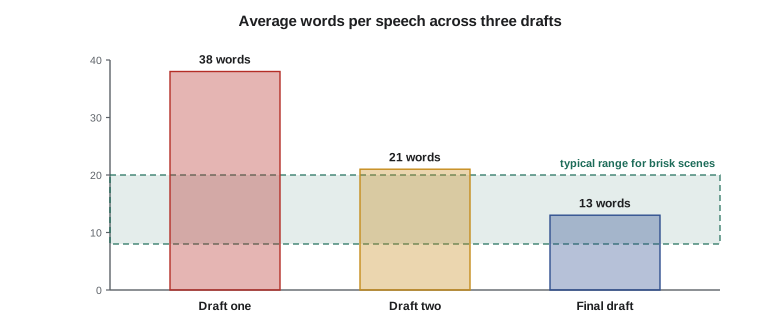
Screen dialogue is usually shorter than beginners expect. Long speeches can work at key moments, but most exchanges are made of short lines. A common guideline is that a line should rarely run more than three or four lines on the page without a reason. Cut words that repeat what the image shows, what another character just said, or what the audience already knows. Let actors and images do some of the work.
Worked problem
Measuring dialogue density
A 3-page scene has 24 lines of dialogue adding up to 330 words and about 18 lines of action description. What is the average words per speech, and what does that suggest?
Show solution
- Average speech length: \( 330 \div 24 = 13.75 \) words.
- At a typical speaking pace of about 150 words per minute, 330 words take about \( 330 \div 150 = 2.2 \) minutes.
- The scene's page length suggests about 3 minutes, so pauses and action fill the remaining time.
Answer: About 14 words per speech, which is a brisk, natural rhythm for most scenes. A scene averaging 40 or more words per speech is usually monologue-heavy and should be checked for cuts.
Speakability
Dialogue is written to be spoken, so read it aloud. Lines that look fine on the page can be tongue twisters or rhythmically awkward in the mouth. Listen for repeated words, unintended rhymes, long clauses before the main point and lines that end weakly. Put the most important word near the end of the line, where actors naturally stress it.
- Read every scene aloud, ideally with other people.
- Mark lines that make readers stumble or pause.
- Cut "well," "so," "I mean" and similar fillers unless they characterize.
- End lines on strong words.
- Hold a table read before major rewrites.
Monologues and silence
Sometimes a long speech is exactly right: a confession, a closing argument, a story told at a funeral. A great monologue has a shape of its own, with a goal, an obstacle and a turn, and it usually reveals something the character has been hiding. It also gives the listener something to react to, because the camera will cut to them.
Silence is just as important. A character who does not answer can say more than any line. Writers indicate silence through action ("She looks at the ring. Doesn't answer.") rather than by writing "(silence)" again and again. Some of the most powerful scenes in film contain almost no dialogue, relying on behavior, sound and image.
Dialogue conventions on the page
Lesson 8 covers formatting in detail, but a few conventions concern dialogue specifically.
- Parentheticals: short directions under the character's name, such as (whispering) or (to Leo), used sparingly to clarify, not to direct every reading.
- Extensions: (V.O.) for voice-over and (O.S.) for off-screen, placed next to the character's name.
- Interruptions: a double hyphen or em dash at the end of a line shows a character is cut off.
- Overlapping dialogue: some writers mark simultaneous speech with dual dialogue columns.
- Other languages: if characters speak a language other than the script's, writers note it once, such as "(in Cree, subtitled)," and then write the lines in English or in the original with translations.
In the United States, many scripts include Spanish and other languages, and writers note subtitled passages clearly so producers can plan translation and subtitling.
Exercise: rewriting for voice
Take a page of your own dialogue and try these steps.
- Cover the names and see if you can tell who is speaking. If not, adjust vocabulary and rhythm.
- Label each line with an action verb. Cut or rewrite lines with no verb.
- Find every piece of exposition and ask whether it can be shown, delayed or dramatized.
- Cut 20 percent of the words without losing meaning.
- Read it aloud and fix any line that makes you stumble.
Dialogue in comedy and genre
Different genres ask different things of dialogue. In comedy, rhythm is everything: setups and punchlines depend on timing, word choice and the order of words, and the funniest word usually comes last. Comic characters often reveal themselves through obsessions, misunderstandings and the gap between what they say and what they do. In thrillers and horror, dialogue tends to be sparse and functional, with tension carried by silence and sound. In romance, dialogue often works through banter, in which characters spar while attraction builds underneath. Period films need dialogue that feels of its time without becoming hard to follow, usually by suggesting the era through formality and a few period terms rather than reproducing archaic speech.
- Comedy: end lines on the funny word, use callbacks to earlier jokes and let characters be serious about absurd goals.
- Thriller: keep lines short, let threats stay implicit and use silence as pressure.
- Romance: build attraction through conflict and wit, not declarations.
- Period: suggest the era with formality and a few chosen words, keeping modern slang out.
Worked problem
Finding the punch word
A comic line reads: "I'm a vegetarian, but I still eat bacon on special occasions like Tuesdays." Where is the punch, and how could the line be tightened?
Show solution
- The surprise is "Tuesdays," which turns "special occasions" into an absurd excuse.
- The punch word already ends the line, which is correct.
- Cut padding: "I'm vegetarian. Except bacon. On special occasions. Like Tuesdays."
- Breaking the line into short beats gives the actor room for timing.
Answer: The punch is "Tuesdays," and it should stay last. Tightening the line and breaking it into beats sharpens the rhythm and gives the performer clear pauses.
Dialogue and the actor
Remember that every line you write will be spoken by an actor who brings choices of their own. Actors look for intention: what does my character want from the other person right now? Dialogue that hides intention under subtext gives actors more to play than dialogue that states everything. At the same time, actors need lines they can say truthfully. If a line exists only to deliver information or set up a plot point, an actor will feel it, and so will the audience. When actors improvise on set or suggest changes in rehearsal, listen; their instincts about speakability are often right.
Reading dialogue aloud
Read every scene aloud before you share it, or better still, ask friends to read the parts while you listen. Lines that look fine on the page often trip the tongue, run too long or sound alike. Mark every place a reader stumbles and revise it.
Common mistakes
MistakeWriting dialogue as information delivery
InsteadTreat every line as an action aimed at a goal
Mistake"As you know" exposition
InsteadDramatize, delay or show information instead of having characters recite it
MistakeAll characters sounding the same
InsteadGive each character a distinct vocabulary, rhythm and level of directness
MistakePhonetic accents on the page
InsteadSuggest accents through word choice and rhythm, and note them in the character introduction
MistakeOverusing parentheticals
InsteadUse them only to clarify meaning or address, and trust actors with line readings
Summary and key terms
- Dialogue is action: characters speak to get something from each other.
- Each character needs a distinct voice built from vocabulary, rhythm, directness, habits and silence.
- Exposition works best when dramatized, delayed, shown or hidden inside action.
- Screen dialogue is compressed; most speeches are short, and long ones need a reason and a shape.
- Reading aloud and table reads reveal lines that are hard to speak.
- Silence and behavior can say more than words.
- Conventions such as parentheticals, extensions and notes for other languages keep dialogue clear on the page.
- Dialogue
- The words characters speak in a screenplay
- Voice
- The distinctive way a character speaks
- Exposition
- Information the audience needs to understand the story
- "As you know" dialogue
- Characters telling each other what they already know so the audience hears it
- Monologue
- A long speech by one character
- Parenthetical
- A brief direction under a character name about delivery or address
- Voice-over (V.O.)
- Dialogue heard over the image from a speaker not present in the scene
- Off-screen (O.S.)
- Dialogue from a character present in the scene but not visible
- Table read
- A reading of the script aloud by actors or collaborators
- Speakability
- How naturally a line can be spoken aloud
Practice problems
Work each problem on paper first, then reveal the answer to check.
Why treat dialogue as action?
Show answer
It gives every line a purpose and creates conflict.
What is "as you know" dialogue?
Show answer
Characters telling each other known facts for the audience's benefit.
Give two ways to deliver exposition without speeches.
Show answer
For example, through an object such as a photograph and through an argument.
How many words per speech is 300 words over 20 speeches?
Show answer
15 words per speech.
Why put the key word at the end of a line?
Show answer
Actors naturally stress the end of a line.
How should a script show a character not answering?
Show answer
Through action, such as "She looks at the ring. Doesn't answer."
What does (O.S.) mean?
Show answer
The speaker is in the scene but off screen.
How long do 450 words of dialogue take at 150 words per minute?
Show answer
About 3 minutes.
Why avoid phonetic spelling of accents?
Show answer
It is hard to read and can become caricature.
What should a good monologue have?
Show answer
Its own goal, obstacle and turn, and something for the listener to react to.
Lesson quiz · 5 questions
Score 60% or more to complete this lesson.
Create a free account to save your progress, take quizzes and earn a certificate.