
FILM-410 · Lesson 11 of 12 · 25 min
Distribution, sales and festivals
A finished film earns nothing until it reaches an audience. Distribution is the business of getting films to audiences through cinemas, streaming services, television, airlines, educational markets and other outlets, and collecting revenue in return. For an independent producer, distribution also determines whether financiers are repaid and whether the producer ever sees profit. Many of the most important distribution decisions are made long before the film is finished, when pre-sales and minimum guarantees are negotiated during financing.
This lesson explains how independent films are sold and released: the roles of sales agents and distributors, territories and windows, theatrical and streaming deals, marketing costs, festival strategy, and the recoupment waterfall that decides who gets paid from each dollar of revenue. Lesson 3 introduced pre-sales and minimum guarantees as financing tools; here we see how they play out after delivery.
Sales agents and distributors
A sales agent represents a film to buyers around the world. The agent attends markets such as the Marché du Film at Cannes, the European Film Market in Berlin and the American Film Market, and festivals with active sales such as Toronto and Sundance, where buyers from many countries gather. The agent negotiates licenses territory by territory, collects payments and charges a commission, usually a percentage of revenue, plus capped marketing expenses. Some sales agents also provide minimum guarantees.
A distributor licenses the right to release a film in a territory, usually for a set term and in specified media. The distributor pays for marketing and releases the film, then recoups its fees and expenses from the revenue before passing the rest to the producer or sales agent. Distributors range from large companies with broad releases to small specialist distributors who release a few films a year in cinemas and on digital platforms.
In the United States, independent films are often sold after completion, at festivals or through sales agents, to distributors and streamers who acquire domestic rights. Some films secure a domestic distributor before production, which helps financing. Others use service deals, in which the producer pays a company to handle a release and keeps more control and revenue, or release films directly on digital platforms through aggregators. The domestic market is usually defined as the United States and often English-speaking Canada, which matters when rights are divided.
Territories, media and windows
Film rights are divided by territory, by media and by time. A territory is a country or group of countries, such as Germany, Latin America or the Benelux. Media include theatrical exhibition, home entertainment, transactional digital (rental and purchase), subscription streaming, free and pay television, airlines and non-theatrical uses such as schools. Windows are the periods in which each medium has exclusivity.
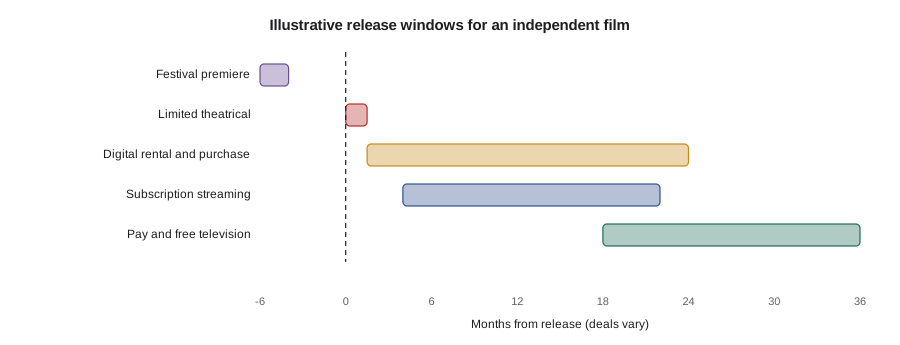
Release windows have changed dramatically. Theatrical exclusivity for major releases, once commonly 90 days or more, has shortened to as little as about 45 days or less for many films, and some films premiere on streaming services with little or no theatrical release. For independent films, the shape of the windows depends on the deals: a small theatrical release may be followed quickly by digital rental, then a streaming license, then television. A streamer that buys worldwide rights may set its own release pattern entirely.
Theatrical economics
In a theatrical release, the cinema keeps a share of the box office and pays the rest, called film rental, to the distributor. For independent films the split is often near 50 percent overall, though it varies by film, week of release and country. The distributor then deducts its distribution fee, often 25 to 35 percent of film rental, and recoups its marketing and release expenses, known as prints and advertising (P and A), before anything flows to the producer. If the distributor paid a minimum guarantee, it also recoups that before paying overages.
These deductions explain why a film with respectable box office may return little to its producer. Marketing costs in particular can be large compared with a small film's box office. Producers negotiate caps on expenses, reporting rights and audit rights to keep distribution accounting honest.
box_office = 900_000
exhibitor_share = 0.50
distribution_fee = 0.30
p_and_a = 180_000           # prints and advertising spent by the distributor
minimum_guarantee = 150_000 # paid by the distributor to the producer earlier

film_rental = box_office * (1 - exhibitor_share)
fee = film_rental * distribution_fee
after_fee = film_rental - fee
after_pa = after_fee - p_and_a
overage = max(0, after_pa - minimum_guarantee)
print(f"Box office:                {box_office:>10,.0f}")
print(f"Cinema keeps:              {box_office - film_rental:>10,.0f}")
print(f"Film rental to distributor:{film_rental:>10,.0f}")
print(f"Distribution fee:          {fee:>10,.0f}")
print(f"P and A recouped:          {p_and_a:>10,.0f}")
print(f"Left to recoup the MG:     {after_pa:>10,.0f}")
print(f"Overage paid to producer:  {overage:>10,.0f}")
needed = (minimum_guarantee + p_and_a) / ((1 - exhibitor_share) * (1 - distribution_fee))
print(f"Box office needed before any overage: {needed:,.0f}")Box office: 900,000 Cinema keeps: 450,000 Film rental to distributor: 450,000 Distribution fee: 135,000 P and A recouped: 180,000 Left to recoup the MG: 135,000 Overage paid to producer: 0 Box office needed before any overage: 942,857
In this illustration, 900,000 of box office leaves the distributor still short of recouping its minimum guarantee, so the producer receives no theatrical overage beyond the guarantee already paid. The calculation shows why minimum guarantees matter: for many independent films, the guarantee is the only money the producer ever receives from that territory.
Streaming and television deals
Streaming services acquire films in several ways: worldwide licenses for a period, territory-specific licenses, or outright buyouts in which the streamer pays a fixed amount for rights in many territories for a long term. License fees vary widely with the film's profile, festival performance, cast and genre. Streamers usually pay flat fees rather than revenue shares, so the producer knows exactly what the deal is worth but receives no upside if the film becomes popular, unless the contract includes performance bonuses.
Television licenses, including pay and free television, are similar: a fee for the right to broadcast a film a set number of times over a term in a territory. Public broadcasters and specialty channels can be important buyers for independent dramas and documentaries.
In the United States, there are no Canadian-style content quotas, so streamers and broadcasters buy purely on their own commercial and editorial judgment. Union agreements require residual payments when films are licensed to some media, which distributors or producers must account for under their assumption agreements.
Festivals
Festivals launch independent films. A premiere at a major festival, such as Cannes, Venice, Berlin, Toronto, Sundance or South by Southwest, can attract sales agents, distributors, critics and audiences. Regional and specialist festivals build a film's reputation and reach audiences who might never see it otherwise. Many festivals have premiere requirements: a world, international or national premiere, so a producer must plan the order of festivals carefully, because premiering at a smaller festival can rule out a larger one.
Festival strategy involves submission fees, often from a few dollars to over a hundred per festival; travel and accommodation for the team; publicists, who are often essential at large festivals; screening copies and DCPs; and marketing materials. A wide festival run can cost tens of thousands of dollars. Producers budget for it, seek festival support from funders where available, and choose festivals that serve the film's goals: sales, awards, audience building or a particular community.
| Festival type | What it can do | Caution |
|---|---|---|
| Major international festival with a market | Launch sales, press and awards prospects | Highly competitive; premiere rules restrict later choices |
| National or regional festival | Reach home audiences and local press | May use up a premiere status |
| Specialist festival, such as genre or documentary | Reach the right buyers and audiences | Smaller press impact |
| Community and identity festivals | Build engaged audiences and partners | Limited sales activity |
| Online or hybrid festival | Broader reach | May affect premiere status and later sales |
Worked problem
Planning a festival strategy for Stillwater Road
Stillwater Road is finished in late spring. The producer hopes for a major premiere, a Canadian or American distributor if not yet secured, and international sales. How should the festival strategy be planned?
Show solution
- Identify the target premiere: a major autumn festival with an active market suits a character drama seeking sales.
- Hold back from smaller festivals until the decision is known, to protect premiere status.
- Work with the sales agent and a publicist to prepare materials and screenings for buyers.
- If the major festival declines, move to the next best premiere with a market or strong press, and then to a regional and specialist circuit.
- Budget submissions, travel and publicity, and apply for festival support where available.
Answer: The plan targets a major premiere first, protects premiere status, coordinates with the sales agent and publicist, and sets a fallback sequence with a realistic festival budget.
Recoupment: the waterfall
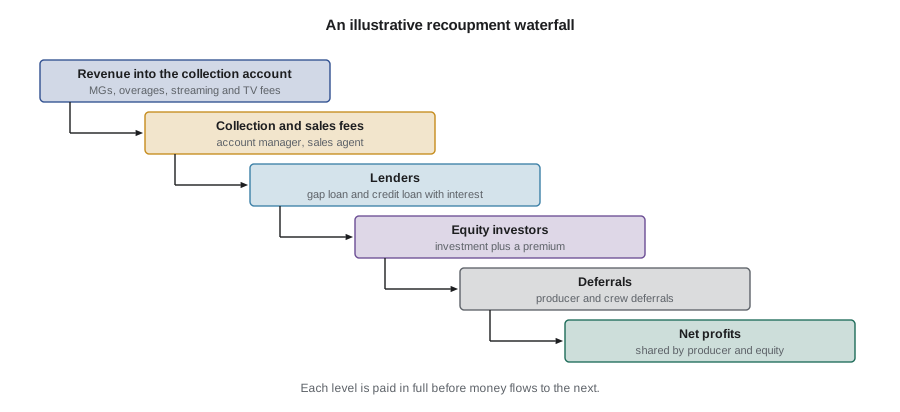
All the revenue from a film's exploitation, from minimum guarantees and overages to streaming fees and television licenses, flows into the recoupment waterfall: the order in which financiers and participants are paid. A typical independent waterfall pays collection account fees and sales commissions first, then lenders, then recoupable investors such as public funds and equity, often with a premium, then deferments, and finally net profits, which are usually shared between the producer and equity investors. The order is negotiated during financing and recorded in agreements managed by a collection account manager.
Producers must be realistic about where they sit. On many independent films, revenue never reaches net profits, and the producer's return comes from fees paid in the budget. That is why producers negotiate their fees carefully and why building a slate and a reputation matters more than any single film's back end.
Marketing materials and the producer's role in release
Even when a distributor handles the release, the producer supplies much of what marketing depends on. Buyers expect a trailer, key art or a poster, high-quality production stills, a press kit with synopses and biographies, and sometimes behind-the-scenes footage. Stills in particular cannot be recreated after the shoot, so producers hire a unit stills photographer for key days and budget for it. Weak marketing materials can sink a good film's release.
Producers also work with distributors and publicists on release plans, festival press, awards campaigns where appropriate, and community screenings for audiences the film was made for. For a small independent film, the director and cast may be the most effective marketing tools, so producers plan for their availability around the release. Reporting rights in distribution agreements let the producer follow revenue and expenses, and audit rights let the producer check them. Experienced producers read every distribution statement, because errors are common and rarely in the producer's favor.
Common mistakes
MistakeAssuming box office goes straight to the producer
InsteadFollow the waterfall through the exhibitor share, distribution fee, expenses and guarantees.
MistakePremiering at the first festival that accepts the film
InsteadPlan premieres in order to protect eligibility for the most important festival.
MistakeSigning distribution deals without expense caps or audit rights
InsteadNegotiate caps, reporting and audit rights.
MistakeCounting on net profits as the producer's income
InsteadRely on fees in the budget and treat profits as an uncertain bonus.
MistakeTreating streaming licenses as revenue shares
InsteadUnderstand that most streaming deals pay flat fees with limited upside.
Summary and key terms
- Distribution brings films to audiences and determines whether financiers are repaid.
- Sales agents sell films territory by territory; distributors release them and recoup fees and expenses.
- Rights are divided by territory, media and windows, which have shortened in recent years.
- Theatrical revenue passes through the exhibitor share, distribution fee, P and A and minimum guarantee before overages.
- Streaming and television deals usually pay flat license fees for a term and territory.
- Festival strategy must protect premiere status and budget for submissions, travel and publicity.
- The recoupment waterfall sets who is paid from each dollar, and many films never reach net profits.
- Sales agent
- A company that sells a film's rights to buyers around the world for a commission.
- Distributor
- A company that licenses and releases a film in a territory.
- Territory
- A country or group of countries for which rights are licensed.
- Window
- A period in which a medium has exclusive rights to a film.
- Film rental
- The share of box office paid by cinemas to the distributor.
- Distribution fee
- The percentage of revenue a distributor keeps for its services.
- P and A
- Prints and advertising: the distributor's marketing and release expenses.
- Overage
- Revenue paid to the producer after a distributor recoups its guarantee, fees and expenses.
- Premiere status
- Whether a festival screening is a world, international or national first showing.
- Recoupment waterfall
- The order in which revenue is paid to financiers and participants.
Practice problems
Work each problem on paper first, then reveal the answer to check.
What does a sales agent do?
Show answer
Represents a film to buyers worldwide, negotiates licenses and collects payments for a commission.
Name three media into which film rights are divided.
Show answer
For example, theatrical, transactional digital, subscription streaming, television or airlines.
What is film rental?
Show answer
The share of box office paid by cinemas to the distributor.
What does a distributor recoup before paying overages?
Show answer
Its fee, P and A expenses and any minimum guarantee.
Why might a minimum guarantee be the only money a producer receives from a territory?
Show answer
Revenue may never exceed the guarantee plus fees and expenses.
How do most streaming deals pay?
Show answer
Flat license fees for a term and territory.
Why must festival premieres be planned in order?
Show answer
Premiering at a smaller festival can rule out a larger one.
Name two costs of a festival run.
Show answer
For example, submission fees, travel, publicists, DCPs or marketing materials.
What is usually last in a recoupment waterfall?
Show answer
Net profits, shared between the producer and equity investors.
Where does most producers' income from an independent film come from?
Show answer
Fees paid in the budget.
Lesson quiz · 5 questions
Score 60% or more to complete this lesson.
Create a free account to save your progress, take quizzes and earn a certificate.