
FILM-410 · Lesson 4 of 12 · 25 min
Public funding: incentives and state tax credits
Governments support film and television production for cultural and economic reasons. Cultural support aims to make sure a country's stories reach its own screens. Economic support aims to attract production spending, jobs and infrastructure. These two motives produce different kinds of programs: cultural funds that invest in or grant money to domestic productions, and production incentives, usually tax credits or rebates, that refund a share of qualifying spending to productions that shoot in a jurisdiction. Most producers rely on some combination of the two.
This lesson explains how these programs work, how to estimate what a production can expect, and what conditions come attached. Rates, caps and rules change often, sometimes every budget cycle, so every figure in this lesson is dated and should be checked against the program's current guidelines before it is used in a real finance plan. The figures here were checked in October 2026.
The United States has no national film agency and no federal production subsidy comparable to those in Canada or Europe. Public support for production comes mainly from state incentives, usually tax credits, plus some federal tax provisions, public media funding and arts grants. For an American independent feature, a state incentive is often the single largest public source.
Cultural funding
Federal support for fiction features is limited. The National Endowment for the Arts funds organizations rather than individual feature productions, and its grant programs changed significantly in 2025 and 2026, so producers should check what is currently available. Documentary producers have more options: the Corporation for Public Broadcasting historically funded public media through organizations such as ITVS and PBS, but federal funding for the Corporation was rescinded in 2025, and public media funding is being restructured, so current programs must be checked carefully.
Most non-tax public support for American independent films now comes from state and city film offices, which may offer small grants, free permits or location support, and from non-profit organizations, foundations and festivals that run grants, labs and fellowships. Fiscal sponsorship allows a project to receive tax-deductible donations through a non-profit sponsor, which is common for documentaries and some independent narrative films.
Because cultural funding is scarce, American independent producers depend more heavily on private equity, pre-sales and state incentives than Canadian producers do. This shapes the kinds of films that get made and the size of the packages producers must assemble.
How production tax credits work
A production tax credit refunds a percentage of qualifying spending in a jurisdiction. Most film credits are refundable, which means the production receives cash even if it owes no tax, or transferable, which means the credit can be sold to a taxpayer who can use it. The credit is claimed after the production is completed and its costs are audited, which is why producers borrow against expected credits during production (lesson 3).
Credits differ in what they count as qualifying spending. Some count only labor paid to residents; others count all spending in the jurisdiction, including equipment rentals, locations and services. Many have minimum spending thresholds, caps on the total credit per production or per year, and uplifts for shooting in certain regions, hiring local crew or including a promotional logo. The same budget can generate very different credits in different places.
| State | Incentive (simplified) | Notable conditions |
|---|---|---|
| Georgia | 20% base credit plus a 10% uplift for including the state's promotional logo | No annual cap at the time of writing; credits are transferable, so many producers sell them at a discount |
| California | Program 4.0, expanded in 2025 to 750 million dollars a year, with credits of 35% for most projects and higher rates for some work outside the Los Angeles zone | Competitive allocation; credits are refundable under Program 4.0 |
| New York | 25% to 35% depending on location in the state | Large annual allocation; credits are refundable |
| New Mexico | 25% base, rising toward 40% with uplifts | Annual cap and rules on resident crew; check the current year |
| Louisiana | 25% to 35% including uplifts | Annual cap |
| New Jersey | 30% to 35% | Annual cap and in-state spending requirements |
The table is a starting point, not a finance plan. A producer estimating a credit must read the program's guidelines, which define eligible costs, residency rules, certification steps and deadlines in detail. Most programs also require registration or pre-approval before principal photography, and missing a deadline can cost the production its credit.
Certification and Canadian content
State incentives do not test the nationality of creative personnel the way Canadian programs do. Instead, they test where money is spent and, often, who is paid. Many states give higher rates for wages paid to residents, require a share of the crew to be residents, or count only spending with in-state vendors. Most require the production to register with the state film office before shooting, submit a budget, and later provide an audit by an approved accountant.
Federal tax law has also affected film finance. Section 181 of the Internal Revenue Code allowed qualified film and television productions to deduct up to 15 million dollars of costs in the year incurred, or 20 million in certain low-income and distressed areas. It applied to productions beginning before 1 January 2026, and the One Big Beautiful Bill Act of 2025 did not extend it for film, although it added sound recordings. Bills to extend or expand it were introduced in Congress in 2025; producers should check whether any have passed. Separately, the 2025 law restored 100 percent bonus depreciation for qualifying property, which can also apply to film costs.
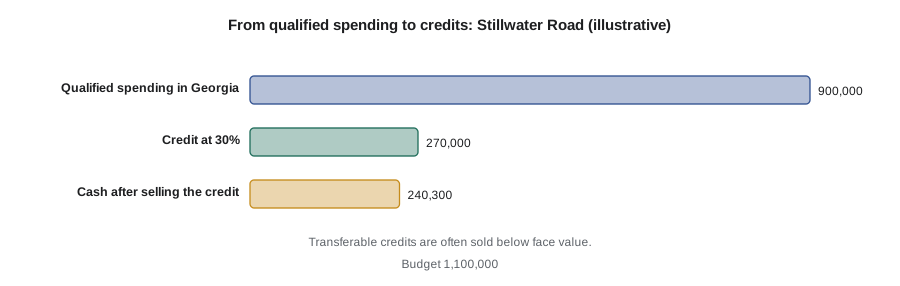
Estimating credits for Stillwater Road
budget = 1_100_000
qualified = {"Georgia": 900_000, "New Mexico": 820_000, "California": 700_000}
rates = {"Georgia": 0.30, "New Mexico": 0.30, "California": 0.35}
transfer_price = {"Georgia": 0.89, "New Mexico": 1.00, "California": 1.00}  # cents per dollar received

for state in qualified:
    gross = qualified[state] * rates[state]
    net = gross * transfer_price[state]
    print(f"{state:<11} qualified {qualified[state]:>9,}  credit {gross:>8,.0f}  cash value {net:>8,.0f}  ({net / budget:.1%} of budget)")
print()
print("California allocations are competitive; Georgia credits are sold at a discount;")
print("New Mexico rates depend on uplifts and resident hiring. A higher rate is not always more cash.")Georgia qualified 900,000 credit 270,000 cash value 240,300 (21.8% of budget) New Mexico qualified 820,000 credit 246,000 cash value 246,000 (22.4% of budget) California qualified 700,000 credit 245,000 cash value 245,000 (22.3% of budget) California allocations are competitive; Georgia credits are sold at a discount; New Mexico rates depend on uplifts and resident hiring. A higher rate is not always more cash.
The calculation shows why producers model credits carefully. Small changes in where a film shoots, who it hires or how its costs are classified can move the credit by tens of thousands of dollars. The calculation also shows why credits are estimates until the audit: if qualifying spending turns out lower, the credit falls, and any loan against it must still be repaid.
Worked problem
Checking a credit estimate before it goes into the finance plan
A line producer gives the producer a credit estimate based on the total budget rather than qualifying spending. The estimate is 30 percent higher than the producer expected. What should the producer check?
Show solution
- Confirm the base: does the program count only labor, only resident labor, or all local spending?
- Remove ineligible costs: amounts paid outside the jurisdiction, non-resident wages where they do not qualify, financing costs and contingency where excluded.
- Apply the correct assistance rules, caps and thresholds, including any reduction of one credit by another.
- Allow for timing: when will the audit be done and the credit paid, and what will borrowing against it cost?
- Document assumptions so the bank, the bond company and the auditor can follow them.
Answer: The producer rebuilds the estimate on qualifying spending only, which brings it back in line, and records the assumptions in a note to the finance plan.
Conditions, audits and recoupment
Public money comes with conditions. Cultural funders may require minimum spending in the jurisdiction, specific credits and logos, delivery of materials, reporting, and repayment in an agreed position from the film's revenues. Tax credits require detailed cost reports, proof of payment and residency, and an audit before the credit is paid. Late or incomplete filings delay cash and can reduce the credit.
Recoupment matters too. When a funder invests rather than grants, it expects repayment from the film's income, often sharing a position with private equity or recouping in a set order. Lesson 11 shows how these positions form part of the recoupment waterfall. A producer who promises the same revenue to too many parties creates disputes; careful drafting and a collection account, managed by an independent company that receives and distributes the film's revenue, help avoid them.
Applying to funders and programs
Applications for public funding and incentives are documents in their own right, and they are judged partly on how clearly and accurately they are prepared. Most programs ask for the script, a budget in the required format, a finance plan, a schedule, chain-of-title documents, the key creative team's credits, and evidence of market interest such as a distributor's letter or license. Missing documents or inconsistent figures delay applications or lead to refusals.
A useful habit is to keep a single master version of every document and generate each application from it, so that the budget in one application never contradicts the budget in another. Funders talk to each other, and inconsistent figures across applications damage a producer's credibility. When a figure changes, the producer updates the master and notifies every funder that relied on the old figure.
American producers applying for a state incentive usually register with the state film office before principal photography, submit a budget and production details, and later file a final cost report with an audit by an approved accountant. Some states pre-certify a credit amount; others allocate limited funds competitively or on a first-come basis, so producers build their timeline around the state's application windows.
After funding is approved, the producer must keep the commitments made in the application: the creative team, the shooting location, the spending in the jurisdiction and the delivery requirements. Significant changes usually require the funder's approval. Treating an application as a promise, rather than a sales document, protects the funding and the producer's reputation for the next project.
Producers should also plan for the possibility that a funding application is refused. Competitive programs turn down many good projects in each round, often for reasons of budget or timing rather than quality. A finance plan that depends entirely on one competitive decision is fragile. Experienced producers identify the next intake date, an alternative source, or a smaller version of the film that could proceed without the refused money, and they ask funders for feedback so the next application is stronger.
Common mistakes
MistakeUsing last year's rates without checking current guidelines
InsteadConfirm current rates, caps and deadlines with each program before building a finance plan.
MistakeEstimating credits on the total budget
InsteadEstimate credits only on qualifying spending, applying caps and assistance rules.
MistakeForgetting that one credit can reduce another
InsteadApply the program's assistance rules, which can reduce the base for other credits.
MistakeMissing registration or pre-approval deadlines
InsteadRegister or apply before principal photography, as programs require.
MistakePromising the same revenue to several funders
InsteadSet a clear recoupment order, ideally through a collection account.
Summary and key terms
- Public support has cultural and economic goals and takes the form of funds and production incentives.
- Rates, caps and rules change often; every figure must be dated and checked against current guidelines.
- Production tax credits refund a share of qualifying spending after completion and audit.
- Different programs count different costs, so the same budget yields different credits in different places.
- Certification and eligibility rules decide whether a production can claim each program.
- Credits are estimates until audited, and borrowing against them carries cost and risk.
- Public investments and grants carry conditions, reporting and sometimes recoupment rights.
- Refundable credit
- A tax credit paid in cash even if the production owes no tax.
- Transferable credit
- A tax credit that can be sold to another taxpayer, usually at a discount.
- Qualifying spending
- The costs a program counts when calculating a credit.
- Assistance
- Government or other support that may reduce the base for a tax credit.
- Uplift
- An extra percentage added to a credit for meeting a condition such as a region or logo.
- Certification
- Official confirmation that a production meets a program's eligibility rules.
- Canadian content points
- A 10-point scale measuring Canadian creative participation in a production.
- Service production
- A production made in a jurisdiction for a foreign or non-qualifying owner.
- Collection account
- An account managed by an independent company that receives and distributes a film's revenue.
- Recoupable investment
- Public or private money repaid from a film's income in an agreed position.
Practice problems
Work each problem on paper first, then reveal the answer to check.
Name the two broad motives for public support of production.
Show answer
Cultural and economic.
When is a production tax credit usually paid?
Show answer
After the production is completed and its costs are audited.
What is the difference between a refundable and a transferable credit?
Show answer
A refundable credit is paid in cash; a transferable credit can be sold to a taxpayer.
Why should a producer never estimate a credit on the total budget?
Show answer
Only qualifying spending counts, after caps and assistance rules.
Name one cultural or public funding source relevant to producers in your country.
Show answer
For example, in Canada Telefilm or the CMF; in the US, state film offices, foundations or fiscal sponsors.
What happens if a production misses a credit program's registration deadline?
Show answer
It may lose the credit.
Why are tax credit estimates uncertain until the audit?
Show answer
Qualifying spending may turn out lower than budgeted.
What is an uplift?
Show answer
An additional percentage for meeting a condition, such as shooting in a region.
Why do producers use a collection account?
Show answer
To receive and distribute revenue according to an agreed recoupment order.
Why must every rate in a finance plan be dated?
Show answer
Programs change often, so the date shows which rules were applied.
Lesson quiz · 5 questions
Score 60% or more to complete this lesson.
Create a free account to save your progress, take quizzes and earn a certificate.