
FILM-410 · Lesson 8 of 12 · 26 min
Pre-production and production management
Pre-production, or prep, is where a financed project becomes a working production. In a few weeks, the producer and production manager must hire a crew, lock locations, finish casting, secure permits and insurance, build sets, fit costumes, finalize the schedule and budget, and prepare everyone to start shooting on a fixed date. Once principal photography begins, the producer's job shifts to keeping the production running: solving problems, protecting the schedule and budget, and making sure everyone works safely.
This lesson covers the producer's side of prep and production: the prep timeline, hiring, locations and permits, insurance and the completion bond, safety, and the daily paperwork that keeps a shoot under control. FILM-320 lesson 3 covers prep from the director's side, and CINE-340 covers set safety in depth. Here we focus on management: who does what, when, and how the producer knows whether things are on track.
The prep timeline
Prep usually runs from six to twelve weeks on a low-budget feature, depending on the complexity of the film and how much was done in development. The first weeks bring on department heads and set up the production office. The middle weeks are the busiest: casting finishes, locations are confirmed, sets and costumes are designed and built, and the schedule is refined. The final weeks bring the tech scout, where department heads visit every location together, the production meeting, where the whole script is walked through scene by scene, and the final schedule and budget lock.
Many prep tasks depend on others. Locations must be confirmed before the art department can design sets. Casting must be complete before costumes can be fitted. The schedule cannot be locked until locations and cast availability are known. A producer who tracks these dependencies can see which delays threaten the start date and act early.
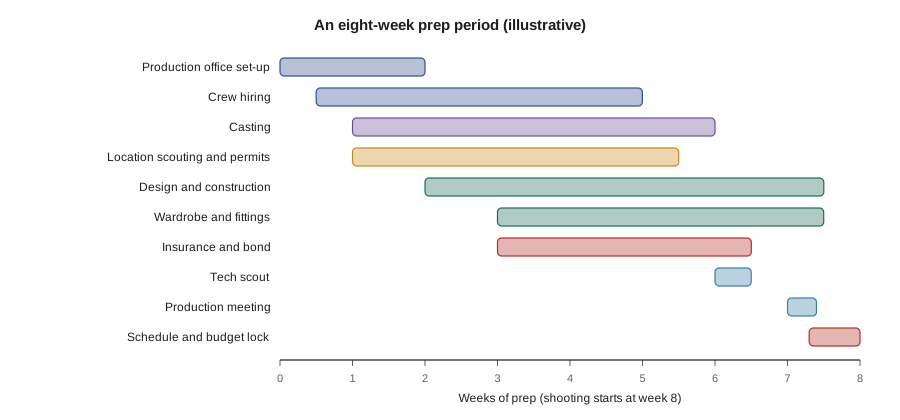
| Week | Milestone |
|---|---|
| 8 weeks out | Production office opens; line producer and production manager start |
| 7 weeks out | Production designer, location manager and first assistant director start |
| 6 weeks out | Casting offers out; main locations shortlisted |
| 4 weeks out | Locations confirmed and permits applied for; insurance bound |
| 3 weeks out | Department heads finalize plans; wardrobe fittings |
| 2 weeks out | Tech scout; completion bond closes |
| 1 week out | Production meeting; schedule and budget locked; safety meeting |
Hiring the crew
The producer, line producer and director hire the department heads, who in turn hire their crews, subject to budget and the producer's approval. Hiring decisions affect cost, quality, safety and the atmosphere on set. A director of photography who works fast with a small crew suits a low-budget schedule; one who needs extensive lighting set-ups may not. A production manager with local knowledge saves money every day.
Crew deals are usually documented in deal memos setting out the role, rate, dates, overtime terms, kit rental, credit and any union coverage. Kit rental pays crew for using their own equipment, such as a makeup artist's supplies or a sound mixer's recorder. Producers should insist on written deal memos for everyone; disputes about what was agreed are far easier to avoid than to resolve.
Inclusive hiring has become an expectation of many funders and broadcasters. Public funders may require diversity reporting or targets, and some programs reward productions that hire from underrepresented groups. Beyond requirements, a crew with a range of backgrounds brings perspectives that strengthen the work. Producers widen their hiring networks by working with training programs, union permit lists and community organizations.
Locations and permits
Locations are often the most complicated part of prep. Each location needs a signed agreement with the owner, setting out dates, fees, access, restrictions, insurance and restoration obligations. Filming on public property, such as streets, parks and sidewalks, usually requires a film permit from the municipality, which may require insurance certificates, notices to residents and businesses, and payment for police or traffic control.
In the United States, permits are issued by city and county film offices and, for state and federal land, by the relevant agencies. Los Angeles uses a central permitting service, and New York City's film office issues permits for filming on city property. Federal lands such as national parks and forests have their own rules, and some low-impact filming on federal land was simplified by legislation in 2025, but commercial productions with crews and equipment still generally need permits. A boat scene on a river may involve the Coast Guard, state agencies and local authorities.
Location fees vary from nothing, for a supportive small town, to large sums for private homes or businesses in demand. Hidden costs include parking, holding areas for cast and crew, power, security, restoration, and compensation for nearby businesses. A location that looks free may be expensive once these are added, and a location far from the crew's base may add travel time to every day.
Insurance and the completion bond
Productions carry several types of insurance, often packaged together by specialist entertainment brokers. A production package usually covers equipment, props, sets and wardrobe; third-party property damage; extra expenses caused by covered events; negative or digital media loss; and cast insurance, which covers costs if a key performer becomes unable to work. Productions also need general liability insurance, automobile coverage, workers' compensation or equivalent, and errors and omissions insurance, which covers claims such as copyright infringement or defamation and is required by distributors before delivery. FILM-420 covers errors and omissions in detail.
Insurance premiums are often expressed as a percentage of the budget, commonly around 1 to 3 percent for a straightforward production, higher for stunts, water work, animals, aircraft or high-risk locations. Insurers may require safety plans, qualified coordinators and medical exams for cast. The producer must read the policy exclusions: weather, for example, is often excluded unless specifically covered.
A completion bond, or completion guarantee, is a promise by a specialist guarantor to the financiers that the film will be completed and delivered on time and on budget, or that the financiers will be repaid. Lenders and some financiers require it. The guarantor reviews the script, budget, schedule and team before issuing the bond, monitors the production through cost reports and visits, and has the right to step in and take over if the production goes seriously off track. Bond fees are a small percentage of the budget, often between 1 and 3 percent, sometimes with a rebate if the bond is not called.
budget = 1_400_000
base_insurance_rate = 0.016
risk_loads = {"night water work with a boat": 0.004, "one minor stunt": 0.002}
bond_rate = 0.0125
eo_premium = 6500          # errors and omissions, quoted separately

insurance = budget * (base_insurance_rate + sum(risk_loads.values()))
bond = budget * bond_rate
print(f"Production package and liability: {insurance:,.0f} ({insurance / budget:.2%} of budget)")
for k, v in risk_loads.items():
    print(f"  includes load for {k}: {budget * v:,.0f}")
print(f"Errors and omissions: {eo_premium:,}")
print(f"Completion bond fee: {bond:,.0f}")
print(f"Total risk cover: {insurance + bond + eo_premium:,.0f} ({(insurance + bond + eo_premium) / budget:.1%} of budget)")Production package and liability: 30,800 (2.20% of budget) includes load for night water work with a boat: 5,600 includes load for one minor stunt: 2,800 Errors and omissions: 6,500 Completion bond fee: 17,500 Total risk cover: 54,800 (3.9% of budget)
In this illustration, risk cover costs a few percent of the budget. That money protects the production against events that could otherwise end it, and financiers will not close without it. Producers should involve a broker early, because insurers' requirements, such as a marine safety plan for a boat scene, can change the schedule and budget.
Safety
Producers are responsible for providing a safe workplace. In both Canada and the United States, occupational health and safety law places duties on employers, and on film sets the production company is the employer of most of the crew. These duties include identifying hazards, planning controls, training workers, providing protective equipment and investigating incidents.
In the United States, workplace safety is regulated federally by OSHA, with state plans in about half the states. The industry's labor-management safety committee publishes safety bulletins on specific hazards, such as firearms, stunts, water work, aerial work and vehicles, which unions and insurers expect productions to follow. California and some other states require written injury and illness prevention programs. Productions should appoint a safety coordinator for complex shoots and follow the bulletins for every relevant hazard.
High-risk activities such as stunts, firearms, water work, vehicles, pyrotechnics, heights and animals require specialists, written plans and safety meetings before the work. After the fatal shooting on the set of Rust in 2021, many productions banned functional firearms with live ammunition from sets entirely, and the industry strengthened rules on armorers and weapon handling. Producers must budget for the specialists, equipment and time these activities require. A safety plan that exists only on paper, with no time or money allowed, is not a plan.
Running the shoot: daily paperwork
During production, a set of documents keeps everyone informed. The call sheet, prepared each day by the assistant directors and approved by the production manager, tells cast and crew where to be, when, what scenes will be shot, what is needed, where the nearest hospital is, and any safety notes. The daily production report records what was actually shot, pages and set-ups completed, hours worked, meal times, delays, incidents and equipment issues. The production manager and line producer use these reports to track progress and costs.
The producer reviews the production report every day, comparing it with the schedule. Is the production on schedule? Were there long days, late meals or short turnarounds that will cost money or create fatigue? Were there incidents? A pattern of small slips, such as a quarter of a page lost each day, can add up to a full day by the end of the shoot. Catching it early lets the producer act: simplifying scenes, adding a second unit for inserts, or adjusting the schedule.
Worked problem
Responding to a schedule slip
By the end of week two, Stillwater Road is a full day behind schedule. Overtime is running above budget, and the night dock scenes are still to come. What should the producer do?
Show solution
- Diagnose the cause with the director, first assistant director and director of photography: is the problem pace, set-ups, weather, equipment or something else?
- Look for scenes that can be simplified or combined without losing story, and inserts that a small second unit can shoot.
- Check the contingency and the cost report: how much has the slip cost, and can the budget absorb an extra day?
- Notify the completion guarantor and financiers as their agreements require, with a plan.
- Protect safety: do not make up time by cutting turnaround or rushing the night water work.
Answer: The producer agrees a plan with the director to simplify two scenes, schedules a half-day second unit, informs the guarantor, and keeps the night dock work on its planned schedule with full safety preparation.
Wrap
Production ends with wrap, the period in which sets are struck, locations restored, equipment returned, final payments made and the production office closed. Wrap has its own budget and schedule. Locations must be returned in the condition agreed, with photographs taken before and after as evidence. Equipment losses and damage must be reported to the insurer promptly. A well-organized wrap protects the production's deposits and its relationships with the communities and vendors it may want to work with again.
Common mistakes
MistakeStarting prep without tracking dependencies
InsteadMap which decisions unlock others and act early on those that threaten the start date.
MistakeHiring crew on verbal agreements
InsteadUse written deal memos with rates, dates, overtime, kit and credit.
MistakeAssuming a cheap location is cheap
InsteadCount parking, power, security, restoration, travel and compensation costs.
MistakeBuying insurance at the last minute
InsteadInvolve a broker early so insurer requirements shape the schedule and budget.
MistakeTreating safety plans as paperwork
InsteadBudget the specialists, time and equipment that safety plans require.
Summary and key terms
- Prep turns a financed project into a working production in a few weeks, with many dependent tasks.
- Department heads hire their crews under written deal memos approved by the producer.
- Locations need agreements, permits, insurance certificates and planning for hidden costs.
- Productions carry packaged insurance, general liability and errors and omissions cover.
- A completion bond guarantees financiers that the film will be completed, and the guarantor can step in if needed.
- Producers are responsible for safety under occupational health and safety law and industry guidance.
- Call sheets and daily production reports let the producer track progress and act on slips early.
- Prep
- The pre-production period before principal photography.
- Tech scout
- A visit to each location by department heads to plan the shoot.
- Production meeting
- A meeting where the whole script is reviewed scene by scene with all departments.
- Deal memo
- A written summary of a crew member's engagement terms.
- Kit rental
- Payment to crew for using their own equipment.
- Film permit
- Permission from a public authority to film on public property.
- Production package
- A bundle of insurance covering equipment, property, extra expense, media and cast.
- Errors and omissions insurance
- Cover for claims such as copyright infringement or defamation.
- Call sheet
- The daily document telling cast and crew where and when to work and what will be shot.
- Daily production report
- A record of what was shot, hours worked, delays and incidents each day.
Practice problems
Work each problem on paper first, then reveal the answer to check.
How long is prep on a typical low-budget feature?
Show answer
About six to twelve weeks.
Why must locations be confirmed before sets are designed?
Show answer
The art department needs to know the spaces it is designing for.
What should a crew deal memo include?
Show answer
Role, rate, dates, overtime terms, kit rental, credit and union coverage.
Name two hidden costs of a location.
Show answer
For example, parking, power, security, restoration or compensation to nearby businesses.
What does cast insurance cover?
Show answer
Costs if a key performer becomes unable to work.
Why do distributors require errors and omissions insurance?
Show answer
To cover claims such as copyright infringement or defamation.
What can a completion guarantor do if a production goes seriously off track?
Show answer
Step in and take over the production.
What does a call sheet include?
Show answer
Times, locations, scenes, cast, requirements, safety notes and the nearest hospital.
Why review the production report every day?
Show answer
To catch small slips and cost problems early.
Name one high-risk activity that needs a specialist and a written plan.
Show answer
For example, stunts, firearms, water work, vehicles or heights.
Lesson quiz · 5 questions
Score 60% or more to complete this lesson.
Create a free account to save your progress, take quizzes and earn a certificate.