
FILM-420 · Lesson 12 of 12 · 25 min
Capstone: clearing and contracting a documentary project
This capstone brings the course together. You will plan the rights work for an invented feature documentary from development to delivery: identifying every rights issue, rating the risks, choosing whether to license, rely on an exception, change the film or accept a documented risk, drafting the key agreements and assembling the materials a distributor and an errors and omissions insurer will require. The project is fictional, and so are its people and companies, but the issues are the ones producers meet every day.
The project is "Last Light at Cedar Point", a 90-minute documentary about the closing of a family-owned fish cannery in a coastal town in Washington State, its workers and the dispute over what caused the closure. The producer is a small Seattle company. A public media outlet has expressed interest, and a sales agent hopes to sell international and streaming rights. Some interviews will be filmed in California, where a former manager now lives.
Step 1: the rights inventory
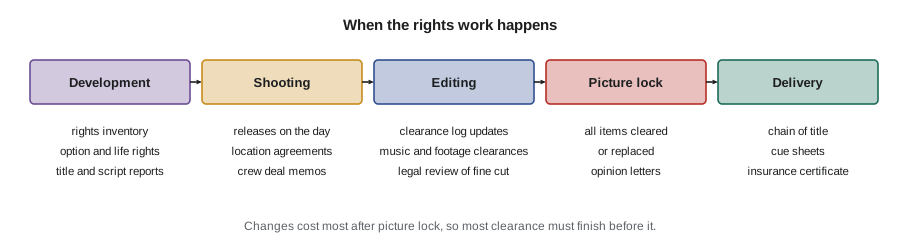
Start with a complete inventory of everything in the planned film that could carry third-party rights. The producer reviews the treatment, the shooting plan and the archive research and lists each element.
| No. | Element | Rights issues |
|---|---|---|
| 1 | Interviews with 12 former workers | Appearance releases; privacy for health information |
| 2 | Interview with the former manager, who blames the owners | Defamation risk to the owners; releases |
| 3 | Home videos from a worker's family, 1980s to 2000s | Copyright of the person who filmed; people shown |
| 4 | Local television news clips about the closure | Footage licenses; underlying music and interviews |
| 5 | Historical photographs from the town museum | Copyright status; museum terms |
| 6 | A large mural of cannery workers painted on the town hall | Copyright in the mural; moral or VARA rights |
| 7 | Three songs by a regional folk band | Sync and master licenses |
| 8 | Original score by a composer | Composer agreement |
| 9 | Drone footage of the cannery and coast | Ownership; aviation rules; private property |
| 10 | AI-restored and colorized versions of old photographs | Tool terms; disclosure; underlying rights |
| 11 | Company logo and product labels | Trademark; depiction |
| 12 | Secretly recorded phone call supplied by a worker | Recording law; privacy; ethics |
Step 2: rating the risks
Next, rate each element by likelihood and severity of a claim, considering the use, the territory and the parties. A simple scale works: high, medium or low. High-risk items need a clearance solution before the cut is locked; medium items need a decision and documentation; low items need logging.
items = {
    "Manager interview blaming owners": (3, 3),
    "Folk band songs": (3, 2),
    "Mural on town hall": (2, 2),
    "News clips": (3, 2),
    "Home videos": (2, 2),
    "Secret phone recording": (2, 3),
    "Museum photographs": (2, 1),
    "Company logo": (1, 1),
}
def band(score):
    return "high" if score >= 6 else "medium" if score >= 4 else "low"
for name, (likely, severe) in sorted(items.items(), key=lambda kv: -kv[1][0] * kv[1][1]):
    s = likely * severe
print(f"{name:34} score {s} {band(s)}")Manager interview blaming owners score 9 high Folk band songs score 6 high News clips score 6 high Secret phone recording score 6 high Mural on town hall score 4 medium Home videos score 4 medium Museum photographs score 2 low Company logo score 1 low
The scores are judgments, not measurements, but writing them down forces a team to discuss each item and to prioritize. In this project, the defamation risk from the manager's interview and the music are the most serious, followed by the news clips and the secret recording.
Step 3: choosing solutions
For each item, the producer chooses one of five responses: license it, rely on an exception with documentation, change the film, get a release or agreement, or accept a low risk and log it.
Interviews and releases. Each worker signs an appearance release covering all media worldwide in perpetuity, including name, likeness, voice and biography, with a waiver of privacy and publicity claims. For the California interview, the release is signed before filming, and the producer takes care with anyone else shown at the manager's home. Workers who discuss health conditions are told how the material will be used, and the producer offers to blur or omit sensitive details.
The manager's allegations. The manager says the owners concealed safety violations. The owners are probably private figures, so they would have to prove falsity and negligence; careful verification is the best defense. The team checks the claims against inspection records and court documents, seeks the owners' response in writing, includes their response fairly, and removes allegations that cannot be supported. A media lawyer reviews the fine cut before delivery.
Music, footage and photographs. The producer negotiates festival licenses with options for all-media rights for the three songs, from both the publisher and the label, and a package agreement with the composer. The news clips are licensed from the station's archive for all media, excluding underlying music, which is replaced; one short clip analyzed on screen is used under fair use with a lawyer's opinion. Museum photographs published before 1931 are in the public domain; later ones are checked and licensed where needed.
Mural, drone, AI and recording. The building is architecture, but the mural is a separate work of visual art that the architectural exception does not cover and VARA may protect, so the producer seeks a license from the artist. Drone footage is shot by a certified pilot under FAA Part 107, under a deal memo that makes the footage a work made for hire with a backup assignment. AI restoration uses a tool whose terms allow commercial use, and the film discloses restored images in the credits. The secretly recorded call was made in Washington, an all-party consent state, so the recording may have been unlawful; the producer does not use the audio and reports the events through other sources.
Step 4: the key agreements
The project needs a standard set of agreements, most of them adapted from templates reviewed by a lawyer. The producer prepares them before shooting so that crews can collect signatures on the day.
- Appearance releases for interviewees and featured people, and a crowd notice for public events.
- Location agreements for the cannery property and any private homes.
- Deal memos for the director, cinematographer, drone pilot, editor and other crew, transferring rights in their work.
- A composer agreement and music licenses for the songs.
- Footage, photograph and artwork licenses.
- A collaboration agreement with the worker's family for the home videos, licensing the footage and confirming who filmed it.
- A distribution or sales agency agreement, with warranties and delivery requirements that match the rights cleared.
Worked problem
Matching rights in to the sales agent's requirements
The sales agent's agreement requires worldwide rights in all media for 15 years. The folk songs are licensed for festivals only, with an option for worldwide all-media rights in perpetuity for 12,000 per song (publisher and label combined). The news clips are licensed worldwide for 10 years. What must the producer do before signing?
Show solution
- Exercise the music options, or negotiate them as part of the sale, so the songs are licensed for at least the agent's 15-year term in all media.
- Extend the news clip licenses from 10 to at least 15 years, or replace the clips.
- Check every other license in the clearance log for media, territory and term against the agent's grant.
- Budget the cost: three songs at 12,000 each is 36,000, plus the news clip extension.
Answer: The producer must upgrade the music and news licenses, budget about 36,000 plus the clip extension, and confirm that nothing in the log is narrower than the grant before signing.
Step 5: errors and omissions insurance and delivery
The distributor requires errors and omissions insurance naming it as an additional insured, typically with limits such as 1 million dollars per claim and 3 million in the aggregate and a term of three years, although requirements vary. To obtain the policy, the producer completes an application describing the film and the clearance procedures used, and supplies a title report, a copyright report or search where relevant, and a lawyer's review of the film. The insurer may exclude specific items, such as an uncleared clip, which the producer must then fix.
Delivery requires the documents that prove the rights: the chain of title, the clearance log with copies of every license and release, music cue sheets, the lawyer's opinion letters for any reliance on exceptions, and a credits list that matches every contractual credit obligation. A complete, organized delivery package speeds payment and builds a producer's reputation with buyers.
| Document | Purpose |
|---|---|
| Chain of title binder | Proves ownership of the film and underlying rights |
| Clearance log with licenses and releases | Shows every third-party element was cleared or assessed |
| Music cue sheet and licenses | Lets broadcasters and performing rights organizations pay royalties and confirms clearances |
| Opinion letters | Supports reliance on fair dealing or fair use for specific uses |
| Errors and omissions certificate | Confirms insurance naming the distributor |
| Title report | Confirms the title can be used |
| Credits list | Matches contractual credit obligations |
Step 6: lessons from the project
Reviewing a project after delivery improves the next one. In this capstone, the most expensive items were the music and the archive footage, which could have been reduced by licensing broader rights at the start or choosing cheaper sources. The riskiest item was the manager's interview, which required the most verification. The secret recording showed how the same act can be lawful in one place and not in another. And the mural showed that public visibility does not mean freedom from rights.
Your capstone assignment is to prepare the same package for a project of your own or for a case your instructor provides: a rights inventory, a risk rating, a clearance plan with a solution for each item, a list of agreements, a clearance budget and a delivery checklist. Show where the law of your jurisdiction changes the answer, date every figure and identify the items on which you would seek legal advice.
Bringing the course together
Across the course, the same habits recur: identify rights early, match rights in to rights out, get permissions in writing, use exceptions carefully and document them, respect people's privacy and reputation, read contracts for the clauses that matter, and keep organized records. The law will keep changing, especially for artificial intelligence and digital replicas, but these habits will keep your projects saleable and insurable. When the stakes are high or the answer is unclear, consult a lawyer who practices media and entertainment law in the relevant jurisdiction.
Common mistakes
MistakeWaiting until picture lock to start the rights inventory
InsteadBuild the inventory in development and update it through the edit.
MistakeTreating every item as equally risky
InsteadRate likelihood and severity and put effort where risk is highest.
MistakeSigning a sales agreement broader than your licenses
InsteadUpgrade or replace licenses so rights in match rights out before signing.
MistakeUsing a recording without checking the law where it was made
InsteadCheck the consent rule at the place of recording before using it.
MistakeDelivering without organized documents
InsteadAssemble the chain of title, clearance log, cue sheets and opinions before delivery.
Summary and key terms
- A rights inventory lists every element that could carry third-party rights.
- Rating likelihood and severity focuses effort on the most serious risks.
- Each item is licensed, covered by an exception, changed, released or logged as a low risk.
- Standard agreements prepared before shooting make collecting signatures practical.
- Licenses must match the media, territory and term granted to distributors.
- Errors and omissions insurance and delivery depend on documented clearance procedures.
- The same habits, applied consistently, keep projects saleable and insurable as the law changes.
- Rights inventory
- A list of every element in a project that may carry third-party rights.
- Risk rating
- An assessment of the likelihood and severity of a claim for each element.
- Picture lock
- The point at which the edit is final and changes become expensive.
- Delivery package
- The materials and documents a producer must deliver to a distributor.
- Additional insured
- A party, such as a distributor, covered by another party's insurance policy.
- Exclusion
- An item or risk that an insurance policy does not cover.
- Sales agent
- A company that licenses a film to distributors in various territories.
- Package agreement
- A composer agreement in which the composer delivers the score for a fixed sum covering costs.
- Fine cut
- A near-final edit reviewed before picture lock.
- Opinion letter
- A lawyer's written analysis supporting reliance on an exception.
Practice problems
Work each problem on paper first, then reveal the answer to check.
What is the first step in planning a documentary's rights work?
Show answer
Building a complete rights inventory.
Which two items in the capstone carried the highest risk?
Show answer
The manager's allegations and the music.
Why did the producer seek a license for the mural?
Show answer
The mural is a separate artwork that public visibility or building exceptions may not cover.
What must the producer do before signing a 15-year sales agreement when some licenses cover 10 years?
Show answer
Extend or replace those licenses.
What typical limits might an errors and omissions policy have?
Show answer
For example, 1 million per claim and 3 million in the aggregate, though requirements vary.
Name three documents in a delivery package.
Show answer
For example, the chain of title, the clearance log and the music cue sheet.
Why did the secret recording raise different issues in different places?
Show answer
Recording consent rules differ by jurisdiction.
What five responses can a producer choose for each rights item?
Show answer
License, rely on an exception, change the film, get a release or agreement, or accept and log a low risk.
Why prepare template agreements before shooting?
Show answer
So crews can collect signatures on the day.
What should the capstone assignment identify besides the plan?
Show answer
Where local law changes the answer and where legal advice is needed.
Lesson quiz · 5 questions
Score 60% or more to complete this lesson.
Create a free account to save your progress, take quizzes and earn a certificate.