
FILM-420 · Lesson 3 of 12 · 27 min
Ownership, authorship and transfers
Knowing that a work is protected is only half the question. The other half is who owns it. The author is the person who creates the work, but the owner may be someone else: an employer, a commissioning client, a production company or a buyer who acquired the rights. Clearance means getting permission from the owner, and selling a work means proving you are the owner. Many disputes in media turn on ownership rather than on whether copying happened.
This lesson explains the default rules on authorship and ownership, the exceptions for employees and commissioned works, joint authorship, and how rights are transferred or licensed. Lesson 10 returns to contracts in detail, and FILM-410 covers the chain of title from the producer's side.
The author as first owner
The general rule in both countries is that the author of a work is its first owner. For a photograph, the author is the photographer. For a song, the authors are the composer and the lyricist. For a script, the author is the writer. For a painting, the author is the painter. The general rule then has exceptions, and the exceptions cover most professional media work.
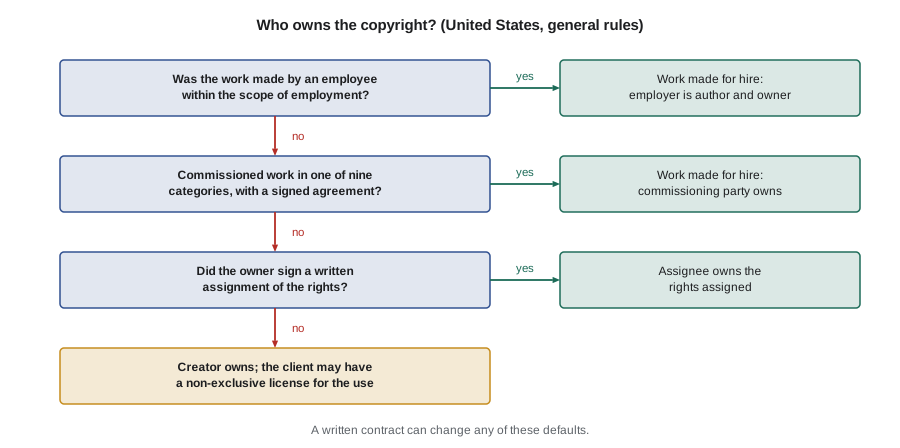
Under the American Copyright Act, the author is the first owner unless the work is a work made for hire. In that case the employer or commissioning party is legally the author, not merely the owner, which affects the term of protection and removes the author's later right to terminate transfers. A freelancer who creates a work for a client owns it unless it qualifies as a work made for hire or the contract assigns it.
Employees and the course of employment
Works created by employees as part of their jobs belong to the employer. The key questions are whether the creator is an employee rather than an independent contractor, and whether the work was created in the course or scope of the employment.
American courts apply the factors set out by the Supreme Court in Community for Creative Non-Violence v Reid (1989), including the hiring party's right to control how the work is done, the skill required, the source of tools, the duration of the relationship, the method of payment, employee benefits and tax treatment. In that case, a sculptor commissioned by a charity was an independent contractor, so he owned the copyright in the sculpture.
Labels in a contract do not decide employment status on their own. A contract that calls someone an independent contractor will not make them one if the relationship looks like employment, and the opposite is also true. Employment status also matters for tax, benefits and employment standards, as BUS-210 explains.
Commissioned works
Commissioned works are where the two countries differ most, and where freelancers and producers most often make mistakes.
In the United States, a commissioned work is a work made for hire only if two conditions are met: it falls within one of nine statutory categories, and the parties sign a written agreement stating that it is a work made for hire. The categories include a contribution to a collective work, a part of a motion picture or other audiovisual work, a translation, a supplementary work, a compilation, an instructional text, a test, answer material for a test and an atlas.
A stand-alone photograph, such as a portrait or a product shot for a website, usually does not fall within any category, so calling it a work made for hire in a contract does not make it one. To transfer ownership, the client needs a written assignment instead. Many contracts include both: a work-for-hire clause and, as a fallback, an assignment of all rights if the work does not qualify.
Worked problem
Who owns the corporate video?
A Denver company hires a freelance videographer to produce a promotional video. The contract says the video is a work made for hire. Two years later, the company wants to cut the footage into a television commercial. Who owns the footage?
Show solution
- The videographer is a freelancer, not an employee.
- A stand-alone promotional video can count as part of an audiovisual work, one of the nine categories, and there is a signed agreement calling it a work made for hire.
- If the work qualifies, the company is the author and owner; if a court disagreed, the result would depend on whether the contract also contains an assignment.
Answer: The company very likely owns the footage and can make the commercial. Careful contracts add a backup assignment in case the work-for-hire label fails.
Joint works and co-authors
A joint work is created by two or more authors whose contributions are not distinct from one another, or who intend their contributions to be merged into one work. Co-authors share ownership, and the rules on what one co-owner can do without the others differ between countries.
In the United States, a joint work requires each author to contribute independently copyrightable expression and to intend to merge contributions into a unitary whole. Each co-owner may grant non-exclusive licenses without the others' consent, but must account to them for a share of the profits. An exclusive license or assignment needs all co-owners.
Disputes over joint authorship often involve collaborators who never signed anything: a director and a cinematographer who developed a documentary together, two photographers who shared a project, or a writer and a performer who improvised scenes. A short written collaboration agreement at the start avoids most of them by stating who owns what, how decisions are made and how income is shared.
Assignments and licenses
Rights move in two main ways. An assignment transfers ownership of the copyright, in whole or in part. A license gives permission to use the work while the owner keeps ownership. A license can be exclusive, which means the owner promises not to license anyone else for the same rights, or non-exclusive, which means the owner may license others.
An American transfer of ownership, including an exclusive license, must be in writing and signed by the owner. A non-exclusive license can be oral or implied from conduct, for example when a client pays for a work created for a specific use. Transfers can be recorded with the Copyright Office, which gives notice to the world and helps with priority if the same rights are transferred twice.
| Feature | Assignment | Exclusive license | Non-exclusive license |
|---|---|---|---|
| Who owns the copyright afterwards | The assignee, for the rights assigned | The original owner | The original owner |
| Can the owner license others for the same rights | No | No | Yes |
| Must it be in writing | Yes | Yes | Best practice; may be implied in some cases |
| Typical use | Buying a script or a score outright | A distributor's rights in a territory | Stock photo or music library license |
| Price | Highest | High | Lowest |
Terminating transfers
Some laws let authors recover rights they transferred long ago. These rules matter to producers who rely on old rights, such as a novel optioned decades ago.
American authors and their heirs can terminate transfers made on or after 1 January 1978 during a five-year window that begins 35 years after the grant, by serving notice in advance. The right cannot be waived by contract and does not apply to works made for hire. A derivative work, such as a film made before termination, can continue to be exploited, but new derivative works need a new grant.
Ownership on a film set
On a typical production, rights come in from dozens of contributors. The production company's job is to make sure each contribution ends up owned by, or licensed to, the company, in writing.
- Writers sign an assignment or work-for-hire agreement, usually through a writer's agreement with guild terms where applicable.
- Directors, cinematographers, editors and designers sign deal memos that assign their rights or make their contributions works made for hire, and waive moral rights where the law allows.
- Composers sign composer agreements, which may assign the score or license it while the composer keeps the publishing rights.
- Performers sign contracts that grant the right to use their performances, names and likenesses, under union agreements where applicable.
- Photographers, illustrators and animators on contract sign agreements that transfer or license their work.
The collected agreements form part of the chain of title (Lesson 10). A gap anywhere, such as a camera operator who shot second-unit footage without a deal memo, can delay a sale while the producer tracks down a signature.
Worked problem
Finding the gaps in a short film's paperwork
A short film is selected for a festival with a sales market. A buyer asks for proof of ownership. The producer has signed agreements with the writer, the director and the actors. The composer was paid but signed nothing. A friend shot drone footage as a favor. Stills were taken by a volunteer. Which items are gaps?
Show solution
- Composer: payment alone does not transfer ownership; at most it creates a license of uncertain scope. A written agreement is needed.
- Drone footage: the friend owns the footage unless there is a written transfer or license. Get one, ideally retroactive, covering all uses.
- Stills: the volunteer owns the photographs. The producer needs a license to use them for publicity, and the buyer will want that license to pass to it.
Answer: Three gaps: the composer, the drone operator and the stills photographer. Each needs a short written agreement before the sale closes.
Practical rules
Most ownership problems can be solved with three practical rules. First, decide who should own each element before work starts, and write it down. Second, use the right instrument: an employment contract, a work-for-hire agreement where the law allows it, an assignment, or a license of a defined scope. Third, keep copies of signed documents in an organized file, because they will be needed for every sale, insurance application and dispute.
Ownership of footage, photographs and files
Owning the copyright in a work is different from owning the physical or digital copy. A client who receives a hard drive of raw footage, or a print of a photograph, owns that object but not the copyright, and a photographer who keeps the original files does not lose ownership of a copyright she has assigned. Contracts should deal separately with deliverables, such as which files are handed over, in what format and when, and with rights, such as which uses the client may make. Disputes often arise when a client asks for raw files or project files that the contract never mentioned. Stating clearly whether raw footage, outtakes and editing project files are included, and at what price, avoids most of them.
Common mistakes
MistakeAssuming that paying for a work means owning it
InsteadGet a written assignment or confirm that an employment or work-for-hire rule applies.
MistakeLabeling a stand-alone photograph a work made for hire
InsteadUse a written assignment when the work does not fall within the statutory categories.
MistakeRelying on an oral agreement to transfer copyright
InsteadPut assignments and exclusive licenses in writing, signed by the owner.
MistakeForgetting that collaborators may be co-authors
InsteadSign a collaboration agreement that sets out ownership and decision making.
MistakeIgnoring rights in footage shot by friends or volunteers
InsteadGet written licenses or transfers from every contributor, including unpaid ones.
Summary and key terms
- The author is generally the first owner, with exceptions for employees and certain commissioned works.
- Employment status is decided by the whole relationship, not the label in a contract.
- Commissioning a work does not, by itself, transfer copyright.
- Joint authors share ownership, and the rules on licensing without consent differ by country.
- Assignments transfer ownership; licenses give permission while the owner keeps the copyright.
- Transfers of ownership and exclusive licenses must be in writing and signed.
- Some laws let authors or their heirs recover rights years after a transfer.
- Author
- The person who creates a work.
- First owner
- The person who owns a work when it is created, usually the author.
- Work made for hire
- A work owned from creation by an employer or, for certain categories, a commissioning party under a signed agreement.
- Assignment
- A transfer of ownership of some or all of the rights in a work.
- License
- Permission to use a work while the owner keeps the copyright.
- Exclusive license
- A license in which the owner agrees not to license the same rights to anyone else.
- Joint work
- A work created by two or more authors whose contributions are merged.
- Implied license
- Permission inferred from the circumstances rather than stated in writing.
- Reversionary interest
- A rule that returns transferred rights to an author's estate after a set period.
- Collaboration agreement
- A contract between co-creators setting out ownership, decisions and income.
Practice problems
Work each problem on paper first, then reveal the answer to check.
Who is the first owner of a work created by an employee as part of their job?
Show answer
The employer, unless there is an agreement otherwise.
Does paying a freelancer for a logo transfer the copyright?
Show answer
Not by itself; a written assignment is needed.
Why do contracts sometimes include both a work-for-hire clause and an assignment?
Show answer
The assignment is a fallback if the work does not qualify as a work made for hire.
What must an assignment of copyright have to be valid?
Show answer
It must be in writing and signed by the owner.
What is the difference between an exclusive and a non-exclusive license?
Show answer
An exclusive license bars the owner from licensing others for the same rights.
Who usually owns drone footage shot by a friend as a favor?
Show answer
The friend, unless there is a written transfer or license.
Name two contributors whose agreements form part of a film's chain of title.
Show answer
For example, the writer and the composer.
What problem can arise if two collaborators never signed an agreement?
Show answer
A dispute over joint authorship, ownership and income.
Why should producers check for reversion or termination rights on older works?
Show answer
Rights transferred long ago can return to the author or heirs.
What are the three practical rules for ownership?
Show answer
Decide ownership before work starts, use the right instrument and keep signed documents organized.
Lesson quiz · 5 questions
Score 60% or more to complete this lesson.
Create a free account to save your progress, take quizzes and earn a certificate.