
FILM-420 · Lesson 4 of 12 · 25 min
Infringement, remedies and enforcement online
Infringement happens when someone does one of the copyright owner's exclusive acts without permission and without an exception that applies. For image makers, infringement runs in both directions. Your photographs and videos are copied, reposted, cropped and used in advertising without permission every day. And your own projects can infringe if they include unlicensed music, footage, artwork or photographs. This lesson explains how infringement is proved, what remedies the law offers, and how enforcement works online.
PHOT-410 lesson 4 covers small claims and online infringement from a photographer's business point of view, including how to price a retroactive license. This lesson concentrates on the legal tests and the enforcement systems, and on avoiding infringement in your own work.
Proving infringement
To succeed in a claim, a copyright owner generally has to show three things: that they own a valid copyright in the work, that the defendant copied it, and that what was copied amounts to a substantial part of the protected expression.
Copying can be proved directly, for example by metadata, watermarks, an admission or a screen recording, but more often it is inferred from access and similarity. If the defendant had a reasonable opportunity to see the work, and the two works are similar in ways that are unlikely to be coincidence, a court can conclude that copying occurred. Independent creation is a complete answer: two people can create similar works without infringing if neither copied the other.
American courts ask whether the works are substantially similar in protected expression. Methods vary by federal circuit. Many courts first filter out unprotected elements, such as ideas, facts and stock scenes, and then compare the remaining expression, sometimes through the eyes of an ordinary observer. The Ninth Circuit, which covers California, uses an extrinsic test of objective elements and an intrinsic test of overall impression.
Kinds of infringement
Direct infringement is doing a restricted act yourself, such as copying a photograph onto a website. Secondary infringement covers people who did not copy the work themselves but are responsible for infringement in other ways.
American law recognizes contributory infringement, when someone knowingly induces or materially contributes to another's infringement, and vicarious infringement, when someone has the right and ability to supervise the infringer and a direct financial interest in it. The Digital Millennium Copyright Act prohibits circumventing access controls and removing or altering copyright management information knowingly, with separate statutory damages for violations.
Producers can face secondary liability too. A producer who hires an editor knowing that the edit uses unlicensed music, or a distributor who keeps selling a film after being told it infringes, can be liable along with the person who made the copy.
Remedies
Courts can award several remedies when infringement is proved. The most important for image makers are injunctions, damages and profits, statutory damages, and costs or fees.
- An injunction orders the infringer to stop, for example to take down a website image, recall copies or stop distributing a film. A court can grant an interim injunction before trial in urgent cases.
- Damages compensate the owner for actual loss, often measured by the license fee the infringer should have paid.
- An accounting of profits requires the infringer to hand over profits made from the infringement.
- Statutory damages, available in both countries, let a court award an amount within a range set by law, without proof of actual loss.
- Costs or fees shift some of the legal expenses of the case.
American statutory damages range from 750 to 30,000 dollars per work infringed, at the court's discretion. A court can increase the award to up to 150,000 dollars per work for willful infringement, and reduce it to as little as 200 dollars for innocent infringement. Statutory damages and attorney's fees are available only if the work was registered before the infringement began, or within three months of first publication (Lesson 2).
Attorney's fees are not awarded automatically; a court may award reasonable fees to the prevailing party, considering factors such as the reasonableness of each side's position. Without timely registration, an owner can recover only actual damages and profits, which for a single photograph may be a few hundred dollars, while litigation in federal court costs far more.
fee = 600                  # what permission for this use would have cost
profits = 0                # infringer's profits traceable to the image (hard to prove)
ranges = {"commercial range A": (500, 20000), "range B": (750, 30000)}
print("Actual damages estimate:", fee + profits)
for name, (low, high) in ranges.items():
    mid = (low + high) / 2
print(f"{name}: minimum {low}, midpoint {mid:,.0f}, maximum {high:,}")Actual damages estimate: 600 commercial range A: minimum 500, midpoint 10,250, maximum 20,000 range B: minimum 750, midpoint 15,375, maximum 30,000
In the output, the first range is the Canadian commercial range and the second is the American range. For an American photographer who registered in time, statutory damages and the possibility of fees change the negotiation completely. Without timely registration, the claim is worth roughly the license fee, and most photographers settle or use the Copyright Claims Board.
Enforcement short of court
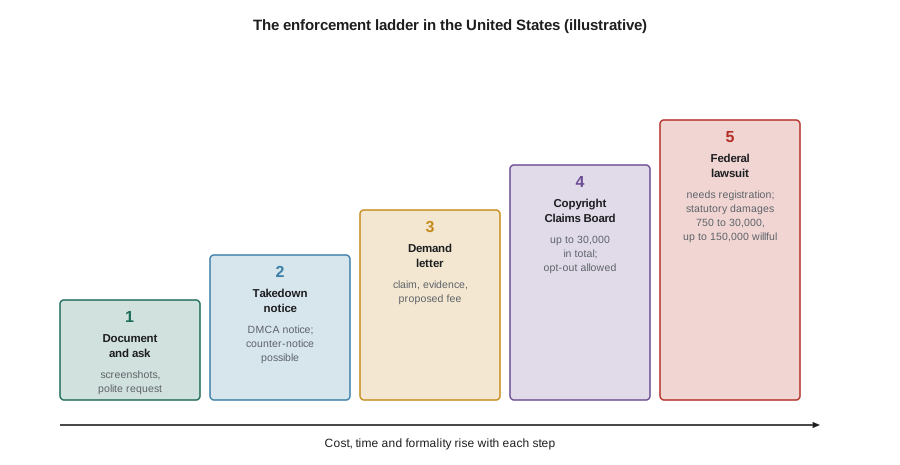
Most infringement disputes never reach a courtroom. A sensible sequence starts with the cheapest tools and escalates only as needed.
- Document the infringement: screenshots with dates and URLs, copies of the page, and evidence of your ownership and original files.
- Ask: a polite request to credit, license or remove often works, especially with individuals and small businesses.
- Use platform tools: notice systems, content-identification services and reporting forms.
- Send a demand letter: set out the claim, the evidence and a proposed license fee or settlement, with a deadline.
- Use a small-claims process or court only if the value and evidence justify it.
American law includes the notice-and-takedown system of section 512 of the Digital Millennium Copyright Act. A service provider that removes or disables access to material promptly after receiving a valid notice is protected from liability. The user can send a counter-notice, after which the provider may restore the material in 10 to 14 business days unless the owner sues. Anyone who knowingly misrepresents infringement in a notice or counter-notice is liable for damages, and owners must consider fair use before sending a notice (Lenz v Universal Music, 2015).
Platforms add their own private systems on top of the law. Content-identification systems on video platforms match uploads against reference files from rights holders and let them block, track or monetize matches. They are fast and cheap, but they make mistakes, especially with public domain material, licensed music and fair dealing or fair use. Filmmakers who license music should keep copies of licenses to dispute wrong claims.
Small claims options
For individual photographers and small producers, the cost of court often exceeds the value of a claim. Lower-cost options exist.
The Copyright Claims Board, created by the CASE Act of 2020, decides copyright claims up to 30,000 dollars in total, without lawyers being required and largely online. Statutory damages are capped at 15,000 dollars per work for timely registered works and 7,500 dollars for works not timely registered, within the 30,000 dollar total. Respondents can opt out within 60 days of being served, in which case the claim ends and the owner must go to federal court. A registration application must be filed before bringing a claim.
Avoiding infringement in your own work
The best defense is not to infringe. Infringement claims against filmmakers and photographers usually come from a handful of predictable sources, and each has a preventive step.
| Source | Example | Prevention |
|---|---|---|
| Music | A popular song playing on set or added in the edit | License sync and master rights or use cleared library music |
| Footage and stills | A news clip or photograph found online | License from the owner or archive, or rely on a documented exception |
| Artwork and design | Posters, paintings or sculptures on set | Use cleared or original art, or get permission |
| Scripts and stories | An idea pitched to the producer earlier | Keep submission records and use submission agreements |
| Fonts and software | Commercial fonts in titles, plug-ins in the edit | Check licenses for commercial use |
| Characters and formats | A character that resembles a famous one | Create original characters and review similarities |
Unsolicited submissions deserve special care. Producers who receive scripts or pitches can face claims that a later project copied them, even when it was developed independently. Many companies refuse unsolicited material or require a submission release, and they keep records of their own development to prove independent creation.
Worked problem
Responding to a demand letter
A small production company receives a demand letter claiming that a photograph used in the background of a web series episode infringes copyright. The letter demands 7,500 and attaches the photographer's registration certificate. The production cannot find any license. What should it do?
Show solution
- Preserve evidence and take the episode down or blur the image while you investigate, to stop any continuing infringement.
- Check the facts: who added the photograph, where it came from, whether any license exists, how long the episode was online and how many people viewed it.
- Assess the claim: whether the photograph is featured or barely visible, whether an exception could apply, and the likely range of remedies in the jurisdiction.
- Respond in writing, ideally through a lawyer, with a counter-offer based on a fair license fee if the claim appears valid.
Answer: The company should stop the use, investigate, assess its exposure and negotiate. Ignoring the letter or deleting evidence makes things worse.
Criminal and border remedies
Deliberate commercial-scale piracy can be a crime in both countries, punished by fines and imprisonment, and customs authorities can detain infringing goods at the border at the request of rights holders. These remedies matter mainly to large rights holders, but filmmakers should know that sharing a screener of an unreleased film can expose the sharer to serious consequences, both under the law and under festival and distribution contracts.
Limitation periods and keeping evidence
Infringement claims must be brought within a limitation period, so delay can cost an owner their remedy. Owners should act reasonably promptly once they discover an infringement, and producers who receive a claim should note the dates involved.
The American Copyright Act requires civil claims to be brought within three years after the claim accrued. In Warner Chappell Music v Nealy (2024), the Supreme Court held that a timely claim can recover damages for infringements more than three years old under the discovery rule used in many circuits, without deciding whether that rule applies.
Keep original files, metadata, contracts and correspondence for as long as the works are being exploited, plus the limitation period. These records prove ownership, dates of creation and the terms of each license.
Common mistakes
MistakeAssuming that independent creation is no answer to a claim
InsteadIndependent creation is a complete defense; keep development records that show it.
MistakeIgnoring a demand letter
InsteadInvestigate, preserve evidence and respond, ideally with legal advice.
MistakeSending a takedown notice without considering exceptions
InsteadConsider fair dealing or fair use and the facts before sending a notice.
MistakeRelying only on platform systems to judge infringement
InsteadKeep your own licenses and dispute wrong content-identification claims.
MistakeThinking small claims are always available for any remedy
InsteadCheck the forum's limits on amount and on remedies such as injunctions.
Summary and key terms
- Infringement requires ownership, copying and the taking of a substantial part of protected expression.
- Copying is often inferred from access and similarity; independent creation defeats a claim.
- Secondary infringement can make distributors and producers liable for others' copying.
- Remedies include injunctions, damages, profits, statutory damages and costs or fees.
- Online enforcement relies on legal notice systems and private platform tools.
- Small claims options lower the cost of enforcing modest claims.
- Most infringement by producers comes from music, footage, art and unsolicited ideas, and can be prevented.
- Infringement
- Doing an act reserved to the copyright owner without permission or an applicable exception.
- Substantial part
- A part of a work important enough in quality or quantity that copying it infringes.
- Independent creation
- Creating a similar work without copying, a complete defense.
- Secondary infringement
- Liability for dealing in, enabling or profiting from another's infringement.
- Injunction
- A court order to stop doing something.
- Accounting of profits
- A remedy requiring an infringer to hand over profits from infringement.
- Demand letter
- A letter setting out a claim and proposing a settlement.
- Takedown system
- A system in which a host removes material after a valid notice from the owner.
- Counter-notice
- A user's response asking a host to restore removed material.
- Content identification
- Automated systems that match uploads against rights holders' reference files.
Practice problems
Work each problem on paper first, then reveal the answer to check.
What three things must a copyright owner usually prove?
Show answer
Ownership, copying and the taking of a substantial part.
How is copying usually proved when there is no direct evidence?
Show answer
By access plus similarity unlikely to be coincidence.
Name two remedies a court can award for infringement.
Show answer
For example, an injunction and statutory damages.
Why should an image maker document infringement before contacting the infringer?
Show answer
Evidence can disappear once the infringer is alerted.
What is the first, cheapest enforcement step?
Show answer
A polite request to credit, license or remove.
Why should a producer keep copies of music licenses?
Show answer
To dispute wrong content-identification claims and satisfy buyers.
Why do companies use submission releases?
Show answer
To reduce the risk of claims that later projects copied unsolicited ideas.
What should a production do first after receiving a credible demand letter?
Show answer
Preserve evidence and stop or limit the use while investigating.
Give one source of infringement claims against filmmakers and its prevention.
Show answer
For example, music playing on set, prevented by licensing or using cleared music.
Can sharing an unreleased film's screener have consequences?
Show answer
Yes, legal and contractual consequences, including possible criminal liability for commercial piracy.
Lesson quiz · 5 questions
Score 60% or more to complete this lesson.
Create a free account to save your progress, take quizzes and earn a certificate.