
FILM-430 · Lesson 3 of 12 · 25 min
Realism
Realist film theory turns the formalist argument on its head. Where formalists praised film for transforming reality, realists argued that cinema's unique power lies in its bond with the physical world. A photograph or film shot, they said, is not merely a picture of something; it is a trace left by light reflected from real objects. This lesson covers the two great realist theorists, André Bazin and Siegfried Kracauer, the filmmaking movements associated with realism, and the debates their ideas still provoke.
FILM-120 Lesson 7 covered Italian neorealism as a historical movement. Here the focus is on the theory that celebrated it and the questions that theory raises about style, ethics and truth.
Bazin and the ontology of the photographic image
André Bazin was a French critic who co-founded the journal Cahiers du cinéma in 1951 and mentored the critics who became the French New Wave. His essays, collected after his early death in 1958 as What Is Cinema?, remain among the most influential writing on film. In his essay on the ontology of the photographic image, Bazin argued that photography satisfied a deep human desire to preserve things against time, a desire he traced back to Egyptian mummification. Painting could only approximate its subject; photography, produced mechanically by light, transfers reality from the thing to its reproduction.
Later theorists described this relationship using the philosopher Charles Sanders Peirce's term index: a sign that is physically caused by its object, like a footprint or smoke from a fire. The photograph is an index of what was before the lens. Bazin also argued that cinema adds time to this trace, preserving duration and change. He called the dream of a complete representation of reality the myth of total cinema and suggested that each technical advance, from sound to color to widescreen, moved cinema closer to it, the opposite of Arnheim's fear in Lesson 2.
Depth, the long take and ambiguity
Bazin's most practical arguments concerned style. He contrasted two tendencies: directors who put their faith in the image, using editing and expressive manipulation to impose meaning, and directors who put their faith in reality, using techniques that preserve the continuity and ambiguity of the world. He admired deep-focus staging, in which foreground and background are both sharp, and the long take, which keeps space and time intact.
In Bazin's view, analytical editing breaks a scene into close-ups that tell the viewer exactly where to look and what to think. Deep focus and long takes, by contrast, present a whole space in which several actions occur at once and let viewers choose what to notice. The spectator's relationship to the image becomes closer to their relationship with reality, which is active, open and ambiguous. Bazin praised Orson Welles's Citizen Kane (1941) and William Wyler's The Best Years of Our Lives (1946) for staging in depth, and Jean Renoir's films of the 1930s for their fluid camera and crowded, layered compositions.
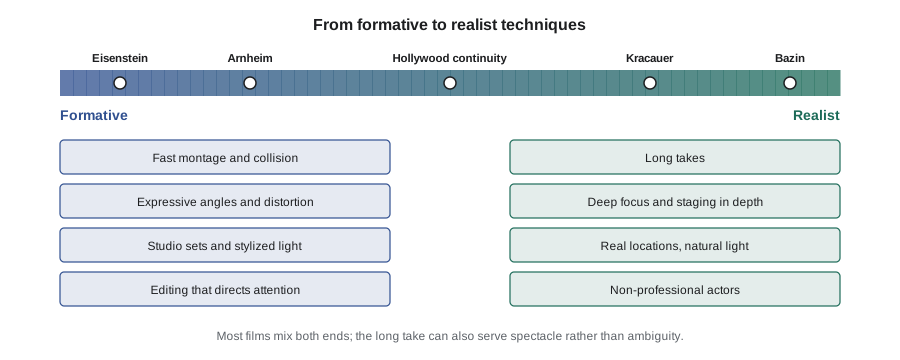
Bazin did not reject editing altogether. He argued that when the essence of a scene depends on the simultaneous presence of two or more elements, such as a hunter and an animal in the same frame, editing that separates them destroys the scene's truth. When it does not, editing is acceptable. This principle, sometimes summarized as forbidden montage, is a useful test for filmmakers today: if the audience must believe two things truly shared a space, keep them in the same shot.
Worked problem
Testing Bazin's principle on a scene
A documentary shows a wildlife photographer approaching a wild bear. The editor has two options: intercut separate close-ups of the photographer and the bear, or use a single wide shot that holds both in the frame as the distance closes. Apply Bazin's principle.
Show solution
- Identify the essence of the scene: the danger and tension depend on the real proximity of person and animal.
- Intercutting could be assembled from shots filmed at different times and places, so it cannot prove that they shared the space; Kuleshov's creative geography (Lesson 2) shows how easily editing fabricates proximity.
- A single wide shot, held as the gap closes, preserves the spatial truth and lets viewers judge the danger themselves.
- Close-ups can still be used before and after the moment of shared presence, where proximity is not the point.
Answer: Bazin would insist on the wide shot for the moment of proximity, because the scene's truth depends on both being present together.
Italian neorealism as Bazin's model
Bazin championed Italian neorealism, the movement that emerged after the Second World War in films such as Roberto Rossellini's Rome, Open City (1945) and Vittorio De Sica's Bicycle Thieves (1948). Neorealist films shot on real streets, used non-professional actors alongside professionals, followed ordinary people in everyday situations, and favored episodic stories over tight plots. The screenwriter Cesare Zavattini, a key neorealist voice, called for films that would show daily life in its ordinary duration, without the artificial drama of conventional storytelling.
For Bazin, Bicycle Thieves exemplified a cinema in which events are not arranged to illustrate a predetermined meaning but simply happen, and meaning emerges from them. A worker searches Rome for his stolen bicycle with his young son; the film follows the search, the detours and the small humiliations, and it ends without resolution. Bazin admired the film's apparent absence of artifice, while recognizing that this impression was itself carefully achieved.
Kracauer and the redemption of physical reality
Siegfried Kracauer, a German critic who emigrated to the United States, published Theory of Film in 1960 with the subtitle The Redemption of Physical Reality. Kracauer argued that film has an affinity for certain kinds of subject matter: the unstaged, the fortuitous, the endless, the indeterminate and what he called the flow of life. Films that respect these affinities, by recording street scenes, crowds, chance events and fleeting movements, realize the medium's potential. Films that impose theatrical staging, literary plots or abstract designs work against it.
Kracauer's theory has a moral and historical dimension. He wrote in the shadow of the Second World War and the Holocaust and believed that modern people had lost contact with concrete experience, living among abstractions. Film, by showing the physical world in detail, could restore that contact. His earlier book From Caligari to Hitler (1947) had argued that German films of the 1920s revealed the psychological dispositions that prepared the way for Nazism, an early attempt to read films as evidence of a society's mentality.
| Aspect | André Bazin | Siegfried Kracauer |
|---|---|---|
| Key texts | Essays collected as What Is Cinema? (1958 to 1962) | Theory of Film (1960) |
| Core idea | The image is an imprint of reality that preserves time | Film redeems physical reality and the flow of life |
| Favored techniques | Deep focus, long take, staging in depth | Recording chance, street life, crowds and fleeting movements |
| Attitude to fiction | Accepts fiction if style respects reality's ambiguity | Prefers loosely plotted films open to the unstaged |
| Exemplary films | Neorealism, Renoir, Welles, Wyler | Lumière actualities, neorealism, documentary |
Realism and documentary movements
Realist ideas helped shape documentary practice in the 1950s and 1960s, when lightweight cameras and synchronized sound recorders allowed filmmakers to follow people without staging. Two broad approaches emerged. Observational or direct cinema aimed to be a fly on the wall, recording events with minimal intervention. Cinéma vérité, associated with Jean Rouch in France, accepted and even provoked the camera's influence, treating filming as a catalyst that could reveal truths.
In the United States, Robert Drew's team, including Richard Leacock, D. A. Pennebaker and Albert and David Maysles, made Primary (1960), which followed John F. Kennedy and Hubert Humphrey through a Wisconsin election campaign. Frederick Wiseman's long observational studies of institutions, from Titicut Follies (1967) onward, became a model of direct cinema, while Canadian filmmakers at the National Film Board developed similar approaches in parallel.
The long take today
The long take remains a powerful marker of realism, but its meaning has shifted. Some contemporary films, often grouped as slow cinema, use extremely long takes and minimal action to make viewers feel duration, in a tradition running from Chantal Akerman's Jeanne Dielman, 23 quai du Commerce, 1080 Bruxelles (1975) to the work of Béla Tarr and Kelly Reichardt. Other films use long takes for spectacle: digitally stitched sequences that appear continuous, as in Birdman (2014) or 1917 (2019), aim for immersion and virtuosity rather than Bazinian ambiguity.
Simple arithmetic shows how far such films depart from typical editing. The figures below are rounded, and hidden cuts make exact counts debatable, but they illustrate the scale of the difference.
films = [
    ("Typical recent studio feature (illustrative)", 120, 2400),
    ("Rope (1948), about 10 takes", 80, 10),
    ("Russian Ark (2002), one take of about 90 minutes", 90, 1),
]
for name, minutes, shots in films:
    asl = minutes * 60 / shots
print(f"{name}: ASL {asl:,.0f} s")Typical recent studio feature (illustrative): ASL 3 s Rope (1948), about 10 takes: ASL 480 s Russian Ark (2002), one take of about 90 minutes: ASL 5,400 s
The comparison does not prove that longer takes are more realist. Russian Ark glides through a museum in a single take but stages centuries of history with elaborate choreography. The long take is a technique; whether it serves realism depends on what it shows and how.
Critiques of realism
Realist theory has been challenged from several directions. Formalists argue that every film involves selection and construction, so no style is closer to reality than another. Ideological critics, discussed in Lesson 6, argue that the impression of reality is precisely what makes mainstream cinema persuasive: by hiding its construction, it presents a particular view of the world as natural. Semioticians, discussed in Lesson 7, argue that even photographs are read through cultural codes. And digital technology, discussed in Lesson 11, has weakened the indexical bond on which Bazin's ontology rested, since an image may now be generated or altered without any original object.
Defenders reply that realism was never a claim that films are neutral copies. Bazin understood neorealism as an aesthetic, and he valued ambiguity because it gives viewers freedom. The ethical core of realism, respect for the world and for the viewer's judgment, remains attractive to many filmmakers, especially in documentary, where audiences still expect that what they see actually happened.
Common mistakes
MistakeThinking Bazin rejected all editing
InsteadBazin objected to editing that destroys the truth of a scene depending on simultaneous presence, not to editing in general.
MistakeAssuming long takes are automatically realist
InsteadAsk what the long take shows and whether it preserves ambiguity or creates spectacle.
MistakeCalling neorealism unstaged documentary
InsteadNeorealist films were scripted fictions that used real locations and non-professional actors to create an impression of reality.
MistakeTreating index as meaning resemblance
InsteadAn index is a sign physically caused by its object, like a footprint; resemblance is an icon.
MistakeConfusing direct cinema with cinéma vérité
InsteadDirect cinema minimizes intervention; cinéma vérité accepts or provokes the camera's influence.
Summary and key terms
- Realists argued that film's power lies in its physical bond with reality rather than in transforming it.
- Bazin saw the photographic image as an imprint of reality that preserves time, an idea later described with Peirce's term index.
- Bazin valued deep focus and long takes for preserving the continuity and ambiguity of space and time.
- His principle of forbidden montage says to keep elements in one shot when the scene's truth depends on their shared presence.
- Kracauer argued that film redeems physical reality and has affinities for the unstaged, the fortuitous and the flow of life.
- Realist ideas shaped direct cinema and cinéma vérité, including Canada's Candid Eye and Quebec's cinéma direct.
- Critics challenge realism as construction, ideology and code, and digital imaging weakens its indexical basis.
- Realism
- Theories valuing film's bond with physical reality and styles that preserve it.
- Index
- A sign physically caused by its object, such as a footprint or a photograph.
- Myth of total cinema
- Bazin's term for the dream of a complete reproduction of reality.
- Deep focus
- Staging and lens choices that keep foreground and background sharp at once.
- Long take
- A shot of unusually long duration that preserves continuous time and space.
- Forbidden montage
- Bazin's principle that editing must not separate elements whose shared presence is essential.
- Neorealism
- Postwar Italian movement using real locations, ordinary people and episodic stories.
- Flow of life
- Kracauer's term for the open, unstaged continuity of everyday reality.
- Direct cinema
- Observational documentary that minimizes the filmmaker's intervention.
- Cinéma vérité
- Documentary approach that accepts or provokes the camera's influence to reveal truth.
Practice problems
Work each problem on paper first, then reveal the answer to check.
Explain why Bazin compared photography to mummification.
Show answer
Both answer a desire to preserve things against time; photography preserves an imprint of reality.
What is an index, and why is a photograph one?
Show answer
A sign physically caused by its object; a photograph is caused by light from what was before the lens.
Why did Bazin admire deep focus?
Show answer
It presents whole spaces and lets viewers choose what to notice, preserving ambiguity.
When would Bazin's forbidden montage principle require a single shot?
Show answer
When the scene's truth depends on two elements really sharing the space.
Name two features of Italian neorealism.
Show answer
Real locations, non-professional actors, everyday subjects, episodic stories.
List two of Kracauer's affinities of film.
Show answer
The unstaged, the fortuitous, the endless, the indeterminate, the flow of life.
Calculate the ASL of an 80-minute film made of 10 takes.
Show answer
4,800 seconds divided by 10 is 480 seconds, or 8 minutes.
Give one reason a long take may not be realist.
Show answer
It may be digitally stitched spectacle or elaborately staged rather than preserving ambiguity.
Distinguish direct cinema from cinéma vérité.
Show answer
Direct cinema observes with minimal intervention; vérité accepts or provokes the camera's influence.
How does digital imaging challenge Bazin's ontology?
Show answer
Images can be generated or altered without an original object, weakening the indexical bond.
Lesson quiz · 5 questions
Score 60% or more to complete this lesson.
Create a free account to save your progress, take quizzes and earn a certificate.