
FILM-430 · Lesson 4 of 12 · 25 min
Auteur theory and its critics
When people say "a Hitchcock film" or "a Villeneuve film", they are using auteur theory, often without realizing it. The idea that the director is the true author of a film, whose personality and vision can be traced across many works, transformed criticism in the 1950s and 1960s and remains the default way that festivals, critics and marketers talk about cinema. This lesson traces the theory from its French origins to its American translation, its structuralist revision and the many objections it has faced.
FILM-120 Lesson 8 covered the French New Wave as a historical movement, and FILM-320 Lesson 1 looked at the director's role from the inside. This lesson examines authorship as a critical theory: what it claims, what it reveals and what it hides.
The politique des auteurs
In the early 1950s, a group of young critics at Cahiers du cinéma, including François Truffaut, Jean-Luc Godard, Claude Chabrol, Éric Rohmer and Jacques Rivette, attacked the respected French cinema of their day. In a famous 1954 essay, Truffaut criticized what he called the tradition of quality: polished literary adaptations in which screenwriters supplied the substance and directors merely illustrated it. Against this, the critics praised directors who expressed a personal vision through the means of cinema itself: staging, camera movement, rhythm and tone.
They called their position the politique des auteurs, a policy or polemical stance rather than a theory. Its most provocative claim was that genuine authors could be found inside the Hollywood studio system, which French intellectuals had largely dismissed as industrial entertainment. Alfred Hitchcock, Howard Hawks, Nicholas Ray, Fritz Lang and Samuel Fuller worked on assigned genre projects with studio crews and stars, yet the Cahiers critics argued that their films revealed consistent themes and a recognizable style. Hitchcock's recurring concerns with guilt, voyeurism and the transfer of suspicion to innocent people became a standard example.
Bazin, the journal's co-founder, supported the young critics' enthusiasm but warned against a cult of personality. He argued that individual talent always works within a historical moment and a genre, and he cautioned that the policy could lead critics to praise every film by a favored director, however weak.
Mise-en-scène as the signature of the author
For the Cahiers critics, a director's authorship lay less in the story, which the studio often chose, than in the mise-en-scène: how the scene is staged, framed, lit and timed. Two directors could film the same script and produce entirely different works. The critic's task was to read the style closely and discover the vision it expressed. This emphasis made the director's handling of space and time the focus of criticism and encouraged careful attention to form that later theory would build on.
- Recurring themes: the questions, conflicts and obsessions that return across a director's films.
- Recurring style: characteristic camera movements, compositions, editing patterns, use of color or sound.
- Recurring collaborators: actors, cinematographers, editors and composers who help create a consistent world.
- Development over time: how the vision evolves, deepens or changes across a career.
Sarris and the auteur theory in America
The American critic Andrew Sarris introduced the French idea to English-language readers in 1962, calling it the auteur theory. He proposed three concentric circles of value. The outer circle was technical competence; the middle circle was a distinguishable personality, visible as recurring stylistic traits; and the inner circle was interior meaning, the tension between a director's personality and the material. In his 1968 book The American Cinema, Sarris ranked Hollywood directors into categories, placing Hitchcock, Ford, Hawks, Chaplin and a few others in a pantheon.
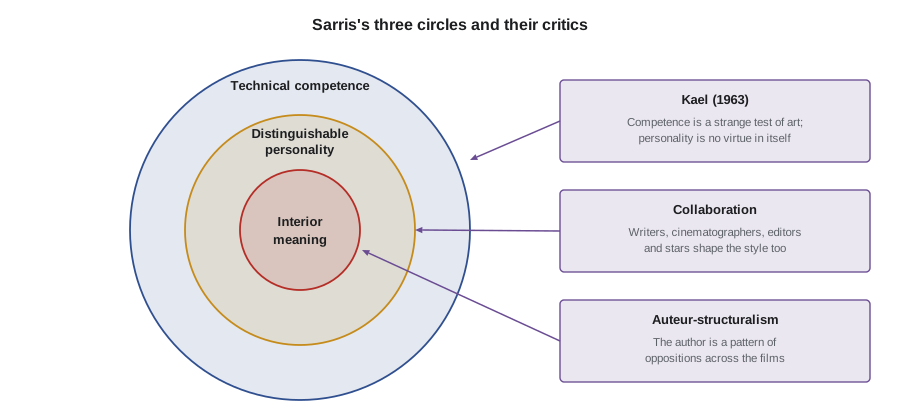
Sarris's ranking made auteurism a tool for writing film history and for rescuing neglected directors. It also made it hierarchical and personal, inviting fierce debate about who belonged in which category.
Kael's objections
The most famous response came from Pauline Kael, later the influential critic of The New Yorker. In her 1963 essay Circles and Squares, she mocked Sarris's criteria. Technical competence, she argued, is a strange requirement for art; a distinguishable personality is no virtue if the personality is dull or repellent; and interior meaning seemed to reward directors for struggling against poor material rather than for making good films. She worried that auteurism encouraged critics to value trivial genre films over ambitious ones simply because a favored director's touches could be found in them.
In 1971 Kael extended her critique in Raising Kane, an essay arguing that Herman J. Mankiewicz, the co-writer of Citizen Kane, deserved more credit for the film than auteurist criticism gave him. Scholars have disputed many of her claims, but the essay dramatized a central objection: films are collaborative, and crediting the director alone erases writers, cinematographers, editors, designers, actors and producers.
Worked problem
Applying Sarris's circles to a contemporary director
Apply Sarris's three circles to Denis Villeneuve, a Quebec director whose career runs from French-language films such as Incendies (2010) to English-language productions such as Arrival (2016) and the Dune films (2021 and 2024). Then note one objection a critic in Kael's tradition might raise.
Show solution
- Technical competence: Villeneuve's films are widely praised for their control of scale, sound and visual design, so the outer circle is easily met.
- Distinguishable personality: recurring traits include slow, deliberate pacing; vast, often desaturated landscapes; oppressive sound design; and protagonists facing violence, grief or incomprehensible forces.
- Interior meaning: a critic might argue that a consistent concern with communication across barriers, from war-torn family history in Incendies to language and time in Arrival, persists across very different material.
- Kael-style objection: much of the recognizable look and sound comes from collaborators such as cinematographers Roger Deakins and Greig Fraser and composer Jóhann Jóhannsson, and from big-budget studio franchises; the auteur label may credit one person for a collective style.
Answer: Villeneuve fits all three circles by Sarris's criteria, but a critic should also show how collaborators and studio structures shaped the style the label attributes to him.
Auteur-structuralism
In the late 1960s, critics influenced by structuralism (Lesson 7) tried to put auteur theory on a more rigorous footing. Peter Wollen, in Signs and Meaning in the Cinema (1969), argued that the auteur is not a living person but a structure: a pattern of oppositions found across a body of films. In John Ford's westerns, for example, critics traced recurring oppositions between wilderness and garden, nomad and settler, and individual and community. The pattern belongs to the films, not necessarily to Ford's conscious intentions, and it may combine with patterns contributed by stars, genres and studios.
This approach shifted attention from biography to the films as texts. It also linked auteurism to the wider structuralist project, which sought deep patterns beneath surface variety in myths, novels and cultures.
The death of the author and the author as brand
In 1967 the French critic Roland Barthes published an essay called The Death of the Author, arguing that meaning is produced by readers and by the network of texts a work draws on, not by the intention of a single creator. Applied to film, this challenged the idea that criticism should uncover the director's vision. Later scholars such as Timothy Corrigan observed that by the 1980s the auteur had become a commercial category: a brand name used to market films, organize festival programs and build fan communities. Directors give interviews, record commentaries and cultivate public personas that shape how audiences read their films.
Today the auteur is both a critical idea and an industrial fact. Streaming services commission directors with recognizable styles, festivals build retrospectives around names, and audiences follow filmmakers across platforms. Understanding authorship as partly a marketing construction does not make it meaningless, but it should make critics careful about taking the label at face value.
Who gets to be an auteur?
Auteur criticism has historically celebrated white male directors working in prestigious genres and markets. Feminist critics have noted that women directors were rare in classical Hollywood and that those who worked, such as Dorothy Arzner and Ida Lupino, were long neglected. Critics of color have noted that Black, Indigenous and Asian filmmakers were often discussed in terms of community representation rather than personal vision. Recent scholarship has expanded the canon and questioned whether the solitary genius model suits collaborative or community-based filmmaking.
In the United States, auteur criticism has shaped how audiences discuss directors from Martin Scorsese and Spike Lee to Kathryn Bigelow, Ava DuVernay and Greta Gerwig. Lee's Do the Right Thing (1989) and later work show a recognizable style, with direct address to the camera, saturated color and a signature floating dolly shot, combined with explicit political commitment. Critics have also asked why women and filmmakers of color have so rarely been granted the auteur label, and whether the model of the solitary genius fits collaborative, community-based filmmaking.
Measuring style across a body of work
Some scholars test auteurist claims with measurement, comparing a director's shot lengths, shot scales or camera movements with those of contemporaries. The example below uses invented figures to show the method: if a director's average shot lengths sit far from the norm for the period, that supports a claim of distinctive style, though it says nothing yet about meaning.
import statistics
director = [9.8, 11.2, 10.5, 12.1, 9.4]
peers = [4.9, 5.6, 6.2, 5.1, 4.4, 5.8, 6.0, 5.3, 4.7, 5.5]
mu, sd = statistics.mean(peers), statistics.stdev(peers)
print(f"Peer mean ASL {mu:.2f} s, standard deviation {sd:.2f} s")
for i, asl in enumerate(director, 1):
    z = (asl - mu) / sd
    print(f"Film {i}: ASL {asl:4.1f} s, z = {z:+.1f}")
print(f"Director's mean ASL {statistics.mean(director):.2f} s")Peer mean ASL 5.35 s, standard deviation 0.58 s Film 1: ASL 9.8 s, z = +7.7 Film 2: ASL 11.2 s, z = +10.1 Film 3: ASL 10.5 s, z = +8.9 Film 4: ASL 12.1 s, z = +11.6 Film 5: ASL 9.4 s, z = +7.0 Director's mean ASL 10.60 s
Every film sits several standard deviations above the peer mean, a strong sign of a consistent preference for longer takes. A good auteurist essay would then ask why: what the long takes do in each film, and whether they connect to recurring themes.
Using auteur theory well
Auteur theory remains useful when it is applied carefully. It encourages viewing a film in the context of a body of work, attending to style, and noticing development over a career. Its risks are hero worship, neglect of collaboration and industry, and the assumption that intention explains meaning. A strong auteurist essay names collaborators, places the director in an industrial and generic context, and argues for patterns with specific evidence from several films.
Common mistakes
MistakeTreating every film by a favored director as a masterpiece
InsteadEvaluate each film on its merits while noting how it fits the body of work.
MistakeIgnoring collaborators when describing a director's style
InsteadName the cinematographers, editors, writers and composers who help create the recognizable look and sound.
MistakeEquating authorship with the director's stated intentions
InsteadRead patterns in the films themselves, as auteur-structuralism suggested, and test them against evidence.
MistakeAssuming auteurs exist only in art cinema
InsteadThe Cahiers critics found auteurs inside the Hollywood studio system working on genre films.
MistakeUsing the auteur canon as if it were neutral
InsteadAsk whose work was excluded and how gender, race and nation shaped who was called an auteur.
Summary and key terms
- The Cahiers critics' politique des auteurs argued that directors could be authors even inside the studio system.
- Authorship was located mainly in mise-en-scène and recurring themes and style across a body of work.
- Sarris translated the idea as the auteur theory, with three circles of competence, personality and interior meaning.
- Kael objected to Sarris's criteria and emphasized collaboration, as in her claims about the writing of Citizen Kane.
- Auteur-structuralism located the author in patterns of oppositions across films rather than in a person.
- Barthes's death of the author and Corrigan's commerce of auteurism questioned intention and highlighted marketing.
- Critics have expanded the auteur canon and questioned the solitary genius model for collaborative and community-based work.
- Auteur
- A director regarded as the author of films that express a consistent personal vision.
- Politique des auteurs
- The Cahiers du cinéma critics' polemical policy of championing director-authors.
- Tradition of quality
- Truffaut's term for polished, literary French films he considered impersonal.
- Auteur theory
- Sarris's English-language version of the politique, with its three circles of value.
- Pantheon
- Sarris's top category of directors in The American Cinema.
- Interior meaning
- Sarris's innermost circle, the tension between a director's personality and material.
- Auteur-structuralism
- The search for patterns of oppositions across a director's films.
- Death of the author
- Barthes's argument that meaning comes from readers and texts, not the creator's intention.
- Commerce of auteurism
- Corrigan's idea that the auteur functions as a marketing brand.
- Body of work
- All the films by a filmmaker, read together for recurring themes and style.
Practice problems
Work each problem on paper first, then reveal the answer to check.
What did Truffaut criticize in his 1954 essay?
Show answer
The tradition of quality: polished literary adaptations in which directors only illustrated scripts.
Why was it provocative to call Hollywood directors auteurs?
Show answer
Hollywood was seen as industrial; the critics found personal vision inside studio genre films.
List Sarris's three circles.
Show answer
Technical competence, distinguishable personality and interior meaning.
Give one of Kael's objections to auteur theory.
Show answer
It rewards trivial films for directorial touches, or ignores collaboration such as writers' contributions.
How did auteur-structuralism redefine the author?
Show answer
As a pattern of oppositions across films rather than a person's intentions.
What did Barthes argue in The Death of the Author?
Show answer
That meaning is produced by readers and texts, not by the creator's intention.
What does the commerce of auteurism describe?
Show answer
The use of directors' names and personas as marketing brands.
A director's films have ASLs about 3 standard deviations above period norms. What does this suggest?
Show answer
A consistent stylistic preference for long takes, which an essay must then interpret.
Name one Canadian filmmaker whose work shows community-accountable authorship.
Show answer
Alanis Obomsawin.
What should a strong auteurist essay include besides the director?
Show answer
Collaborators, industrial and genre context, and evidence across several films.
Lesson quiz · 5 questions
Score 60% or more to complete this lesson.
Create a free account to save your progress, take quizzes and earn a certificate.