
FILM-430 · Lesson 8 of 12 · 27 min
Psychoanalysis, spectatorship and the gaze
Why do we take pleasure in watching films, and what kinds of pleasure are they? In the 1970s, film theorists turned to psychoanalysis, the theory of the mind developed by Sigmund Freud and reinterpreted by Jacques Lacan, to answer these questions. They argued that cinema engages unconscious desires and fears, and that its pleasures are shaped by sexual difference. The most influential result was Laura Mulvey's theory of the male gaze, which remains one of the most widely cited ideas in all of film studies. This lesson explains the psychoanalytic concepts involved, Mulvey's argument and the many responses it provoked.
Lesson 6 introduced apparatus theory and suture, which drew on psychoanalysis. This lesson develops those foundations and focuses on spectatorship and gender. Lesson 9 extends the discussion to feminist and queer theory more broadly.
Psychoanalytic concepts film theorists use
Freud argued that much of mental life is unconscious, shaped by repressed desires and early childhood experiences, and that these surface indirectly in dreams, slips, symptoms and art. Several of his concepts became central to film theory. Scopophilia is the pleasure of looking, which Freud linked to curiosity and sexuality; voyeurism is pleasure in looking at others who do not know they are watched. Fetishism is the substitution of an object or part for something that provokes anxiety. The uncanny describes the eerie feeling when something familiar becomes strange, often because it recalls something repressed.
Lacan, a French psychoanalyst, reinterpreted Freud through linguistics. His concept of the mirror stage proposed that an infant, seeing its reflection, identifies with an image of itself as whole and coordinated, though it does not yet feel that way. The self is founded on this misrecognition. Lacan distinguished the imaginary, the realm of images and identifications, from the symbolic, the realm of language, law and social roles, into which the child enters. Film theorists saw obvious parallels: a viewer sitting before a screen of images, identifying with figures who appear more complete and powerful than themselves.
Metz and the imaginary signifier
Christian Metz, whose semiotic work appears in Lesson 7, turned to psychoanalysis in The Imaginary Signifier (1975). He argued that cinema is more perceptual than other arts, involving sight and sound richly, yet what it shows is absent: the actors and places are not really there. The film image is an imaginary signifier, present to perception but absent in reality. Metz proposed that viewers engage in primary identification with the camera, the all-seeing look that organizes the image, and secondary identification with characters. Cinema, in his view, is fundamentally voyeuristic: we watch people who cannot see us, in a darkened room, as if through a keyhole.
Mulvey and visual pleasure
In 1975, the British filmmaker and theorist Laura Mulvey published Visual Pleasure and Narrative Cinema in the journal Screen. She described her essay as a political use of psychoanalysis, intended to expose and destroy the pleasures of classical Hollywood cinema. Her central argument was that mainstream narrative film is structured by a patriarchal unconscious that divides looking along gender lines. Men are active bearers of the look; women are passive objects of it. In her phrase, which is often paraphrased, women on screen are coded for their to-be-looked-at-ness.
Mulvey identified three looks in cinema: the look of the camera as it records, the look of the audience as it watches, and the looks of characters at each other within the film. Classical narrative subordinates the first two to the third, so that viewers seem to see through characters' eyes and forget the camera. When the male protagonist looks at a woman, the camera and the audience share his look, aligning spectators with a male point of view whatever their own gender.
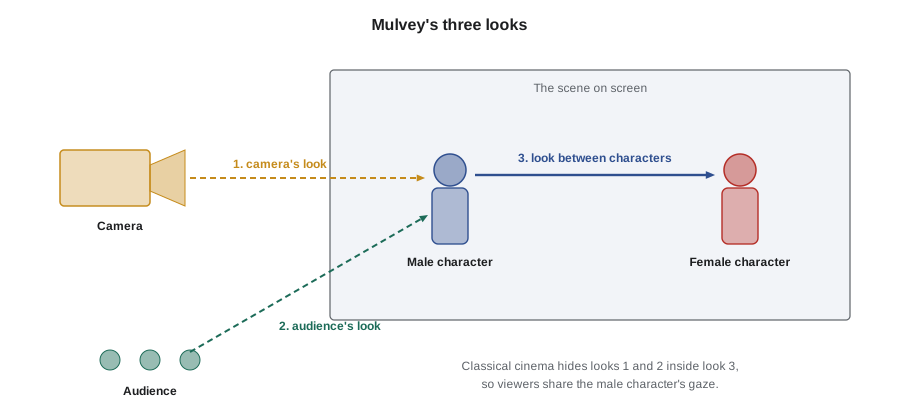
Mulvey argued that the image of woman also provokes anxiety in psychoanalytic terms, because it signifies sexual difference and the threat of lack. Classical cinema manages this anxiety in two ways. Voyeuristic investigation examines the woman, discovers her guilt and punishes or saves her, a pattern Mulvey found in film noir and in Alfred Hitchcock. Fetishistic scopophilia turns the woman into a spectacle, an object of beauty that stops the narrative, as in the stylized close-ups of Marlene Dietrich in Josef von Sternberg's films.
| Mode | What the film does | Typical techniques | Examples Mulvey discussed |
|---|---|---|---|
| Voyeuristic investigation | Investigates, judges and punishes or rescues the woman | Point-of-view shots, investigation plots, narrative control | Hitchcock's Vertigo and Marnie, film noir |
| Fetishistic scopophilia | Turns the woman into a beautiful spectacle | Lighting, close-ups, frozen moments that halt the story | Von Sternberg's films with Marlene Dietrich |
Worked problem
Applying the three looks
In Hitchcock's Vertigo (1958), a retired detective follows a mysterious woman around San Francisco, and later tries to remake another woman in her image. Apply Mulvey's three looks to a typical following sequence.
Show solution
- Character look: the detective watches the woman from his car or from a distance; we see shots of him looking, followed by shots of what he sees.
- Camera look: the camera adopts his position, framing her in profile, in museums and doorways, often in long silent sequences that turn her into an image.
- Audience look: viewers share his look and his curiosity, and the film offers no alternative perspective for long stretches, so we are aligned with his desire.
- Interpretation: Mulvey argued that the film exposes and also indulges the voyeuristic and controlling gaze, especially in the later makeover, where the detective forces a woman to match his fantasy.
Answer: The three looks merge into the detective's gaze, which is why Mulvey used Vertigo as a central example of how classical cinema structures looking around male desire.
Responses and revisions
Mulvey's essay provoked debate for decades, including her own response. In Afterthoughts (1981), she considered the female spectator, who may oscillate between identifying with the active male hero and with the passive female figure, and she discussed melodramas centered on women. Other theorists challenged and extended her argument.
- Masquerade: Mary Ann Doane argued in 1982 that femininity can be performed as a masquerade, a deliberate excess that creates distance and lets female spectators view the image critically.
- Masculinity as spectacle: Steve Neale argued in 1983 that male bodies are also displayed, in westerns, epics and action films, though often disguised by violence or contests.
- Masochism: Gaylyn Studlar argued that cinematic pleasure can be masochistic, involving submission to a powerful image rather than control of it.
- Cross-gender identification: Carol Clover's Men, Women, and Chain Saws (1992) showed that young male viewers of slasher films identify with the final girl, the resourceful woman who survives and defeats the killer.
- The oppositional gaze: bell hooks argued in 1992 that Black women spectators, excluded from Hollywood's address, developed a critical, oppositional way of looking that refuses identification and interrogates the image.
- The abject: Barbara Creed's The Monstrous-Feminine (1993) drew on Julia Kristeva to show how horror films figure women as monstrous through bodily horror.
hooks's argument is especially important because it challenged the universal spectator assumed by psychoanalytic theory. Mulvey and Metz described a single position that the film constructs. hooks insisted that real spectators are shaped by race as well as gender, and that looking can be an act of resistance. Her essay connects psychoanalytic film theory with Stuart Hall's oppositional reading in Lesson 6 and with the theories of race in Lesson 10.
Worked problem
The final girl
In John Carpenter's Halloween (1978), a masked killer stalks teenagers in a small town on Halloween night; one young woman, Laurie, survives and fights back. Explain how Clover's concept of the final girl complicates Mulvey's account.
Show solution
- Early in the film, the camera adopts the killer's point of view, including a long opening shot through his mask, which seems to align viewers with a male, voyeuristic gaze.
- As the film proceeds, the point of view shifts to Laurie, who is watchful, resourceful and less sexually active than her friends, and who survives by fighting back.
- Clover argued that audiences, including young men, come to identify with the final girl's terror and resistance, crossing gender lines.
- This suggests that spectatorship is more fluid than Mulvey's model of active male and passive female looking, although Clover also noted that the final girl is often masculinized.
Answer: The final girl shows viewers identifying across gender with a female protagonist, complicating the idea that cinema always aligns spectators with a male gaze.
Counting looks
Some researchers test claims about the gaze by coding point-of-view and eyeline shots, noting who looks and who is looked at. The example below uses invented data from a single film to show how such coding can support, or challenge, an interpretation.
from collections import Counter
pov = [("man", "woman"), ("man", "woman"), ("woman", "man"), ("man", "object"),
       ("man", "woman"), ("woman", "object"), ("man", "woman"), ("man", "man"),
       ("woman", "woman"), ("man", "woman"), ("woman", "man"), ("man", "woman")]
lookers = Counter(a for a, b in pov)
targets = Counter(b for a, b in pov)
print("Point-of-view shots by who looks:", dict(lookers))
print("Point-of-view shots by who is looked at:", dict(targets))
share = sum(1 for a, b in pov if a == "man" and b == "woman") / len(pov)
print(f"Man looking at woman: {share:.0%} of point-of-view shots")Point-of-view shots by who looks: {'man': 8, 'woman': 4}
Point-of-view shots by who is looked at: {'woman': 7, 'man': 3, 'object': 2}
Man looking at woman: 50% of point-of-view shotsCounts like these cannot capture how a look is framed or what it means, but they can test whether a film's structure of looking is as one-sided as a reading claims. A critic might combine such data with close analysis of key scenes.
Critiques of psychoanalytic film theory
Psychoanalytic theory has been criticized on several grounds. Cognitive theorists, discussed in Lesson 11, argue that it relies on unproven claims about the unconscious and cannot be tested against evidence. Audience researchers point out that it describes an ideal spectator constructed by the text rather than real viewers. Others note that it often treats heterosexual desire as the norm and assumes a single structure for all films. Even critics who reject its foundations, however, often keep its key insight: films organize looking, desire and identification in ways that are shaped by gender and power.
The term male gaze has also traveled far beyond academic theory. It is now used in journalism, filmmaking and social media to describe images that present women as objects for a heterosexual male viewer. Filmmakers such as Céline Sciamma, whose Portrait of a Lady on Fire (2019) was widely discussed as an exploration of a female gaze, have consciously built alternatives. When using the term, distinguish Mulvey's specific psychoanalytic argument from its broader popular meaning.
Common mistakes
MistakeUsing male gaze to mean simply that men look at women in a film
InsteadMulvey's argument concerns how camera, character and audience looks combine to position spectators.
MistakeTreating psychoanalytic spectators as real audiences
InsteadThe theory describes positions constructed by films; audience research shows real responses vary.
MistakeAssuming all viewers identify only with characters of their own gender
InsteadClover and Mulvey's own revisions show identification can cross gender lines.
MistakeIgnoring race in theories of spectatorship
Insteadhooks's oppositional gaze shows how race shapes looking and resistance.
MistakeQuoting Mulvey without explaining her psychoanalytic framework
InsteadExplain scopophilia, voyeurism and fetishism before applying her conclusions.
Summary and key terms
- Psychoanalytic film theory uses concepts such as scopophilia, voyeurism, fetishism and the uncanny.
- Lacan's mirror stage and the imaginary and symbolic suggested parallels with viewers identifying with screen images.
- Metz called the film image an imaginary signifier and distinguished identification with the camera and with characters.
- Mulvey argued that classical cinema makes men bearers of the look and women objects of it, aligning viewers with a male gaze.
- She identified three looks and two responses to the image of woman: voyeuristic investigation and fetishistic scopophilia.
- Responses included masquerade, masculinity as spectacle, masochism, the final girl, the oppositional gaze and the abject.
- Critics question psychoanalysis's evidence and universal spectator, but its insight into gendered looking remains influential.
- Psychoanalysis
- Freud's theory of the mind and its unconscious desires, reinterpreted by Lacan.
- Scopophilia
- Pleasure in looking.
- Voyeurism
- Pleasure in watching others who do not know they are watched.
- Fetishism
- Substituting an object or part for something that provokes anxiety.
- Mirror stage
- Lacan's account of the self formed by identifying with an idealized image.
- Imaginary signifier
- Metz's term for the film image, present to perception but absent in reality.
- Male gaze
- Mulvey's concept of cinema structuring looking around an active male viewer and a passive female object.
- Final girl
- Clover's term for the female survivor of slasher films with whom viewers identify.
- Oppositional gaze
- hooks's concept of critical, resistant looking by Black women spectators.
- Abject
- Kristeva's term, used by Creed, for what disgusts and threatens the boundaries of the self.
Practice problems
Work each problem on paper first, then reveal the answer to check.
Define scopophilia and voyeurism.
Show answer
Scopophilia is pleasure in looking; voyeurism is looking at others who do not know they are watched.
What did Lacan's mirror stage suggest to film theorists?
Show answer
Viewers identify with idealized, coherent images, as infants do with their reflections.
Explain Metz's primary identification.
Show answer
Identification with the camera's all-seeing look that organizes the image.
Name Mulvey's three looks.
Show answer
The camera's look, the audience's look and the characters' looks at each other.
Distinguish voyeuristic investigation from fetishistic scopophilia.
Show answer
One investigates and judges the woman; the other turns her into a beautiful spectacle.
What did Mulvey add in Afterthoughts?
Show answer
A discussion of the female spectator's oscillating identification and of women-centered melodrama.
Explain Clover's final girl in one sentence.
Show answer
The resourceful female survivor of slasher films with whom viewers of all genders identify.
How did bell hooks challenge earlier spectatorship theory?
Show answer
She argued that Black women developed an oppositional gaze, challenging the universal spectator.
In the invented coding, what share of point-of-view shots show a man looking at a woman?
Show answer
50 percent, 6 of 12 shots.
Give one critique of psychoanalytic film theory.
Show answer
It relies on untestable claims about the unconscious and ignores real audiences.
Lesson quiz · 5 questions
Score 60% or more to complete this lesson.
Create a free account to save your progress, take quizzes and earn a certificate.