
HSE-382 · Lesson 4 of 12 · 17 min
Grease buildup and cleaning schedules
▶ Video coming soon A video version of this lesson is on the way.
The day after the February fire, two technicians from a hood cleaning company arrived at Juniper Street at 11 p.m. and worked until 6 the next morning. They wrapped the appliances in plastic, hung a funnel of plastic sheeting under the hood to catch the runoff, sprayed a hot alkaline degreaser through the plenum and up the duct, scraped the heavy deposits, pressure-washed every surface they could reach through the access panels, and went up on the roof to tilt back the fan and clean its blades and housing. In the morning they left a certificate taped to the hood, a written report with photographs, and a short list of places they could not reach. That list turned out to matter, as this lesson explains.
Lesson 3 described the exhaust system. This lesson covers how grease builds up in it, how often it must be inspected and cleaned, who is allowed to do the cleaning, and how a restaurant keeps track of it all.
How grease builds up
Grease enters the exhaust system as a fine mist of fat droplets carried by hot air. The filters catch most of it, but not all. The droplets that get past cool as they travel up the duct and stick to the walls. At first the coating is a thin, soft film. With time and heat it thickens, darkens and hardens into a crust, and fresh soft grease collects on top of the old. The heaviest deposits form where the air slows down or changes direction: in the plenum behind the filters, at elbows and horizontal runs in the duct, and in the fan housing.
How fast grease builds up depends on what is cooked, how much and for how long. Charbroiling fatty meat, deep-frying, wok cooking and burning wood or charcoal produce the most. Steaming, boiling and baking produce very little. A restaurant that serves burgers and fries from 11 a.m. to 11 p.m. every day loads its system many times faster than a church kitchen that cooks one supper a week.
How often the system must be inspected
NFPA 96 sets a schedule for inspecting the whole exhaust system for grease buildup, based on the type and volume of cooking. If the inspection finds grease, the contaminated parts must be cleaned. In practice, most restaurants have the system inspected and cleaned at the same visit, on the same schedule.
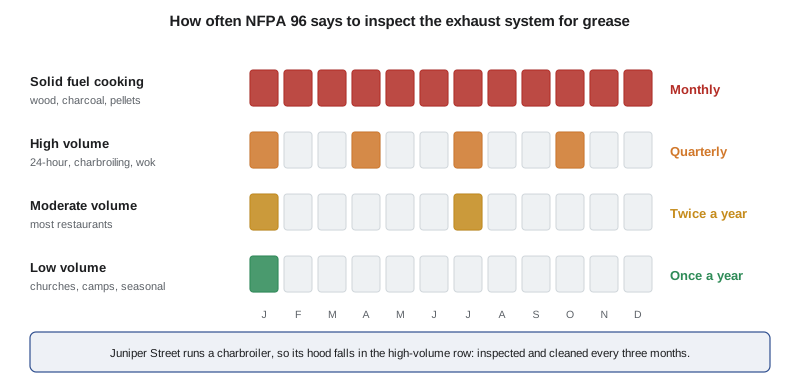
- Systems serving solid fuel cooking, such as wood-fired ovens and charcoal grills, are inspected monthly.
- Systems serving high-volume cooking, such as 24-hour restaurants, charbroiling and wok cooking, are inspected quarterly.
- Systems serving moderate-volume cooking are inspected twice a year.
- Systems serving low-volume cooking, such as churches, day camps, seasonal businesses and senior centers, are inspected once a year.
These are minimums. A system that is found heavily loaded at every visit needs a shorter interval, and the inspector can require one. Juniper runs a charbroiler and fryers twelve hours a day, so its system falls in the high-volume row and is cleaned every three months. After February, the hood cleaning company suggested adding a quick inspection of the plenum and the first section of duct halfway between cleanings, to confirm that the new filter routine was working.
NFPA 96 also gives a way to measure whether a surface needs cleaning, rather than leaving it to judgment. Inspectors use a depth gauge comb to measure the grease deposit, and current editions of the standard call for cleaning when deposits reach 0.078 in (about 2 mm) on duct and hood surfaces, with a slightly larger allowance in the fan housing. A thin film can be wiped with a finger; a layer that the comb sinks into is a fire load.
Who cleans the system
The restaurant's own staff clean the parts they can reach safely: the filters, the grease cups and trough, and the inside surfaces of the hood canopy, which are wiped down with a non-flammable degreaser on the same schedule as the filters. The plenum, duct and fan are cleaned by a professional contractor. NFPA 96 requires that the inspection and cleaning be done by properly trained, qualified and certified people acceptable to the authority having jurisdiction.
In Georgia, kitchen exhaust cleaning is not a state-licensed trade, so fire marshals and insurers look for evidence of training and certification, such as certification through a recognized kitchen exhaust cleaning association, and for a company that follows NFPA 96. Some local fire departments in the United States keep a list of registered hood cleaning companies; Savannah's fire marshal's office reads the cleaning reports and will question a certificate that does not match what its inspectors see. When Juniper chose its contractor, Daniel asked for the technicians' certifications, proof of liability insurance, a sample report, and references from two other restaurants with charbroilers.
What a proper cleaning involves
A professional cleaning is a night's work for a restaurant of Juniper's size, and the kitchen manager should know what it looks like so that a poor job can be spotted. A thorough cleaning includes these steps:
- The fuel and power to the cooking appliances are shut off, and the appliances are allowed to cool and are covered.
- The suppression system is protected, but not disabled by the hood cleaners. If the system must be taken out of service, that is done by the suppression contractor, who restores it afterwards, and the kitchen does not cook while it is out of service.
- The filters are removed and cleaned, and the hood, plenum, duct, fan and grease containment are cleaned to bare metal, using scraping, chemical degreasers and hot water pressure washing. Flammable solvents are never used.
- Access panels are opened along the duct, and closed and sealed again afterwards with their original gaskets.
- Wastewater and grease are captured and disposed of properly, not washed into storm drains or onto the roof.
- The system is put back in service, the fan is checked, and the kitchen is left clean enough to cook in.
Afterwards, the contractor gives the restaurant a written report and fixes a certificate or label to the hood. The label shows the company's name, the date of cleaning, the name of the technician, and any areas that were not cleaned. That last item is easy to overlook and is one of the most important parts of the report.
The places nobody reached
The report after February listed two areas the technicians could not clean: a horizontal section of duct 10 ft (about 3 m) long above the walk-in cooler ceiling, which had no access panel, and the area behind the duct bend where it entered the shaft. A section of duct that cannot be reached cannot be cleaned, and grease builds up there visit after visit. Fire investigators often find that duct fires spread through exactly these uncleaned sections.
Elena paid a mechanical contractor to install two listed access panels in that section of duct, with a permit. At the next cleaning in May, the technicians reported heavy, hard deposits there, several years of buildup in a duct that had always been certified as clean. The lesson for supervisors is to read the report, not just file the certificate, and to treat every area marked as not cleaned as a problem to solve.
Between cleanings
The professional cleaning resets the system to bare metal, but how quickly it reloads depends on what the kitchen does every day. Juniper's daily and weekly routine after February looks like this:
- Every night: wash the filters over the charbroiler and fryers, empty the grease cups, wipe the hood canopy and the front edge of the trough, and scrape the charbroiler grates and empty its drip tray.
- Twice a week: wash the remaining filters, degrease the walls and the ledge behind the line, and clean under and behind the fryers and range.
- Monthly: Aisha shines a flashlight through the filter openings into the plenum and photographs it, to compare with the last cleaning; the photographs go in the binder.
- Quarterly: professional hood, duct and fan cleaning, with the report read by Daniel and any items followed up.
Rooftop grease
The roof deserves a mention. An upblast fan that is not maintained, or a grease containment system that is full, lets grease drip and blow onto the roof membrane around the fan. Grease softens and degrades roofing materials and is itself a fire hazard: sparks or a hot fan housing can ignite it. The hood cleaning contractor should report on the roof around the fan at each visit and replace the grease containment pads when they are saturated.
Tracking the schedule
With nightly, twice-weekly, monthly and quarterly tasks, it is easy for something to slip, which is exactly what happened before February. Juniper's office computer now produces a list of upcoming cleaning dates from the last completed date and the interval for each task. The program below shows the idea for the quarterly and monthly tasks. Dates are in year, month, day order, and no units are involved, so the same program serves both countries.
# Plan the next dates for exhaust system tasks from the last completed date.
from datetime import date, timedelta

def add_months(d, months):
    y, m = divmod(d.month - 1 + months, 12)
    y, m = d.year + y, m + 1
    days_in = [31, 29 if y % 4 == 0 and (y % 100 != 0 or y % 400 == 0) else 28,
               31, 30, 31, 30, 31, 31, 30, 31, 30, 31][m - 1]
    return date(y, m, min(d.day, days_in))

INTERVAL_MONTHS = {"monthly": 1, "solid fuel": 1, "high volume": 3, "moderate volume": 6, "low volume": 12}

tasks = [
    # (task, last done, interval key)
    ("Hood, duct and fan cleaning (contractor)", date(2026, 2, 23), "high volume"),
    ("Plenum photo check (Aisha)", date(2026, 3, 30), "monthly"),
    ("Patio smoker hood (trial)", date(2026, 3, 1), "solid fuel"),
]

today = date(2026, 4, 6)
for task, last, kind in tasks:
    nxt = add_months(last, INTERVAL_MONTHS[kind])
    while nxt < today:
        print(f"  missed: {task} was due {nxt}")
        nxt = add_months(nxt, INTERVAL_MONTHS[kind])
print(f"{task:42s} next {nxt} ({(nxt - today).days} days)")Hood, duct and fan cleaning (contractor) next 2026-05-23 (47 days) Plenum photo check (Aisha) next 2026-04-30 (24 days) missed: Patio smoker hood (trial) was due 2026-04-01 Patio smoker hood (trial) next 2026-05-01 (25 days)
The output shows the next contractor visit in late May, the next photo check at the end of April, and a missed monthly check on the patio smoker hood, which Juniper was testing that spring. Writing the schedule down and checking it against the calendar takes a few minutes a month and would have caught the slipping filter routine weeks before the fire.
What supervisors should watch for
A few signs mean the system is loading faster than the schedule assumes and needs attention before the next cleaning:
- Grease dripping from the hood edge or the filters onto the appliances.
- Filters that are coated again within a day or two of washing.
- Smoke escaping from under the hood at normal cooking loads.
- Visible grease around the fan on the roof, or a fan that sounds strained.
- A cleaning report that lists areas not cleaned, or photographs that show heavy deposits.
Any of these goes to the kitchen manager, who decides whether to call the contractor early. After February, nobody at Juniper treats an early call as a waste of money.
Summary and key terms
- Grease that gets past the filters builds up in the plenum, duct and fan, thickest where the air slows or turns; how fast depends on what is cooked and how much.
- NFPA 96 requires inspection for grease monthly for solid fuel cooking, quarterly for high-volume cooking, twice a year for moderate volume and yearly for low volume, with cleaning wherever grease is found.
- Staff clean filters, grease cups and the hood canopy; trained, certified contractors clean the plenum, duct and fan to bare metal without flammable solvents.
- Every cleaning ends with a report and a label showing the date, the company and any areas not cleaned; uncleaned areas must be followed up, often by adding access panels.
- A written schedule of nightly, weekly, monthly and quarterly tasks, checked against the calendar, keeps cleaning from slipping.
- Grease buildup
- The layer of fat that condenses on exhaust system surfaces and thickens and hardens over time.
- Inspection frequency
- How often NFPA 96 requires the exhaust system to be inspected for grease, based on the type and volume of cooking.
- Bare metal cleaning
- Cleaning that removes grease from hood, duct and fan surfaces down to the metal.
- Access panel
- A sealed, removable cover in a grease duct that lets cleaners reach the inside.
- Cleaning certificate
- A label or report fixed to the hood after cleaning, showing the date, the company, the technician and any areas not cleaned.
Choosing the right interval
A restaurant does not choose its own row in the NFPA 96 table by preference. The fire authority can decide which row applies, and a contractor who finds heavy deposits at every visit will recommend a shorter interval. Changes in the menu or hours can move a kitchen into a different row: a café that adds late-night burgers or a restaurant that starts smoking meat in-house may need a much more frequent schedule. Juniper reviews its interval every time the menu changes significantly.
Common mistakes
MistakeA cleaning certificate on the hood means the whole system is clean.
InsteadRead the report: any area listed as not cleaned or inaccessible is still loaded with grease and needs a solution.
MistakeEvery restaurant needs its hood cleaned twice a year.
InsteadThe interval depends on the cooking: a kitchen with a charbroiler or a wood oven needs quarterly or monthly service.
MistakeKitchen staff can save money by degreasing the duct themselves with solvent.
InsteadFlammable solvents are forbidden, and duct, plenum and fan cleaning is done by trained, certified contractors.
Practice problems
Work each problem on paper first, then reveal the answer to check.
A café serves soups, salads and baked goods and has one small griddle used at breakfast. A steakhouse runs two charbroilers from 4 p.m. to midnight. Which NFPA 96 rows probably apply?
Show answer
The café is low or moderate volume, depending on how much the griddle is used; the steakhouse is high volume because of the charbroiling and needs quarterly service.
The cleaning report says the horizontal duct above the office ceiling could not be reached. What should the manager do?
Show answer
Arrange for a qualified contractor to install listed access panels, with a permit, and have that section cleaned at the next visit.
Juniper's last contractor cleaning was on 23 February. Using a quarterly interval, when is the next one due?
Show answer
23 May.
Lesson quiz · 5 questions
Score 60% or more to complete this lesson.
Create a free account to save your progress, take quizzes and earn a certificate.