
HSE-382 · Lesson 6 of 12 · 17 min
Class K and other extinguishers
▶ Video coming soon A video version of this lesson is on the way.
On the wall beside the fryers at Juniper Street hangs a tall, silver extinguisher with a long wand and a placard above it. By the back door hangs a squat red one with a short hose. Ask a new cook which one to grab for a fryer fire and most will point to the red one, because it looks like every extinguisher they have ever seen. That would be the wrong choice. This lesson covers the classes of fire, the extinguishers that match them, where they go in a kitchen, how they are checked, and, most important, when to use one and when to walk away.
Classes of fire
Fires are grouped into classes by what is burning, because each kind of fuel needs a different extinguishing agent. Canada and the United States use the same letters, and extinguishers are labeled with the classes they are rated for.
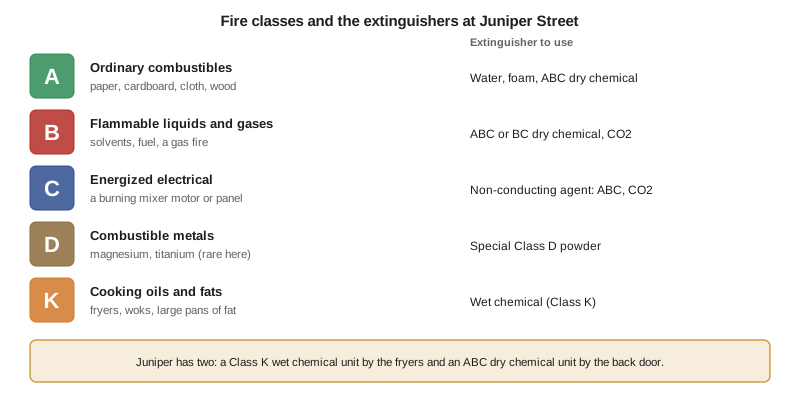
- Class A fires involve ordinary combustibles such as paper, cardboard, cloth, wood and many plastics. They leave ash. Water, foam and multipurpose dry chemical work on them.
- Class B fires involve flammable liquids and gases, such as solvents, alcohol, fuel and gas leaks. Dry chemical and carbon dioxide work on them; water spreads them.
- Class C fires involve energized electrical equipment. The agent must not conduct electricity, so carbon dioxide or dry chemical is used, and the equipment is de-energized as soon as it is safe.
- Class D fires involve combustible metals. They are rare in restaurants and need special powders.
- Class K fires involve cooking oils and fats in large quantities, such as in a deep fryer. They have their own class because they burn so hot and reignite so easily that ordinary agents often fail.
Why Class K
Cooking oil fires were once lumped in with Class B flammable liquids. As fryers became larger and better insulated and kitchens switched to vegetable oils, testing showed that ordinary dry chemical and carbon dioxide extinguishers could knock the flames down but often could not stop the oil from reigniting a few seconds later, because the oil was still above its autoignition temperature. Class K was created for these fires, and Class K extinguishers use the same kind of wet chemical agent as the hood system. They discharge it as a gentle, fine mist from a long wand, so that it settles on the oil surface instead of blasting into it and splashing burning oil out of the fryer.
A Class K extinguisher is a backup to the hood suppression system, not a replacement for it. It is designed to finish off a fire that the fixed system has knocked down but not fully extinguished, or to deal with a small fire in a pan or fryer that the fixed system does not reach. That is why the rules about where it goes and when it is used are so specific.
Placement in a kitchen
NFPA 10 and the International Fire Code require a Class K extinguisher for cooking appliances that use oils and fats, located within 30 ft (9 m) of those appliances, along the normal path of travel and not blocked from view. A placard must be posted near it stating that the fixed fire suppression system should be activated before the Class K extinguisher is used. A kitchen also needs extinguishers for Class A fires, such as burning cardboard or paper, and for electrical fires, placed within the travel distances the code allows and mounted so that the top is at a reachable height.
Juniper has a Class K extinguisher on the wall between the fryers and the back door, 13 ft (about 4 m) from the fryers and on the way to the exit, with the placard above it. A multipurpose ABC dry chemical extinguisher hangs by the back door, and another by the bar. The ABC units cover paper, cardboard, the dumpster area outside the back door and small electrical fires. The ABC extinguisher is never used on the fryers: its powder can blast burning oil out of the vat and, even if it knocks the flames down, the oil can reignite.
Reading an extinguisher label
Every extinguisher carries a label with its classes and a numerical rating that reflects how large a test fire it can put out. A label reading 2-A:10-B:C, for example, means the extinguisher is rated for Class A fires with a relative size of 2, Class B fires with a relative size of 10, and is safe on electrical fires, which carry no number. A Class K extinguisher carries the letter K. The label also lists the agent, the operating instructions and the testing organization's mark, such as ULC in Canada or UL in the United States. Kitchen staff do not need to memorize ratings, but they should be able to look at a label and say whether it is the right extinguisher for the fire in front of them.
Monthly checks and yearly service
Extinguishers are inspected visually at least once a month, which takes about a minute each. At Juniper, Kofi Mensah does the monthly check on the first Monday of the month and initials the tag or the log. He checks that:
- The extinguisher is in its marked place, mounted, visible and unobstructed.
- The pressure gauge needle is in the green band, for extinguishers that have one.
- The pin and tamper seal are intact, so nobody has used it and put it back.
- There is no visible damage, corrosion, leaking or clogged nozzle or wand.
- The instructions on the label face outward and are readable.
- The service tag is current.
- For the Class K unit, the placard is in place.
Once a year, a certified fire protection technician services each extinguisher, opening or weighing it as the standard requires, and attaches a new tag. Extinguishers also need internal maintenance and hydrostatic pressure testing at longer intervals that depend on the type: wet chemical and dry chemical units have different schedules, measured in years. Fire inspectors check the tags, and OSHA's portable extinguisher standard also requires monthly visual inspection and annual maintenance where employees are expected to use extinguishers.
Any extinguisher that has been used, even for a second, goes back to the service company for recharging. An extinguisher that was used briefly and put back on the wall may have lost most of its pressure or have a clogged valve.
Should you fight the fire?
Extinguishers save lives and buildings when small fires are caught early. They also tempt people to stay too long. A portable extinguisher empties in seconds: a typical kitchen unit discharges for about 10 to 30 seconds. Before using one, a worker should be able to answer yes to every one of these questions:
- Has the alarm been raised, and has someone called 911 or is calling now?
- Is the fire small, about the size of a wastebasket or smaller, and not spreading?
- Is it the right extinguisher for this fire?
- Is there a clear way out behind me that the fire cannot cut off?
- Have I been trained to use this extinguisher?
- Is the room free of heavy smoke?
If the answer to any question is no, the worker leaves, closes doors behind them if possible, and follows the evacuation plan. If the extinguisher is used and the fire is not clearly going out within a few seconds, the worker stops and leaves. Fighting a fire is never part of a cook's job if it means putting themselves at risk.
The order for a fryer fire
For a fire in or above a fryer, the order of actions matters, and it is the same in both countries.
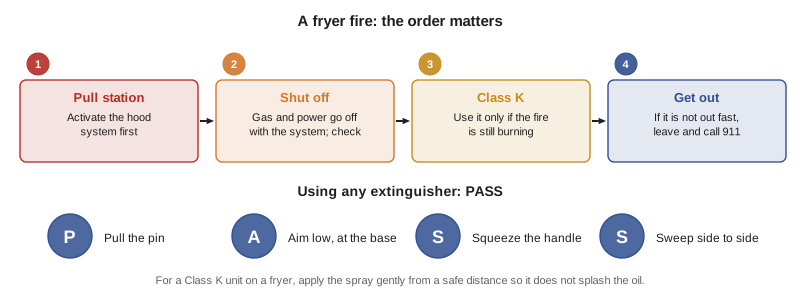
First, pull the manual station to fire the hood system. This puts a large quantity of agent exactly where it is needed and shuts off the fuel. Second, make sure the gas and power to the fryer are off; the hood system should do this, but a quick check of the fryer controls costs nothing. Third, if flames are still visible after the system has discharged, and only if it is safe to approach, use the Class K extinguisher. Fourth, if the fire is not out quickly, leave.
To use the Class K extinguisher, stand back from the fryer, pull the pin, hold the wand with the nozzle pointed at the fire, and squeeze the handle. Apply the mist gently over the surface of the oil, in a sweeping motion, until the whole surface is covered with foam, and keep going until the extinguisher is empty. Do not stop as soon as the flames disappear: the foam layer must cover the oil completely to stop it reigniting.
PASS for other extinguishers
For an ABC extinguisher on a Class A or electrical fire, most training uses the word PASS: pull the pin, aim low at the base of the fire, squeeze the handle, and sweep from side to side. Start a few meters back and move closer as the fire goes down. For an electrical fire, turn off the power at the switch or panel if it is safe to do so, and treat the fire as a Class A fire once the equipment is de-energized.
Training
If an employer expects employees to use portable extinguishers, OSHA's 29 CFR 1910.157 requires training in the general principles of fire extinguisher use and the hazards of fighting early-stage fires, when employees are first hired and at least once a year after that. Juniper trains every cook and the closing staff during orientation, using a training extinguisher and a demonstration video from its fire protection company, and every staff member at least once a year after that. The training covers the fire classes, the order for a fryer fire, the PASS steps and, above all, the decision not to fight a fire that has grown.
Checking the monthly log
Kofi records his monthly checks in a simple log. The program below reviews the log and flags anything that needs action. Each entry records the location, the type, whether the gauge was in the green band, whether the pin and seal were intact, and the month of the last annual service.
# Review the monthly extinguisher check and flag anything needing action.
checks = [
    # (location, type, gauge ok, seal ok, mounted and visible, months since annual service)
    ("between fryers and back door", "Class K wet chemical", True, True, True, 7),
    ("back door", "ABC dry chemical", True, False, True, 7),
    ("bar", "ABC dry chemical", False, True, True, 7),
    ("basement office", "ABC dry chemical", True, True, False, 13),
]

problems = 0
for place, kind, gauge, seal, visible, months in checks:
    notes = []
    if not gauge:
        notes.append("pressure low: replace and send for service")
    if not seal:
        notes.append("seal broken: may have been used, send for recharge")
    if not visible:
        notes.append("blocked or not mounted: clear and remount")
    if months >= 12:
        notes.append("annual service overdue")
    problems += bool(notes)
    print(f"{place:30s} {kind:22s} {'OK' if not notes else '; '.join(notes)}")
print(f"{problems} of {len(checks)} extinguishers need action")between fryers and back door Class K wet chemical OK back door ABC dry chemical seal broken: may have been used, send for recharge bar ABC dry chemical pressure low: replace and send for service basement office ABC dry chemical blocked or not mounted: clear and remount; annual service overdue 3 of 4 extinguishers need action
Three of the four need action. The broken seal on the back door unit turned out to be from a busser who had pulled the pin out of curiosity; it was sent for recharge and swapped with a spare from the service company the same day. The bar unit had lost pressure. The basement office unit was hidden behind a stack of chair cushions and was a month past its annual service. A monthly check that takes ten minutes caught all three.
Summary and key terms
- Fires are grouped into classes A, B, C, D and K by what is burning, and each extinguisher is labeled with the classes it is rated for.
- Class K wet chemical extinguishers are for cooking oil fires; they are a backup to the hood suppression system, located within 30 ft (9 m) of the fryers with a placard saying to activate the fixed system first.
- For a fryer fire: pull the hood system first, confirm the fuel is off, use the Class K extinguisher only if flames remain and it is safe, and leave if the fire is not out quickly.
- Extinguishers are checked visually every month, serviced yearly by a certified technician, and recharged after any use.
- Only fight a fire if it is small, the alarm has been raised, you have the right extinguisher and training, and your way out is clear.
- Class K fire
- A fire involving large quantities of cooking oil or fat, such as in a deep fryer.
- Class K extinguisher
- A portable extinguisher that discharges wet chemical agent as a gentle mist for cooking oil fires.
- ABC extinguisher
- A multipurpose dry chemical extinguisher for ordinary combustibles, flammable liquids and electrical fires; not for fryers.
- Placard
- A sign posted near the Class K extinguisher stating that the fixed suppression system should be activated first.
- PASS
- Pull the pin, aim low, squeeze the handle, sweep side to side.
Common mistakes
MistakeAny extinguisher will put out a fryer fire if you use enough of it.
InsteadDry chemical and water can splash burning oil or let it reignite; fryer fires need the hood system and a Class K extinguisher.
MistakeGrab the Class K extinguisher first, since it is closer than the pull station.
InsteadActivate the hood system first; the Class K unit is a backup for flames that remain.
MistakeAn extinguisher that was used for a second is still nearly full and can go back on the wall.
InsteadAny discharge can drop the pressure or clog the valve; send it for recharge and replace it.
Practice problems
Work each problem on paper first, then reveal the answer to check.
A cardboard box catches fire near the back door. Which extinguisher should be used, if any?
Show answer
The ABC dry chemical extinguisher, if the fire is small, the alarm has been raised and the way out is clear; otherwise leave and call 911.
What does the placard above the Class K extinguisher say, and why?
Show answer
That the fixed suppression system should be activated before the extinguisher is used, because the hood system delivers far more agent and shuts off the fuel.
During the monthly check, the gauge on an extinguisher points to the red zone. What should happen?
Show answer
Take it out of service, replace it with a charged unit, and send it to the service company.
Lesson quiz · 5 questions
Score 60% or more to complete this lesson.
Create a free account to save your progress, take quizzes and earn a certificate.