
HSE-382 · Lesson 5 of 12 · 17 min
Wet chemical suppression systems
▶ Video coming soon A video version of this lesson is on the way.
When Hana pulled the manual station on that Friday in February, a small steel cylinder in a red cabinet at the end of the line released its charge of pressurized gas. The gas pushed 3 gal (about 11 L) of liquid agent through a network of steel pipes to fourteen nozzles: one over each cooking appliance, several in the plenum behind the filters, and one at the opening of the duct. In about a minute the agent had covered the charbroiler, the fryers and the filters in a layer of thick foam, the gas valve to the line had snapped shut, and the electric salamander and combi oven had lost power. The fire was out before the first fire truck arrived. This lesson explains how that system works, what keeps it ready, and what the kitchen must do after it goes off.
Why restaurants have these systems
Fire codes require an automatic fire-extinguishing system for cooking appliances that produce grease-laden vapors, such as fryers, griddles, ranges, charbroilers and woks. The system protects three places at once: the cooking surfaces, where most fires start; the plenum behind the filters; and the entrance to the duct, where a fire must be stopped before it travels up the building. Ordinary building sprinklers are not designed for burning cooking oil, and water on an oil fire makes it worse, so kitchens use a special system designed for grease fires.
Older systems used dry chemical powder. They worked on the vegetable shortening and lard of the 1960s and 1970s, but modern fryers are better insulated, hold heat longer and use vegetable oils with higher autoignition temperatures, and dry chemical fires in these fryers often reignited after the powder settled. In 1994, UL 300 was published as a new test standard that reflected modern cooking, and fire codes and insurers soon required systems that met it. Today almost every restaurant hood in the United States has a wet chemical system listed to UL 300, designed and maintained under NFPA 17A and NFPA 96.
How wet chemical agent works
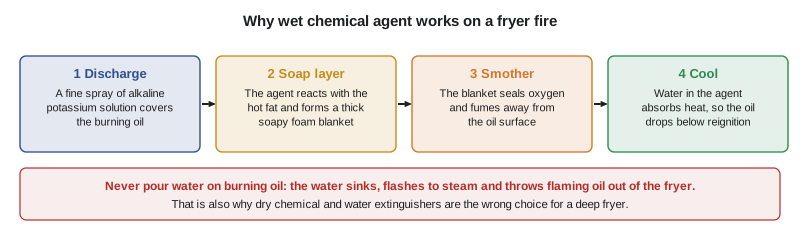
Wet chemical agent is a solution of potassium salts, such as potassium acetate, potassium carbonate or potassium citrate, in water. It is strongly alkaline. When the fine spray lands on burning cooking oil, two things happen. First, the agent reacts with the hot fat in a process called saponification, the same chemistry used to make soap, and forms a thick, soapy foam layer on top of the oil. The foam seals the surface off from oxygen and stops flammable vapor from escaping. Second, the water in the agent absorbs a great deal of heat as it turns to steam, which cools the oil below the temperature at which it would reignite. The foam needs to stay in place long enough for the oil to cool, which is why the fuel supply to the appliance is shut off at the same moment.
The parts of the system
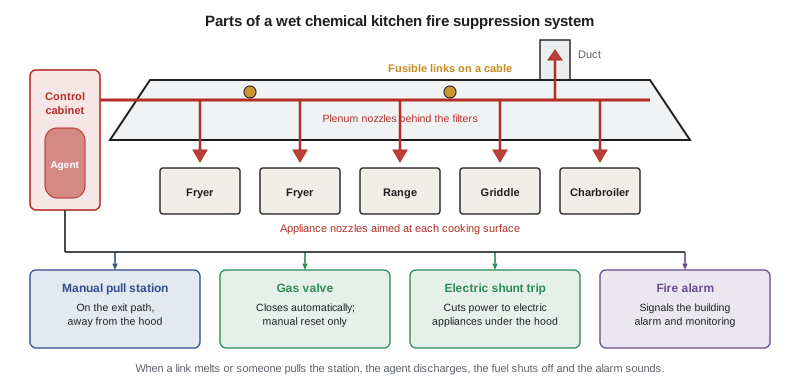
- The agent cylinder holds the wet chemical solution, and a smaller cartridge or the cylinder itself holds the pressurized gas that drives it. Juniper's system has one cylinder, sized by the designer for the number of nozzles needed.
- The detection line is a steel cable running through the hood with fusible links positioned over the appliances and in the duct opening. Each link is two pieces of metal soldered together with an alloy that melts at a set temperature. When a fire heats a link past that temperature, the solder melts, the link separates, the cable goes slack and the release mechanism in the control cabinet fires.
- The nozzles are sized and aimed for the specific appliance below each one, and each has a blow-off cap that keeps grease out of the nozzle opening until the agent pushes it off.
- The manual pull station lets a person fire the system immediately, without waiting for a link to melt. It is mounted on the path to an exit, away from the hood, so that someone can reach it as they leave.
- The fuel shut-off closes the gas valve to every appliance under the hood, and a shunt trip cuts electrical power to electric appliances. Both are designed so that they must be reset by hand, after the system has been serviced, before the appliances can be used again.
- An alarm connection signals the building fire alarm and, where there is one, the monitoring company, which calls the fire department.
When the system fires, the exhaust fan normally keeps running so that smoke is drawn out, while the make-up air supply is shut down so that fresh air is not blown into the fire. The details depend on the system design and the local code.
Pre-engineered systems and why changes matter
Kitchen systems are pre-engineered: the manufacturer has tested a specific combination of cylinder size, pipe lengths, nozzle types and nozzle positions against specific appliances, and the installer follows the manufacturer's design manual exactly. Each nozzle covers a defined area at a defined height. A fryer nozzle is not the same as a range nozzle, and a nozzle aimed at the center of a 18 in (45 cm) fryer will not cover a fryer twice that size.
This means the system protects the appliances it was designed for, in the positions it was designed for, and nothing else. Three everyday changes can quietly leave an appliance unprotected:
- Moving appliances. Fryers and ranges on wheels are pulled out for cleaning and pushed back. If the fryer goes back 6 in (15 cm) to the left, its nozzle may now be aimed at the gap between appliances. Juniper painted marks on the floor so that every appliance goes back in its exact place.
- Swapping appliances. Replacing a range with a charbroiler, or a single fryer with a larger split-vat fryer, changes the hazard below the nozzle. Any change to the line must be reviewed by the suppression contractor before the new appliance is used, and the system may need new nozzles or a larger cylinder.
- Adding appliances. A countertop fryer or a second griddle placed under the hood but not on the system's design is not protected at all.
When Tomás wanted to replace one of the floor fryers with a model that has automatic basket lifts, the suppression contractor came out first to check the nozzle type and height for the new fryer. It turned out that the new fryer's vat was larger and needed a different nozzle. Without that visit, the kitchen would have run for months with a fryer the system could not reliably put out.
Inspection and service
NFPA 96 and NFPA 17A require the system to be inspected and serviced by a qualified technician at least every six months. A semi-annual service visit typically includes:
- Checking that the appliances, their positions and the hood have not changed since the last visit, and that every nozzle is still aimed correctly and capped.
- Checking the agent cylinder pressure and weight, the condition of the piping and the gas cartridge.
- Replacing the fusible links on the schedule the standard and the manufacturer require, at least once a year and more often where they are heavily coated with grease.
- Testing the release mechanism, the manual pull station, the gas valve shut-off and the electrical shut-off, without discharging agent into the kitchen.
- Checking the alarm connection with the monitoring company.
- Tagging the system with the date, the technician's name and the company, and leaving a written report.
Larger maintenance comes on a longer cycle, such as testing the agent cylinder under pressure, which manufacturers and the standard require at set intervals of several years. The kitchen's job is to keep the six-month visits on schedule, read the reports, and not let the tag go out of date. Juniper's last service before February had been in September, so the system was within its interval when it fired, and that is one reason it worked.
Daily care by kitchen staff
Kitchen staff do not service the system, but they protect it every day:
- Keep the nozzle caps on. A missing cap lets grease clog the nozzle. If a cap is missing or a nozzle looks blocked, report it the same day.
- Do not hang anything from the pipes or the detection cable, and do not wrap tape or foil around the links.
- Keep the manual pull station visible and clear. Nothing is stacked in front of it, and nobody hangs aprons on it.
- Return every appliance to its marked position after cleaning.
- Never adjust, reset or move any part of the system. Only the suppression contractor does that.
When the system fires
A discharge is loud and fast, and the first moments matter more than anything else. When the system fires, whether automatically or because someone pulled the station:
- Everyone leaves the cooking line. The fire may not be fully out, and the agent spray and steam are irritating.
- The fire alarm is sounded if it has not gone off on its own, and 911 is called.
- The manager on duty starts the evacuation according to the fire safety plan.
- Nobody tries to restart the appliances, reset the gas valve or turn the power back on.
- If the fire is still burning after the discharge, a trained person may use the Class K extinguisher as a backup, as Lesson 6 explains, but only if it is safe to do so.
After the discharge
A fired system cannot protect the kitchen until it has been recharged and reset, so the cooking line under the hood cannot be used. Juniper's February timeline shows what the day after involves:
- The fire department confirmed the fire was out, checked the duct from the roof and released the building to the owner.
- The suppression contractor came the next morning to recharge the cylinder, replace the fusible links and the nozzle caps, check the piping for grease blockage and reset the gas valve and shunt trip.
- The hood cleaning contractor cleaned the hood, plenum, duct and fan, because the fire and the agent had both left deposits.
- Kitchen staff cleaned up the agent residue on every surface, wearing chemical-resistant gloves and safety glasses because the agent is alkaline and irritates the skin and eyes. Food that was exposed to the agent or to smoke was thrown out. The cleanup used plenty of hot water, the dish machine for small items, and a neutral cleaner on stainless steel.
- The fire department inspected before the line was allowed to run again.
The whole sequence took about a day and a half. It would have taken far longer if Juniper had not had a service contract with a company that could come out the next morning.
Keeping track of service
Daniel tracks the suppression system in the same binder as the hood cleaning. The program below checks the last service date against the six-month interval and lists the appliance changes since the last visit, which the technician must review.
# Check suppression system service status and flag line changes for the technician.
from datetime import date

last_service = date(2026, 2, 24)      # recharge and full service after the fire
today = date(2026, 7, 20)
interval_days = 183                   # at least every six months

changes_since_service = [
    ("2026-05-12", "fryer 2 replaced with automatic basket-lift model", "nozzle changed by contractor"),
    ("2026-06-03", "countertop induction burner placed at end of line", "not on system design"),
]

age = (today - last_service).days
print(f"Last service {last_service}, {age} days ago; next due within {interval_days - age} days")
if interval_days - age <= 30:
    print("Book the semi-annual service now.")
for when, what, note in changes_since_service:
    flag = "OK" if "changed by contractor" in note else "REVIEW"
print(f"{flag:6s} {when} {what} ({note})")Last service 2026-02-24, 146 days ago; next due within 37 days OK 2026-05-12 fryer 2 replaced with automatic basket-lift model (nozzle changed by contractor) REVIEW 2026-06-03 countertop induction burner placed at end of line (not on system design)
The fryer change was handled properly. The induction burner was not: an induction burner does not produce flames, but a pan of oil on it can still catch fire, and it was sitting under the hood without a nozzle. Aisha moved it to the prep counter, away from the line, until the contractor's next visit.
Summary and key terms
- Fire codes require an automatic suppression system over appliances that produce grease-laden vapors; it protects the cooking surfaces, the plenum and the duct entrance.
- Modern systems use a wet chemical agent listed to UL 300 or ULC/ORD-C1254.6, which forms a soapy foam on burning oil and cools it below reignition.
- The system fires automatically when a fusible link melts or manually from the pull station; it shuts off the gas and power to the appliances and signals the alarm.
- Systems are pre-engineered for specific appliances in specific positions; moving, swapping or adding appliances can leave them unprotected and must be reviewed by the contractor.
- A qualified technician services the system at least every six months; after any discharge the system must be recharged and reset, and the hood cleaned, before cooking resumes.
- Wet chemical agent
- An alkaline solution of potassium salts that smothers and cools burning cooking oil.
- Saponification
- The reaction between an alkaline agent and hot fat that forms a soapy foam layer.
- Fusible link
- A soldered metal link that separates at a set temperature to trigger the system automatically.
- Manual pull station
- A handle, mounted on the path to an exit, that fires the suppression system by hand.
- Pre-engineered system
- A system built to a manufacturer's tested design for specific appliances, pipe runs and nozzle positions.
- Shunt trip
- A device that cuts electrical power to appliances under the hood when the system fires.
Common mistakes
MistakeAfter the system goes off, the cooks can wipe up and restart the line once the fire is out.
InsteadThe system must be recharged and reset by the contractor, and the hood cleaned, before the line can be used again.
MistakeAny fryer can replace the old one, since the suppression nozzles are already there.
InsteadNozzles are designed for specific appliances; the contractor must review any new appliance before it is used.
MistakeA missing nozzle cap is cosmetic.
InsteadWithout its cap, a nozzle can clog with grease and fail to discharge; report it the same day.
Practice problems
Work each problem on paper first, then reveal the answer to check.
Why did dry chemical systems often fail on modern fryers?
Show answer
Modern fryers hold heat longer and use oils with higher autoignition temperatures, so the oil was still hot enough to reignite after the powder settled.
The cooks pull a range out for deep cleaning on Sunday night. What must they check when they push it back?
Show answer
That it goes back to its exact marked position under its nozzles, with any gas connection and restraint reattached properly.
The suppression system tag says it was serviced eight months ago. What should the manager do?
Show answer
Book a service immediately; the system is overdue for its six-month inspection and may not work as designed.
Lesson quiz · 5 questions
Score 60% or more to complete this lesson.
Create a free account to save your progress, take quizzes and earn a certificate.