
HSE-392 · Lesson 11 of 12 · 24 min
Sharps outside the hospital
▶ Video coming soon A video version of this lesson is on the way.
Most of this course has been set inside Northbridge Community Hospital, where sharps containers hang on the wall, safety devices come from central supply and Employee Health and Safety is a phone call away. But a large share of sharps injuries happen elsewhere: in clients' homes, in long-term care, in clinics and dental offices, in police cars and parks, in school washrooms and in the back of garbage trucks. The workers in these places often have less equipment, less training and no one nearby to help. This lesson covers how the same principles apply when the hospital's systems are not there.
Home care: the client's home is the workplace
Northbridge Home Health's 42 nurses, certified nursing assistants and therapists see about 310 clients, many of whom use needles every day for insulin, blood thinners, fertility treatment or other drugs. In the client's home, the worker does not control the lighting, the space, the pets or the other people in the room, and the sharps may be the client's own rather than ones the agency supplies.
Northbridge's home care procedure sets out a few rules that stay the same from house to house:
- Bring your own: every nurse carries a small sharps container in the visit bag, along with the safety-engineered devices for the procedures they will do, so they never depend on whatever the client has.
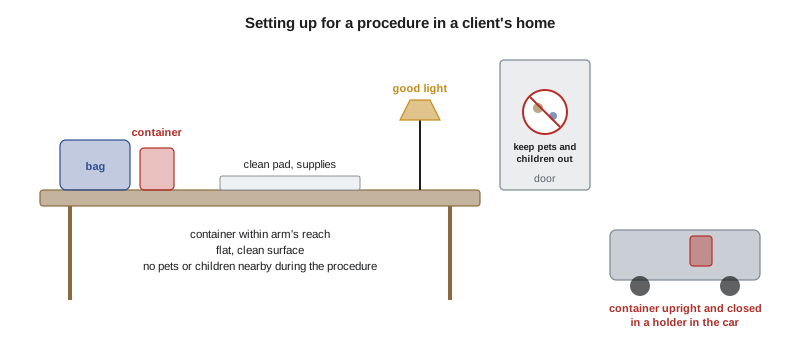
- Set up before you start: clear a flat, well-lit surface, put the container within arm's reach on the side of the dominant hand, and ask that children and pets be kept out of the room during the procedure.
- Dispose at the point of use: the used sharp goes straight into the container, with the safety feature activated, just as in the hospital. Nothing used is put down on a table, a bed or a cushion.
- Close and carry safely: the container is closed between visits and kept upright in a fixed holder in the car, not loose on the seat or in the trunk where it can tip.
- Never take a sharp out of a container, and never pour one container into another.
Clients who inject themselves are taught to use their own approved sharps container or, where local rules allow, a sturdy plastic bottle with a screw cap. Workers check the container on each visit. A container that is overfull, or a pile of used pen needles on the kitchen counter, is a hazard to the worker, the family and anyone who handles the household garbage.
Hazards that are hard to control in a home
Some risks in the community have no hospital equivalent, and they need planning before the visit rather than improvisation during it:
- Restless or confused clients. A client with dementia may pull away during an injection. The nurse plans the procedure for a calm time of day, explains each step, and asks a family member to help hold the arm when it is safe to do so.
- Sharps hidden in the home. Used needles may turn up in a bed, a sofa or the laundry, especially when the client is not managing their own disposal well. Workers never reach into a place they cannot see, such as under cushions or into a bag, without looking first.
- Pets. Dogs and cats can bump an arm, and cats in particular are drawn to anything that moves on a table.
- Poor light and cramped spaces. The nurse carries a headlamp or a small lamp and does not start a procedure until they can see clearly.
- Driving. A container that tips over in a car can open, so it is fixed in place, and used sharps are never carried in a pocket or loose in the bag.
Because home care staff often work alone, the exposure response is planned in advance. Each nurse carries a small exposure kit with gauze, a waterproof dressing, saline for eyes and the procedure card with the on-call number, so that the first aid steps in Lesson 9 can be done anywhere. After an exposure, the nurse calls the on-call line, finishes the visit only if it is safe and quick to do so, and goes to the nearest emergency department.
Long-term care
At Maple Court, the main sharps are insulin pens, blood glucose lancets and the occasional injection. The risks come from the residents and from routine rather than from complex procedures. A resident with dementia may grab a nurse's hand during a finger stick. A nurse doing a medication pass for 24 residents may be tempted to carry several used lancets to the cart rather than dispose of each one at the bedside.
Maple Court uses safety lancets that retract after one use, insulin pen needles with a safety shield at both ends, and small containers on each medication cart and in each resident's room where blood glucose tests are done. Lina Santos and the other certified nursing assistants do not handle needles, but they are trained to report any sharp they find and never to pick one up with their hands.
Clinics, dental offices and other health settings
Family practice clinics, walk-in clinics, dental offices, blood collection sites, pharmacies that give vaccines, physiotherapy clinics that use acupuncture needles, and veterinary clinics all handle sharps, often with a handful of staff and no occupational health department of their own. The rules for devices, containers, vaccination and post-exposure care apply to them as well, and the employer has to arrange in advance where a worker will be assessed after an exposure, usually the local emergency department or an occupational health clinic. Lesson 12 builds an exposure control plan for exactly this kind of small clinic.
Dental work has its own patterns. Many injuries come from burs, scalers, wires and syringes during cleanup of the tray, and dental offices often use a recapping device or a one-handed scoop for local anesthetic syringes, because the needle is used more than once on the same patient during a procedure. That is one of the few situations where recapping is allowed, and only with the device or the one-handed method.
Discarded needles in public places
Outside healthcare, the most common sharps hazard is a needle someone else threw away. Custodians in schools, malls and transit stations, parks and public works staff, sanitation and recycling workers, police officers, retail staff and hotel housekeepers all find discarded needles. The chance that one of these needles carries a virus that is still able to infect someone is lower than for a fresh needle in a hospital, because the viruses do not survive long when dried, and HIV in particular is fragile outside the body. But hepatitis B can survive on surfaces for at least a week, hepatitis C for days to weeks in some conditions, and any needlestick from an unknown needle is handled as an exposure.
Employers whose workers may find needles have duties under the Bloodborne Pathogens standard whenever contact with blood or sharps is reasonably anticipated in the job, which includes custodians and sanitation workers who regularly find needles. That means training, the right tools, a container, the offer of hepatitis B vaccine where appropriate, and post-exposure evaluation. Where contact is not reasonably anticipated, the General Duty Clause still applies. Many cities and counties provide public sharps disposal boxes and pickup services through their health departments or syringe services programs.
Picking up a discarded needle
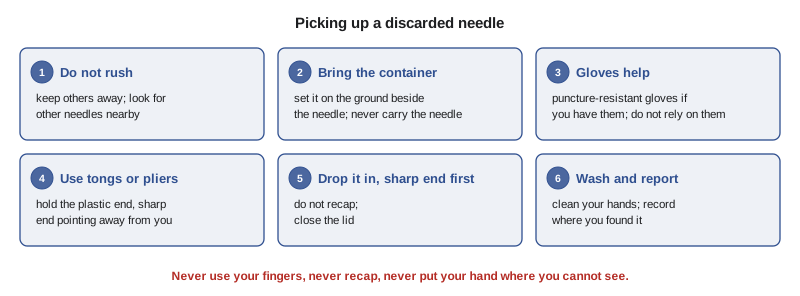
Workers who may find needles carry or have quick access to a pickup kit: tongs or a long-handled grabber, a small rigid sharps container, puncture-resistant gloves and hand sanitizer. The steps are simple, and the most important ones are about what not to do: never use fingers, never recap, never break the needle off, and never put a hand into a place you cannot see, such as a trash bin, a gap between seat cushions, a bag or the back of a toilet tank. Waste bags are carried away from the body and never compressed with hands or feet.
Sanitation and recycling workers are often hurt by needles thrown into household garbage or, worse, into recycling, where sorters handle material by hand. That is one reason public programs ask people who inject at home to use a proper container and return it to a pharmacy or a drop-off point.
In the United States, the FDA recommends that people who use needles at home put them in an FDA-cleared sharps container right after use, or, if one is not available, a heavy-duty plastic household container with a tight lid, and follow their state and local rules for disposal. Some areas accept sealed household containers in the trash; others require drop-off at a pharmacy, a hospital or a collection site.
Police, corrections, security and first aid
Police officers, corrections officers, security guards and loss prevention staff can be stuck by needles during searches. The basic rules are the same as in a hospital: look before you reach, use tools, and dispose of sharps immediately. Officers are trained to ask a person before a search whether they have anything sharp on them, to pat down the outside of clothing slowly rather than reaching into pockets, to use a flashlight and mirror to look into hidden spaces in vehicles, and to put any needle found straight into a rigid container rather than an evidence bag. Bites and spitting during arrests are handled as possible exposures and assessed the same way.
Designated first aiders in workplaces such as factories, offices and schools may be exposed to blood when they help an injured coworker or student. Their first aid kits include gloves and a face shield or pocket mask for rescue breathing, and they follow the same rules for cleaning blood and disposing of anything sharp. A first aider who is exposed is assessed like any other worker.
Tattoo, piercing and personal service settings
Tattoo artists, body piercers, electrolysis and some aesthetic services use needles every day, outside any hospital. Public health rules for personal service settings require single-use needles, proper sharps containers, cleaning and disinfection, and records, and they are inspected by local public health. The workers in these businesses face the same hazards as nurses, and the same habits protect them: never recap, dispose at the point of use, and know where to go after an exposure.
Tracking where needles turn up
Joanne also sits on a city working group with public works, parks, the school board and the public health unit. The group pooled a year of reports of needles found by city and school staff, to decide where to put new public disposal boxes and where pickup crews should look first.
# Needles found and reported by city and school staff over one year
found = [
    ("riverside trail", 64), ("transit terminal", 51), ("central library", 23),
    ("downtown parking garage", 47), ("arena washrooms", 18), ("north park", 9),
    ("high school grounds", 6), ("recycling plant sort line", 14),
]
total = sum(n for _, n in found)
print(f"total needles reported: {total}")
running = 0
for place, n in sorted(found, key=lambda x: -x[1]):
    running += n
    share = round(100 * n / total)
print(f"{place:26} {n:3} ({share:2} in 100) cumulative {round(100 * running / total):3} in 100")total needles reported: 232 riverside trail 64 (28 in 100) cumulative 28 in 100 transit terminal 51 (22 in 100) cumulative 50 in 100 downtown parking garage 47 (20 in 100) cumulative 70 in 100 central library 23 (10 in 100) cumulative 80 in 100 arena washrooms 18 ( 8 in 100) cumulative 88 in 100 recycling plant sort line 14 ( 6 in 100) cumulative 94 in 100 north park 9 ( 4 in 100) cumulative 97 in 100 high school grounds 6 ( 3 in 100) cumulative 100 in 100
Four places accounted for more than three quarters of the needles found. The group put disposal boxes at the trail head, in the transit terminal and in the parking garage stairwell, and agreed that crews would check those sites first each morning. The 14 needles found on the recycling sort line were a separate problem: they had all come through household recycling, so the city ran a campaign with pharmacies reminding residents never to put needles in household recycling.
Worked problem
Nadia's visit to Mr. Fournier
Nadia Rahman, a home care nurse, visits Mr. Fournier, 81, who has diabetes and mild memory loss and injects his own insulin. When she sits down on the sofa, she sees an uncapped pen needle between the cushions. On the kitchen counter there are about a dozen more in a cup. What should she do, now and afterwards?
Show solution
- She stands up carefully, does not reach between the cushions, and takes her sharps container and tongs from her bag. She puts the container down beside the sofa and picks up the needle with the tongs, sharp end away from her, and drops it in.
- She checks the rest of the sofa by looking, not by feeling, and then puts the needles from the cup into the container the same way.
- She talks with Mr. Fournier and his daughter about using an approved sharps container, shows them where it should sit next to his insulin, and arranges for the pharmacy to supply one and take it back when full.
- She reports the hazard to her team lead, who adds a note to the client's care plan so every visiting worker knows to check, and asks the case manager whether Mr. Fournier needs more help managing his injections.
Answer: Pick up each needle with tongs into her own container, never by hand, then fix the cause with a proper container for the client and a note in the care plan.
Common mistakes
MistakeUsing whatever container the client has, or none at all.
InsteadBring your own sharps container to every visit and set it within reach before you start.
MistakePicking up a discarded needle with your fingers because it is only one.
InsteadAlways use tongs or a grabber and a rigid container, and bring the container to the needle.
MistakeReaching into a trash bag or between cushions to see what is there.
InsteadNever put your hand where you cannot see; look first, and use tools.
MistakeLeaving a used-sharps container loose in the car.
InsteadKeep it closed and upright in a fixed holder.
MistakeTreating a stick from a discarded needle as harmless because the needle was old.
InsteadReport it and get assessed; some viruses survive for days or more.
Summary and key terms
- Sharps injuries happen in homes, long-term care, clinics, public places and many non-health jobs, often with less support than in a hospital.
- Home care staff bring their own containers and safety devices, set up before the procedure and dispose at the point of use.
- Plan for restless clients, hidden sharps, pets, poor light and driving with containers.
- Workers who may find discarded needles need training, tongs, a container, gloves and a post-exposure plan.
- Bring the container to the needle, pick it up with tools by the blunt end, and never recap or reach where you cannot see.
- Hepatitis B can survive on surfaces for a week or more, so any stick from an unknown needle is assessed.
- Tracking where needles are found helps decide where to put disposal boxes and where to check first.
- Point-of-use disposal
- Putting a used sharp into a container right where it was used, without carrying it.
- Pickup kit
- Tongs or a grabber, a rigid sharps container, puncture-resistant gloves and hand sanitizer for collecting discarded needles.
- Harm reduction program
- A public health service that provides sterile supplies and safe disposal to people who use drugs.
- Personal service setting
- A business such as a tattoo or piercing studio that may expose clients and workers to blood.
- Designated first aider
- A worker trained and assigned to give first aid in the workplace.
Practice problems
Work each problem on paper first, then reveal the answer to check.
Why does every home care nurse carry their own sharps container?
Show answer
So they never depend on what the client has and can always dispose at the point of use.
When you find a discarded needle, do you bring the needle to the container or the container to the needle?
Show answer
The container to the needle, and put it down right beside it.
Why are workers told never to reach into a trash bag or between cushions?
Show answer
Hidden needles can stick a hand they cannot see.
Is a stick from an old discarded needle an exposure?
Show answer
Yes; it is reported and assessed, because hepatitis B can survive on surfaces for a week or more.
How should a full sharps container be carried in a car?
Show answer
Closed and upright in a fixed holder, never loose.
What did the city working group do with its needle data?
Show answer
Placed disposal boxes where most needles were found, set crews to check those sites first, and ran a campaign about needles in recycling.
Lesson quiz · 5 questions
Score 60% or more to complete this lesson.
Create a free account to save your progress, take quizzes and earn a certificate.