
HSE-392 · Lesson 7 of 12 · 21 min
Blood and body fluid spills
▶ Video coming soon A video version of this lesson is on the way.
Blood ends up on floors, beds, walls, stretchers and equipment every day in a hospital: a dislodged IV, a nosebleed, a wound that soaks through its dressing, a broken specimen tube, a delivery, a trauma resuscitation. The viruses in it do not die the moment it leaves the body. Hepatitis B can survive in dried blood on a surface for at least seven days and still cause infection, and hepatitis C can survive for days to weeks. A spill that is left, or cleaned badly, is a hazard to the next person who touches it, kneels in it or picks up the broken glass in it.
Cleaning a spill safely is not complicated, but it has to be done in the right order with the right products. This lesson covers who cleans what, the spill kit, the steps, the disinfectants and the special cases.
Who cleans a spill
At Northbridge, the rule is that the person who finds a spill makes it safe immediately, and the spill is cleaned promptly by someone trained to do it. Making it safe means keeping people away: standing by it, putting out a wet floor sign, closing the door or covering it with absorbent material. For small spills in patient rooms, such as a few drops of blood on a bedside table, the clinical staff who are there clean it with the disinfectant wipes on the unit. Larger spills, spills on floors and spills in public areas are cleaned by environmental services, called by phone or pager. Lab spills are cleaned by trained lab staff using the lab's own procedure, because lab specimens can contain much higher concentrations of virus.
A large spill of blood or body fluid is not usually announced overhead. It is a routine environmental services call, unless the spill involves hazardous chemicals, in which case the hazardous materials spill announcement and procedure apply.
The spill kit
Every unit, the emergency department, the lab, the laundry and each Maple Court area has a spill kit in a marked place, checked monthly. The kit holds:
- Disposable gloves in several sizes, with heavier utility gloves for broken glass.
- A fluid-resistant gown or apron, and shoe covers.
- Eye protection or a face shield, and a mask.
- Absorbent material: disposable towels, absorbent pads, or a solidifying powder that turns liquid into a gel.
- A scoop and scraper, or tongs, for picking up broken glass and other sharp debris without hands.
- The hospital's approved disinfectant, ready to use or with instructions for diluting it.
- A biohazard bag, a small sharps container for glass, and a tie.
- A wet floor sign.
- A card with the steps, in plain language.
The steps
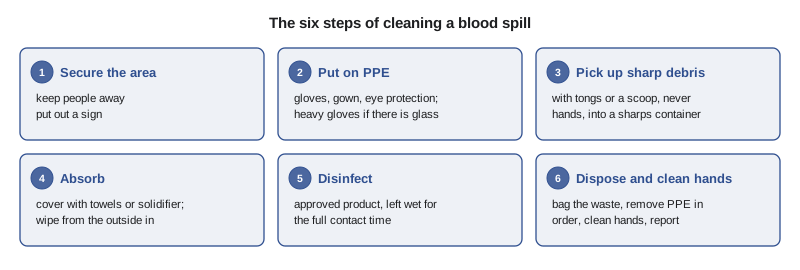
- Secure the area. Keep people away, put out a sign and, if possible, close the door. Ventilate if a solidifier or disinfectant has a strong smell.
- Put on protective equipment. Gloves at minimum; a gown or apron if clothing could be soiled; eye protection if there is any chance of splashing, such as on a vertical surface or when using a spray; heavy utility gloves over disposable gloves if there is broken glass.
- Remove sharp debris first. Use tongs, forceps, a scoop and scraper or a dustpan and brush to pick up broken glass, needles and other sharp items, and put them into a sharps container. Never use your hands, even gloved.
- Absorb the spill. Cover it with disposable towels or a solidifier. Wipe from the outside edge toward the center so the spill does not spread. Put the soaked material in a biohazard bag or the bag the procedure specifies.
- Clean and disinfect. Clean the surface to remove the remaining blood, because disinfectants work poorly on surfaces that are still covered in organic matter. Then apply the approved disinfectant and leave it wet for the full contact time on the label, which may be several minutes. Wipe again if needed.
- Dispose of waste and remove PPE. Bag the waste, remove gloves and other PPE in the order you were taught, and clean your hands. Restock the spill kit.
If any blood got onto your skin, into your eyes or mouth, or if you were cut by debris, follow the steps in Lesson 9 at once.
Disinfectants
OSHA requires contaminated surfaces to be cleaned and decontaminated with an appropriate disinfectant after contact with blood. OSHA accepts EPA-registered disinfectants that are tuberculocidal or whose labels claim effectiveness against HIV and hepatitis B, as well as a fresh dilution of household bleach. Common hospital choices include ready-to-use hydrogen peroxide products, quaternary ammonium compounds combined with alcohol, and chlorine (bleach) solutions. Each has a contact time, the length of time the surface must stay wet for the product to work, printed on the label.
Bleach is cheap, fast and kills bloodborne viruses well, but it has drawbacks. It damages many surfaces and fabrics, irritates the eyes, skin and airways, and must never be mixed with ammonia or acids, as HSE-390 explained. Diluted bleach also loses strength over time, so solutions are made fresh each day. Household bleach is usually a solution of about 5 to 8 parts in 100 of sodium hypochlorite. For blood spills, public health guidance commonly uses two strengths:
- A 1 in 100 dilution, roughly 500 to 800 parts per million of chlorine, for small spills on hard, non-porous surfaces after cleaning.
- A 1 in 10 dilution, roughly 5,000 to 8,000 parts per million, for large spills, or for spills in labs and other areas with high concentrations of virus, applied before cleaning as well as after.
Environmental services at Northbridge uses a ready-to-use hydrogen peroxide disinfectant for most spills, because it is less irritating and kinder to surfaces, and keeps bleach for specific uses. But staff are taught how to make a bleach dilution correctly, because Maple Court and the Northbridge Home Health team sometimes need it. Marta keeps a small calculator script for the strength of a dilution.
# Strength of a bleach dilution in parts per million (ppm) of chlorine.
# Bleach strength is given as grams of sodium hypochlorite per 100 mL.

def ppm(bleach_g_per_100ml, parts_bleach, parts_water):
    fraction = parts_bleach / (parts_bleach + parts_water)
    return bleach_g_per_100ml * 10000 * fraction

for strength in (5.25, 6.0, 8.25):
    small = ppm(strength, 1, 99)   # 1 in 100
    large = ppm(strength, 1, 9)    # 1 in 10
    print(f"bleach at {strength} g per 100 mL: 1 in 100 = {small:,.0f} ppm,"
          f" 1 in 10 = {large:,.0f} ppm")

# How much bleach to add to 1,000 mL of water for about 5,000 ppm?
target, strength, water_ml = 5000, 6.0, 1000
bleach_ml = target * water_ml / (strength * 10000 - target)
print(f"\nfor {target:,} ppm with {strength} g bleach: add {bleach_ml:.0f} mL to {water_ml} mL water")bleach at 5.25 g per 100 mL: 1 in 100 = 525 ppm, 1 in 10 = 5,250 ppm bleach at 6.0 g per 100 mL: 1 in 100 = 600 ppm, 1 in 10 = 6,000 ppm bleach at 8.25 g per 100 mL: 1 in 100 = 825 ppm, 1 in 10 = 8,250 ppm for 5,000 ppm with 6.0 g bleach: add 91 mL to 1000 mL water
The code shows why the exact bleach product matters: a 1 in 10 dilution of a stronger bleach gives about 8,000 parts per million, while a weaker one gives about 5,000. Both are within the range used for large spills, but someone who uses the wrong dilution, such as a 1 in 1,000 mix, may be wiping the surface with something too weak to work. Ready-to-use products avoid the arithmetic, which is one reason hospitals prefer them.
Other body fluids
Vomit, urine, stool and other body fluids that are not visibly bloody are not a bloodborne virus risk, but they are often a bigger infection risk overall. Vomit from a patient with norovirus can spread the virus through the air as droplets and onto surfaces several meters away, and stool from a patient with C. difficile leaves spores that alcohol and many common disinfectants do not kill. The same steps apply: secure, protect, absorb, clean and disinfect. What changes is the product and sometimes the protection. Infection control tells each unit which disinfectant to use for which organism, often a sporicidal product such as a chlorine or peroxide solution for C. difficile, and a mask and eye protection for vomit, which can splash and aerosolize. When in doubt, treat the fluid as if it carried the worst likely germ and ask infection control.
For supervisors: kits and training
Spill kits are only useful if they are complete, easy to find and familiar to staff. Assign someone on each unit to check the kit every month and after every use, and record the check on a tag inside the lid. Keep the kit in the same place on every unit, so float and agency staff can find it. Include spill cleanup in orientation and practice it once a year, ideally with a mock spill containing a few pieces of fake glass. And make sure night staff know how to reach environmental services, and what to do while they wait.
Special cases
- Spills with broken glass: always pick up the glass with tools first, and wear heavy gloves over disposable ones. Small fragments can be picked up with a damp disposable towel held in tongs.
- Spills on carpet or upholstery: absorb as much as possible, then clean with a product approved for the material, or remove and replace it. Many hospitals avoid fabric surfaces in clinical areas for this reason.
- Spills inside equipment, such as a centrifuge or an analyzer in the lab: follow the lab's procedure, which usually involves waiting for aerosols to settle, as HSE-390 described for Daniel's centrifuge breakage.
- Spills on clothing: remove the clothing as soon as possible, as if it were contaminated PPE, and have it laundered by the hospital. If blood soaked through to the skin, wash the skin and report it.
- Blood on a patient's skin or hair: clean it gently as part of care, wearing gloves.
- Spills in vehicles and homes: the same steps apply, with the kit home health staff carry, as Lesson 11 describes.
Worked problem
The emergency department hallway
At 0230, a patient in the emergency department pulls out an IV while walking to the washroom. By the time a nurse reaches him, there are drops and smears of blood along about 5 meters of hallway and a larger pool by the washroom door, with a broken specimen tube in it. The night environmental services lead is on another call for 20 minutes. What should happen?
Show solution
- The nurse first deals with the patient: pressure on the IV site, gloves on, and help back to his stretcher.
- A second staff member secures the hallway with wet floor signs and stands by the pool so nobody walks through it, then calls environmental services and reports the broken glass.
- Because the spill is large and in a busy area, a trained emergency department aide starts cleanup with the spill kit while waiting: gloves, gown, eye protection and heavy gloves, picking up the broken tube with tongs into a sharps container first, then absorbing the pool with solidifier.
- When the environmental services lead arrives, she cleans and disinfects the whole area with the hospital disinfectant, leaving it wet for the full contact time, and restocks the kit. Nobody was exposed, so no exposure report is needed, but a note goes to the department about IV securement.
Answer: Care for the patient, secure the area, remove the glass with tools first, absorb, then clean and disinfect for the full contact time.
Common mistakes
MistakePicking up broken glass in a spill with gloved hands.
InsteadUse tongs, a scoop or a dustpan, and heavy gloves over disposable ones.
MistakeSpraying disinfectant on a spill and wiping it straight off.
InsteadClean first, then leave the disinfectant wet for the full contact time on the label.
MistakeMixing bleach with other cleaners to make it stronger.
InsteadNever mix bleach with ammonia, acids or other products; use it alone at the right dilution.
MistakeUsing yesterday's bleach solution.
InsteadMake diluted bleach fresh each day, or use a ready-to-use product.
MistakeLeaving a spill for environmental services without securing it.
InsteadKeep people away and put out a sign straight away.
Summary and key terms
- Hepatitis B can survive in dried blood for at least seven days, so spills must be cleaned promptly and properly.
- Whoever finds a spill makes it safe at once; trained staff clean it.
- Spill kits hold PPE, absorbent, tools for glass, disinfectant, bags and a sign, and are checked monthly.
- The steps are: secure, protect, remove sharps with tools, absorb, clean and disinfect, dispose and clean hands.
- Disinfectants work only on cleaned surfaces and only if left wet for the full contact time.
- Bleach is used at 1 in 100 for small spills and 1 in 10 for large or lab spills, mixed fresh and never with other products.
- Spill kit
- A ready set of PPE, absorbent, tools, disinfectant and bags for cleaning a blood or body fluid spill.
- Solidifier
- A powder that turns liquid into a gel so it can be scooped up.
- Contact time
- The time a surface must stay wet with a disinfectant for it to work, stated on the label.
- Parts per million (ppm)
- A measure of concentration; used for the strength of chlorine in a bleach dilution.
- Non-porous surface
- A hard surface, such as steel, glass or sealed plastic, that liquids do not soak into.
Practice problems
Work each problem on paper first, then reveal the answer to check.
How long can hepatitis B survive in dried blood on a surface?
Show answer
At least seven days.
What is the first step when you find a blood spill?
Show answer
Make the area safe by keeping people away, for example with a sign or by standing by it.
Why is a surface cleaned before the disinfectant is applied?
Show answer
Disinfectants work poorly on surfaces still covered in organic matter such as blood.
What bleach dilution is used for a large blood spill?
Show answer
About 1 in 10, or roughly 5,000 to 8,000 parts per million.
How should broken glass in a spill be picked up?
Show answer
With tongs, a scoop or a dustpan, never hands, wearing heavy gloves over disposable ones.
Why do hospitals prefer ready-to-use disinfectants for most spills?
Show answer
They avoid dilution errors and are less irritating and damaging than bleach.
Lesson quiz · 5 questions
Score 60% or more to complete this lesson.
Create a free account to save your progress, take quizzes and earn a certificate.