
HSE-392 · Lesson 3 of 12 · 22 min
Routine and standard precautions
▶ Video coming soon A video version of this lesson is on the way.
Nobody can tell by looking whether a patient has hepatitis B, hepatitis C or HIV. Many people with these infections do not know it themselves. In Canada, about 1 in 4 people with hepatitis C, and in the United States roughly 4 in 10, do not know they are infected. Any approach that protects workers only from patients known to be infected will miss a large share of the risk. The answer, worked out in the 1980s, is to treat the blood and certain body fluids of every patient as potentially infectious, and to use the same basic precautions with everyone.
From universal precautions to standard precautions
In 1987, at the height of concern about HIV, the CDC introduced universal precautions: blood and certain body fluids from all patients were to be handled as if infected. In 1996 the CDC combined universal precautions with body substance isolation into standard precautions, which apply to blood, all body fluids, secretions and excretions except sweat, non-intact skin and mucous membranes. The OSHA standard still uses the term universal precautions, and accepts standard precautions as meeting it. Standard precautions are built around the worker's judgment, before each interaction, about what exposure is likely and what protection is needed.
Whatever the name, the elements are the same:
- Hand hygiene.
- A risk assessment before each task.
- Personal protective equipment chosen for the exposure you expect.
- Safe handling of sharps and safe injection practices.
- Respiratory hygiene and cough etiquette.
- Cleaning and disinfection of equipment and the environment.
- Safe handling of linen and waste.
- Patient placement that takes infection risk into account.
This lesson focuses on the parts that protect workers from blood and body fluids. HSE-245 Infection Prevention and Control covers the rest.
The risk assessment before each task
The question a worker asks before every interaction is simple: what could I be exposed to, and how? The answer depends on the task, the patient and the setting, not on the patient's diagnosis. Starting an IV on a calm adult carries a small risk of a blood splash to the hands. Starting one on a frightened, struggling child carries more. Suctioning a tracheostomy can spray secretions toward the face. Emptying a drainage bag can splash. Changing the bed of a patient with a bleeding wound means contact with blood-soaked linen.
Amira teaches new nurses on 4 West to pause at the door of every room and run through three questions in a few seconds:
- Will my hands touch blood, body fluids, mucous membranes, non-intact skin or contaminated items? Then gloves.
- Could my clothing or arms be soiled? Then a gown.
- Could anything splash or spray toward my face? Then a mask and eye protection, or a face shield.
She adds a fourth question for herself: will I be using a sharp, and is the sharps container where I need it? Lesson 5 explains why that one matters so much.
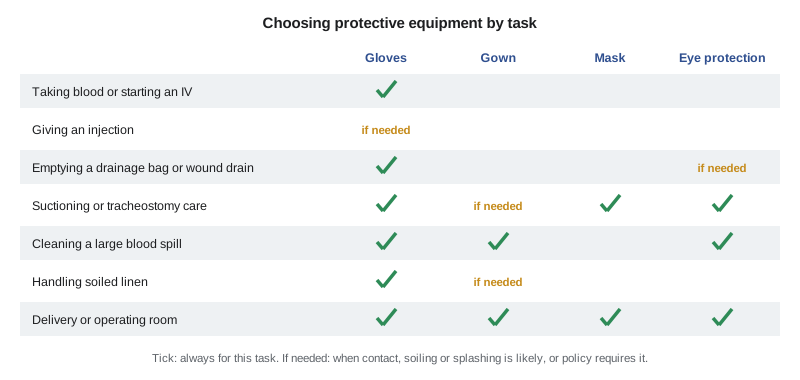
Hand hygiene
Clean hands are the foundation. Most transfers of germs in healthcare happen on hands, and blood on the hands becomes a risk the moment it meets a cut or a chapped knuckle. The moments for hand hygiene are the same in both countries: before touching a patient or the patient's surroundings, before a clean or aseptic procedure, after a risk of exposure to body fluids, and after touching a patient or the patient's surroundings. Hand hygiene is also needed every time gloves come off, because gloves have tiny holes and hands are often contaminated as gloves are removed.
Alcohol-based hand rub is the default for hands that are not visibly soiled. Hands with visible blood or other body fluids need soap and running water. And because dry, cracked skin is a route for bloodborne viruses, hand care is part of hand hygiene: hospital-approved lotion, reporting dermatitis to Employee Health and Safety, and covering cuts on the hands with a waterproof dressing before work.
Gloves
Gloves are the most used and most misused piece of protective equipment in a hospital. They protect hands from blood and body fluids, but only if they are worn for the right tasks and changed at the right times.
- Wear gloves when you expect to touch blood, body fluids, secretions, excretions, mucous membranes, non-intact skin or contaminated items, and for all vascular access procedures such as drawing blood and starting IVs.
- Use one pair for one patient and one task. Change them between a dirty task and a clean one on the same patient.
- Never wash or sanitize gloves to reuse them.
- Remove them as soon as the task is done, before touching clean surfaces such as the computer, the phone or the door handle, and clean your hands.
- Choose the right size: gloves that are too big catch and tear, and gloves that are too small split.
- Use nitrile or another non-latex material unless there is a reason not to, because latex allergy is a real occupational hazard.
A glove will not stop a needle. Its value in a needlestick is that it wipes some blood off the outside of the needle as it passes through, which lowers the dose. In operating rooms and other settings where many sharps are used, double gloving is standard practice. Studies show the inner glove is punctured much less often than the outer one, and colored indicator underglove systems make outer glove holes easy to see.
Gowns and facial protection
A gown protects skin and clothing when splashes or soiling are likely. For most care, a regular isolation gown is enough. For procedures with a lot of blood or fluid, such as deliveries, major surgery or trauma care, a fluid-resistant or impervious gown is needed, because a cotton or thin gown soaks through.
Eye, nose and mouth protection is needed whenever blood or body fluid could splash or spray. Prescription glasses are not eye protection, because they leave gaps at the sides and top. Goggles, safety glasses with side shields, or a face shield over a mask are the usual choices. Face shields have the advantage of protecting the whole face and being easy to put on over glasses. Splashes to the eyes are the most common kind of mucous membrane exposure in hospitals, and many happen during tasks nobody expected to splash, such as removing an IV, emptying a drain or handling a specimen container whose lid was not on tight.
Safe injection practices
Safe injection practices protect patients from each other, and several of them also protect workers. The core rule is one needle, one syringe, one time: a needle or syringe is never reused on another patient, and never used to re-enter a medication vial or bag after it has been used on a patient. Single-dose vials are used for one patient only. Medications are prepared in a clean area away from used equipment. And used sharps go straight into a sharps container at the point of use, without being recapped, as Lesson 5 explains.
Linen, waste and cleaning
Environmental services workers, laundry workers and transporters handle the materials that clinical staff leave behind. Standard precautions protect them too, but only if clinical staff do their part:
- Soiled linen is handled as little as possible, rolled with the dirtiest part inside, and placed in a bag at the bedside. Wet linen goes in a leak-resistant bag.
- No sharps ever go into linen or regular waste.
- Blood and body fluid spills are cleaned up promptly, as Lesson 7 explains.
- Reusable equipment that has touched blood is cleaned and disinfected or sent for reprocessing, not left for the next shift.
For supervisors: making the right choice the easy one
Most lapses in precautions are not decisions to take a risk. They happen because the right equipment is not where the task happens, because a worker is rushing to an alarm, or because the unit has drifted into habits nobody questions. Supervisors can change those conditions. Stock gloves in every size, face shields and gowns at the point of care, not in a distant storeroom. Put hand rub at the door of every room and on every cart. Check during rounds that supplies are full at the start of each shift. When you see someone skip protection, ask what got in the way before you correct them, because the answer often points to a fix. And wear the protection yourself every time: staff notice what the charge nurse does far more than what the policy says.
Checking the habits
Joanne's infection control colleagues audit precautions on each unit every quarter. An observer watches a sample of tasks and records whether the right protection was used. The results for 4 West in the last audit are summarized below.
# Observations from the 4 West audit: (task, needed, used)
# needed/used are sets of items: G gloves, W gown, E eye protection, M mask
obs = [
    ("blood draw", "G", "G"), ("blood draw", "G", "G"), ("blood draw", "G", ""),
    ("IV start", "G", "G"), ("IV start", "G", "G"), ("IV start", "G", "G"),
    ("drain empty", "GE", "G"), ("drain empty", "GE", "GE"), ("drain empty", "GE", "G"),
    ("trach suction", "GWEM", "GWEM"), ("trach suction", "GWEM", "GM"),
    ("wound care", "GW", "GW"), ("wound care", "GW", "G"),
    ("linen change", "G", "G"), ("linen change", "G", "G"),
]

by_item = {}
full = 0
for task, need, used in obs:
    if set(need) <= set(used):
        full += 1
    for item in need:
        n, ok = by_item.get(item, (0, 0))
        by_item[item] = (n + 1, ok + (item in used))

print(f"tasks with all needed protection: {full} of {len(obs)}")
names = {"G": "gloves", "W": "gown", "E": "eye protection", "M": "mask"}
for item in "GWEM":
    n, ok = by_item[item]
print(f" {names[item]:15} used {ok} of {n} times needed")tasks with all needed protection: 10 of 15 gloves used 14 of 15 times needed gown used 2 of 4 times needed eye protection used 2 of 5 times needed mask used 2 of 2 times needed
Gloves were used almost every time they were needed. Eye protection and gowns were the gaps, missed in most of the drain and wound tasks where splashing or soiling was likely. That pattern is common in hospitals: people protect their hands and forget their faces. When Sarah asked staff why, the answer was practical. Face shields were kept in the clean utility room at the far end of the unit, not with the drainage supplies. Moving a box of face shields to each supply cart did more than a reminder poster could.
Worked problem
The drain that splashed
Lina Santos, the CNA in Birch at Maple Court, is asked to help a nurse empty a resident's wound drain into a measuring container. She wears gloves. As the nurse opens the drain port, it spurts, and a drop lands near Lina's eye. What should Lina have worn, and what happens now?
Show solution
- A drain under pressure can splash, so the risk assessment before the task should have added eye protection, and a gown if soiling was likely.
- Lina checks whether fluid reached her eye. She is not sure, so she treats it as a possible exposure and flushes the eye with water at the eyewash station for several minutes.
- She tells the nurse and the charge nurse immediately, and the nurse calls Employee Health and Safety, which arranges an assessment the same morning, as Lesson 9 describes.
- The Birch team adds face shields to the dressing cart, and the dressing procedure is updated to say eye protection is used whenever a drain is opened.
Answer: Eye protection should have been worn; Lina flushes, reports at once and is assessed, and the cart and procedure are changed so the right protection is at hand.
Common mistakes
MistakeChoosing protection by the patient's diagnosis.
InsteadChoose protection by the task and the exposure you expect, with every patient.
MistakeWearing the same gloves from one patient to the next.
InsteadUse one pair for one patient and one task, and clean your hands when you remove them.
MistakeCounting prescription glasses as eye protection.
InsteadUse goggles, side-shield glasses or a face shield whenever splashing is possible.
MistakeWorking with uncovered cuts or cracked skin on the hands.
InsteadCover cuts with a waterproof dressing, care for your skin and report dermatitis.
MistakeLeaving sharps or bloody items in linen for others to find.
InsteadDispose of sharps at the point of use and bag soiled linen at the bedside.
Summary and key terms
- Many people with bloodborne infections do not know they are infected, so precautions must be used with every patient.
- Standard precautions are the American approach, which meets the OSHA requirement for universal precautions.
- Protection is chosen by task: gloves for hands, gowns for clothing and skin, masks and eye protection for splashes.
- Hand hygiene is needed before and after patient contact, after body fluid exposure and every time gloves come off.
- Gloves reduce the dose in a needlestick but do not stop the needle; double gloving helps where many sharps are used.
- Safe injection practice means one needle, one syringe, one time.
- Clinical staff protect support staff by bagging linen properly and never leaving sharps behind.
- Universal precautions
- The 1987 approach of treating blood and certain body fluids from all patients as infectious.
- Routine practices
- The Canadian set of infection control practices used with every patient, based on a point-of-care risk assessment.
- Standard precautions
- The American set of infection control practices used with every patient, introduced by the CDC in 1996.
- Point-of-care risk assessment
- A quick judgment before each interaction about what exposure is likely and what protection is needed.
- Double gloving
- Wearing two pairs of gloves, used in surgery and other high-risk procedures to reduce exposure from glove punctures.
- Fluid-resistant gown
- A gown designed to resist penetration by blood and body fluids during procedures with heavy exposure.
Practice problems
Work each problem on paper first, then reveal the answer to check.
Why are precautions used with every patient rather than only those known to be infected?
Show answer
Many people with bloodborne infections do not know they are infected, so diagnosis-based precautions would miss them.
What three questions does Amira ask at the door of each room?
Show answer
Will my hands touch blood or fluids? Could my clothing be soiled? Could anything splash toward my face?
When must hands be washed with soap and water rather than hand rub?
Show answer
When they are visibly soiled with blood or other body fluids.
Why do gloves help in a needlestick if they cannot stop the needle?
Show answer
They wipe some blood off the needle as it passes through, reducing the dose.
What does one needle, one syringe, one time mean?
Show answer
A needle or syringe is used for only one patient and never to re-enter a vial or bag after use.
What fixed the gap in eye protection on 4 West?
Show answer
Putting face shields on each supply cart where the drainage supplies were, instead of at the far end of the unit.
Lesson quiz · 5 questions
Score 60% or more to complete this lesson.
Create a free account to save your progress, take quizzes and earn a certificate.