
LES-103 · Lesson 4 of 12 · 21 min
Elements of an offense: the guilty mind and causation
▶ Video coming soon A video version of this lesson is on the way.
Ms. Liu starts the fourth class by dropping a heavy textbook on the floor. Several students jump. Did she assault the room? Nobody thinks so, because she meant only to make a noise. Now, she says, suppose she had thrown the book at Marco and missed. Suppose she had thrown it at the wall knowing he was standing beside it. Suppose she had tossed it carelessly over her shoulder without looking. The act could be identical in each case, but the law treats the four people very differently, because criminal law is concerned with what was in the actor's mind. That mental element is called mens rea, the guilty mind. This lesson explains the levels of mental fault, how officers gather evidence of what someone was thinking, and the related question of causation: when the accused's conduct legally caused a result such as death.
Why the guilty mind matters
The requirement of a guilty mind reflects a basic idea of justice: people should be punished for harm they chose to cause or risked causing, not for accidents. A driver who hits a child who darts into the road, despite driving carefully, has caused a terrible harm but has done nothing wrong. Requiring a guilty mind also makes the law fair to the accused in another way: it lets people avoid criminal liability by choosing to obey the law. The Supreme Court of the United States has repeatedly said that requiring a culpable mental state is the rule rather than the exception in Anglo-American criminal law. In Morissette v. United States (1952), it held that a man who took bomb casings from a federal bombing range, believing they were abandoned, could not be convicted of stealing government property without proof that he knew they were not abandoned. In Elonis v. United States (2015) it refused to convict a man of making threats on the basis of how a reasonable person would read his posts alone, and in Counterman v. Colorado (2023) it held that the First Amendment requires proof at least that a speaker consciously disregarded a substantial risk that his words would be seen as threatening violence.
Mens rea is not the same as motive. Motive is the reason a person acted: greed, jealousy, revenge, desperation. Intent is the mental state with which the person acted. A woman who steals bread to feed her children has a sympathetic motive, but she intends to take bread that is not hers, and that is theft. Motive is not an element of most offenses and need not be proved, though it is often powerful evidence, because people rarely act without a reason. Prosecutors routinely tell juries that they need not prove why the defendant acted, only that he or she acted with the required mental state, while still presenting motive evidence because it helps explain the case.
The four culpable mental states
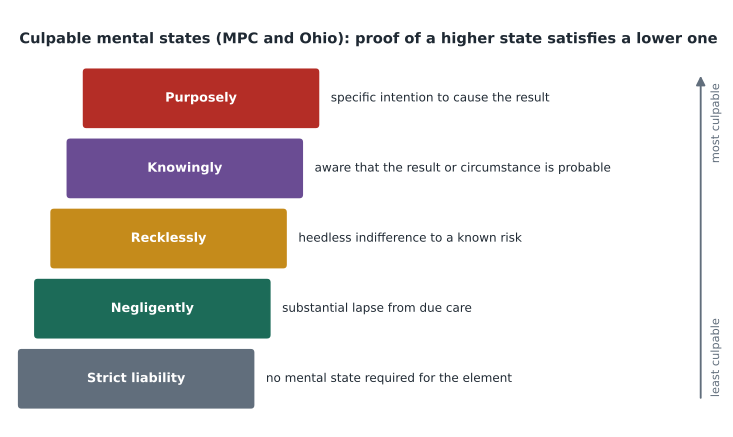
The Model Penal Code, section 2.02, defines four culpable mental states, and Ohio's section 2901.22 uses the same four words with slightly different definitions. A person acts purposely when it is his or her specific intention to cause a certain result, or, when the offense is defined by conduct, it is the person's specific intention to engage in that conduct. A person acts knowingly, regardless of purpose, when aware that his or her conduct will probably cause a certain result or will probably be of a certain nature, and has knowledge of circumstances when aware that they probably exist; Ohio adds that knowledge exists when a person subjectively believes there is a high probability of a fact and fails to make inquiry or acts with a conscious purpose to avoid learning it, the rule known as willful blindness. A person acts recklessly when, with heedless indifference to the consequences, the person disregards a substantial and unjustifiable risk that the conduct is likely to cause a certain result or be of a certain nature. A person acts negligently when, because of a substantial lapse from due care, the person fails to perceive or avoid a risk that the conduct may cause a certain result or be of a certain nature.
The four states form a hierarchy. Under the Model Penal Code and Ohio law, proof of a higher mental state also proves the lower ones: if a statute requires recklessness, proof that the defendant acted knowingly or purposely is enough. When a statute defining an offense does not specify any mental state, Ohio's section 2901.21 says that recklessness is required unless the section plainly indicates a purpose to impose strict liability. Strict liability offenses, which require no culpable mental state, are common for traffic and regulatory matters and for some serious offenses where the legislature has said so clearly. Driving while impaired in Ohio, called operating a vehicle under the influence or OVI, is a strict liability offense: the state need not prove the driver knew he was impaired.
Proving what someone was thinking
Nobody can see inside another person's mind, so the guilty mind is almost always proved by inference from what the person said and did. The law allows a common sense inference that a sane and sober person intends the natural and probable consequences of his or her acts. A man who swings a baseball bat at another person's head can be inferred to have intended at least bodily harm. But the inference is not automatic, and the judge or jury must consider everything that might point the other way, such as intoxication, panic or an honest mistake. Ohio juries are told they may infer purpose or knowledge from the manner in which an act was done, the means used and all the other facts and circumstances, but they are never required to.
That is why the officer's notes matter so much. Statements made at the scene are often the best evidence of intent: a man who says I told him I would make him pay before he hit him has supplied his own mens rea. So is preparation, such as bringing a weapon or buying gloves; concealment, such as wiping fingerprints or lying about where one was; the number and location of blows; threats before the event; the relationship between the parties; and what the person did afterward, such as calling for help or running away. Good notes record exact words in quotation marks, the sequence of events and observations of the person's condition, such as whether he appeared sober, coherent and calm. Ms. Liu says that more cases are lost for want of evidence about the mind than for want of evidence about the act.
Mistakes of fact and mistakes of law
An honest mistake of fact can mean the accused lacked the required guilty mind. A woman who takes an identical umbrella from a restaurant rack, honestly believing it is hers, has not stolen it, because she did not intend to take property belonging to another. For offenses requiring subjective fault, the mistake need only be honest, not reasonable, though an unreasonable claim is less likely to be believed. For offenses of negligence, the mistake must also be reasonable. For strict liability offenses, a mistake of fact is no defense, because no mental state is required.
A mistake of law is different. The traditional rule, followed in Ohio, is that ignorance of the law is no excuse. Everyone is presumed to know the criminal law, because a system in which people could escape liability by claiming they did not know the rules could not work. There are narrow exceptions. The Model Penal Code, section 2.04, excuses a person who reasonably relies on an official statement of the law, such as a statute or a judicial decision later found invalid or an official interpretation by the public officer responsible for the law. For officers, this has a practical side: officers must be careful when they tell members of the public what the law allows, because their words can later be relied on.
Causation: did the conduct cause the result?
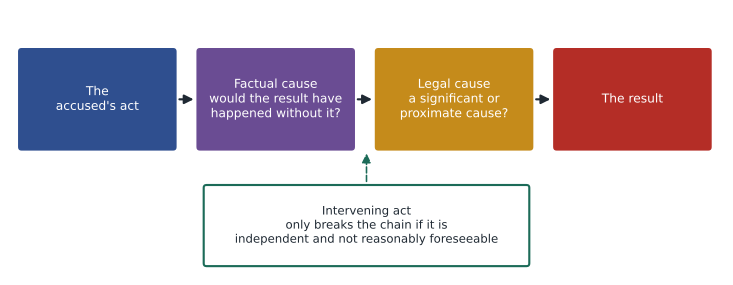
For result crimes such as homicide and felonious assault, the prosecution must prove that the accused's conduct caused the prohibited consequence. Causation has two parts. Factual causation asks whether the result would have happened but for the conduct. Legal causation asks whether the accused should be held legally responsible for the result, which depends on how direct the connection was and whether something else intervened. The Model Penal Code, section 2.03, requires that the conduct be a but-for cause of the result and that the actual result not be too remote or accidental in its occurrence to have a just bearing on the actor's liability. Courts usually call the second part proximate cause. A defendant's conduct need not be the only cause, but an independent intervening cause that was not reasonably foreseeable can break the chain. In Burrage v. United States (2014), the Supreme Court held that a federal law punishing drug distribution resulting in death requires but-for causation: the drug must have been the cause without which the death would not have occurred, not merely a contributing factor.
Two further rules matter often. The first is the thin skull rule, also called the eggshell skull rule: you take your victim as you find him. If a man punches someone who, unknown to him, has a fragile skull or a heart condition and the victim dies, the man is responsible for the death even though a healthy person would have survived. American courts apply it in the same way. The second is that poor medical treatment of an injury rarely breaks the chain of causation. Courts generally hold that negligent medical care is a foreseeable consequence of inflicting a serious injury and does not relieve the attacker of responsibility, unless the treatment was so grossly wrong that it alone caused death. For investigators, these rules mean that the full medical picture, from the first injury to the cause of death certified by the pathologist, must be documented.
The code below applies the fault hierarchy to a set of situations from Port Ardent files, showing how the proved mental state compares with what each offense requires. Marco says it helps him see why the same act can lead to very different charges.
# Does the proved mental state meet what the charge requires? (MPC 2.02(5); R.C. 2901.22(E))
ladder = ["purposely", "knowingly", "recklessly", "negligently"]   # most to least culpable
def meets(required, proved):
    if required == "strict liability":
        return True
    return proved in ladder and ladder.index(proved) <= ladder.index(required)
cases = [("felonious assault", "knowingly", "purposely"), ("assault (A)", "knowingly", "recklessly"),
         ("assault (B)", "recklessly", "recklessly"), ("receiving stolen property", "knowingly", "recklessly"),
         ("negligent homicide", "negligently", "recklessly"), ("OVI", "strict liability", "none"),
         ("murder", "purposely", "knowingly")]
for charge, required, proved in cases:
print(f"{charge:28s} requires {required:17s} proved {proved:10s} -> {'met' if meets(required, proved) else 'NOT met'}")felonious assault requires knowingly proved purposely -> met assault (A) requires knowingly proved recklessly -> NOT met assault (B) requires recklessly proved recklessly -> met receiving stolen property requires knowingly proved recklessly -> NOT met negligent homicide requires negligently proved recklessly -> met OVI requires strict liability proved none -> met murder requires purposely proved knowingly -> NOT met
The output shows the logic the courts apply. Proof of a higher level of fault always satisfies a lower requirement, but never the reverse. Recklessness about whether property was stolen is not enough for receiving stolen property, which requires knowledge or reasonable cause to believe, and knowledge that death would probably result is not enough for murder in Ohio, which requires purpose. Getting the mental element right is often the difference between two charges, which is why the next lessons keep returning to it.
Worked problem
An overdose death
Port Ardent investigators are called to an apartment where a 24-year-old man has died of an overdose. His phone shows that four hours earlier he bought half a gram of what was sold as heroin from a dealer the police know. The toxicology report finds fentanyl and no other drug. The dealer is arrested with more of the same substance. Can he be charged with causing the death?
Show solution
- Offense: Ohio's involuntary manslaughter statute, R.C. 2903.04(A), applies when a person causes another's death as a proximate result of committing a felony, and selling fentanyl is a felony trafficking offense. Ohio also has a specific offense of corrupting another with drugs, and federal law has a twenty-year mandatory minimum for distribution resulting in death.
- Factual causation: the toxicology report and the pathologist must establish that fentanyl caused the death; the text messages and the matching substance link the dealer's sale to the drug consumed.
- Legal causation: the death must be a proximate, foreseeable result of the sale; under Burrage, a federal charge requires the drug to be a but-for cause, which is why a toxicology report showing only fentanyl matters.
- Evidence to gather: the phone, the remaining substance for analysis, the timeline of purchase and use, any other source of drugs, and the pathologist's opinion on cause of death.
Answer: A homicide charge is possible if the evidence establishes both factual and legal causation. Investigators should treat the scene as a potential homicide from the start, because evidence lost in the first hours cannot be recovered.
Common mistakes
MistakeMotive must be proved for every crime.
InsteadMotive is not an element of most offenses, though it is often useful evidence; the required mental state is what must be proved.
MistakeIf the victim had a hidden medical condition, the attacker is not responsible for the death.
InsteadUnder the thin skull rule, the attacker takes the victim as he finds him.
MistakeI didn't know it was illegal is a defense.
InsteadIgnorance of the law is not an excuse, apart from narrow exceptions for reliance on official advice.
MistakeAny careless act that causes harm is a crime of negligence.
InsteadCriminal negligence in Ohio requires a substantial lapse from due care; ordinary carelessness is a matter for civil law.
Summary and key terms
- The guilty mind is the mental element of an offense; it is different from motive, which need not be proved.
- The four culpable mental states are purposely, knowingly, recklessly and negligently; proof of a higher one proves the lower ones.
- In Ohio, recklessness is required when a statute is silent, unless it plainly imposes strict liability.
- Intent is proved by inference from words, preparation, the manner of the act, concealment and conduct afterward, so precise notes are vital.
- An honest mistake of fact can negate the guilty mind; ignorance of the law is not an excuse.
- Causation requires a but-for cause and a proximate, foreseeable connection; the eggshell skull rule applies.
- Culpable mental state
- The mental element required for an offense: purposely, knowingly, recklessly or negligently.
- Purposely
- With the specific intention to cause a result or engage in conduct.
- Knowingly
- Aware that conduct will probably cause a result or be of a certain nature.
- Recklessly
- With heedless indifference, disregarding a substantial and unjustifiable risk.
- Strict liability
- Liability without proof of any culpable mental state.
- Proximate cause
- The legal part of causation: the result was a foreseeable, not too remote, consequence of the conduct.
Practice problems
Work each problem on paper first, then reveal the answer to check.
What is the difference between motive and intent?
Show answer
Motive is why a person acted; intent is the mental state with which the person acted. Intent is an element; motive usually is not.
What does Ohio law say about a person who deliberately avoids learning a fact?
Show answer
If the person believes there is a high probability of the fact and fails to inquire or acts to avoid learning it, he or she has knowledge of it.
Give three kinds of evidence an officer can record to prove intent.
Show answer
Examples: statements and threats, preparation such as bringing a weapon, the manner and number of blows, concealment and flight.
A man punches a stranger, who falls and dies because of an undiagnosed brain condition. Is the man responsible for the death?
Show answer
Yes, under the thin skull rule, if the punch was a legal cause of death; the victim's frailty does not break the chain.
Lesson quiz · 5 questions
Score 60% or more to complete this lesson.
Create a free account to save your progress, take quizzes and earn a certificate.