
LES-103 · Lesson 5 of 12 · 21 min
Accomplices, attempts, solicitation and conspiracy
▶ Video coming soon A video version of this lesson is on the way.
Professor Desjardins begins week five with a case from early in his career. Two young men walked into a convenience store on Lakeshore Avenue in Port Ardent. One pointed a replica gun at the clerk and took 340 dollars from the till. The other stood by the door watching the street. A third waited in a car with the engine running. A fourth, the driver's cousin, let them hide in his basement that night and burned their jackets. And a fifth, the gunman's girlfriend, had told them the store had only one clerk after 11 p.m. and no camera over the till. Only one person took the money. Who committed the robbery? The criminal law's answer is that, depending on what each knew and intended, several of them did, and others committed related offenses. This lesson covers the rules that make people liable for crimes committed with or through others, and for crimes that were planned or attempted but never completed.
Why the law reaches beyond the person who acts
Crimes are often group efforts, and those who plan, encourage or assist can be as blameworthy as the person who strikes the blow. The driver who waits outside a bank robbery is as essential to the plan as the robber inside. The law also intervenes before harm is done. A person caught breaking into a car is not innocent just because police arrived before he found anything to steal, and two people who agree to kill a witness have done something dangerous even if they never get the chance. For police, these rules matter at every step: they decide whom to arrest, what each person can be charged with and what evidence must be gathered about each person's knowledge and intention, which is often different for every member of a group.
Complicity: accomplice liability
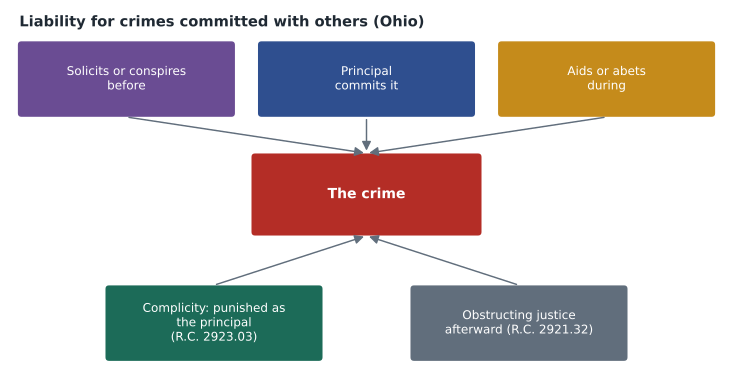
Under the Model Penal Code, section 2.06, a person is an accomplice if, with the purpose of promoting or facilitating the commission of an offense, he solicits another person to commit it, aids or agrees or attempts to aid the other person in planning or committing it, or has a legal duty to prevent it and fails to make a proper effort to do so. Ohio's complicity statute, R.C. 2923.03, says no person, acting with the kind of culpability required for the commission of an offense, shall solicit or procure another to commit the offense, aid or abet another in committing it, conspire with another to commit it, or cause an innocent or irresponsible person to commit it. A person guilty of complicity is prosecuted and punished as if he were the principal offender, and the charge may be stated in terms of complicity or in terms of the principal offense. It is no defense that no one else has been convicted of the principal offense.
Presence at the scene of a crime is not enough. Ohio courts have held repeatedly that mere presence at the scene, or mere association with the principal offender, is not enough to prove complicity; the state must show the defendant supported, assisted, encouraged, cooperated with, advised or incited the principal and shared the principal's criminal intent. Intent can be inferred from presence, companionship and conduct before and after the offense. This principle protects bystanders, friends and family members who happen to be nearby, and it means that officers must gather evidence of what each person did and said, not simply who was there.
Courts also hold accomplices responsible for crimes that are the natural and probable consequence of the crime they agreed to assist, in some states. Under the federal Pinkerton rule, from Pinkerton v. United States (1946), each conspirator is liable for reasonably foreseeable crimes committed by co-conspirators in furtherance of the conspiracy. Ohio requires that an accomplice act with the culpability required for each offense, so an accomplice to a robbery is guilty of a shooting during it only if he shared the required mental state, though Ohio's felony murder provision, discussed in lesson 7, can make participants in a violent felony liable for a resulting death.
Solicitation and help after the crime
Under the Model Penal Code, section 5.02, solicitation is commanding, encouraging or requesting another person to engage in conduct that would constitute a crime, with the purpose of promoting or facilitating it; the offense is complete when the request is made, even if the other person refuses. Ohio has no general solicitation offense; soliciting another to commit a crime that is committed or attempted makes the solicitor an accomplice under the complicity statute, and some specific solicitation offenses exist, such as soliciting for sexual activity for hire. Help after the crime is dealt with as obstructing justice under R.C. 2921.32, which makes it an offense, with purpose to hinder the discovery, apprehension, prosecution or conviction of another person for a crime, to harbor or conceal the other person, provide money or transportation for escape, warn the person of approaching discovery, destroy or conceal evidence, or communicate false information. Its degree depends on the seriousness of the crime committed by the person assisted.
Attempts
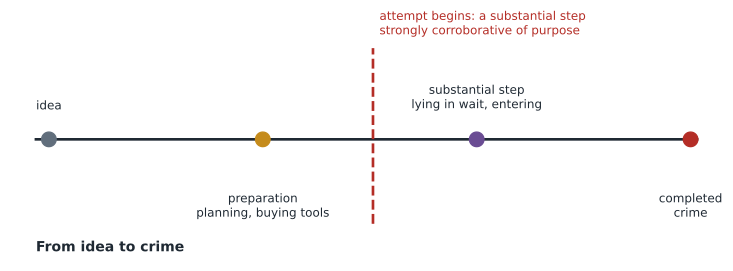
An attempt is an incomplete offense: the person intended to commit a crime and took steps toward it, but did not complete it. The Model Penal Code, section 5.01, says a person is guilty of an attempt if, acting with the culpability required for the crime, he purposely engages in conduct that would constitute the crime if the circumstances were as he believes them to be, or does anything that is a substantial step in a course of conduct planned to culminate in the crime. A substantial step must be strongly corroborative of the actor's criminal purpose; the Code's examples include lying in wait, enticing the victim to go to the place where the crime is planned, reconnoitring that place, and unlawfully entering a structure or vehicle where the crime is to be committed. Ohio's attempt statute, R.C. 2923.02, says no person, purposely or knowingly, and when purpose or knowledge is sufficient culpability for the offense, shall engage in conduct that, if successful, would constitute or result in the offense. An attempt is generally one degree less serious than the completed offense, and attempted aggravated murder or murder is a felony of the first degree.
Two features of attempt law often surprise students. First, impossibility is usually no defense. Ohio's statute says it is no defense that, in retrospect, commission of the offense was impossible, if it could have been committed had the attendant circumstances been as the actor believed them to be. This is why police stings, in which an officer poses as a child online or a buyer of stolen goods, can lead to attempt convictions. Second, giving up halfway may or may not help. Ohio recognizes a defense of abandonment: it is an affirmative defense that the actor abandoned the effort to commit the offense or otherwise prevented its commission, in circumstances showing a complete and voluntary renunciation of criminal purpose. A person who stops only because police arrived has not voluntarily renounced anything.
Conspiracy
Under the Model Penal Code, section 5.03, a person is guilty of conspiracy if, with the purpose of promoting or facilitating a crime, he agrees with another person that one or more of them will commit it or attempt or solicit it, and, for less serious crimes, an overt act in pursuance of the conspiracy is done. The Code takes a unilateral approach: a person who agrees with an undercover officer can be guilty even though the officer never intended the crime. Ohio's conspiracy statute, R.C. 2923.01, is narrower. It applies only to agreements to commit listed serious offenses, such as aggravated murder, murder, kidnapping, aggravated arson, aggravated robbery, robbery, aggravated burglary, burglary, human trafficking and felony drug trafficking, and requires that a substantial overt act in furtherance of the conspiracy be proved, done by the accused or a co-conspirator after the accused entered the agreement. A conspirator who thwarts the success of the conspiracy, under circumstances showing complete and voluntary renunciation, has an affirmative defense. Federal law punishes conspiracy to commit any federal offense under 18 U.S.C. 371 and has its own drug and racketeering conspiracy statutes.
Conspiracy cases are built on communications: phone calls, text and encrypted messages, recorded meetings and the testimony of participants who agree to cooperate. They are usually investigated by specialized units with judicial authorizations to intercept communications, and they raise special evidence rules about when one conspirator's words can be used against another. For a patrol officer, the main lessons are to recognize when a call may be part of a larger investigation, to preserve phones and messages lawfully, and to pass information to investigators rather than act alone in a way that could expose an ongoing operation.
The code below applies the rules to the convenience store robbery from the start of the lesson, recording what the evidence showed about each person's role and knowledge. Amara notes that the same five people could face five different outcomes depending on a few facts about what each one knew.
# Who is liable for the store robbery, and how? (R.C. 2923.03 and 2921.32, simplified)
people = [
    # name, role, shared the purpose beforehand, helped or encouraged, acted after the crime to hinder police
    ("gunman", "took the money at gunpoint", True, True, False),
    ("lookout", "watched the street at the door", True, True, False),
    ("driver", "waited with the engine running", True, True, False),
    ("girlfriend", "told them about one clerk and no camera", True, True, False),
    ("cousin", "hid them and burned their jackets", False, False, True),
    ("friend", "was in the store buying gum, left with them", False, False, False),
]
for name, role, shared, helped, after in people:
    if role.startswith("took"):
        result = "principal: aggravated robbery, R.C. 2911.01, if the gun is proved real; else robbery"
    elif shared and helped:
        result = "complicity: punished as the principal, R.C. 2923.03"
    elif after:
        result = "obstructing justice if he acted to hinder discovery, R.C. 2921.32"
    else:
        result = "mere presence: no liability without more evidence"
print(f"{name:10s} {role:42s} -> {result}")gunman took the money at gunpoint -> principal: aggravated robbery, R.C. 2911.01, if the gun is proved real; else robbery lookout watched the street at the door -> complicity: punished as the principal, R.C. 2923.03 driver waited with the engine running -> complicity: punished as the principal, R.C. 2923.03 girlfriend told them about one clerk and no camera -> complicity: punished as the principal, R.C. 2923.03 cousin hid them and burned their jackets -> obstructing justice if he acted to hinder discovery, R.C. 2921.32 friend was in the store buying gum, left with them -> mere presence: no liability without more evidence
The code simplifies real decisions, but it captures the logic. Every person is assessed separately, and the key facts are what each knew before or during the crime, what each did to help or encourage, and what each did afterward. The friend who happened to be in the store is a witness, not a suspect, unless further evidence shows otherwise. The girlfriend's tip, given with the shared purpose of helping the robbery succeed, makes her an accomplice; if she had urged them to do it, she would also have solicited it.
Worked problem
A sting on a stolen goods ring
Port Ardent's property crime unit sets up an undercover storefront that buys used electronics. Over three months, a man sells the undercover officer eleven laptops, telling him each time that they come from car break-ins his friends do, and asking him to pay more if he can because his friends are splitting the money. Police later arrest the man and two friends. What incomplete or group offenses could apply?
Show solution
- Receiving stolen property, R.C. 2913.51, is the main charge for the seller, based on his statements about the source of the laptops.
- The friends are principals to the thefts and vehicle break-ins; if the seller encouraged them to steal more, he may be an accomplice to those thefts.
- Conspiracy: Ohio's conspiracy statute covers only listed serious offenses, so an agreement to commit ordinary theft is not a conspiracy under R.C. 2923.01; prosecutors would instead charge complicity, or consider the state's corrupt activity statute if the pattern is large enough.
- Evidence: recordings of every transaction, the serial numbers matched to theft reports, and the phone messages among the three, each obtained with the proper legal authority.
Answer: The sting supports charges against all three, each based on separate evidence of what he did and knew. The rules on group and incomplete offenses let police act on agreements and encouragement as well as completed thefts.
Common mistakes
MistakeEveryone present at a crime is guilty of it.
InsteadMere presence is not enough; there must be evidence of aiding, encouraging or a shared intent.
MistakeA person who helps only after the crime is guilty of the crime itself.
InsteadHelp after the crime is a separate offense, such as obstructing justice, whose degree depends on the crime committed.
MistakeIf the crime was impossible, there can be no attempt.
InsteadImpossibility is generally no defense; a person who tries to buy what he believes is stolen property can be guilty of attempt.
MistakeAny agreement to commit any crime is a conspiracy under Ohio law.
InsteadOhio's conspiracy statute covers only listed serious offenses and requires a substantial overt act.
Summary and key terms
- Under R.C. 2923.03, those who solicit, aid, abet or conspire with the culpability required for the offense are punished as principals.
- Mere presence at a crime is not enough for liability; there must be assistance or encouragement and the required knowledge and intent.
- Help after the crime is obstructing justice under R.C. 2921.32; Ohio has no general solicitation offense.
- An attempt requires purpose or knowledge and conduct that would constitute the offense if successful; abandonment can be a defense.
- Ohio conspiracy covers only listed serious offenses and requires a substantial overt act; the MPC and federal law are broader.
- Each person in a group must be assessed separately, based on evidence of what he or she knew, intended and did.
- Complicity
- Liability for an offense committed by another, by soliciting, aiding, abetting or conspiring with the required culpability.
- Accomplice
- A person who is liable through complicity.
- Substantial step
- Under the MPC, conduct strongly corroborative of criminal purpose that marks the start of an attempt.
- Solicitation
- Commanding, encouraging or requesting another to commit a crime.
- Abandonment
- An affirmative defense to attempt or conspiracy based on complete and voluntary renunciation.
- Overt act
- An act in furtherance of a conspiracy, required by Ohio law for conspiracy.
Practice problems
Work each problem on paper first, then reveal the answer to check.
What must the prosecution prove about an aider's mental state?
Show answer
That the accomplice acted with the culpability required for the offense and shared the principal's criminal purpose.
Why is mere presence not enough for liability?
Show answer
Because it does not show assistance, encouragement or a shared intent, and the law protects bystanders who happen to be nearby.
What test does the Model Penal Code use to separate preparation from attempt?
Show answer
A substantial step strongly corroborative of the actor's criminal purpose.
Why can a person caught in a sting be convicted of attempt?
Show answer
Because impossibility is no defense: the person intended the crime and acted on what he believed the circumstances to be.
Lesson quiz · 5 questions
Score 60% or more to complete this lesson.
Create a free account to save your progress, take quizzes and earn a certificate.