
LES-103 · Lesson 8 of 12 · 25 min
Sexual offenses, menacing and stalking
▶ Video coming soon A video version of this lesson is on the way.
Professor Desjardins opens this lesson more carefully than any other. He reminds the class that statistically, several people in any room of thirty have experienced sexual violence, and that many never reported it. He tells them that the way a first officer responds to a disclosure shapes whether a survivor ever trusts the justice system again, and whether a case can be proved at all. Ms. Liu adds that sexual offense files are the ones where she most often sees good evidence lost in the first hour, and the ones where careful, respectful police work makes the biggest difference. This lesson covers the law of sexual offenses and consent, offenses involving children, and the related offenses of threats and menacing and stalking that so often come before or after violence. The goal is legal knowledge an officer can apply on a call, explained without graphic detail.
Why these offenses need their own lesson
Sexual offenses differ from other crimes against the person in three ways that matter to police. First, they are among the most underreported crimes. The National Crime Victimization Survey has found that only about a fifth to a third of rapes and sexual assaults are reported to police, a lower share than for most other violent crimes. Second, they usually happen in private between people who know each other, so there are rarely independent witnesses, and the case often turns on what each person said and did and on the surrounding evidence. Third, the law has been reformed repeatedly to remove old rules that treated complainants unfairly, such as requirements that a complaint be made immediately or that the complainant's testimony be corroborated, and to limit questioning about a complainant's sexual history. Officers who still carry the old assumptions, for example that a real victim would have fought back, screamed or reported right away, can damage an investigation and a person.
Jesse Morningstar asks why the class is studying this in a first-year law course rather than leaving it to specialized investigators. Professor Desjardins answers that the patrol officer is almost always the first contact. The first officer takes the initial report, decides what evidence to protect, arranges medical care and support, and writes the notes that defense counsel will read line by line months later. Specialized sexual assault or special victims units take over the investigation, but they can only work with what the first officer preserved.
Sexual offenses in the Ohio Revised Code
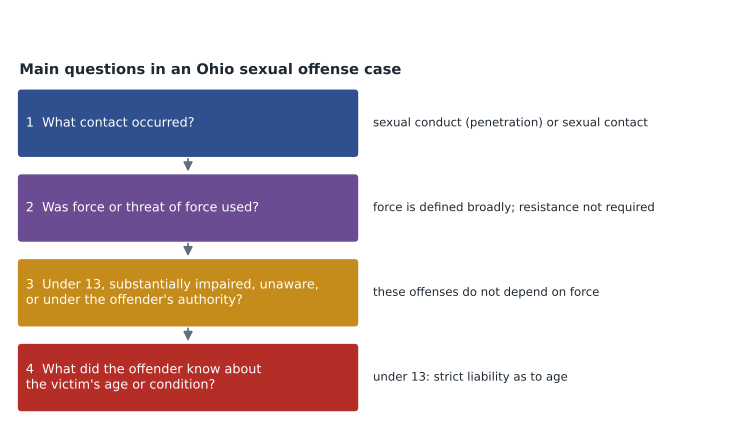
Ohio's sexual offenses are in R.C. Chapter 2907, and they are graded by the type of contact and the circumstances. Rape, under R.C. 2907.02, is engaging in sexual conduct, which the statute defines as penetration of any kind however slight, with another person by purposely compelling the person to submit by force or threat of force, or where the victim is under 13, or where the offender has substantially impaired the victim's judgment or control by giving a drug or intoxicant, or where the victim's ability to resist or consent is substantially impaired because of a mental or physical condition the offender knows about. Rape is a felony of the first degree, with life sentences for some offenses against children. Sexual battery, under R.C. 2907.03, covers sexual conduct obtained by coercion that would prevent resistance by a person of ordinary resolution, sexual conduct with a person the offender knows is unaware of the act, and sexual conduct by people in positions of authority, such as a parent, teacher, coach, clergy member, peace officer or person with custody of the victim; it is generally a felony of the third degree. Gross sexual imposition, under R.C. 2907.05, covers sexual contact, meaning touching of an erogenous zone for sexual arousal or gratification, by force or threat of force, with a victim under 13, or with a victim the offender has substantially impaired; sexual imposition, under R.C. 2907.06, covers sexual contact the offender knows is offensive to the other person and is a misdemeanor.
The common law idea of consent still matters in Ohio even though most of the statutes are written around force, impairment and authority rather than lack of consent. Force is defined broadly in R.C. 2901.01 as any violence, compulsion or constraint physically exerted by any means upon or against a person or thing, and Ohio courts have held that the force needed depends on the relationship and the ages of the people involved, so that subtle or psychological pressure by a parent or other authority figure over a child can be enough. Consent is not a defense where the victim was under 13, substantially impaired or unaware of the act. The Model Penal Code's original sexual offenses in Article 213, written in the 1950s, were criticized for their focus on force and their special rules for complainants; in 2022 the American Law Institute approved a revised Article 213 that places much more weight on whether the person gave consent, and several states have moved in the same direction.
Ohio law also reflects what research has shown about how victims behave. The rape statute says the victim need not prove physical resistance to the offender, and Ohio courts allow testimony explaining why victims often delay reporting or continue contact with an offender they know. Because so many cases involve intoxication, officers should understand the difference between a person who has been drinking and a person whose ability to resist or consent is substantially impaired, which is a question of fact for the jury based on all the evidence of the person's condition.
Knowledge, age and the mental state
For most Ohio sexual offenses, the mental state is purposely or knowingly, and the state must prove the offender's knowledge of key facts. For rape by impairment, for example, the state must prove that the offender knew or had reasonable cause to believe that the victim's ability to resist or consent was substantially impaired. Under R.C. 2907.02(A)(1)(b), rape of a child under 13 is a strict liability offense as to age: it does not matter whether the offender knew the child's age or reasonably believed the child was older. For offenses involving teenagers, discussed next, the state must usually prove the offender knew the age or was reckless about it. Officers should therefore record any statements about what the offender knew, such as references to the victim's age, school grade or condition.
Offenses involving children and the age of consent
The age of consent in Ohio is 16. Unlawful sexual conduct with a minor, under R.C. 2907.04, is committed by a person 18 or older who engages in sexual conduct with a person 13 to 15 years old, knowing the other person's age or being reckless about it. It is a felony of the fourth degree, but a misdemeanor of the first degree if the offender is less than four years older, and a felony of the third degree if the offender is ten or more years older. Sexual conduct with a child under 13 is rape regardless of consent or the offender's age. Ohio also criminalizes importuning, under R.C. 2907.07, which covers soliciting a minor, including by phone or online, and federal law adds offenses for online enticement and interstate travel. Laws on child sexual abuse material, R.C. 2907.322 and 2907.323 together with federal law, carry severe penalties, and investigations are handled by specialized Internet Crimes Against Children task forces. A patrol officer who comes across such material, for example on a seized phone, should stop looking, secure the device and hand it to specialists rather than browsing it.
Calls involving children require the officer to work with child protection authorities. Ohio makes police officers, teachers, doctors and many others mandatory reporters of suspected child abuse to the public children services agency under R.C. 2151.421, and many counties have child advocacy centers where forensic interviewers trained in protocols such as the National Children's Advocacy Center model interview the child once, on video, with police and children services watching. Patrol officers should not conduct detailed interviews of young children. They should note the child's spontaneous words exactly, ensure the child is safe and leave the forensic interview to trained specialists.
Responding to a report of sexual assault
The first officer's priorities follow the pattern from earlier lessons: safety and medical care first, then evidence and investigation. Many hospitals have sexual assault nurse examiner (SANE) programs where specially trained nurses can treat injuries, offer medication to prevent pregnancy and sexually transmitted infection, and, with the person's consent, collect forensic evidence in a sexual assault evidence kit. Evidence is best collected within a few days, so officers should explain the option early, but the decision belongs to the survivor. In Ohio, a victim can have a kit collected without reporting to police, and state law requires agencies to submit kits from reported cases to a crime lab for testing within set time limits, after a statewide project found thousands of untested kits.
- Believe and support: listen without judgment, and avoid questions that sound like blame, such as why were you there or why didn't you leave.
- Ask only what is needed at first: what happened in brief, when and where, who the suspect is, and whether the person is hurt or in danger.
- Preserve evidence: advise the person, gently, that not bathing, changing or discarding clothing before the medical examination preserves evidence, but never insist.
- Protect the scene and digital evidence: secure the location, bedding and any items, and note phones, messages and social media that may hold communications before and after the event.
- Connect to support: offer victim services, a support person and information about what happens next, including the person's rights as a victim.
Investigators now use trauma-informed interviewing, which accounts for the way trauma can affect memory. People who have been through a traumatic event may remember sensory details vividly but have gaps, recall events out of order, or remember more after sleep. Fragmented accounts are not by themselves a sign of lying, and investigators often wait a sleep cycle or two before a full interview. Marco DiSanto recognizes this from his military training on critical incidents and says it matches what he saw after a training accident in his unit.
Ohio's rape shield law, in R.C. 2907.02(D) and 2907.05(E), bars evidence of the victim's sexual activity except evidence of the origin of semen, pregnancy or disease, or of past sexual activity with the offender, and then only if it is material to a fact at issue and its inflammatory or prejudicial nature does not outweigh its value; the court decides admissibility in a hearing. Ohio has also extended the limitation period for rape to 25 years, and longer when DNA identifies an offender later. Police should collect relevant communications, but should not go fishing in a victim's private life.
Menacing and aggravated menacing
Ohio grades threatening conduct by what the victim is caused to believe. Aggravated menacing, under R.C. 2903.21, is knowingly causing another to believe that the offender will cause serious physical harm to the person or property of the other person, the other person's unborn or a member of the other person's immediate family; it is a misdemeanor of the first degree, rising to a felony in listed circumstances, such as threats against a children services caseworker over official duties. Menacing, under R.C. 2903.22, is knowingly causing another to believe the offender will cause physical harm, and is a misdemeanor of the fourth degree. Federal law separately makes it a crime to transmit threats in interstate communications, and in Counterman v. Colorado (2023) the Supreme Court held that the First Amendment requires the state to show at least that the speaker was reckless, consciously disregarding a substantial risk that the words would be viewed as threatening violence.
Linh Tran points out that most threats she sees online are made by people who will never act on them. Professor Desjardins agrees, but says officers cannot know that from the words alone. Threats are an important warning sign in domestic violence, workplace violence and school safety cases, and threat assessment teams look at the whole picture: the person's history of violence, access to weapons, recent losses or grievances, fixation on a target, and whether the threat is specific and actionable.
Menacing by stalking and telecommunications harassment
Menacing by stalking, under R.C. 2903.211, is engaging in a pattern of conduct, meaning two or more actions or incidents closely related in time, that knowingly causes another person to believe that the offender will cause physical harm to the person or a family or household member, or causes the person mental distress. The pattern can include electronic communications and posts, and the offense covers causing a third party to engage in the conduct. It is a misdemeanor of the first degree, and a felony of the fourth degree in listed circumstances, such as a prior conviction, a threat of physical harm, trespass at the victim's home or work, a weapon, or a victim who is a minor. Telecommunications harassment, under R.C. 2917.21, covers repeated calls or messages made to abuse, threaten or harass, and R.C. 2917.211 prohibits nonconsensual dissemination of private sexual images.
Stalking cases are built over time, so the officer's most important tool is documentation. Victims should be encouraged to keep a log of every incident with the date, time, place, what happened and any witnesses, and to preserve messages, call logs, voicemails and screenshots with dates visible. Officers should check for previous reports, protection orders or bond conditions that the conduct may also violate, and any access to firearms. A civil stalking protection order under R.C. 2903.214 or a domestic violence civil protection order under R.C. 3113.31 can give the victim legal protection while an investigation continues, and violating it is a separate offense that officers can enforce immediately.
Linh, who wants to be a crime analyst, writes a short program to organize a victim's incident log. It counts incidents by type and flags when the pattern shows escalation, which is one factor threat assessment looks for. The counts use the made-up log below.
# Organize a stalking victim's incident log (invented data)
from collections import Counter
from datetime import date
log = [
    (date(2026, 1, 4), "message", "asked to meet"),
    (date(2026, 1, 9), "message", "angry messages, 14 in one night"),
    (date(2026, 1, 16), "following", "car seen outside workplace"),
    (date(2026, 1, 22), "message", "says he knows her new address"),
    (date(2026, 1, 30), "watching", "parked outside home 2 hours"),
    (date(2026, 2, 3), "threat", "says she will regret leaving"),
    (date(2026, 2, 6), "following", "followed her to the gym"),
]
by_type = Counter(kind for _, kind, _ in log)
print("incidents:", len(log), "over", (log[-1][0] - log[0][0]).days, "days")
for kind, n in by_type.most_common():
    print(f"  {kind:10s} {n}")
# Escalation: physical presence or threats in the second half of the period
half = len(log) // 2
early = sum(k in ("following", "watching", "threat") for _, k, _ in log[:half])
late = sum(k in ("following", "watching", "threat") for _, k, _ in log[half:])
print("in-person or threat incidents, first half:", early, "second half:", late)
print("escalating" if late > early else "not escalating")
gaps = [(b[0] - a[0]).days for a, b in zip(log, log[1:])]
print("days between incidents:", gaps)incidents: 7 over 33 days message 3 following 2 watching 1 threat 1 in-person or threat incidents, first half: 1 second half: 3 escalating days between incidents: [5, 7, 6, 8, 4, 3]
The output shows seven incidents in about a month, with more in-person conduct and a threat in the second half, and shrinking gaps between incidents. An officer reviewing this log would see a pattern of conduct of two or more related incidents, and the threat and the following support a reasonable belief of physical harm, which together likely meet the elements of menacing by stalking, a felony here because of the threat. A program cannot decide whether a charge is proved, but it helps an officer see a pattern that a series of separate calls can hide.
Worked problem
A pattern of calls
Over six weeks, Port Ardent officers take three separate calls from the same woman. First, her former partner sent dozens of messages in one night. Second, she saw his car outside her work. Third, he left a note on her windshield saying you can't hide from me. Each call was handled by a different officer and closed with advice. On a fourth call, Constable Malhotra notices the history. What should he do?
Show solution
- Link the incidents: pull the earlier reports and treat them as one investigation, because menacing by stalking is about a course of conduct, not single events.
- Assess the elements: at least two closely related incidents forming a pattern; the note and following knowingly cause her to believe he will cause physical harm or mental distress; and the threat raises the offense to a felony.
- Assess risk: ask about past violence, weapons, threats of suicide, recent separation and any escalation, using the service's risk assessment tool, and check for firearms.
- Preserve evidence: photograph the note, secure the messages with dates and times and obtain any workplace camera footage.
- Protect the victim: explain civil stalking protection orders, arrange victim services and safety planning, and consider arrest if grounds exist.
Answer: Treated separately, each call looked minor. Treated together, they form a pattern that is a serious offense and a warning sign for violence. Supervisors like Sergeant Haddad now require officers to check call history for repeat addresses and names before closing a harassment call.
Common mistakes
MistakeA real victim would resist, report immediately and avoid the suspect afterward.
InsteadMany victims freeze, delay reporting or stay in contact with someone they know; the law does not require resistance, and research supports this.
MistakeIf the victim did not fight back, the offense was not committed.
InsteadForce can be subtle, and impairment, age or authority offenses do not require resistance at all.
MistakeA threat is only a crime if the person meant to carry it out.
InsteadThe question is whether the words were meant to intimidate or be taken seriously, not whether the person would act.
MistakeSeparate harassment calls can each be closed on their own.
InsteadStalking is a pattern; officers should link incidents and look at the course of conduct.
Summary and key terms
- Ohio grades sexual offenses by the conduct and circumstances: rape, sexual battery, gross sexual imposition and sexual imposition.
- Force is defined broadly, resistance is not required, and age, impairment and authority offenses do not depend on force.
- The state must prove what the offender knew, except that rape of a child under 13 is strict liability as to age.
- The age of consent is 16, with close-in-age exceptions and special offenses for children.
- First officers put safety and medical care first, preserve evidence and use a trauma-informed approach.
- Menacing, aggravated menacing and menacing by stalking cover threats and patterns of conduct that cause fear.
- Sexual conduct
- Under R.C. 2907.01, intercourse and other acts involving penetration, however slight.
- Sexual contact
- Touching of an erogenous zone for the purpose of sexual arousal or gratification.
- Substantial impairment
- A reduced ability to appraise, control or resist conduct, proved by evidence of the victim's condition.
- Rape shield
- Ohio's limits on evidence of the victim's sexual activity.
- Menacing by stalking
- A pattern of conduct that knowingly causes belief of physical harm or mental distress.
- Aggravated menacing
- Knowingly causing another to believe the offender will cause serious physical harm.
Practice problems
Work each problem on paper first, then reveal the answer to check.
What is the difference between sexual conduct and sexual contact in Ohio law?
Show answer
Sexual conduct involves penetration, however slight; sexual contact is touching of an erogenous zone for sexual gratification.
A 15-year-old and an 18-year-old are in a relationship. Is sexual activity between them lawful?
Show answer
In Ohio, no: a person 18 or older engaging in sexual conduct with a 13- to 15-year-old commits unlawful sexual conduct with a minor; here it is a misdemeanor because the age difference is less than four years.
Why should officers not interview young children in detail?
Show answer
Because repeated or leading questioning can harm the child and the case; trained forensic interviewers should conduct one recorded interview.
Name three kinds of evidence to preserve in a stalking case.
Show answer
Messages and call logs with dates, a victim's incident log, photos of notes or damage, camera footage and witness statements.
Lesson quiz · 5 questions
Score 60% or more to complete this lesson.
Create a free account to save your progress, take quizzes and earn a certificate.