
MATH-201 · Lesson 4 of 12 · 35 min
More methods for linear equations
Lesson 3 solved linear equations with constant coefficients and simple forcing terms: exponentials, polynomials, sines and cosines. Engineering problems often go beyond that. The forcing may be an arbitrary measured signal, such as a ground acceleration record or a load that ramps up over time. The coefficients may vary, as they do for stresses in a thick pipe wall, where the equation contains the radius. And the equation may be of fourth order, as it is for beams. This lesson adds the tools for these cases: the theory of fundamental solutions and the Wronskian, reduction of order, variation of parameters (which handles any forcing and leads to Duhamel's integral), Cauchy-Euler equations with variable coefficients, and higher-order equations, applied to a rail resting on its ballast.
Fundamental solutions and the Wronskian
For the homogeneous equation \(y'' + p(t)y' + q(t)y = 0\), Lesson 3 combined two solutions into \(y = C_1y_1 + C_2y_2\). This works only if the two solutions are genuinely different, so that any initial position and velocity can be matched. The test is the Wronskian:
If \(W \ne 0\), the two solutions form a fundamental set and \(C_1y_1 + C_2y_2\) is the general solution. If \(W = 0\) everywhere, one solution is a multiple of the other and a second, independent solution is still needed. The Wronskian is the determinant of the 2 × 2 system for \(C_1\) and \(C_2\) at the initial time, so it is exactly the condition that this system has a unique solution (MATH-125).
Worked problem
Checking a fundamental set
Show that \(e^{-t}\cos 2t\) and \(e^{-t}\sin 2t\) form a fundamental set for \(y'' + 2y' + 5y = 0\).
Show solution
- Both solve the equation (roots \(-1 \pm 2i\), Lesson 3).
- \(W = e^{-t}\cos 2t \cdot e^{-t}(-\sin 2t + 2\cos 2t) - e^{-t}(-\cos 2t - 2\sin 2t) \cdot e^{-t}\sin 2t\).
- Simplifying: \(W = 2e^{-2t}(\cos^2 2t + \sin^2 2t) = 2e^{-2t}\).
Answer: W = 2e^(−2t), which is never zero, so they form a fundamental set. A useful fact (Abel's theorem) is that the Wronskian of any two solutions is either always zero or never zero, so checking it at one point is enough.
Reduction of order
If one solution \(y_1\) is known, a second can be found by trying \(y = v(t)\,y_1(t)\). Substituting into the equation, the terms in \(v\) itself cancel (because \(y_1\) is a solution), leaving a first-order equation for \(v'\). This is how the extra factor \(t\) in the repeated-root case of Lesson 3 is derived, and it is the standard way to complete a solution when one solution can be guessed.
Worked problem
The repeated root explained
For \(y'' - 2y' + y = 0\), one solution is \(y_1 = e^t\). Find a second.
Show solution
- Let \(y = ve^t\). Then \(y' = (v' + v)e^t\) and \(y'' = (v'' + 2v' + v)e^t\).
- Substituting: \((v'' + 2v' + v - 2v' - 2v + v)e^t = v''e^t = 0\).
- So \(v'' = 0\), \(v = At + B\), and the new solution is \(te^t\).
Answer: y₂ = te^t, the repeated-root solution of Lesson 3, now derived rather than assumed.
Variation of parameters
The method of undetermined coefficients (Lesson 3) needs a forcing term of a special form. Variation of parameters works for any continuous forcing. For \(y'' + p(t)y' + q(t)y = g(t)\) with a known fundamental set \(y_1, y_2\), look for a particular solution \(y_p = u_1y_1 + u_2y_2\), letting the constants vary. Imposing the convenient condition \(u_1'y_1 + u_2'y_2 = 0\) and substituting gives two linear equations for \(u_1'\) and \(u_2'\), whose solution is:
Integrating these gives the particular solution:
The equation must first be divided by the coefficient of \(y''\) so that the leading coefficient is 1; forgetting this is the most common error.
Worked problem
A forcing term undetermined coefficients cannot handle
Solve \(y'' + y = \sec t\) for \(-\pi/2 < t < \pi/2\).
Show solution
- Fundamental set: \(y_1 = \cos t\), \(y_2 = \sin t\), \(W = 1\).
- \(u_1' = -\sin t\sec t = -\tan t\), so \(u_1 = \ln|\cos t|\).
- \(u_2' = \cos t\sec t = 1\), so \(u_2 = t\).
Answer: y = C₁ cos t + C₂ sin t + cos t ln(cos t) + t sin t. No trial function in the method of undetermined coefficients would have produced the logarithm.
Duhamel's integral
Applying variation of parameters to an undamped oscillator \(m\ddot{x} + kx = f(t)\), starting from rest, gives a formula for the response to any force:
This is Duhamel's integral. It has a clear physical meaning: the force during each short interval \(d\tau\) delivers a small impulse \(f(\tau)\,d\tau\), which sets the mass vibrating as \(\sin\omega_n(t - \tau)\) from that moment on, and the response is the sum of all these vibrations. Structural engineers evaluate it numerically for measured earthquake records, and Lesson 8 shows that it is a convolution, the same operation that Laplace transforms turn into a product.
Worked problem
How fast can a load be applied?
A force rises linearly from 0 to \(F_0\) over a time \(t_r\): \(f = F_0t/t_r\). Find the response of an undamped oscillator during the ramp, and the dynamic overshoot as a fraction of the static deflection \(F_0/k\).
Show solution
- Substitute into Duhamel's integral with \(u = t - \tau\): \(\int_0^t (t - u)\sin\omega_n u\,du = \dfrac{t}{\omega_n} - \dfrac{\sin\omega_n t}{\omega_n^2}\).
- \[x(t) = \frac{F_0}{k\,t_r}\left(t - \frac{\sin\omega_n t}{\omega_n}\right)\]
- The first term is the slowly growing static deflection; the second is an oscillation of amplitude \(\dfrac{F_0}{k\,\omega_nt_r}\).
- As a fraction of the final static deflection, the oscillation amplitude is \(1/(\omega_nt_r)\). If the ramp lasts 5 natural periods, \(\omega_nt_r = 10\pi\) and the overshoot is 3.2%.
Answer: Applying a load over several natural periods makes it effectively static, while a sudden load (t_r → 0) doubles the deflection (Lesson 7). This is why cranes lift slowly and why testing standards specify loading rates.
Cauchy-Euler equations
Most linear equations with variable coefficients have no solution in elementary functions, but one important family does. A Cauchy-Euler (equidimensional) equation has the form:
Each derivative is multiplied by the matching power of \(x\), so the trial \(y = x^m\) turns every term into a multiple of \(x^m\). Substituting gives the indicial equation:
Its roots decide the form of the solution, in close analogy with the characteristic equation:
- Two real roots: \(y = C_1x^{m_1} + C_2x^{m_2}\).
- A repeated root: \(y = (C_1 + C_2\ln x)\,x^m\), found by reduction of order.
- Complex roots \(\alpha \pm i\beta\): \(y = x^{\alpha}\left[C_1\cos(\beta\ln x) + C_2\sin(\beta\ln x)\right]\).
These equations appear wherever a problem has no natural length scale, especially in polar and cylindrical coordinates: stresses in pipes, discs and around holes, and steady heat conduction through cylindrical walls.
Worked problem
Stresses in a thick-walled cylinder
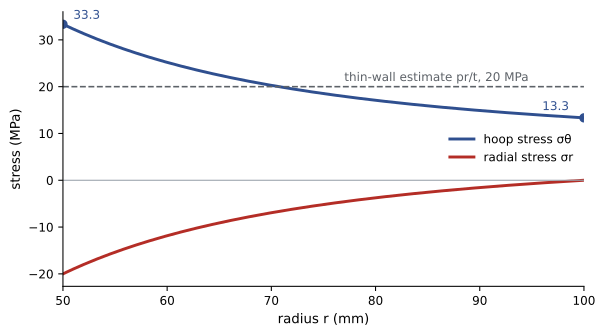
For a long cylinder with inner radius a = 50 mm and outer radius b = 100 mm under internal pressure p = 20 MPa, the radial displacement satisfies \(r^2u'' + ru' - u = 0\). The stresses then take the form \(\sigma_r = A - B/r^2\) and \(\sigma_\theta = A + B/r^2\). Find the maximum hoop stress.
Show solution
- Indicial equation: \(m(m - 1) + m - 1 = m^2 - 1 = 0\), so \(m = \pm 1\) and \(u = C_1r + C_2/r\), which produces the stress forms given.
- Boundary conditions: \(\sigma_r(a) = -p\) (pressure pushes on the inner surface) and \(\sigma_r(b) = 0\).
- Solving: \(A = \dfrac{pa^2}{b^2 - a^2} = \dfrac{20 \times 2500}{7500} = 6.67\) MPa and \(B = \dfrac{pa^2b^2}{b^2 - a^2} = 66\,700\) MPa·mm².
- \(\sigma_\theta(a) = 6.67 + 66\,700/2500 = 33.3\) MPa; \(\sigma_\theta(b) = 6.67 + 6.67 = 13.3\) MPa.
Answer: The maximum hoop stress is 33.3 MPa at the inner surface, two and a half times the value at the outer surface. The thin-wall formula pr/t with the inner radius gives only 20 MPa: for thick walls it is unconservative, and these Lamé equations are used instead. Thickening the wall further brings diminishing returns, because the outer material carries little stress.
Higher-order equations
Everything in Lesson 3 extends to linear constant-coefficient equations of any order. For an nth-order equation, the characteristic polynomial has n roots, each contributing a solution (with extra factors of \(t\) for repeated roots), and n initial or boundary conditions fix the n constants. The most important engineering example is fourth order: the Euler-Bernoulli beam equation \(EI\,y'''' = w(x)\), which relates the deflection of a beam to the load per unit length on it.
Worked problem
A rail on its ballast
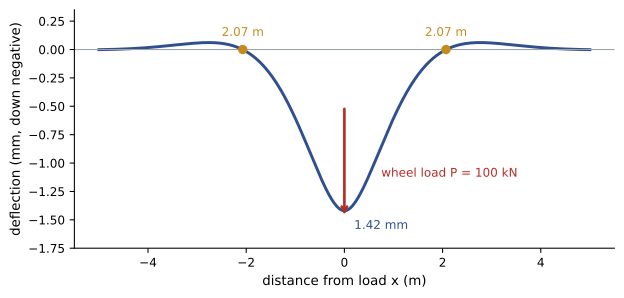
A rail rests on a continuous elastic foundation that pushes back with force \(k\,y\) per unit length. A wheel applies a point load P. The deflection satisfies \(EI\,y'''' + ky = 0\) away from the load. With EI = 6.0 MN·m², k = 40 MPa (N/m per meter of rail) and P = 100 kN, find the maximum deflection and the distance at which the rail first lifts.
Show solution
- Write \(y'''' + 4\beta^4y = 0\) with \(\beta = (k/4EI)^{1/4} = (40/24)^{1/4} = 1.136\) m⁻¹.
- Characteristic equation \(m^4 = -4\beta^4\): roots \(m = \beta(\pm 1 \pm i)\).
- For \(x > 0\), the deflection must die away far from the load, so only the roots with negative real part remain: \(y = e^{-\beta x}(C_3\cos\beta x + C_4\sin\beta x)\).
- Symmetry (zero slope under the load) and the load balance give \(y = \dfrac{P\beta}{2k}e^{-\beta|x|}(\cos\beta x + \sin\beta|x|)\).
- Maximum: \(y(0) = \dfrac{P\beta}{2k} = \dfrac{10^5 \times 1.136}{8 \times 10^7} = 1.42\) mm.
- The rail lifts where \(\cos\beta x + \sin\beta x = 0\), at \(\beta x = 3\pi/4\), or \(x = 2.07\) m.
Answer: A maximum deflection of 1.42 mm under the wheel, with the rail lifting slightly beyond 2.07 m on either side. The same equation, with β as the key parameter, describes footings on soil, pipelines on the seabed and floating ice sheets.
Which method to use
For linear equations, the choice now runs as follows. With constant coefficients and simple forcing, use the characteristic equation and undetermined coefficients (Lesson 3), or Laplace transforms (Lessons 7 and 8) for switched and impulsive inputs. For arbitrary forcing, use variation of parameters or its integral form, Duhamel's integral. For variable coefficients of the Cauchy-Euler type, try powers of \(x\); for other variable coefficients, use series solutions (covered in more advanced courses) or a numerical method (MATH-300). In every case, the general solution is the homogeneous solution plus one particular solution, and the constants are fitted last.
Common mistakes
MistakeApplying variation of parameters without dividing by the leading coefficient.
InsteadWrite the equation as y″ + py′ + qy = g first; g is the right side after dividing.
MistakeAssuming two solutions form a fundamental set without checking.
InsteadCompute the Wronskian; it must be non-zero.
MistakeUsing eᵐˣ for a Cauchy-Euler equation.
InsteadTry y = xᵐ; the indicial equation is m(m − 1) + am + b = 0.
MistakeKeeping growing exponentials in a problem on an infinite domain.
InsteadPhysical solutions must stay bounded, which removes the growing terms.
MistakeUsing the thin-wall formula for a thick pipe.
InsteadWhen the wall is more than about a tenth of the radius, use the Lamé solution.
Summary and key terms
- Two solutions form a fundamental set when their Wronskian is non-zero.
- Reduction of order, y = v y₁, finds a second solution from a known one.
- Variation of parameters gives a particular solution for any continuous forcing.
- Duhamel's integral expresses an oscillator's response as a sum of responses to impulses.
- Loads applied over several natural periods act almost statically; sudden loads double the deflection.
- Cauchy-Euler equations x²y″ + axy′ + by = 0 are solved with y = xᵐ; they govern stresses in thick cylinders.
- Higher-order equations have one solution per characteristic root; a beam on an elastic foundation decays as e^(−βx) cos and sin.
- Fundamental set
- Two independent solutions whose combinations give every solution of a second-order homogeneous equation.
- Wronskian
- The determinant y₁y₂′ − y₁′y₂, non-zero for a fundamental set.
- Reduction of order
- Finding a second solution in the form v(t) y₁(t).
- Variation of parameters
- A method for particular solutions that lets the constants in the homogeneous solution vary.
- Duhamel's integral
- The response of an oscillator to arbitrary forcing written as an integral of impulse responses.
- Cauchy-Euler equation
- An equation in which each derivative is multiplied by the matching power of x.
- Indicial equation
- The equation for the exponent m in a Cauchy-Euler trial solution xᵐ.
- Lamé equations
- The stress distribution in a thick-walled cylinder under pressure.
- Beam on elastic foundation
- A beam supported continuously by a medium that pushes back in proportion to deflection.
Practice problems
Work each problem on paper first, then reveal the answer to check.
Find the Wronskian of \(e^{2t}\) and \(e^{-3t}\).
Show answer
W = −5e^(−t), never zero.
Given \(y_1 = x\) solves \(x^2y'' - xy' + y = 0\), find a second solution.
Show answer
y₂ = x ln x.
Solve \(y'' + y = \tan t\) by variation of parameters.
Show answer
y_p = −cos t ln|sec t + tan t|.
Find a particular solution of \(y'' - y = e^t\) by variation of parameters.
Show answer
y_p = ½te^t (plus multiples of e^t).
Solve \(x^2y'' + xy' - 4y = 0\).
Show answer
y = C₁x² + C₂x⁻².
Solve \(x^2y'' - 3xy' + 4y = 0\).
Show answer
Repeated root m = 2: y = (C₁ + C₂ ln x)x².
Solve \(x^2y'' + xy' + 9y = 0\).
Show answer
m = ±3i: y = C₁ cos(3 ln x) + C₂ sin(3 ln x).
For the thick cylinder example, what is the hoop stress at r = 75 mm?
Show answer
6.67 + 66 700/5625 = 18.5 MPa.
If the foundation stiffness of the rail example quadruples, by what factor does the maximum deflection change?
Show answer
β rises by √2, so Pβ/2k falls by √2/4: to 0.35 times, about 0.50 mm.
A load ramps up over 2 natural periods. Estimate the dynamic overshoot.
Show answer
1/(ωₙt_r) = 1/(4π) ≈ 8%.
Lesson quiz · 5 questions
Score 60% or more to complete this lesson.
Create a free account to save your progress, take quizzes and earn a certificate.