
MATH-209 · Lesson 9 of 12 · 31 min
Vector operators in curvilinear coordinates
Lesson 8 defined divergence and curl in rectangular coordinates and connected them to flux and circulation through the theorems of Gauss, Green and Stokes. Many engineering problems have round geometry: pipes and cables, pressure vessels and storage tanks, rotating machinery, the field around a wire or a charged sphere, flow toward a well. In these problems rectangular coordinates are clumsy, and the natural choice is cylindrical or spherical coordinates. This lesson develops the gradient, divergence, curl and Laplacian in those coordinates and shows where their extra factors come from. It also collects the vector identities that engineers use constantly, explains why fields with zero curl have scalar potentials and fields with zero divergence have vector potentials, and applies the results to heat loss from insulated pipes, the critical radius of insulation, spherical conduction and vortex flows.
The del operator and the Laplacian
The symbol \(\nabla = \mathbf{i}\,\partial/\partial x + \mathbf{j}\,\partial/\partial y + \mathbf{k}\,\partial/\partial z\) acts like a vector of derivatives. Applied to a scalar it gives the gradient \(\nabla f\); dotted with a field it gives the divergence \(\nabla \cdot \mathbf{F}\); crossed with a field it gives the curl \(\nabla \times \mathbf{F}\). The divergence of a gradient is the Laplacian:
The Laplacian compares the value of f at a point with its average over a small surrounding sphere: if \(\nabla^2 f > 0\), the point is lower than its surroundings. This is why it appears in the heat equation (a point warms when it is colder than its neighborhood), in diffusion, in the wave equation and in the equations for electrostatic and gravitational potential. A function with \(\nabla^2 f = 0\) is harmonic: its value at every point equals the average around it, so it has no interior maxima or minima. A steady temperature distribution with no internal heat sources is harmonic, so the hottest and coldest points are always on the boundary.
Vector identities
A handful of identities, each provable by writing out components, simplify a great deal of engineering analysis:
| Identity | Meaning |
|---|---|
| \(\nabla \times (\nabla f) = \mathbf{0}\) | Gradient fields have no rotation |
| \(\nabla \cdot (\nabla \times \mathbf{F}) = 0\) | Curl fields have no sources |
| \(\nabla \cdot (f\mathbf{F}) = f\,\nabla \cdot \mathbf{F} + \mathbf{F} \cdot \nabla f\) | Product rule for divergence |
| \(\nabla \times (f\mathbf{F}) = f\,\nabla \times \mathbf{F} + \nabla f \times \mathbf{F}\) | Product rule for curl |
| \(\nabla \times (\nabla \times \mathbf{F}) = \nabla(\nabla \cdot \mathbf{F}) - \nabla^2\mathbf{F}\) | Used to derive wave equations (Lesson 11) |
The first two identities have converses that matter in practice. In a region without holes, a field with zero curl is the gradient of a scalar potential, \(\mathbf{F} = \nabla\phi\) (Lesson 7 found such potentials for conservative forces). Similarly, a field with zero divergence is the curl of a vector potential, \(\mathbf{F} = \nabla \times \mathbf{A}\). The Helmholtz theorem goes further: any reasonable field can be split into an irrotational part and a solenoidal part, \(\mathbf{F} = \nabla\phi + \nabla \times \mathbf{A}\). Fluid dynamicists use this to separate the compressing and swirling parts of a flow, and electrical engineers use it to describe electric and magnetic fields with potentials.
Worked problem
Using a product rule
Find the divergence of the field \(\mathbf{F} = \mathbf{r}/r^3\), where \(\mathbf{r} = (x, y, z)\) and \(r = |\mathbf{r}|\), away from the origin.
Show solution
- Write \(\mathbf{F} = f\mathbf{r}\) with \(f = r^{-3}\). Then \(\nabla \cdot \mathbf{F} = f\,\nabla \cdot \mathbf{r} + \mathbf{r} \cdot \nabla f\).
- \(\nabla \cdot \mathbf{r} = 3\), and \(\nabla(r^{-3}) = -3r^{-4}\,\nabla r = -3r^{-5}\mathbf{r}\).
- So \(\nabla \cdot \mathbf{F} = 3r^{-3} - 3r^{-5}(\mathbf{r} \cdot \mathbf{r}) = 3r^{-3} - 3r^{-3} = 0\).
Answer: The divergence is zero everywhere except the origin. This inverse-square field, the shape of gravitational and electrostatic fields of a point source, has all of its source concentrated at one point, which is why its flux through any closed surface around the origin is the same, 4π (Gauss's law, Lesson 8).
Cylindrical coordinates
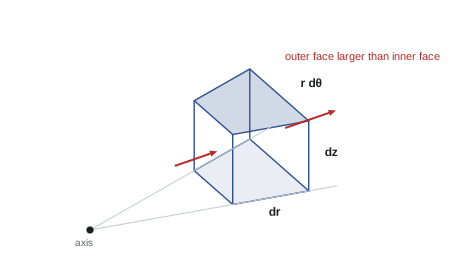
In cylindrical coordinates \((r, \theta, z)\), the unit vectors \(\mathbf{e}_r\), \(\mathbf{e}_\theta\), \(\mathbf{e}_z\) point outward, around and along the axis. A small step dθ in angle moves a distance \(r\,d\theta\), not dθ, and this scale factor r is the source of every extra term below:
The factor r inside the radial derivative of the divergence has a direct physical meaning. Consider a thin cylindrical shell between r and r + dr. Its outer surface is larger than its inner surface, in proportion to r. A purely radial field with no sources must therefore weaken as 1/r so that the same total flux passes through each shell: the quantity \(rF_r\) must be constant. The z-component of the curl, needed for swirling flows, is \((\nabla \times \mathbf{F})_z = \frac{1}{r}\left[\frac{\partial (rF_\theta)}{\partial r} - \frac{\partial F_r}{\partial \theta}\right]\).
Worked problem
Heat loss from an insulated pipe
A steam pipe has an outer radius of 30 mm at 150 °C and is covered with 50 mm of insulation (k = 0.040 W/(m·K)) whose outer surface is at 20 °C. Find the temperature distribution in the insulation and the heat loss per meter.
Show solution
- Steady conduction with no heat sources and no variation in θ or z: \(\nabla^2 T = \frac{1}{r}\frac{d}{dr}\left(r\frac{dT}{dr}\right) = 0\).
- Integrating twice: \(r\,dT/dr = A\), so \(T = A\ln r + B\).
- Fitting \(T(0.03) = 150\) and \(T(0.08) = 20\): \(A = -130/\ln(8/3) = -132.5\) K.
- Heat flow per meter: \(q' = -k\,\dfrac{dT}{dr}\,2\pi r = -2\pi kA = 2\pi \times 0.040 \times 132.5 = 33.3\) W/m.
Answer: T = 150 − 132.5 ln(r/0.03) °C, a logarithmic profile, and a loss of 33.3 W per meter. In general q′ = 2πkΔT/ln(r₂/r₁). Because of the logarithm, doubling the insulation thickness reduces the loss by much less than half.
The critical radius of insulation
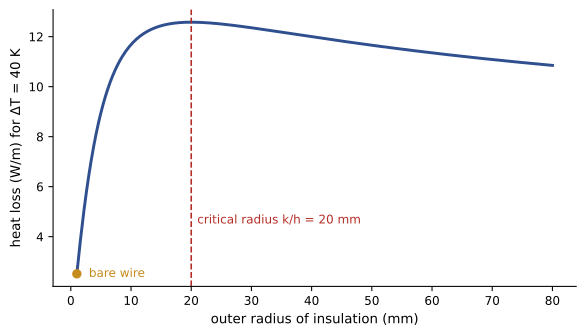
Adding insulation to a cylinder does two things: it adds conduction resistance \(\ln(r_2/r_1)/(2\pi k)\), which reduces heat loss, and it enlarges the outer surface, which increases convection to the air, with resistance \(1/(2\pi r_2h)\). Minimizing the total resistance with respect to \(r_2\) (a one-variable optimization) shows that the heat loss is greatest when \(r_2 = k/h\), the critical radius. For a large steam pipe the critical radius (a few millimeters) is far smaller than the pipe, and insulation always helps. For a thin electrical wire with PVC insulation (k ≈ 0.2 W/(m·K), h ≈ 10 W/(m²·K)), the critical radius is about 20 mm, so the insulation on a thin wire actually increases its heat loss, which helps keep cables cool.
Spherical coordinates
In spherical coordinates \((\rho, \phi, \theta)\), with ρ the distance from the origin, φ the angle from the positive z-axis and θ the angle around it, the scale factors are 1, ρ and \(\rho\sin\phi\). For a function that depends only on ρ, which covers spheres, point sources and spherical tanks, the Laplacian reduces to
and the divergence of a radial field \(F_\rho(\rho)\,\mathbf{e}_\rho\) is \(\frac{1}{\rho^2}\frac{d}{d\rho}(\rho^2F_\rho)\). The factor \(\rho^2\) is proportional to the area of a sphere of radius ρ, so a source-free radial field must fall off as \(1/\rho^2\), the inverse-square law.
Worked problem
A cryogenic storage sphere
A spherical tank of liquid nitrogen at −196 °C has an outer radius of 1.00 m and is covered with insulation (k = 0.020 W/(m·K)) to a radius of 1.20 m, whose outer surface is at 20 °C. Find the heat leak.
Show solution
- Solve \(\frac{1}{\rho^2}\frac{d}{d\rho}\left(\rho^2\frac{dT}{d\rho}\right) = 0\): \(\rho^2\,dT/d\rho = A\), so \(T = -A/\rho + B\).
- Heat flow \(q = -k\,\dfrac{dT}{d\rho}\,4\pi\rho^2 = -4\pi kA\), and fitting the two surfaces gives \(q = \dfrac{4\pi k\,(T_1 - T_2)}{1/\rho_1 - 1/\rho_2}\).
- \(q = 4\pi \times 0.020 \times (-216)/(1 - 0.8333) = -326\) W.
Answer: About 326 W flows into the tank. With a latent heat of 199 kJ/kg, this boils off 326 × 86 400/199 000 ≈ 140 kg of nitrogen per day, which is why such tanks use vacuum insulation with effective conductivities hundreds of times lower.
Vortex flows
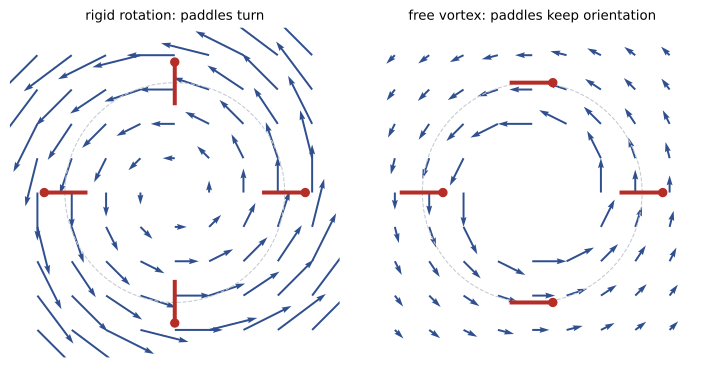
Swirling flows show clearly the difference between circulation around a path and rotation at a point. Compare two flows with circular streamlines:
- Rigid rotation, \(\mathbf{v} = \Omega r\,\mathbf{e}_\theta\), as in a tank of liquid spun steadily: the curl is \(\frac{1}{r}\frac{d}{dr}(\Omega r^2) = 2\Omega\), the same everywhere. Every fluid element spins.
- A free vortex, \(\mathbf{v} = \dfrac{\Gamma}{2\pi r}\mathbf{e}_\theta\), as in a draining bathtub or a tornado outside its core: the curl is \(\frac{1}{r}\frac{d}{dr}\left(\frac{\Gamma}{2\pi}\right) = 0\) for r > 0. The fluid circulates around the center, yet small elements do not spin; a tiny paddle wheel carried by the flow keeps its orientation.
The free vortex still has circulation Γ around any loop enclosing the center, which by Stokes' theorem means all its vorticity is concentrated at r = 0, just as the inverse-square field concentrates its divergence at the origin. Real vortices combine the two: a core in rigid rotation surrounded by a free vortex (the Rankine vortex), which is a useful model of tornadoes and of the tip vortices trailing behind aircraft wings.
Worked problem
A tornado
A tornado is modeled as a Rankine vortex with a core of radius 50 m in rigid rotation and a maximum wind speed of 80 m/s at the edge of the core. Find the wind speed 200 m from the center and the vorticity in the core.
Show solution
- Outside the core, \(v = \Gamma/(2\pi r)\) with \(\Gamma = 2\pi \times 50 \times 80\). So \(v(200) = 80 \times 50/200 = 20\) m/s.
- Inside the core, \(v = \Omega r\) with \(\Omega = 80/50 = 1.6\) rad/s, so the vorticity is \(2\Omega = 3.2\) s⁻¹.
Answer: The wind falls to 20 m/s at 200 m, a quarter of the peak, because the free vortex speed varies as 1/r. All of the rotation is in the core, where the vorticity is 3.2 s⁻¹.
Common mistakes
MistakeWriting the cylindrical divergence as ∂F_r/∂r + ∂F_θ/∂θ + ∂F_z/∂z.
InsteadInclude the scale factors: (1/r)∂(rF_r)/∂r + (1/r)∂F_θ/∂θ + ∂F_z/∂z.
MistakeAssuming circulating flow must have non-zero curl.
InsteadA free vortex circulates but is irrotational away from its center.
MistakeUsing the plane-wall formula for pipe insulation.
InsteadCylindrical conduction gives q′ = 2πkΔT/ln(r₂/r₁).
MistakeAssuming more insulation always reduces heat loss.
InsteadBelow the critical radius k/h, insulation increases heat loss.
MistakeConcluding a curl-free field has a potential in a region with a hole.
InsteadThe region must be simply connected; the free vortex is a counterexample around its center.
Summary and key terms
- The Laplacian ∇²f = ∇·∇f compares a value with its local average; harmonic functions have no interior extremes.
- curl(grad f) = 0 and div(curl F) = 0; curl-free fields have scalar potentials and divergence-free fields have vector potentials.
- Scale factors (r in cylindrical; ρ and ρ sin φ in spherical) produce the extra terms in curvilinear operators.
- Steady radial conduction gives T = A ln r + B in a cylinder and T = −A/ρ + B in a sphere.
- Insulation increases heat loss below the critical radius k/h.
- Source-free radial fields fall off as 1/r in cylinders and 1/ρ² in spheres.
- Rigid rotation has curl 2Ω; a free vortex is irrotational except at its center.
- Laplacian
- The divergence of the gradient, ∇²f.
- Harmonic function
- A function with zero Laplacian.
- Scalar potential
- A function φ with F = ∇φ.
- Vector potential
- A field A with F = ∇ × A.
- Helmholtz theorem
- A field can be decomposed into irrotational and solenoidal parts.
- Scale factor
- The distance moved per unit change of a curvilinear coordinate.
- Critical radius of insulation
- The outer radius k/h at which heat loss from an insulated cylinder is greatest.
- Free vortex
- A swirling flow with speed proportional to 1/r and zero curl away from the center.
- Rankine vortex
- A model vortex with a rigidly rotating core surrounded by a free vortex.
Practice problems
Work each problem on paper first, then reveal the answer to check.
Find \(\nabla^2(x^2 + y^2 + z^2)\).
Show answer
6.
Is \(f = x^2 - y^2\) harmonic?
Show answer
Yes: 2 − 2 = 0.
Find the divergence of \(\mathbf{F} = r\,\mathbf{e}_r\) in cylindrical coordinates.
Show answer
(1/r) d(r²)/dr = 2.
Show that \(\ln r\) is harmonic in cylindrical coordinates (r > 0).
Show answer
(1/r) d/dr (r · 1/r) = 0.
Show that \(1/\rho\) is harmonic in spherical coordinates (ρ > 0).
Show answer
(1/ρ²) d/dρ (ρ² · (−1/ρ²)) = 0.
Find the heat loss per meter through insulation from r = 20 mm to 60 mm, k = 0.05 W/(m·K), ΔT = 100 K.
Show answer
2π(0.05)(100)/ln 3 = 28.6 W/m.
Find the critical radius for insulation with k = 0.15 W/(m·K) and h = 12 W/(m²·K).
Show answer
12.5 mm.
Find the curl of \(\mathbf{v} = 3r\,\mathbf{e}_\theta\).
Show answer
(1/r) d(3r²)/dr = 6.
A free vortex has speed 4 m/s at r = 0.5 m. Find the speed at r = 2 m and the circulation.
Show answer
1 m/s; Γ = 2π(0.5)(4) = 12.6 m²/s.
Why does a tiny paddle wheel not spin in a free vortex?
Show answer
The curl (local rotation) is zero away from the center.
Lesson quiz · 5 questions
Score 60% or more to complete this lesson.
Create a free account to save your progress, take quizzes and earn a certificate.