
MEC-210 · Lesson 6 of 12 · 26 min
Impulse, momentum and impact
Work and energy integrated the second law over distance. Integrating it over time gives the third great tool of particle kinetics, the principle of impulse and momentum. It is the natural method when forces act for a known time, when they are huge but brief and hard to measure, as in collisions, or when several bodies push on each other and the internal forces are unknown. A paddle diverter kicking a tote sideways, a shuttle bumping into another at a buffer, a parcel bouncing off a guide rail and a package hitting the floor in a drop test are all impulse problems. In each, the details of the force during contact are messy, but the change in momentum is simple.
Linear momentum and impulse
The linear momentum of a particle is \(\mathbf{L} = m\mathbf{v}\), a vector in the direction of the velocity. Because the mass of a particle is constant, the second law can be written as \(\sum\mathbf{F} = d(m\mathbf{v})/dt\). Multiplying by \(dt\) and integrating from time \(t_1\) to \(t_2\) gives
The integral \(\int \mathbf{F}\,dt\) is the linear impulse of the force, measured in newton-seconds or pound-seconds. The principle says that the initial momentum plus the impulses of all forces equals the final momentum. It is a vector equation, so in a plane it gives two scalar equations, one for each component. That is an advantage over work and energy, which gives only one, and it is why impulse-momentum can find directions.
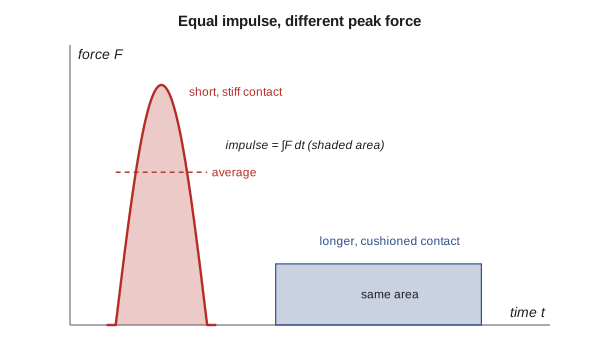
On a graph of force against time, the impulse is the area under the curve. Two very different force histories, a small force acting for a long time and a large force acting briefly, can have the same area and therefore produce the same change in velocity. That is the principle behind every cushioned landing: an airbag, a crumple zone or the foam in a parcel does not reduce the momentum that must be removed, but by stretching the stopping time it reduces the force needed to remove it.
Average force and impulsive forces
When the force history is unknown but its duration can be estimated, the average force over the contact time is \(F_{avg} = \Delta(mv)/\Delta t\). This is the standard way to estimate loads in short events: kicks, impacts, catches and the action of fast actuators. The peak force is always higher than the average. For a force pulse shaped like half a sine wave, the peak is \(\pi/2\), about 1.57, times the average; for a sharp triangular spike it is twice the average.
During a very short impact, forces such as the contact force become so large that ordinary forces, such as the weight of the body or the friction from a conveyor bed, contribute negligible impulse over the few milliseconds of contact. Impulse-momentum analyses of collisions therefore usually include only the impulsive forces and neglect the others during the contact itself. Before and after the impact, of course, the ordinary forces are back in charge.
Worked problem
Kicking a tote off a conveyor
A pneumatic paddle diverter pushes a tote weighing 25 lb sideways off a main line onto a spur. The paddle accelerates the tote from zero to 6.0 ft/s across the line in about 0.12 s. Estimate the average force the paddle exerts on the tote, neglecting friction from the conveyor bed.
Show solution
- Consider only the sideways direction. Initial sideways momentum is zero. The mass is \(25/32.2 = 0.776\) slugs.
- \[0 + F_{avg}(0.12) = 0.776(6.0) \;\Rightarrow\; F_{avg} = \frac{4.66}{0.12} = 38.8 \text{ lb}\]
- If the force pulse is roughly half-sine, the peak is about \(1.57 \times 38.8 = 61 \text{ lb}\).
Answer: The paddle averages about 39 lb and peaks near 61 lb. Friction from the bed would add to the required force, and Lesson 4's methods could estimate it; for a tote on driven rollers it is often small. The paddle face, its mounting and the tote wall must all take the peak, repeated thousands of times a day.
Conservation of linear momentum
When two or more particles interact, the forces between them are equal and opposite by Newton's third law and act for the same time, so their impulses cancel when the particles are considered together. If no external impulse acts on the group in some direction, or the external impulses are negligible, the total momentum in that direction is conserved:
Conservation of momentum is often the only way to solve a problem in which the internal forces are unknowable, such as a collision, a coupling or a separation. It holds even though kinetic energy is usually lost in such events, to deformation, heat and sound. A common error is to assume that energy is conserved in a collision because momentum is. The two principles are independent: momentum comes from the third law and is conserved whenever external impulses are negligible; mechanical energy is conserved only when no non-conservative forces do work, which is rarely true in an impact.
Impact
An impact is a collision between two bodies in which large forces act for a very short time. If the bodies' centers of mass both lie on the line of impact, which is the common normal to the contact surfaces, the impact is central; otherwise it is eccentric, and rotation becomes involved (Lesson 11). If the velocities are along the line of impact, the impact is direct; if not, it is oblique.
During the impact there are two phases. In the deformation phase, the bodies squeeze together until they have the same velocity along the line of impact. In the restitution phase, they spring apart, more or less completely depending on the materials. The coefficient of restitution measures how complete the rebound is:
That is, \(e\) is the ratio of the speed of separation after impact to the speed of approach before it, both measured along the line of impact. A perfectly elastic impact has \(e = 1\) and loses no energy. A perfectly plastic impact has \(e = 0\): the bodies stick together. Real values depend on the materials, the impact speed and the shapes. Hardened steel balls may have \(e\) around 0.9; rubber buffers perhaps 0.5 to 0.8; wooden pallets and filled cartons are often well below 0.5.
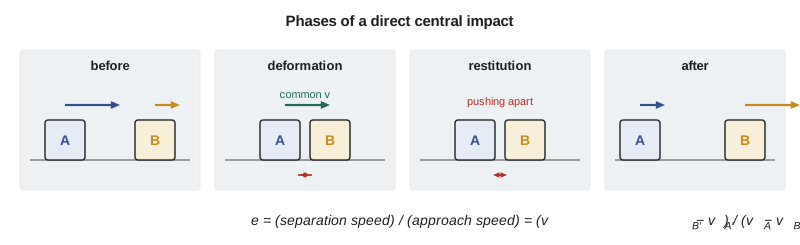
For a direct central impact, conservation of momentum and the definition of \(e\) give two equations in the two unknown final velocities. Solving them in general:
It is usually clearer to write the two equations and solve them for each problem than to memorize these formulas, but they make good checks.
Worked problem
Shuttles bumping on a rail
On a test track, a 250 kg shuttle moving at 0.50 m/s runs into a stationary 150 kg shuttle. Their rubber bumpers give a coefficient of restitution of 0.40. Find the velocities just after impact and the energy lost.
Show solution
- Momentum along the rail: \(250(0.50) + 0 = 250 v_A + 150 v_B\), so \(250 v_A + 150 v_B = 125\).
- Restitution: \(v_B - v_A = 0.40(0.50 - 0) = 0.20\).
- Solving: \(v_A = 0.238 \text{ m/s}\) and \(v_B = 0.438 \text{ m/s}\), both in the original direction.
- Kinetic energy before: \(\tfrac12(250)(0.50)^2 = 31.3 \text{ J}\). After: \(\tfrac12(250)(0.238)^2 + \tfrac12(150)(0.438)^2 = 7.1 + 14.4 = 21.4 \text{ J}\).
- Energy lost: about 9.8 J, or 31 percent, mostly as heat in the bumpers.
Answer: After the bump the struck shuttle moves off at 0.44 m/s and the striking one follows at 0.24 m/s. A third of the kinetic energy is lost even though momentum is fully conserved.
Oblique impact
In an oblique impact, split each velocity into components along the line of impact (the normal) and along the contact plane (the tangent). If the contact surfaces are smooth, there is no tangential impulse, so each body's tangential velocity component is unchanged. Along the normal, conservation of momentum and the coefficient of restitution apply exactly as in a direct impact. When one body is fixed, such as a wall or a guide rail, only restitution applies along the normal: the rebounding normal velocity is \(e\) times the approaching one.
Worked problem
A parcel glancing off a guide rail
A parcel sliding at 6.5 ft/s strikes a fixed side guide at 30° to the guide. The coefficient of restitution is 0.30, and friction between parcel and guide during the brief contact is negligible. Find the parcel's velocity after the impact.
Show solution
- Tangential component (along the guide): \(6.5\cos 30^\circ = 5.63 \text{ ft/s}\), unchanged.
- Normal component (into the guide): \(6.5\sin 30^\circ = 3.25 \text{ ft/s}\); after impact \(0.30 \times 3.25 = 0.975 \text{ ft/s}\) away from the guide.
- Speed after: \(\sqrt{5.63^2 + 0.975^2} = 5.71 \text{ ft/s}\), at \(\tan^{-1}(0.975/5.63) = 9.8^\circ\) to the guide.
Answer: The parcel leaves the guide at 5.71 ft/s, nearly parallel to it. Low restitution is what makes guide rails work: the parcel is steered rather than bounced back across the belt.
Friction between the parcel and the guide during contact would also reduce the tangential component, and a rotating parcel would complicate matters further. For layout purposes, the smooth-contact model is usually adequate; for fragile items, guide liners with low friction and soft facings are chosen to keep both the normal impulse and the tangential drag small.
Measuring an impact: the drop test
Package designers test their designs by dropping them from set heights and measuring how hard they land. The coefficient of restitution can be found from the drop and rebound heights alone, because the impact and rebound speeds come from energy conservation during the free fall: \(e = \sqrt{h_{up}/h_{drop}}\). The impulse is the change in momentum, and a load cell or accelerometer gives the duration and shape of the pulse. The program below works through a 4.0 kg package dropped from 0.76 m that rebounds to 0.12 m, with a measured contact time of 6 ms.
# Drop test: a 4.0 kg package falls 0.76 m onto a rigid floor and
# rebounds 0.12 m. A load cell under the floor plate records a roughly
# half-sine force pulse lasting 6 ms. Find e, the impulse, and the forces.
import math

g, m = 9.81, 4.0
h_drop, h_up, tau = 0.76, 0.12, 0.006

v_in = math.sqrt(2 * g * h_drop)          # speed just before impact
v_out = math.sqrt(2 * g * h_up)           # speed just after
e = v_out / v_in
J = m * (v_in + v_out)                    # impulse (velocity reverses)
print(f"impact {v_in:.3f} m/s, rebound {v_out:.3f} m/s, e = {e:.3f}")
print(f"impulse from momentum change: {J:.2f} N s")

# Build the sampled pulse a load cell would record (50 kHz) with the
# peak chosen so its area equals J, then integrate it like real data.
F_peak = J * math.pi / (2 * tau)
dt = 1 / 50000
samples = [F_peak * math.sin(math.pi * k * dt / tau) for k in range(int(tau / dt) + 1)]
area = sum((samples[k] + samples[k + 1]) / 2 * dt for k in range(len(samples) - 1))
print(f"integrated pulse area: {area:.2f} N s")
print(f"average force {J / tau:7.0f} N   peak force {F_peak:7.0f} N")
print(f"peak deceleration {F_peak / m / g:.0f} g")
print(f"kinetic energy lost: {0.5 * m * (v_in**2 - v_out**2):.1f} J of {0.5 * m * v_in**2:.1f} J")impact 3.862 m/s, rebound 1.534 m/s, e = 0.397 impulse from momentum change: 21.58 N s integrated pulse area: 21.58 N s average force 3597 N peak force 5651 N peak deceleration 144 g kinetic energy lost: 25.1 J of 29.8 J
The numbers are sobering. A drop of under a meter gives an average contact force of about 3,600 N on a 4 kg package, close to a hundred times its weight, and a peak near 144 g. The package's weight, about 39 N, contributes less than 1 percent of the impulse during the 6 ms contact, which justifies leaving it out. The cushioning inside the box exists to lengthen the contact time for the product itself: if the foam stretches the product's stopping time from 6 ms to 30 ms, the peak force on the product falls fivefold for the same impulse.
| Method | Integrates the second law over | Best for | Gives |
|---|---|---|---|
| Force and acceleration | Nothing (instantaneous) | Forces at an instant, motion along a known path | Vectors, including directions |
| Work and energy | Distance | Speeds at two positions; springs, gravity | One scalar equation |
| Impulse and momentum | Time | Impacts, brief forces, known durations, interacting bodies | Vector equations |
Common mistakes
MistakeAssuming kinetic energy is conserved in a collision because momentum is.
InsteadEnergy is lost unless e = 1; use momentum plus restitution.
MistakeIncluding the weight's impulse during a millisecond impact.
InsteadNon-impulsive forces are negligible during the contact itself.
MistakeApplying restitution to the tangential velocity components.
InsteadWith smooth surfaces, tangential components are unchanged; restitution applies along the line of impact.
MistakeTreating the average force as the peak force.
InsteadThe peak is higher, about 1.57 times the average for a half-sine pulse.
MistakeGetting the order of velocities wrong in the definition of e.
Insteade = speed of separation / speed of approach, both along the line of impact.
Summary and key terms
- Impulse ∫F dt equals the change in momentum m v.
- Average force = change in momentum / contact time; peaks are higher.
- Momentum is conserved when external impulses are negligible.
- The coefficient of restitution compares separation and approach speeds along the line of impact.
- Kinetic energy is lost in any impact with e < 1.
- In oblique impacts with smooth contact, tangential velocity components are unchanged.
- Cushioning works by lengthening the contact time, which lowers the force for the same impulse.
- Linear momentum
- The product of mass and velocity.
- Linear impulse
- The time integral of a force.
- Impulsive force
- A large force acting for a very short time.
- Line of impact
- The common normal to the contact surfaces during a collision.
- Central impact
- An impact in which both centers of mass lie on the line of impact.
- Coefficient of restitution
- The ratio of the speed of separation to the speed of approach.
- Perfectly plastic impact
- An impact with e = 0 in which the bodies stick together.
- Oblique impact
- An impact in which the velocities are not along the line of impact.
Practice problems
Work each problem on paper first, then reveal the answer to check.
A 0.5 kg part moving at 4 m/s is stopped in 0.02 s. What average force acts on it?
Show answer
F = 0.5 x 4 / 0.02 = 100 N.
Two 100 kg carts, one at 1 m/s and one at rest, couple together. What is their common velocity and the energy lost?
Show answer
0.5 m/s; energy falls from 50 J to 25 J, so 25 J is lost.
In the shuttle example, what are the final velocities if e = 1?
Show answer
v_A = 0.125 m/s and v_B = 0.625 m/s; no energy is lost.
A ball dropped from 2.0 m rebounds to 1.28 m. What is e?
Show answer
e = sqrt(1.28/2.0) = 0.80.
In the program, what peak force results if the cushioning stretches the contact to 30 ms?
Show answer
About a fifth as much, roughly 1,130 N.
Why can impulse-momentum find a direction when work-energy cannot?
Show answer
It is a vector equation; work-energy is a single scalar equation.
Lesson quiz · 5 questions
Score 60% or more to complete this lesson.
Create a free account to save your progress, take quizzes and earn a certificate.