
PHOT-202 · Lesson 12 of 12 · 25 min
Ethics of image manipulation and capstone
Every photograph involves choices: what to include, when to press the shutter, how to process the file. Editing has always been part of photography, from darkroom dodging to digital retouching, and most manipulation is uncontroversial. But some changes mislead viewers about facts, sell products dishonestly, harm people's self-image or misrepresent individuals. As generative AI makes realistic alteration effortless, photographers need clear principles for when editing is acceptable and when it must be disclosed or avoided. This final lesson covers a framework for thinking about manipulation, documentary and photojournalism standards, advertising and consumer protection law, beauty retouching and body image, portraits and consent, generative AI and authenticity, disclosure and content credentials, and the capstone portfolio.
A framework: context and expectation
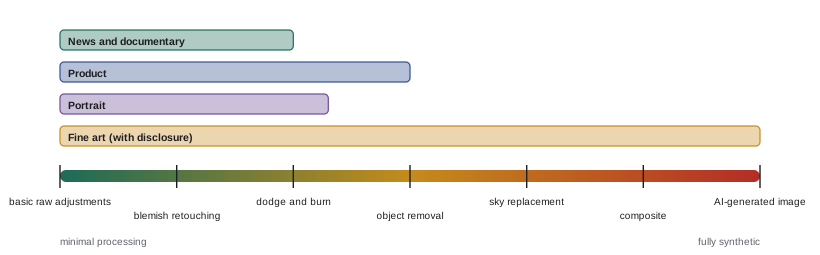
Whether an edit is acceptable depends largely on context and on what viewers reasonably expect. Viewers understand that fine art, fashion, advertising illustration and conceptual images may be heavily manipulated or entirely constructed. They expect news and documentary photographs to show what the camera recorded. They expect product photographs to represent what they will receive. They expect portraits to look like the person, at their best. A useful test is to ask: would a reasonable viewer, knowing what was changed, feel misled? Another is to ask whether the edit changes the meaning or factual content of the image, or only its presentation. Adjusting exposure, color and contrast to reproduce what the photographer saw changes presentation; adding or removing people, objects or events changes content.
| Context | Viewer expectation | Generally acceptable | Generally unacceptable |
|---|---|---|---|
| News and documentary | Faithful record | Exposure, color, contrast, cropping that keeps meaning | Adding, removing or moving content; staging |
| Product and advertising | Accurate representation of the product | Cleaning, color matching, presentation | Changing features, results or quantity |
| Portrait | Recognizable person at their best | Removing temporary blemishes, subtle enhancement | Reshaping without consent, misrepresenting identity |
| Fine art and conceptual | Creative interpretation | Any manipulation | Presenting fabricated scenes as real events |
Documentary and photojournalism standards
News and documentary photography has the strictest standards, because the public relies on it to understand events. Professional codes, such as the National Press Photographers Association Code of Ethics in the United States, the Canadian Association of Journalists' ethics guidelines, and the policies of news agencies such as Reuters, the Associated Press and the Canadian Press, typically allow only basic adjustments, such as exposure, contrast, color balance and cropping, that do not alter the content or meaning of the image, and prohibit adding, removing or moving elements, staging scenes presented as candid, and composites presented as single images. Photographers have been fired and stripped of awards for removing objects, combining frames or staging. Competitions such as World Press Photo examine raw files to verify entries. Cropping and selection can also mislead, by removing context that changes the meaning of an event, so honesty applies to framing as well as editing. PHOT-320 covers photojournalism ethics in depth.
Advertising and consumer protection
Product and advertising images are governed by consumer protection law and advertising standards, which prohibit misleading representations.
In the United States, the Federal Trade Commission Act prohibits unfair or deceptive acts or practices, including misleading advertising, enforced by the Federal Trade Commission. The National Advertising Division of BBB National Programs reviews advertising claims, and has recommended that cosmetics advertisers disclose or discontinue retouched images that exaggerate product results, such as enhanced eyelashes in mascara advertisements. Some states have considered or adopted rules on disclosure of altered images in advertising.
In both countries, the principle is the same: images may present products attractively, but must not create a false impression of what the product is or does. Before-and-after images for cosmetics, fitness, cleaning and other products are particularly sensitive; retouching the "after" image to exaggerate results is deceptive. Real estate photographs that hide defects or replace views can also mislead buyers, and professional bodies and listing services often have rules about altering property images.
Worked problem
A client request
A skincare brand asks a retoucher to smooth the skin in the "after" image of a before-and-after advertisement for an anti-wrinkle cream, to make the results look more dramatic. How should the retoucher respond?
Show solution
- Recognize that the image presents the product's results, so altering the skin misrepresents what the product does.
- Explain to the client that exaggerating results in before-and-after images can breach advertising law and standards, exposing the brand to complaints and penalties.
- Offer acceptable alternatives: matching lighting, exposure and color between the two images, removing temporary blemishes unrelated to the claim in both images equally, or using the images without retouching the treated area.
- Document the conversation, and decline work that would clearly mislead consumers.
Answer: Decline to exaggerate the results, explain the legal and ethical risks, and offer consistent, honest presentation of both images.
Beauty retouching and body image
Heavily retouched images of bodies and faces in advertising and media have been linked in research and public debate to body dissatisfaction, particularly among young people. Responses include laws and rules requiring labels on retouched commercial images, such as France's 2017 law and Norway's 2022 rule requiring labels on retouched advertising images, including influencer posts, of bodies; commitments by some brands and publications to stop or limit retouching of models; and campaigns celebrating unretouched images and diverse bodies. Photographers and retouchers can contribute by retouching subtly, preserving texture and natural features, avoiding body reshaping unless explicitly requested and appropriate, respecting diverse skin tones and body types, and being transparent with clients and audiences about the level of retouching.
Portraits, consent and identity
Portrait subjects have a stake in how they are presented. Good practice includes discussing retouching with the subject, honoring requests to keep or change features within reason, and avoiding changes that misrepresent identity, such as lightening skin, changing ethnic features, or altering age or body significantly without a clear request. Images of people used commercially require model releases, and images altered in ways that portray people falsely, such as placing them in situations they were never in, can raise legal issues such as defamation, false light or misappropriation of likeness, depending on jurisdiction. Deepfakes and AI-generated images of real people, especially intimate or defamatory images, are increasingly regulated, and creating them without consent can be unlawful and seriously harmful.
Generative AI and authenticity
Generative tools can now add, remove or create realistic content from simple prompts, and entirely synthetic images can be indistinguishable from photographs. This challenges the trust viewers place in photographs. For photographers, key considerations include: whether generative content is appropriate for the context (generally not in news and documentary, and subject to client policies in commercial work); copyright and licensing of generated content, which varies by jurisdiction and tool and may limit the protection or use of images; competition and award rules, many of which now prohibit or separately categorize AI-generated or AI-altered entries; and honesty with audiences, avoiding presenting generated scenes as photographs of real events. Generative tools can also be used responsibly for creative work, concept development and clearly labeled illustration.
Disclosure and content credentials
Disclosure lets audiences understand what they are seeing. Practices include captions noting composites, illustrations or significant alterations; labels such as "photo illustration" in editorial contexts; disclosure of retouching in advertising where required or appropriate; and platform labels for AI-generated or altered content, which major social platforms increasingly require for realistic synthetic media. Content credentials, based on the C2PA standard, attach cryptographically signed records of an image's capture and edit history, including whether generative tools were used, and are supported by some cameras, Photoshop, Lightroom and an increasing number of platforms (PHOT-201 Lesson 11). Preserving and enabling content credentials helps establish authenticity, particularly for documentary work.
Developing your own ethical practice
Beyond laws and codes, photographers develop personal standards. Useful habits include deciding in advance, for each project, what kinds of edits are acceptable; keeping original files and records of edits, which protect you if questions arise; being honest with clients about what retouching can and cannot ethically do; disclosing significant manipulation when it matters to viewers; and considering the effect of your images on subjects and audiences. Ethical practice builds trust, which is one of a photographer's most valuable assets.
Capstone: digital darkroom portfolio
The capstone asks you to demonstrate the full range of digital darkroom skills in a portfolio with documentation. It should include:
- An organized catalog or session for a shoot of your own, with consistent folders, file names, metadata including copyright and captions, ratings, collections and a backup plan.
- A set of at least eight raw-processed images showing control of profile, white balance, tone, color, detail and local adjustments, edited consistently as a series.
- One portrait retouched to a standard or high-end level, with the layered file and a description of each step.
- One product image prepared to an e-commerce style guide, including a clean cut-out and shadow.
- One multi-image technique: an exposure blend, panorama, focus stack or composite, with a description of how light, perspective and color were matched.
- Output files prepared for web and for print, with a soft proof and, if possible, a test print.
- A short statement of about 500 words on the ethical choices you made: what you changed, what you chose not to change, and how you would disclose the edits in each context.
Present the portfolio with before-and-after comparisons, as you would to a prospective client or employer.
Notable cases
History offers many cautionary examples. In 1982, National Geographic moved the Great Pyramids of Giza closer together to fit its cover, prompting debate about manipulation in editorial publishing. In 2003, a Los Angeles Times photographer was dismissed after combining two images from Iraq into one. In 2006, a Reuters photographer's image of smoke over Beirut was found to have been altered with the clone tool, and the agency withdrew hundreds of his images. Award-winning photographs have been disqualified from competitions when entrants removed objects or combined frames, and advertising campaigns have been withdrawn after complaints about retouched models and exaggerated product results. These cases show that manipulation, once discovered, can destroy credibility far beyond the single image concerned.
Professional standards for different roles
Photographers working in different fields should know the standards that apply to them: news agencies' and publications' editing policies for photojournalists; advertising codes and consumer protection law for commercial photographers; professional association codes for portrait and wedding photographers; competition rules for entrants; and platform policies for content creators. Clients may impose their own standards, such as a brand that has committed to unretouched models. When standards conflict, for example a client requesting edits that would breach advertising law, the photographer should explain the issue and, where necessary, decline.
Teaching and learning from originals
Keeping original files and edit histories is not only a protection; it is a learning tool. Comparing early and recent edits of the same images shows how your skills and taste have developed, and sharing before-and-after comparisons with students or clients demonstrates the role of editing honestly. Many photographers publish their editing process openly, building trust with audiences who appreciate transparency.
Ethics as part of the brief
For commercial projects, discussing editing ethics at the start saves difficulty later. Agree with the client what level of retouching is expected, whether generative tools may be used, how product accuracy will be ensured, and whether any labels or disclosures are required by law, platform policy or the client's own commitments. Writing these points into the brief or contract protects both parties and makes clear that honest images are part of the professional service.
Common mistakes
MistakeApplying the same editing freedom to news as to art.
InsteadMatch manipulation to context and viewer expectations.
MistakeExaggerating product results in before-and-after images.
InsteadPresent results honestly.
MistakeAltering identity or body shape without consent.
InsteadDiscuss retouching and respect the subject.
MistakePresenting AI-generated scenes as photographs of real events.
InsteadLabel generative content and follow policies.
MistakeDiscarding originals and edit records.
InsteadKeep originals and enable content credentials.
Summary and key terms
- Acceptability depends on context and reasonable viewer expectations.
- News and documentary codes allow only adjustments that do not change content.
- Advertising law in Canada and the US prohibits misleading product images.
- Beauty retouching affects body image; some countries require labels.
- Portrait subjects deserve consent and respect for identity.
- Generative AI raises authenticity, licensing and disclosure issues.
- Disclosure and content credentials build trust; the capstone integrates the course.
- Manipulation
- Altering an image's content or appearance.
- Presentation edit
- Adjustment that does not change content or meaning.
- Content edit
- Adding, removing or moving elements.
- Staging
- Arranging a scene and presenting it as candid.
- Photo illustration
- Label for manipulated or constructed editorial images.
- Misleading representation
- Advertising that creates a false impression.
- Before-and-after image
- Comparison showing claimed results.
- Model release
- Permission to use a person's likeness.
- Deepfake
- Realistic synthetic media depicting real people.
- Content credentials
- Signed record of an image's history.
Practice problems
Work each problem on paper first, then reveal the answer to check.
What test helps judge whether an edit is acceptable?
Show answer
Would a reasonable viewer feel misled if they knew?
Give an example of a presentation edit.
Show answer
Exposure, color or contrast adjustment.
What do photojournalism codes prohibit?
Show answer
Adding, removing or moving content, and staging.
Can cropping mislead?
Show answer
Yes, by removing context.
Which agency enforces misleading advertising rules in your country?
Show answer
Competition Bureau (Canada) or FTC (US).
Why are before-and-after images sensitive?
Show answer
Retouching can exaggerate results.
Name two countries requiring labels on retouched body images.
Show answer
France and Norway.
What identity changes should be avoided without request?
Show answer
Skin lightening, ethnic features, age, body shape.
Name two concerns with generative AI.
Show answer
Authenticity, licensing, competition rules, misleading viewers.
What do content credentials record?
Show answer
Capture and edit history, including generative edits.
Lesson quiz · 5 questions
Score 60% or more to complete this lesson.
Create a free account to save your progress, take quizzes and earn a certificate.