
PHOT-240 · Lesson 3 of 12 · 24 min
Film formats and cameras
The format of a film, the size and shape of each frame, shapes everything about analog photography: the cameras available, the number of exposures per roll, the cost, the grain and detail in the print, the depth of field, and how the photographer works. A photographer working quickly on the street with a small 35 mm camera has a very different experience from one composing on the ground glass of a large format view camera under a dark cloth. This lesson covers the main film formats from half-frame to large format, the main types of film cameras and how they differ, lenses across formats, instant film, choosing and buying a used camera, testing and maintaining film cameras, and loading film correctly.
35 mm film
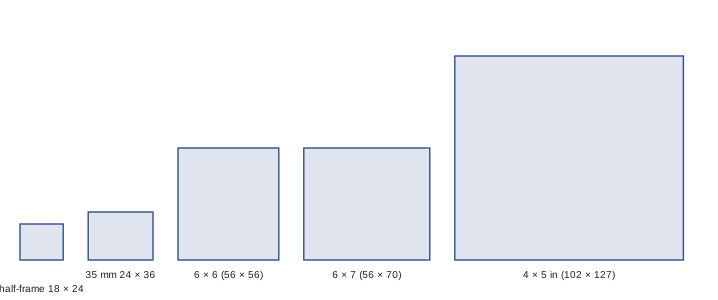
35 mm film, also called 135 format, comes in light-tight metal cassettes with 24 or 36 exposures, each frame measuring 24 × 36 mm, the same size as a full-frame digital sensor. It was adapted from motion picture film by Oskar Barnack at Leitz, whose Leica camera of 1925 made the format popular, and it became the most widely used still format of the twentieth century. 35 mm cameras are compact and fast to use, with a huge range of lenses, and film is widely available. Half-frame cameras record 18 × 24 mm frames, giving 72 exposures on a 36-exposure roll, an economical choice that has seen renewed interest with new half-frame cameras in the 2020s; the smaller frame means more grain and less detail when enlarged. Panoramic 35 mm cameras use wider frames, such as 24 × 65 mm.
Medium format
Medium format uses 120 roll film, a roll of film about 61 mm wide wound with an opaque paper backing on a spool, without a cassette. 220 film, twice the length without backing paper, is no longer widely made. Depending on the camera, 120 film produces frames of several sizes:
| Format | Nominal frame size | Frames per 120 roll | Enlargement for 8 × 10 in (approx.) |
|---|---|---|---|
| 6 × 4.5 (645) | 56 × 42 mm | 15–16 | 5.4× |
| 6 × 6 | 56 × 56 mm | 12 | 4.5× (cropped) |
| 6 × 7 | 56 × 70 mm | 10 | 3.6× |
| 6 × 9 | 56 × 84 mm | 8 | 3.6× (cropped) |
| 6 × 17 panoramic | 56 × 168 mm | 4 | Panoramic prints |
Larger negatives need less enlargement, producing finer grain, smoother tones and more detail at a given print size. Medium format cameras include twin-lens reflexes, single-lens reflexes, rangefinders and folding cameras. Medium format was the standard for professional portrait, fashion and wedding photography for decades, and remains popular for its image quality and the distinctive square or near-square compositions of 6 × 6 and 6 × 7.
Large format
Large format cameras use individual sheets of film, most commonly 4 × 5 inches, and also 5 × 7, 8 × 10 inches and larger. Sheet film is loaded in the dark into double-sided holders that slide into the back of the camera. A 4 × 5 inch negative has about 13 times the area of a 35 mm frame, and an 8 × 10 inch negative can be contact printed at full size without an enlarger, producing extraordinary detail and tonal subtlety. Large format view cameras allow camera movements: the lens and film planes can be shifted, tilted and swung independently, correcting converging verticals in architecture and controlling the plane of focus in landscapes and still life, as tilt-shift lenses do on smaller formats. Each sheet can be developed individually, making large format ideal for the zone system (Lesson 5). Large format is slow and deliberate: composing an upside-down, reversed image on a ground glass under a dark cloth, focusing with a loupe, inserting a holder, closing the shutter, removing the dark slide and exposing takes minutes for each image.
Types of film cameras
Film cameras come in several designs, each with strengths:
- Single-lens reflex (SLR): a mirror reflects the image from the lens up to a viewfinder, showing exactly what the lens sees; the mirror flips up during exposure. 35 mm SLRs, such as the Nikon FM2, Canon AE-1, Pentax K1000 and Olympus OM series, are widely available used. Medium format SLRs include the Hasselblad V system, Mamiya RB67 and RZ67, and Pentax 67.
- Rangefinder: a separate viewfinder window shows the scene, with a focusing aid that superimposes two images until they align. Rangefinders are compact, quiet and good in low light, popular for street and documentary work; examples include the Leica M series and medium format Mamiya 7.
- Twin-lens reflex (TLR): two matched lenses, one for viewing via a mirror and ground glass on top, one for taking the picture; held at waist level, used for 6 × 6 portraits and street photography. Rolleiflex and Yashica Mat are classic examples.
- Point-and-shoot compacts: automatic exposure and focus in a small body; many 1990s models are sought after, though their electronics can fail and cannot easily be repaired.
- View cameras and field cameras: large format cameras with bellows and movements, in monorail designs for studio work and folding field designs for landscape.
- Folding and box cameras, pinhole cameras and toy cameras such as the Holga, valued for simplicity or character.
- Instant cameras: Polaroid and Fujifilm Instax cameras produce self-developing prints.
Lenses and formats
The same focal length gives different angles of view on different formats. A "normal" lens, giving a natural perspective, has a focal length roughly equal to the diagonal of the format: about 50 mm on 35 mm, 80 mm on 6 × 6, 90 to 110 mm on 6 × 7, and 150 mm on 4 × 5. Wide-angle and telephoto lenses scale similarly. Larger formats require longer focal lengths for the same view, so depth of field at the same aperture and framing is shallower, and large format photographers often stop down to f/22 or smaller for depth, accepting some diffraction because the negative needs little enlargement.
where \(d_{35} \approx 43\) mm is the 35 mm diagonal. For example, an 80 mm lens on 6 × 6 (diagonal about 79 mm) gives roughly the view of a 44 mm lens on 35 mm, though the square format crops the long side.
Choosing and buying a used camera
Most film cameras are bought used, from camera shops, online marketplaces, estate sales and other photographers. Check:
- Shutter: fire at every speed and listen; slow speeds should sound proportionally longer, and fast speeds should be crisp. Look through the open back with the lens removed or aperture open, if possible, to see the shutter open fully. Many shops and technicians test speeds with electronic testers.
- Light seals and mirror foam: older cameras often have deteriorated foam seals around the back door and mirror, which cause light leaks and stick to film. Seals are inexpensive to replace.
- Lens: check for haze, fungus (web-like growths), separation, scratches and sticky aperture blades, which may be slow to close and cause overexposure.
- Meter: compare with a known-good meter; many older cameras used mercury batteries no longer available and need adapters or recalibration.
- Film advance, rewind and frame counter: should operate smoothly.
- Viewfinder and focusing screen: clean and bright; rangefinder images aligned at infinity.
Buying from a reputable dealer offering a short warranty, or a camera recently serviced (sometimes called "CLA", clean, lubricate and adjust), reduces risk. Mechanical cameras that work without batteries, such as many SLRs from the 1970s, can be repaired long into the future; complex electronic cameras may not be.
Worked problem
Checking shutter speeds by ear and with a test roll
A used camera's 1/1000 s and 1/500 s speeds sound similar, and the student suspects the fastest speed is slow. How can this be tested without an electronic tester?
Show solution
- Shoot a test roll of a well-lit, evenly toned subject such as a gray wall, at each shutter speed with the aperture adjusted to keep the same exposure (for example f/2.8 at 1/1000 s, f/4 at 1/500 s, f/5.6 at 1/250 s).
- Develop normally and compare negative densities on a light box or with a densitometer.
- If the 1/1000 s frame is denser than the others, the shutter is slower than marked; if a frame shows uneven density across it, the shutter curtains may be traveling unevenly.
- Record findings and compensate, or have the shutter serviced.
Answer: Shoot equivalent exposures at each speed and compare densities; a denser 1/1000 s frame reveals a slow shutter.
Instant film
Instant films develop themselves in minutes after exposure, producing a unique print. Polaroid (now Polaroid B.V.) makes integral films for its cameras, and Fujifilm's Instax line, in mini, square and wide formats, is the best-selling film product today. Peel-apart films, once used by professionals for test shots, are produced only in small quantities. Instant film has a narrow exposure latitude and is sensitive to temperature, developing best at about 13 to 28 °C, and its distinctive colors and imperfections are part of its appeal. Instant prints can be scanned or rephotographed for sharing.
Loading and unloading film
Correct loading is essential, and mistakes can waste a whole roll. For 35 mm, load in subdued light, pull the leader across to the take-up spool, engage the sprocket holes, close the back and advance until the counter reaches 1, watching that the rewind knob turns to confirm the film is advancing. At the end of the roll, press the rewind release and rewind fully into the cassette, or leave the leader out if you will develop it yourself and want easier loading onto reels. For 120, thread the paper leader onto the empty take-up spool, align the start marks if the camera has them, and advance to frame 1; at the end, wind the paper fully onto the take-up spool and seal it tightly, since loose 120 rolls leak light at the edges. Sheet film holders are loaded in total darkness, with the emulsion side identified by notch codes on the edge: with the notches at the top right edge, the emulsion faces you.
Matching format to purpose
Choosing a format is a practical decision as well as an aesthetic one. Street, documentary and travel photographers often prefer 35 mm for its speed, compact cameras and many frames per roll. Portrait, fashion and landscape photographers often choose medium format for its tonal smoothness and larger negatives, accepting fewer frames and heavier cameras. Architectural and fine art landscape photographers may choose large format for its movements and individual sheet development. Many photographers use more than one: a 35 mm camera for everyday work and a medium or large format camera for planned projects. Consider also the enlarger and scanner available, since a 4 × 5 negative requires a large format enlarger or scanner to print or scan well.
Cameras for learning
For learning, a mechanical 35 mm SLR with manual exposure, a built-in meter and a 50 mm lens is ideal: it teaches aperture, shutter speed and metering directly, it is inexpensive and widely available, and it keeps working even if the meter battery fails. Avoid cameras that only offer automatic exposure for a first course, since they hide the decisions this course is about. Medium format TLRs are an affordable way to try the format, and simple 4 × 5 field cameras with a single lens are available used for those who want to explore large format.
Caring for film cameras
Keep film cameras clean and dry, store them with shutters uncocked and away from heat, remove batteries during long storage to prevent corrosion, and exercise shutters occasionally by firing them at all speeds, which keeps lubricants from settling and slow speeds accurate.
Common mistakes
MistakeBuying an untested used camera.
InsteadCheck shutter, seals, lens and meter, or buy serviced.
MistakeAssuming the rewind knob is irrelevant when loading.
InsteadWatch it turn to confirm film is advancing.
MistakeLeaving exposed 120 rolls loosely wound.
InsteadWind tightly and seal to prevent edge fog.
MistakeIgnoring old mercury battery requirements.
InsteadUse adapters or recalibrate meters.
MistakeLoading sheet film emulsion backwards.
InsteadUse notch codes to find the emulsion side.
Summary and key terms
- 35 mm frames are 24 × 36 mm in cassettes of 24 or 36 exposures; half-frame doubles the count.
- 120 roll film gives 6 × 4.5 to 6 × 9 frames and beyond.
- Large format sheets such as 4 × 5 inches allow movements and individual development.
- SLRs, rangefinders, TLRs, compacts and view cameras suit different ways of working.
- Normal focal lengths roughly equal the format diagonal.
- Check used cameras carefully; mechanical cameras are easiest to maintain.
- Load film carefully and use notch codes for sheet film.
- 135 format
- 35 mm film in cassettes.
- Half-frame
- 18 × 24 mm frames on 35 mm film.
- 120 film
- Medium format roll film with paper backing.
- Sheet film
- Individual sheets for large format cameras.
- Camera movements
- Shifts, tilts and swings of lens and film planes.
- SLR
- Single-lens reflex camera with a mirror.
- Rangefinder
- Camera with a separate focusing viewfinder.
- TLR
- Twin-lens reflex camera.
- Light seals
- Foam strips preventing light leaks.
- Notch code
- Edge notches identifying sheet film type and emulsion side.
Practice problems
Work each problem on paper first, then reveal the answer to check.
Frame size of 35 mm film?
Show answer
24 × 36 mm.
How many 6 × 6 frames on 120 film?
Show answer
12.
How much larger in area is 4 × 5 than 35 mm?
Show answer
About 13 times.
What do camera movements control?
Show answer
Perspective and the plane of focus.
What distinguishes a rangefinder?
Show answer
A separate viewfinder with a superimposed-image focusing aid.
Normal lens for 4 × 5?
Show answer
About 150 mm.
Equivalent of 80 mm on 6 × 6 in 35 mm terms?
Show answer
About 44 mm.
Name three things to check on a used camera.
Show answer
Shutter, seals, lens, meter, advance, viewfinder.
What is a CLA?
Show answer
Clean, lubricate and adjust service.
Ideal temperature range for instant film development?
Show answer
About 13–28 °C.
Lesson quiz · 5 questions
Score 60% or more to complete this lesson.
Create a free account to save your progress, take quizzes and earn a certificate.