
PHOT-330 · Lesson 12 of 12 · 29 min
Processing, honest editing, selling work and capstone portfolio
A nature photograph is not finished when the shutter closes. Processing turns raw sensor data into a finished image; editing decides which frames are worth keeping; presentation and sales bring the work to an audience. Each step involves choices about honesty, because viewers of nature images usually assume they show what was there. This final lesson covers a RAW workflow for landscapes and wildlife, merging panoramas, brackets and focus stacks, the line between enhancement and manipulation, competition and editorial rules, printing and pricing, licensing nature images, and a capstone project: a seasonal landscape and wildlife portfolio that brings the whole course together.
A RAW workflow for nature images
Most nature photographers shoot RAW, which keeps the full range of data from the sensor and allows extensive adjustment without degrading quality. A typical workflow is:
- Import and back up immediately: copy files to a computer and at least one other drive, following a 3-2-1 approach (three copies, on two kinds of media, one off site).
- Cull and rate: reject technical failures and weak compositions, then rate the best. Be ruthless; a portfolio is judged by its weakest image.
- Add metadata: captions, keywords, locations (keeping sensitive locations private, as Lesson 10 discussed), species names, copyright and contact information.
- Global adjustments: white balance, exposure, contrast, highlight and shadow recovery, and lens corrections.
- Local adjustments: graduated and radial masks, brushes and subject or sky masks to balance light, much as a printer once dodged and burned.
- Noise reduction and sharpening, especially for high-ISO wildlife and night images.
- Export for each use: web, print or client, with appropriate size, color space and sharpening.
Calibrated monitors and consistent viewing conditions, covered in earlier courses, matter for accurate color, particularly for prints.
Merging panoramas, brackets and stacks
Lessons 3 to 7 introduced techniques that produce several frames for one image. Software merges them:
- Panoramas stitch overlapping frames. Check edges for stitching errors, especially where near objects shift.
- HDR merges and exposure blends combine bracketed exposures. Watch for ghosting where clouds, water or leaves moved, and avoid heavy tone mapping that produces halos and flat, unnatural results.
- Focus stacks combine frames focused at different distances. Inspect edges and moving elements for halos and smears, and retouch where needed.
- Night sky stacks align and average multiple sky frames to reduce noise; star trails stack frames with a lighten blend.
These techniques record more of what was in front of the camera than a single frame can, and most audiences and competitions accept them when they represent a real scene captured at one time and place.
Enhancement and manipulation
There is no single rule for how much editing is acceptable; it depends on the context. Fine art landscape photographers may combine elements freely, while documentary, editorial and scientific nature photography demand strict honesty. Useful distinctions are:
| Category | Examples | Typical acceptance |
|---|---|---|
| Global and local adjustments | White balance, exposure, contrast, dodging and burning, noise reduction | Accepted almost everywhere when they do not misrepresent |
| Same-scene merges | Panoramas, exposure blends and focus stacks from one time and place | Widely accepted; some contests require disclosure |
| Removing small distractions | Sensor dust, a twig or a stray bright spot | Accepted in many art contexts; often restricted in documentary and contest rules |
| Time blending | Sky from a later frame, foreground shot at blue hour with a night sky | Accepted in art if disclosed; often not allowed in strict contests |
| Compositing | Adding a moon, animal or sky from another place or time | Art or illustration only, clearly labeled |
| Generative AI fill or creation | Extending or inventing parts of the scene | Not acceptable as photography of nature without clear disclosure |
The ethical test is whether the image misleads viewers about what happened. A landscape that combines a sky from a different evening may be beautiful art, but presented as a single moment it deceives. A wildlife image of a captive animal, a baited predator or a composite can mislead viewers about animal behavior and the photographer's achievement. Disclosure in captions and metadata resolves many problems: viewers can accept an image as art if they know how it was made.
Generative AI adds new questions. Tools can now remove objects, extend skies, invent animals or create entire scenes. Content credentials, the C2PA standard discussed in PHOT-320, attach a record of how an image was created and edited; some camera makers, software companies and publishers support it. For nature photographers whose credibility depends on honest images, documenting the workflow and keeping RAW files is increasingly valuable.
Competition and editorial rules
Major nature photography competitions publish detailed rules and usually require entrants to submit original RAW files for finalists, so judges can verify what was done. Common rules include: no adding or removing elements, apart from sensor dust and similar minor cleaning; no compositing; restricted or disclosed use of focus stacking, HDR and panoramas; disclosure of captive, controlled or baited subjects, or a ban on them in wildlife categories; and a ban on images that involved harm or disturbance to wildlife. Disqualifications have followed when stuffed or captive animals were presented as wild, or when elements were added. Read the rules of each competition carefully; they differ.
Editorial publications, such as news and nature magazines, generally follow photojournalism standards similar to those in PHOT-320: no adding or removing content, adjustments only to the degree that they keep the image truthful, and captions that explain any unusual technique.
Printing nature photographs
Prints remain an important outlet for landscape work, and large prints reveal flaws that screens hide. The maximum good print size depends on resolution and viewing distance. A common target is about 300 pixels per inch (ppi) for close viewing; 200 to 240 ppi is often acceptable for larger prints viewed from farther away. Print size in inches is pixels divided by ppi.
Worked problem
How large can I print?
A 45-megapixel image measures 8,192 × 5,464 pixels. What print size does it support at 300 ppi and at 200 ppi? What about a stitched panorama of 22,000 × 6,500 pixels at 240 ppi?
Show solution
- At 300 ppi: 8,192 / 300 ≈ 27.3 in by 5,464 / 300 ≈ 18.2 in.
- At 200 ppi: about 41 × 27 in.
- Panorama at 240 ppi: 22,000 / 240 ≈ 91.7 in by 6,500 / 240 ≈ 27.1 in.
Answer: About 27 × 18 in at 300 ppi or 41 × 27 in at 200 ppi; the panorama supports a print over 7 ft (2.3 m) wide at 240 ppi. Larger sizes are possible with careful upscaling, but sharpness, focus and noise problems become more visible, which is why technique in the field matters.
Paper choice affects the look: glossy and luster papers give deep blacks and saturated color; matte and fine art papers give a softer, painterly look suited to intimate landscapes; metal and acrylic prints give vivid color and modern presentation. Soft-proofing in software, using the printer and paper profile, previews how the print will look.
Pricing and selling prints
Pricing prints means covering costs, overhead and your time, and positioning the work in the market. Costs include printing, paper, framing or mounting, packaging, shipping, sales platform fees and taxes. Many photographers use a cost-plus approach, then adjust to the market. Limited editions, where only a stated number of prints are made in each size, can support higher prices but must be honored strictly.
Worked problem
Pricing a framed print
A 24 × 36 in framed print costs $95 to print, $210 to frame, $35 to pack and $45 to ship. The photographer wants a gross margin of 55 percent on the selling price, before sales tax. What price is needed?
Show solution
- Total direct cost: 95 + 210 + 35 + 45 = $385.
- With a 55 percent margin, cost is 45 percent of price.
- Price = 385 / 0.45 ≈ $856.
- Round to a market-friendly price such as $850 or $875.
Answer: About $855 to $875 before tax. Sales tax depends on the state and on where the buyer receives the print; PHOT-302 covered sales tax basics. Galleries typically take 40 to 50 percent commission, so gallery prices must be higher.
Licensing nature images
Licensing grants clients the right to use an image for a defined purpose, time, territory and medium, while the photographer keeps copyright. Nature images are licensed for books, magazines, calendars, tourism campaigns, corporate reports, websites and educational materials. Fees depend on use: a full-page editorial use in a national magazine pays differently from a website thumbnail or a national advertising campaign. Stock agencies set prices for most of their sales, often low; direct licensing to clients usually pays more but requires marketing and negotiation. Keep model and property releases where people or recognizable private property appear, and remember that some parks and Indigenous nations restrict commercial use of images made under certain permits or of culturally significant places.
Conservation organizations often ask for donated images. Donating selectively can support causes you care about and build relationships, but set clear terms on credit, uses and time limits.
Building a nature portfolio
A portfolio is a curated selection, usually 12 to 20 images for a specific purpose, such as a gallery submission, a client pitch or a website section. Strong nature portfolios have a clear focus, a consistent level of quality, variety within that focus (wide, medium and close; landscape and detail; behavior and portrait), and a sequence that flows. They also reflect the photographer's own vision and deep knowledge of places, rather than a collection of famous viewpoints.
Capstone: a seasonal landscape and wildlife portfolio
The capstone asks you to plan, shoot and present a portfolio of 15 images from one place, or a small group of places within easy reach, across at least two seasons, combining landscapes, wildlife or macro subjects and at least one technique from the course: long exposure, night sky, focus stacking, panorama or blending. The project brings together planning, composition, technique, ethics, safety and presentation.
The project has six parts:
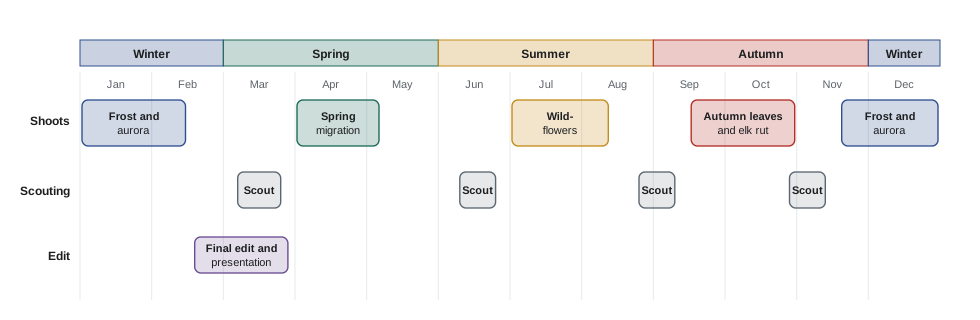
- Proposal: the place, the story you want to tell and why it matters; a seasonal calendar of light and natural events (Lesson 2); and a shot list of at least 30 ideas.
- Plan: dates, sun, moon and tide data, weather decision rules, equipment and backups.
- Ethics and permits: wildlife distances and species considerations, location-sharing policy, permits or permissions needed, and Leave No Trace measures (Lesson 10).
- Safety plan: hazards, trip plans, check-in contacts and cold or heat measures (Lesson 11).
- Fieldwork: shoot the plan over the seasons, keeping notes on conditions, settings and what you learned.
- Presentation: a sequenced set of 15 images with titles, captions that disclose techniques such as stacks or blends, a short artist's statement and a one-page technical appendix.
Worked problem
Budgeting time for the capstone
A student plans 10 field outings averaging 6 hours each including travel, 4 scouting visits of 3 hours, 2 hours of editing per outing, and 12 hours to sequence, caption and write the statement. What is the total time?
Show solution
- Field outings: 10 × 6 = 60 hours.
- Scouting: 4 × 3 = 12 hours.
- Editing: 10 × 2 = 20 hours.
- Presentation: 12 hours.
- Total: 60 + 12 + 20 + 12 = 104 hours.
Answer: About 104 hours, roughly what a substantial course project needs. Field time dominates, which is why planning and decision rules that avoid wasted trips matter so much.
Assessment criteria typically include clarity of vision and story, technical quality, composition, variety within a coherent theme, evidence of planning and fieldcraft, ethical practice and honest disclosure, and quality of presentation and writing.
Common mistakes
MistakeKeeping too many similar frames in a portfolio.
InsteadCull hard; the weakest image defines the portfolio.
MistakeAdding a moon or animal from another frame without telling viewers.
InsteadLabel composites as art, or keep images true to a single scene.
MistakePushing HDR tone mapping until halos appear.
InsteadBlend subtly so the image looks like a natural scene.
MistakePricing prints below cost after framing and shipping.
InsteadCalculate all costs and the margin you need before setting prices.
MistakeEntering a competition without reading its editing and wildlife rules.
InsteadRead the rules and keep RAW files for verification.
Summary and key terms
- Shoot RAW, back up immediately, cull hard and add careful metadata.
- Panoramas, blends, focus stacks and sky stacks extend what one frame records.
- Editing ranges from basic adjustments to compositing and AI generation; context sets the limits.
- The test is whether the image misleads viewers; disclosure resolves many problems.
- Competitions require RAW files and ban harmful practices and undisclosed manipulation.
- Print size is pixels divided by ppi; price prints from full costs and target margins.
- The capstone portfolio combines planning, technique, ethics, safety and honest presentation.
Practice problems
Work each problem on paper first, then reveal the answer to check.
Print width at 300 ppi for a 6,000-pixel-wide image?
Show answer
20 in.
At 240 ppi?
Show answer
25 in.
Direct costs $200 and target margin 50 percent: price?
Show answer
$400.
Direct costs $300 and target margin 60 percent: price?
Show answer
300 / 0.4 = $750.
Name two same-scene merges that are widely accepted.
Show answer
Panoramas and focus stacks (also exposure blends).
Why do competitions ask for RAW files?
Show answer
To verify what was captured and how it was edited.
What does 3-2-1 backup mean?
Show answer
Three copies on two kinds of media, one off site.
Give one way to resolve an honesty problem with a time blend.
Show answer
Disclose it in the caption and present it as art.
What should a capstone proposal include?
Show answer
Place, story, seasonal calendar and a shot list.
Why keep sensitive locations out of public metadata?
Show answer
To protect wildlife and fragile places from crowds or collectors.
Lesson quiz · 5 questions
Score 60% or more to complete this lesson.
Create a free account to save your progress, take quizzes and earn a certificate.