
PHOT-330 · Lesson 6 of 12 · 31 min
Long exposures: water, clouds and light trails
A long exposure records movement over time in a single frame. Rushing water becomes silky, waves turn to mist, clouds streak across the sky and headlights trace lines through the dark. These effects are among the most recognizable in landscape photography, and also among the most overused. This lesson explains how to choose shutter speeds for different effects, estimates how far things move during an exposure, covers technique for stable long exposures in the field, and discusses when a long exposure helps a picture and when it becomes a cliché. Lesson 5 covered the ND filters that make long exposures possible in daylight.
Shutter speed as a creative choice
In most photography, shutter speed is chosen to avoid blur. In long-exposure landscape work, it is chosen to create a specific amount of blur. The key question is how far a moving element travels during the exposure, relative to its size and the frame. A wave that moves 1 m during a 1/4 s exposure keeps much of its texture; one that moves 1 m during a 30 s exposure, back and forth many times, disappears into a smooth mist.
The distance moved is simply speed multiplied by time:
On the sensor, the blur length depends on magnification, as discussed in earlier courses: for a subject at distance \( d \) photographed with focal length \( f \), the blur on the sensor is about \( v t f / d \). For long exposures, though, it is often more useful to think about the blur relative to the size of the subject or the frame.
Water: from texture to silk
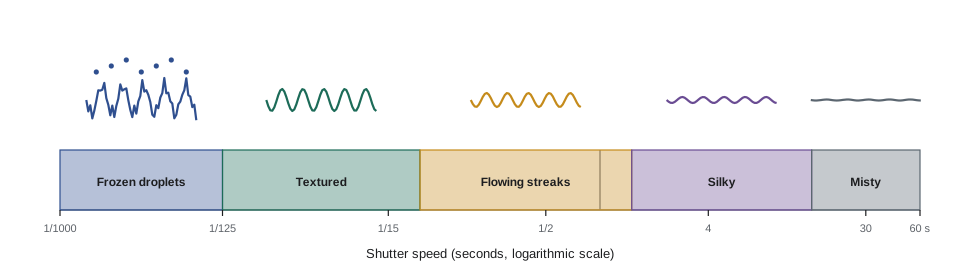
Different shutter speeds give different looks to moving water:
| Shutter speed | Typical effect on moving water |
|---|---|
| 1/1,000 s and faster | Freezes droplets and spray; water looks crisp and textured |
| 1/60 to 1/15 s | Slight blur; water still shows shape and texture |
| 1/8 to 1 s | Flowing streaks with visible direction; often best for streams and waterfalls |
| 2 to 10 s | Smooth, silky water; waves become soft |
| 30 s and longer | Sea and lakes become flat and misty; reflections smooth out |
For waterfalls, the water accelerates as it falls. Ignoring air resistance, water falling a height \( h \) reaches a speed of about:
where \( g ≈ 9.8 \) m/s². This helps estimate how much the water will blur.
Worked problem
Blur at the base of a waterfall
Water drops 12 m over a waterfall. Estimate its speed at the bottom, and how far it moves during exposures of 1/250 s, 1/4 s and 2 s.
Show solution
- Speed: \( v = \sqrt{2 \times 9.8 \times 12} = \sqrt{235} ≈ 15.3 \) m/s.
- At 1/250 s: \( s = 15.3 / 250 ≈ 0.06 \) m, about 6 cm, so drops look nearly frozen.
- At 1/4 s: \( s ≈ 3.8 \) m, a long streak.
- At 2 s: \( s ≈ 31 \) m, more than the whole height, so streaks merge into smooth white.
Answer: About 15 m/s. At 1/250 s the falls look textured, at 1/4 s they show long streaks with structure, and at 2 s they become smooth. Many photographers find 1/4 to 1 s keeps the most character in a large waterfall; the right choice is a matter of taste and the image's mood.
Because bright white water can easily overexpose, expose to keep highlight detail in the falls, checking the histogram and highlight warnings, and lift shadows later.
Waves and coastal long exposures
At the coast, exposures of about 0.3 to 1 s capture the motion of retreating waves as streaks around rocks, which many photographers find more interesting than total smoothness. Timing matters: start the exposure just as a wave begins to retreat. Longer exposures of 30 s or more turn the sea into a smooth plane, which can isolate rocks, piers and sea stacks in a minimalist composition.
Coastal long exposures demand safety awareness. Watch the sea for several minutes before setting up, never turn your back on waves on exposed shores, and know the tide (Lesson 2 covered tides; Lesson 11 covers safety). Rogue or sneaker waves, much larger than average, have swept photographers from rocks on both coasts of North America. Salt spray also coats lenses and filters quickly; check and clean between frames.
Clouds
Moving clouds streak across the frame during exposures of tens of seconds to several minutes, giving a sense of motion and time. The effect depends on cloud speed, direction relative to the camera and focal length. Clouds moving toward or away from the camera create radiating lines; clouds moving across the frame create horizontal streaks.
Worked problem
How far will the clouds move?
Cumulus clouds about 2 km above the ground move at 30 km/h across the view. A photographer uses a 24 mm lens on full frame, framing the clouds at about 5 km distance. During a 2-minute exposure, how far do the clouds move, and how much of the frame width is that?
Show solution
- Speed: 30 km/h = 30,000 / 3,600 ≈ 8.3 m/s.
- Distance in 120 s: 8.3 × 120 ≈ 1,000 m.
- Frame width at 5 km: \( W = 36 \times 5{,}000 / 24 = 7{,}500 \) m.
- Share of frame width: 1,000 / 7,500 ≈ 0.13, or 13 percent.
Answer: About 1 km, or 13 percent of the frame width: enough for clear streaks without losing all cloud shape. Faster winds or longer exposures produce more abstract smears.
Cloud streaks need a bright enough subject and a dense ND filter in daylight, and they work best with defined clouds. A clear blue sky or uniform gray overcast shows little motion.
Light trails
After dark, moving lights draw lines. Car headlights and taillights on roads, boats on lakes and rivers and even flashlights carried by hikers on a trail create trails that add energy and show human presence in a landscape. Exposures of 10 to 30 s at night usually capture complete trails from passing vehicles. The trail's length is the vehicle's speed times the exposure time, limited by how long the vehicle is in the frame.
Worked problem
Will the car cross the whole frame?
A mountain road crosses the frame over a visible length of 1,300 ft. Cars travel at about 40 mph. What exposure time is needed for one car to draw a complete trail across the frame?
Show solution
- Speed: 40 mph ≈ 58.7 ft/s.
- Time to cross: 1,300 / 58.7 ≈ 22 s.
Answer: About 22 s, so a 25 to 30 s exposure, started as the car enters the frame, captures a complete trail. Several cars in one exposure create denser, layered trails.
Twilight, during the blue hour, is often the best time for light trails in landscapes: the sky still has color and detail, while artificial lights are bright enough to stand out. Stand only where it is safe and legal, well off the road, and never photograph from road shoulders where drivers cannot see you.
Technique for sharp long exposures
Long exposures blur moving elements on purpose, but the stationary parts of the scene must stay sharp. Common causes of unwanted blur are tripod movement, wind, vibration from the camera itself and touching the camera. Good practice includes:
- A solid tripod, with the center column down and the heaviest leg sections extended first. Hang a bag from the hook to add weight, but not so it swings.
- A remote release or self-timer, so pressing the shutter does not shake the camera. For exposures over 30 s, use bulb mode with a lockable remote or the camera's built-in bulb timer.
- Mirror lock-up or an electronic first-curtain shutter to avoid vibration from the shutter mechanism.
- Shielding from wind with your body, a bag or a nearby rock. On boardwalks and bridges, footsteps and traffic shake the tripod.
- Turning off image stabilization on a tripod, unless the lens manual says it detects tripod use, because stabilization can introduce drift.
- Focusing and composing before fitting a dense ND filter, then switching to manual focus so it does not change.
Noise, heat and battery life
Long exposures warm the sensor and increase noise, especially hot pixels: bright single pixels that appear in long exposures. The camera's long-exposure noise reduction takes a second exposure of equal length with the shutter closed, a dark frame, and subtracts it, which removes hot pixels but doubles the time. On a cold night this is less of a problem, while in summer heat it can matter more. Long exposures also drain batteries, particularly in cold weather, so carry spares in an inside pocket (Lesson 11).
Calculating exposure in bulb mode
With dense ND filters, the required exposure often exceeds 30 s. A simple method is to meter without the filter, then apply the filter factor from Lesson 5. When the light is changing quickly, such as at sunset, recheck often. In very low light, take a short high-ISO test frame to measure exposure quickly, then convert back to low ISO: each doubling of ISO halves the needed time.
Worked problem
From a high-ISO test to the final exposure
At dusk, a test frame at ISO 6,400, f/8, 2 s looks correctly exposed. What exposure is needed at ISO 100 and f/8?
Show solution
- ISO 6,400 to ISO 100 is a factor of 64, which is 6 stops.
- Exposure time increases by 64: 2 × 64 = 128 s.
- Because light is fading, add a little extra or bracket: try about 2 to 2.5 minutes.
Answer: About 128 s, or slightly longer as the light falls. The test frame saves several minutes of trial and error.
When a long exposure helps, and when it doesn't
Silky water and smooth seas became so popular that they risk looking generic. A long exposure should support the picture's idea. It works well when it simplifies a busy scene, reveals patterns of movement that the eye cannot see, conveys calm or the passage of time, or separates a static subject from a moving background. It works badly when it removes interesting texture, such as the power of a storm wave, or makes every waterfall look the same. Try several shutter speeds and compare: sometimes 1/8 s with visible structure is stronger than 30 s of mist.
Long exposures also raise honesty questions in documentary or scientific contexts. Viewers generally understand that smooth water is a photographic effect, but a long exposure that hides crowds at a busy site can misrepresent how a place is experienced. Captions can clarify.
Planning a long-exposure outing
A simple checklist helps long-exposure outings go smoothly: a sturdy tripod and a weight or bag to hang from it; ND filters in several strengths, cleaned and in a case; a remote release with a lockable button or timer; spare batteries; lens cloths for spray and rain; a headlamp for twilight work; and a note of tide times and safe access on coasts. Arrive early to choose positions while you can see the ground clearly, and test exposure times before the light peaks so you are ready when it does.
Common mistakes
MistakeMaking every waterfall as smooth as possible.
InsteadTry several shutter speeds; moderate blur often keeps more character.
MistakeFocusing after fitting a 10-stop ND filter.
InsteadCompose and focus first, switch to manual focus, then fit the filter.
MistakeLeaving image stabilization on during tripod long exposures.
InsteadTurn it off unless the lens is designed for tripod use.
MistakeShooting from road shoulders for light trails.
InsteadStand well off the road in a safe, legal place.
MistakeTurning your back on the sea during coastal long exposures.
InsteadWatch the waves, know the tide and keep an escape route.
Summary and key terms
- Long exposures choose blur deliberately; distance moved is \( s = vt \).
- Water looks textured at 1/60 s, streaky at about 1/8 to 1 s and silky beyond a few seconds.
- Falling water reaches about \( \sqrt{2gh} \); a 12 m fall gives about 15 m/s.
- Clouds need tens of seconds to minutes to streak; estimate movement against frame width.
- Light trails need the vehicle to cross the frame within the exposure; blue hour balances sky and lights.
- Solid tripods, remote releases, wind shielding and stabilization off keep static parts sharp.
- Use long exposures to support the idea of the picture, not by habit.
Practice problems
Work each problem on paper first, then reveal the answer to check.
Speed of water after falling 20 m?
Show answer
\( \sqrt{2 \times 9.8 \times 20} ≈ 19.8 \) m/s.
How far does it move in 1/8 s?
Show answer
About 2.5 m.
Which shutter speeds give streaky retreating waves?
Show answer
About 0.3 to 1 s.
Clouds at 36 km/h for 60 s: distance moved?
Show answer
10 m/s × 60 = 600 m.
Frame width at 3 km with a 16 mm lens on full frame?
Show answer
36 × 3,000 / 16 = 6,750 m.
A test at ISO 3,200 needs 4 s. Exposure at ISO 100?
Show answer
Factor 32, so 128 s.
A car at 72 km/h crosses 300 m of frame. Time?
Show answer
20 m/s → 15 s.
Why use an electronic first-curtain shutter?
Show answer
To reduce vibration at the start of the exposure.
What does long-exposure noise reduction cost?
Show answer
It doubles the total time by taking a dark frame.
Give one situation where a long exposure weakens a picture.
Show answer
When it removes powerful texture, such as the force of a storm wave.
Lesson quiz · 5 questions
Score 60% or more to complete this lesson.
Create a free account to save your progress, take quizzes and earn a certificate.