
PHOT-350 · Lesson 5 of 12 · 36 min
Flying skills and safety
Good aerial images start with a drone that goes where the pilot intends, stays there steadily and comes home every time. That depends less on reflexes than on habits: a consistent pre-flight routine, failsafes set for the site rather than left at factory defaults, batteries treated with respect, and a practiced response to the handful of emergencies that actually happen. Modern camera drones hold position by themselves, avoid some obstacles and fly home at the press of a button, which makes them easy to fly on a good day and dangerous to trust on a bad one. This lesson covers the core skills a professional aerial photographer needs before thinking about composition: preparing the aircraft, understanding flight modes and sensors, setting failsafes, keeping the drone in sight, handling emergencies, caring for and transporting lithium batteries, and logging flights.
How a camera drone stays in the air
A multirotor drone flies by changing the speed of its motors. Speeding up all four rotors makes it climb; speeding up the rotors on one side tilts it and moves it sideways; speeding up one diagonal pair and slowing the other turns it, because the pairs spin in opposite directions. A flight controller does this hundreds of times a second using an inertial measurement unit (IMU) of gyroscopes and accelerometers to sense tilt and rotation, a barometer to estimate height, a magnetometer (compass) for heading, and GNSS satellite positioning to hold its place over the ground. Downward-facing cameras and sensors help it hold position at low height and land precisely, and forward, rear and side sensors detect obstacles on many models.
Each of these sensors can fail or be fooled. The compass can be disturbed by steel, rebar in concrete, cars, power lines or even a phone in the pilot's pocket near the drone during calibration. GNSS can lose accuracy in urban canyons, under trees, near tall cliffs or during solar storms. Vision sensors struggle over water, snow, glass, featureless surfaces and in low light. The barometer drifts with temperature and gusts. Knowing which sensor does what helps a pilot understand why a drone suddenly drifts, refuses to take off or behaves oddly, and what to do about it.
Flight modes
Most camera drones offer several modes. A normal or position mode uses GNSS and vision to hold position when the sticks are released, limits speed and tilt, and keeps obstacle sensing active. A cine or tripod mode slows every movement for smooth video and precise framing. A sport mode allows higher speed and steeper tilt, usually with obstacle sensing switched off, which is useful for outrunning wind on the way home but dangerous near obstacles. An attitude mode (often called ATTI) holds height but not position, so the drone drifts with the wind like a balloon. Some drones enter attitude mode automatically when GNSS is lost; others let the pilot select it for practice.
Practicing in attitude mode, in an open field on a calm day, is one of the best investments a pilot can make. A pilot who can hold a drifting drone in place and land it smoothly by hand will stay calm when satellite positioning drops out under a bridge or beside a tall building. Professional training programs and flight reviews often include manual control tasks for this reason.
The pre-flight routine
A pre-flight inspection catches most mechanical problems before they become crashes. The routine should be the same every time and written down as a checklist (lesson 4). Typical items include: propellers free of chips, cracks and bends and firmly attached; motors spinning freely without grinding; arms locked; the gimbal clamp removed and the gimbal moving freely; lenses and sensors clean; the battery fully seated, charged, warm enough and free of swelling; the memory card inserted with enough space; firmware and apps up to date (but not updated on site just before a job); the controller and phone charged; and the drone's registration marking visible.
On site, the pilot chooses a take-off point away from metal and reinforced concrete, waits for enough satellites and a confirmed home point, checks that the compass and IMU report no errors, and confirms the failsafe settings. A short hover at 2 to 3 meters for 20 to 30 seconds tests control response, lets cold batteries warm under load and shows whether the drone holds position before it goes high or far.
| Check | What can go wrong if skipped | Typical fix |
|---|---|---|
| Propellers | A chipped blade vibrates, blurs video and can fail | Replace in pairs; carry spares |
| Battery seated and warm | Battery ejects or voltage collapses in flight | Click fully in; warm to the maker's minimum |
| Home point recorded | Return-to-home flies to the wrong place | Wait for the confirmation before take-off |
| Compass and IMU status | Drift, circling ("toilet bowl") or flyaway | Move away from metal; calibrate only when prompted |
| Failsafe settings | Drone climbs into wires or lands in water | Set return height and actions for this site |
| Storage space | Lost shots or a corrupted card | Format in the drone before the job; carry spare cards |
Failsafes and return-to-home
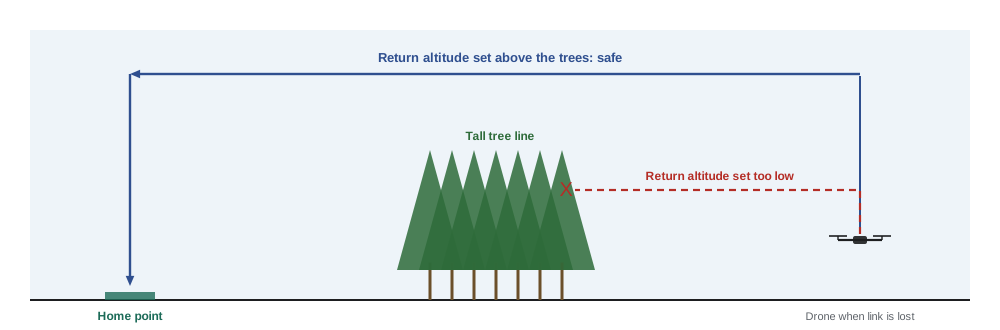
A failsafe is what the drone does when something goes wrong without the pilot's input. The most important is return-to-home (RTH): the drone climbs to a set altitude, flies straight back to the home point and lands or hovers. RTH can trigger when the control link is lost, when the battery reaches a threshold needed to get home, or when the pilot presses the button. On many drones the pilot can choose what happens on signal loss: return home, land in place or hover.
The danger is that RTH flies in a straight line. If the return altitude is lower than a building, tree line, tower or cliff between the drone and home, the drone may hit it, especially if obstacle sensing is off, it is dark or the obstacle is thin like a wire. Setting RTH altitude is therefore part of every site survey: it should clear the tallest obstacle on any likely return path by a safe margin, while staying within the 122 m (400 ft) limit and below any controlled airspace ceiling. Near water, landing in place on signal loss would be a disaster, so returning home or hovering is better. Where the take-off point is crowded, the pilot may choose to update the home point to a safer landing spot or land manually.
Worked problem
Setting a safe return altitude
A photographer is shooting a lakeside cabin. Between the take-off point and the planned shooting area stands a line of pines about 90 ft tall, and a 150 ft communications tower sits 1,000 ft to the side of the route. What return-to-home altitude should be set?
Show solution
- The return path crosses the pines, so the minimum is 90 ft plus a margin.
- A common margin is 50 to 65 ft to allow for height errors and gusts: 90 + 65 = 155 ft.
- The tower is off the route, but a drone that drifts could pass near it; setting 200 ft clears it too.
- Check that 200 ft is below 400 ft and any airspace limits.
Answer: About 200 ft, which clears both the pines and the tower with margin.
Keeping the drone in sight
Visual line of sight means the pilot, or a visual observer in direct contact with the pilot, can see the drone with unaided eyes (glasses are fine; binoculars are not) well enough to know where it is, which way it is going and whether anything is near it. The rules in both countries require this for ordinary operations. In practice, a small camera drone becomes a speck at a few hundred meters, and its orientation becomes impossible to judge long before it disappears. A practical limit for small drones is often 300 to 500 meters in good light, less against a bright sky or busy background.
A visual observer extends safety rather than range. The observer watches for crewed aircraft, birds, people walking into the area and obstacles near the drone, while the pilot concentrates on the camera. Pilot and observer agree on simple calls, such as "aircraft, east, low" or "walker entering from the path", and on who speaks when. On wedding and event jobs, a planner or assistant can serve as a spotter for people, but they must be briefed.
Worked problem
How small does the drone look?
A drone measures about 0.35 m across. The human eye can detect an object of about 1 minute of arc (0.0003 rad) against a plain sky, but judging orientation needs something closer to 5 minutes of arc. At what distance does orientation become hard to judge?
Show solution
- 5 minutes of arc ≈ 5 × 0.00029 ≈ 0.00145 rad.
- Distance = size ÷ angle = 0.35 ÷ 0.00145 ≈ 240 m.
- Detection limit: 0.35 ÷ 0.0003 ≈ 1,170 m against a perfect background.
Answer: Beyond roughly 250 m the pilot can no longer tell which way the drone is facing, even though it may still be detectable as a dot.
Emergencies and how to handle them
Most drone emergencies fall into a few types, and each has a practiced response. The general principle is the same as in crewed aviation: aviate, navigate, communicate. First keep the drone flying safely, then point it somewhere safe, then tell the crew and anyone affected.
- Crewed aircraft approaching: descend immediately and move away; drones must always give way. Helicopters, especially medical and police aircraft, may fly low and fast.
- Loss of GNSS: the drone switches to attitude mode and drifts. Stay calm, fly it manually back toward open sky and home, and land.
- Compass error or circling: if the drone circles or flies in the wrong direction, switch to attitude mode if available, fly it with gentle inputs and land as soon as possible.
- Loss of control link: the failsafe should take over. Move to higher ground with a clear view toward the drone, keep the controller antennas oriented correctly and wait for the link to return.
- Low battery far away: start home early, fly into the wind at a sensible speed, lower altitude if the wind aloft is strong, and choose a closer emergency landing spot if needed.
- Flyaway: if the drone stops responding and leaves, note its last position, heading and battery, try RTH, and alert anyone it could threaten. In both countries a flyaway that endangers aircraft or people can require reporting to the regulator.
- Bird attack: gulls, hawks and eagles attack drones, particularly in nesting season. Climb or move away quickly rather than hovering.
After any incident, the pilot should land, secure the area, check people first and then the aircraft, record the flight log, and decide whether a report is required (lesson 3).
Part 107 requires the remote pilot to report to the FAA within 10 calendar days any operation that results in serious injury, loss of consciousness, or property damage (other than to the drone) of more than $500 to repair or replace. Accidents involving crewed aircraft are reported to the National Transportation Safety Board.
Lithium batteries: care and safety
Drone batteries are lithium-polymer or lithium-ion packs made of several cells in series. They store a lot of energy in a small space, which is why drones fly as long as they do, and why a damaged battery can catch fire violently. Good battery care keeps flight times predictable and prevents fires.
- Charging: use the manufacturer's charger, charge on a non-flammable surface, never leave charging batteries unattended for long, and do not charge a battery that is hot from flight.
- Storage: lithium cells last longest at a partial charge, around 3.8 V per cell (roughly 40 to 60 percent). Smart batteries discharge themselves to storage level after a set number of days. Store in a cool, dry place, ideally in a fire-resistant bag or box.
- Damage: a swollen, punctured, dented or very hot battery should be taken out of service. Never fly a puffed battery.
- Temperature: below about 15 °C, capacity drops; below 0 °C, voltage can collapse under load. Keep batteries warm in a vehicle or insulated bag and hover briefly before working.
- Disposal: discharge fully, tape terminals and take batteries to a battery recycling drop-off rather than household waste.
Worked problem
How much energy is in the battery?
A camera drone uses a 4-cell battery rated 15.4 V and 5,000 mAh. A larger mapping drone uses a 6-cell pack rated 22.8 V and 8,000 mAh. Work out the energy of each in watt-hours.
Show solution
- 5,000 mAh = 5.0 Ah, so 15.4 × 5.0 = 77 Wh.
- 8,000 mAh = 8.0 Ah, so 22.8 × 8.0 ≈ 182 Wh.
Answer: 77 Wh for the camera drone battery and about 182 Wh for the mapping drone battery. The difference matters for air travel.
Traveling with drone batteries
Airlines and transport regulators treat lithium batteries as dangerous goods. Spare batteries, meaning batteries not installed in the drone, must normally travel in carry-on baggage, not checked baggage, with terminals protected against short circuits, for example by their original packaging, terminal covers, tape or individual bags. Limits are set by energy in watt-hours.
| Battery energy | Typical passenger rule | Notes |
|---|---|---|
| 100 Wh or less | Allowed in carry-on; spares limited only by airline policy | Most consumer camera drone batteries |
| Over 100 Wh up to 160 Wh | Airline approval required; usually no more than 2 spares | Larger professional drone batteries |
| Over 160 Wh | Not allowed as passenger baggage | Must ship as cargo under dangerous goods rules |
In the United States, the Pipeline and Hazardous Materials Safety Administration (PHMSA) regulates lithium batteries under the Hazardous Materials Regulations in 49 CFR, and the FAA's PackSafe guidance explains the passenger rules, which follow the international ICAO and IATA limits. Airlines may apply stricter limits. Shipping large batteries by courier requires hazardous materials training and labeling.
Logs, maintenance and currency
Professional operators keep records. Most drones log flights automatically, and many operators sync logs to a cloud service or fleet management system, but the operator should also record the date, location, purpose, pilot, aircraft, battery numbers, flight time and any incidents or defects. Battery logs track cycle counts and capacity loss; most packs are retired after a few hundred cycles or when capacity falls noticeably. Maintenance records note propeller replacements, firmware updates, repairs and inspections.
Part 107 remote pilots must complete free online recurrent training every 24 calendar months to keep their certificate current, and must be able to show their certificate and drone registration to the FAA or law enforcement on request.
Currency also means practice. Skills fade quickly without flying, especially manual control and emergency responses. Many professionals schedule regular practice sessions in an open area: flying figure eights and orbits in cine mode, landing precisely on a pad, flying in attitude mode, and rehearsing an RTH cancellation and manual landing.
Worked problem
Starting home in time
A drone is 900 m from home, cruising home at 10 m/s against a 4 m/s headwind. Descending and landing take about 60 s. The drone uses about 2.5 percent of its battery per minute in flight, and the pilot wants to land with at least 25 percent remaining. At what battery percentage should the return begin?
Show solution
- Ground speed home: 10 − 4 = 6 m/s, so 900 ÷ 6 = 150 s.
- Add 60 s for descent and landing: 210 s = 3.5 minutes.
- Battery used: 3.5 × 2.5 = 8.75 percent.
- Start home at 25 + 8.75 ≈ 34 percent, and round up for gusts: about 40 percent.
Answer: Begin the return at about 35 to 40 percent, not when the low-battery warning sounds.
Professional attitude
Safe flying is mostly about decisions. The pilot in command has final authority over whether a flight happens and how it is flown, and must resist pressure from clients, crowds or their own wish for the shot. Fatigue, dehydration, cold, alcohol, cannabis and some medications all impair judgment; both countries prohibit flying while impaired. The IMSAFE checklist used in aviation, which asks about illness, medication, stress, alcohol, fatigue and eating, is a quick self-check before every job.
Common mistakes
MistakeLeaving return-to-home altitude at the factory default.
InsteadSet it on every site to clear the tallest obstacle on the return path with margin.
MistakeCalibrating the compass on a steel bridge or next to a car.
InsteadCalibrate only when the app asks, in an open area away from metal.
MistakeTrusting obstacle avoidance to stop every collision.
InsteadRemember sensors miss wires, thin branches, glass and anything in sport mode or darkness.
MistakePacking spare batteries in checked luggage.
InsteadCarry spares in the cabin with terminals protected, within the watt-hour limits.
MistakeStarting home when the low-battery alarm sounds.
InsteadCalculate the return time against the wind and start home with a generous reserve.
Summary and key terms
- Drones rely on the IMU, barometer, compass, GNSS and vision sensors, and each can fail or be fooled.
- Position, cine, sport and attitude modes behave differently; attitude mode practice builds manual skill.
- A written pre-flight routine and a short test hover catch most problems.
- Return-to-home flies straight back at its set altitude, which must clear obstacles on the route.
- Visual line of sight limits practical range for small drones to a few hundred meters; observers add safety.
- Emergencies follow aviate, navigate, communicate, and some incidents must be reported.
- Lithium batteries need careful charging, storage, temperature management and transport within watt-hour limits.
Practice problems
Work each problem on paper first, then reveal the answer to check.
Name four sensors a camera drone uses to hold position.
Show answer
IMU, barometer, compass and GNSS (plus vision sensors).
Why can a drone drift suddenly near a tall glass building?
Show answer
GNSS reflections and loss of satellites can degrade positioning, and vision sensors struggle with glass.
What does attitude mode hold and not hold?
Show answer
It holds height but not horizontal position.
Trees on the return path are 22 m tall. Suggest an RTH altitude.
Show answer
About 40 m, giving roughly 15 to 20 m of margin.
Work out the energy of a 14.8 V, 4,500 mAh battery.
Show answer
14.8 × 4.5 ≈ 67 Wh.
Can a 130 Wh spare battery go in checked luggage?
Show answer
No. It travels in carry-on with airline approval, usually two spares at most.
What is the storage voltage per cell for lithium batteries?
Show answer
About 3.8 V per cell.
List the order of priorities in an emergency.
Show answer
Aviate, navigate, communicate.
A drone 600 m away flies home at 8 m/s with a 3 m/s headwind. How long is the return leg?
Show answer
600 ÷ 5 = 120 s, 2 minutes.
Why should a cold battery hover briefly after take-off?
Show answer
Light load warms it and reveals voltage sag before the drone goes high or far.
Lesson quiz · 5 questions
Score 60% or more to complete this lesson.
Create a free account to save your progress, take quizzes and earn a certificate.