
PHYS-460 · Lesson 11 of 12 · 23 min
Photonic devices: LEDs, photodetectors, modulators and integrated photonics
▶ Video coming soon A video version of this lesson is on the way.
Lasers make light, fibers guide it, and nonlinear crystals change its frequency, but a working photonic system also needs devices that emit light cheaply, convert it back into electrical signals, imprint information on it and route it between channels. This lesson covers the four most important: light-emitting diodes, photodetectors, electro-optic modulators and the integrated photonic circuits that combine many functions on a single chip. Most of them are semiconductor devices, and they build directly on the band theory and p–n junctions of PHYS-410.
Light-emitting diodes
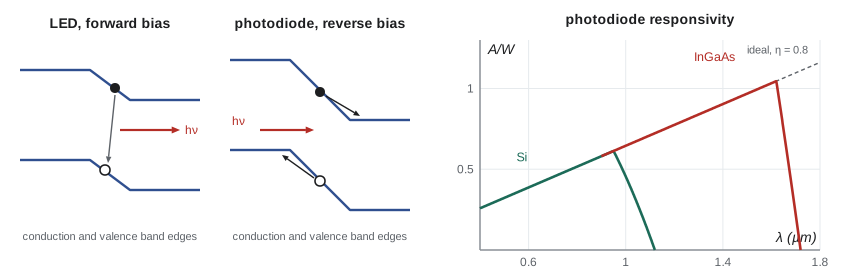
A light-emitting diode is a forward-biased p–n junction in a direct-gap semiconductor. Electrons and holes injected into the junction region recombine, and in a direct-gap material the recombination usually emits a photon with energy close to the band gap, \(h\nu \approx E_g\). Unlike a laser, the LED has no inversion and no cavity; its light comes from spontaneous emission, so it is incoherent, spreads over a wide angle and has a spectral width of about \(1.8k_BT\) in energy, around 20 to 40 nm in the visible.
The color of an LED is set by its band gap. Gallium arsenide, with \(E_g = 1.42\) eV, emits in the near infrared at about 870 nm, used in remote controls and optocouplers. Aluminum gallium indium phosphide covers red to yellow. For decades, efficient blue LEDs could not be made, because the obvious material, gallium nitride, could not be grown with good crystal quality or doped p-type. In the late 1980s and early 1990s Isamu Akasaki and Hiroshi Amano at Nagoya University and Shuji Nakamura at Nichia Corporation solved these problems, producing bright blue LEDs from indium gallium nitride; the three shared the 2014 Nobel Prize in Physics. A blue LED coated with a yellow-emitting phosphor makes white light, which is how nearly all LED lighting works.
The efficiency of an LED is the product of several factors: the internal quantum efficiency, the fraction of injected electron–hole pairs that recombine radiatively; the extraction efficiency, the fraction of generated photons that escape the chip; and the ratio of photon energy to the electrical energy \(eV\) supplied per electron. Extraction is a serious problem because semiconductors have high refractive indices: from GaN, with \(n \approx 2.4\), light can escape a flat surface only within a cone of half-angle \(\arcsin(1/2.4) \approx 25°\). Roughened surfaces, shaped chips and reflective mounts raise extraction to more than 0.8. The best blue LEDs now convert electrical power to light with wall-plug efficiencies around 0.7, while green LEDs lag far behind, a problem known as the green gap.
Photodetectors
A photodetector converts light into an electrical current. In a semiconductor photodiode, a photon with energy above the band gap creates an electron–hole pair in or near the depletion region of a reverse-biased p–n or p–i–n junction, and the built-in field sweeps the carriers apart to give a current. If a fraction \(\eta\) of incident photons produces collected pairs (the quantum efficiency), the photocurrent is \(I = \eta eP/(h\nu)\), and the responsivity is
Responsivity grows with wavelength, because each photon carries less energy but still produces one electron, until the photon energy falls below the band gap and the response collapses. Silicon, with \(E_g = 1.12\) eV, responds up to about 1.1 µm; for the telecom bands at 1.31 and 1.55 µm, indium gallium arsenide (InGaAs) with \(E_g \approx 0.75\) eV is used, and germanium is common in silicon photonics. Avalanche photodiodes apply a high field that multiplies each carrier by impact ionization, adding gain at the cost of extra noise. Charge-coupled devices and CMOS image sensors are two-dimensional arrays of photodetectors.
The sensitivity of a receiver is limited by noise. Shot noise arises because photoelectrons arrive at random times: for a current \(I\) measured in bandwidth \(B\), its mean square is \(\langle i_s^2\rangle = 2eIB\). Thermal or Johnson noise in the load resistance \(R_L\) contributes \(\langle i_t^2\rangle = 4k_BTB/R_L\), independent of the signal. The signal-to-noise ratio is
At low power thermal noise dominates; at high power shot noise dominates, and the SNR grows only linearly with power. Real receivers use transimpedance amplifiers with larger effective resistances and avalanche gain to push down the thermal floor.
Modulators
To send information, light must be modulated. Directly switching the current of a diode laser works up to about the relaxation oscillation frequency (lesson 5) but also chirps the light, which dispersion then turns into pulse distortion. Fast long-haul systems instead keep the laser on and modulate the light externally.
The electro-optic, or Pockels, effect in crystals such as lithium niobate changes the refractive index in proportion to an applied field. In a Mach–Zehnder modulator, light is split into two waveguide arms, the field shifts the phase in one arm relative to the other, and the arms recombine. The output intensity varies as
where \(V_\pi\), the half-wave voltage, is the voltage that changes the relative phase by \(\pi\) and switches the output from full to zero. Lithium niobate modulators reach bandwidths beyond 50 GHz, and thin-film lithium niobate devices now push \(V_\pi\) below a few volts. Modern coherent systems use nested Mach–Zehnder modulators to impose both amplitude and phase on each polarization, encoding several bits per symbol. Electroabsorption modulators, which shift the absorption edge of a quantum well with an applied field, are smaller and can be integrated with the laser on one chip.
Integrated photonics
Electronics was transformed when transistors were integrated on chips; photonics is following the same path. A photonic integrated circuit fabricates waveguides, splitters, filters, modulators and detectors side by side on a wafer. Silicon photonics uses silicon waveguides on a layer of silica, made in the same factories as electronic chips; the high index contrast between silicon (\(n \approx 3.48\)) and silica (\(n \approx 1.44\)) confines light in waveguides only about half a micrometer wide and allows tight bends. Silicon does not emit light efficiently, so lasers are bonded on or supplied from outside, but modulators, germanium detectors and passive optics are integrated. Indium phosphide circuits include lasers and amplifiers as well, and silicon nitride offers very low loss. Integrated transceivers now carry most traffic inside data centers, and photonic circuits are being developed for sensing, lidar and quantum computing.
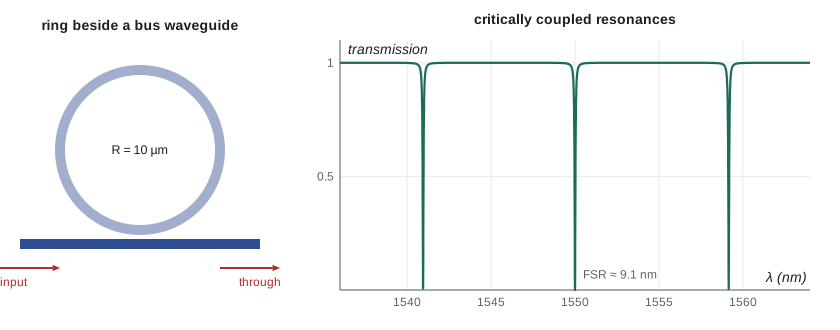
A key building block is the ring resonator: a waveguide loop coupled to a straight bus waveguide. Light at wavelengths for which the ring circumference holds a whole number of wavelengths builds up in the ring and, if the coupling is right, is removed from the bus. The resonances are spaced by the free spectral range
where \(L = 2\pi R\) is the circumference and \(n_g\) the group index. For an all-pass ring with round-trip amplitude transmission \(a\) and self-coupling coefficient \(r\), the bus transmission is
with \(\phi\) the round-trip phase. When \(a = r\), called critical coupling, the transmission on resonance falls to zero. Rings serve as filters for wavelength-division multiplexing, as compact modulators when their resonance is shifted electrically, as sensors that shift when molecules bind to their surface, and, with nonlinear materials, as sources of frequency combs.
Computing devices
The program finds the emission wavelengths of LED materials from their band gaps, computes photodiode responsivities, compares shot and thermal noise in a 10 GHz receiver, estimates LED wall-plug efficiencies, evaluates the Mach–Zehnder transfer curve, and calculates the free spectral range, finesse, linewidth and Q of a silicon ring resonator at critical coupling.
import math
h, c, e, kB = 6.62607015e-34, 2.99792458e8, 1.602176634e-19, 1.380649e-23
# emission wavelength from the band gap of LED materials
print(f"{'material':14s}{'Eg (eV)':>9s}{'lambda (nm)':>13s}")
for name, Eg in [('GaAs', 1.42), ('AlGaInP (red)', 1.97), ('InGaN (green)', 2.35), ('InGaN (blue)', 2.70), ('GaN', 3.40)]:
    print(f"{name:14s}{Eg:9.2f}{1239.84/Eg:13.0f}")
# photodiode responsivity R = eta e lam / (h c)
print()
for name, lam, eta in [('Si at 850 nm', 850e-9, 0.80), ('InGaAs at 1550 nm', 1550e-9, 0.85), ('Si at 1100 nm', 1100e-9, 0.10)]:
    R = eta * e * lam / (h * c)
    print(f"{name:18s}: responsivity {R:.3f} A/W")
# receiver noise: shot noise against thermal (Johnson) noise in a 10 GHz bandwidth
R, B, RL, T = 0.95, 10e9, 50.0, 300.0
print()
print(f"{'P (uW)':>8s}{'I (uA)':>9s}{'SNR shot only':>15s}{'SNR with thermal':>18s}")
for P_uW in (1, 10, 100, 1000):
    I = R * P_uW * 1e-6
    shot = 2 * e * I * B
    therm = 4 * kB * T * B / RL
    snr_s = I**2 / shot; snr = I**2 / (shot + therm)
    print(f"{P_uW:8d}{I*1e6:9.2f}{10*math.log10(snr_s):13.1f}dB{10*math.log10(snr):16.1f}dB")
# LED efficiencies: wall-plug = internal QE x extraction x (photon energy / (e V))
for name, iqe, ext, lam, V in [('blue InGaN LED', 0.90, 0.85, 450e-9, 3.0), ('green InGaN LED', 0.45, 0.80, 530e-9, 3.2)]:
    E = h * c / lam / e
    wpe = iqe * ext * E / V
    print(f"{name}: photon {E:.2f} eV, wall-plug efficiency = {wpe:.2f}")
# Mach-Zehnder modulator: T = cos^2(pi V / (2 V_pi))
Vpi = 3.5
print()
print("Mach-Zehnder transmission, V_pi = 3.5 V:", ", ".join(f"{V:.2f} V -> {math.cos(math.pi*V/(2*Vpi))**2:.2f}" for V in (0, 1.75, 3.5)))
# all-pass ring resonator: FSR, finesse, Q and transmission at and off resonance
ng, Rr, lam0 = 4.2, 10e-6, 1550e-9          # silicon ring: group index, radius
Lr = 2 * math.pi * Rr
FSR_nm = lam0**2 / (ng * Lr) * 1e9
a, r = 0.99, 0.99                            # round-trip amplitude transmission and self-coupling
def T(phi): return (a*a - 2*a*r*math.cos(phi) + r*r) / (1 - 2*a*r*math.cos(phi) + (a*r)**2)
F = math.pi * math.sqrt(a*r) / (1 - a*r)
print(f"ring radius 10 um: FSR = {FSR_nm:.2f} nm, finesse = {F:.0f}, linewidth = {FSR_nm/F*1e3:.1f} pm, Q = {lam0*1e9/(FSR_nm/F):.0f}")
print(f"transmission on resonance = {T(0):.4f} (critical coupling a = r), halfway between = {T(math.pi):.4f}")material Eg (eV) lambda (nm)
GaAs 1.42 873
AlGaInP (red) 1.97 629
InGaN (green) 2.35 528
InGaN (blue) 2.70 459
GaN 3.40 365
Si at 850 nm : responsivity 0.548 A/W
InGaAs at 1550 nm : responsivity 1.063 A/W
Si at 1100 nm : responsivity 0.089 A/W
P (uW) I (uA) SNR shot only SNR with thermal
1 0.95 24.7dB -5.7dB
10 9.50 34.7dB 14.3dB
100 95.00 44.7dB 34.0dB
1000 950.00 54.7dB 51.5dB
blue InGaN LED: photon 2.76 eV, wall-plug efficiency = 0.70
green InGaN LED: photon 2.34 eV, wall-plug efficiency = 0.26
Mach-Zehnder transmission, V_pi = 3.5 V: 0.00 V -> 1.00, 1.75 V -> 0.50, 3.50 V -> 0.00
ring radius 10 um: FSR = 9.10 nm, finesse = 156, linewidth = 58.3 pm, Q = 26609
transmission on resonance = 0.0000 (critical coupling a = r), halfway between = 0.9999The band gaps map neatly onto colors: 1.42 eV for GaAs gives 873 nm in the infrared, 1.97 eV gives red at 629 nm, and InGaN spans green to blue as its indium content falls. Silicon at 850 nm with quantum efficiency 0.8 gives 0.55 A/W, while InGaAs at 1550 nm reaches 1.06 A/W, more than an ampere per watt because each 0.8 eV photon produces one electron. Silicon at 1100 nm, just above its band edge, absorbs weakly and gives only 0.09 A/W.
The noise table shows why receiver design matters. With a 50 Ω load at 10 GHz, 1 µW of light gives a signal-to-noise ratio of \(-6\) dB because thermal noise swamps the signal, although shot noise alone would allow 25 dB. At 1 mW the two nearly agree. The blue LED converts 0.70 of its electrical power into light, the green only 0.26, illustrating the green gap. The Mach–Zehnder transfer curve passes from full transmission through one half at \(V_\pi/2\) to zero at \(V_\pi\). The ring of radius 10 µm has a free spectral range of 9.1 nm, a finesse of 156, resonances 58 pm wide and a Q of about 27,000, and at critical coupling it removes essentially all the light on resonance.
Worked problem
Photocurrent from a weak signal
An InGaAs photodiode with quantum efficiency 0.85 receives \(-25\) dBm at 1550 nm. What is the photocurrent?
Show solution
- \(-25\) dBm \(= 10^{-2.5}\) mW \(= 3.16\) µW.
- \(\mathcal R = 0.85 \times 1.55/1.24 = 1.06\) A/W.
- \(I = 1.06 \times 3.16 = 3.35\) µA.
Answer: About 3.4 µA.
Worked problem
Extraction cone of an LED
Light generated inside a GaN chip (\(n = 2.4\)) radiates in all directions. What fraction escapes through one flat face into air, ignoring Fresnel reflection?
Show solution
- Critical angle: \(\theta_c = \arcsin(1/2.4) = 24.6°\).
- The fraction of a sphere inside a cone of half-angle \(\theta_c\) is \((1 - \cos\theta_c)/2 = (1 - 0.909)/2 = 0.045\).
Answer: About 0.045 per face, a few parts in a hundred, which is why LED chips are textured and shaped to scramble the light and let more escape.
Common mistakes
MistakeThinking an LED is a weak laser.
InsteadAn LED emits by spontaneous emission without inversion or cavity; its light is incoherent and broadband.
MistakeExpecting silicon detectors to work at 1550 nm.
InsteadPhotons below the 1.12 eV gap are not absorbed; InGaAs or germanium is needed.
MistakeIgnoring thermal noise at low power.
InsteadAt microwatt levels, Johnson noise in the load can exceed shot noise by orders of magnitude.
MistakeAssuming direct modulation is always best.
InsteadDirect modulation chirps the light; external modulators give cleaner signals at high rates.
MistakeTreating a ring resonator as a perfect notch at any coupling.
InsteadFull extinction on resonance requires critical coupling, \(a = r\).
Summary and key terms
- LEDs emit near \(h\nu = E_g\) by spontaneous recombination; InGaN blue LEDs plus phosphors make white light.
- Photodiode responsivity is \(\eta e\lambda/(hc)\); silicon works to about 1.1 µm, InGaAs to about 1.7 µm.
- Receiver SNR is \(I^2/(2eIB + 4k_BTB/R_L)\): thermal noise dominates at low power, shot noise at high power.
- Mach–Zehnder modulators give \(T = \cos^2(\pi V/2V_\pi)\) and can encode amplitude and phase.
- Integrated photonics puts waveguides, modulators, detectors and ring resonators on chips; rings have FSR \(\lambda^2/(n_gL)\).
- Responsivity
- Photocurrent per unit optical power, in amperes per watt.
- Shot noise
- Current noise from the random arrival of photoelectrons, \(2eIB\).
- Half-wave voltage
- The voltage \(V_\pi\) that shifts the relative phase in a modulator by \(\pi\).
- Silicon photonics
- Integrated optical circuits made in silicon on silica with electronic-chip fabrication.
- Critical coupling
- The condition in which coupling into a resonator equals its internal loss, giving zero transmission on resonance.
Practice problems
Work each problem on paper first, then reveal the answer to check.
What band gap gives emission at 405 nm?
Show answer
\(1239.84/405 = 3.06\) eV.
A silicon detector has responsivity 0.45 A/W at 800 nm. What is its quantum efficiency?
Show answer
\(\eta = 0.45 \times 1.24/0.80 = 0.70\).
Find the free spectral range of a ring with circumference 100 µm and group index 4.0 at 1550 nm.
Show answer
\((1.55 \times 10^{-6})^2/(4.0 \times 10^{-4}) = 6.0\) nm.
What voltage gives 0.25 transmission in a Mach–Zehnder modulator with \(V_\pi = 4\) V?
Show answer
\(\cos^2(\pi V/8) = 0.25\) gives \(\pi V/8 = \pi/3\), so \(V = 2.67\) V.
Why is shot-noise-limited SNR proportional to optical power?
Show answer
\(I^2/(2eIB) = I/(2eB)\), and \(I\) is proportional to \(P\).
Lesson quiz · 5 questions
Score 60% or more to complete this lesson.
Create a free account to save your progress, take quizzes and earn a certificate.