
PHYS-460 · Lesson 7 of 12 · 23 min
Gaussian beams, coherence and beam quality
▶ Video coming soon A video version of this lesson is on the way.
The output of a laser oscillating in the fundamental transverse mode is a Gaussian beam. Its intensity falls off smoothly from the axis as a Gaussian, its wavefronts are gently curved, and it spreads at the smallest angle that diffraction allows for its size. Gaussian beams are to laser optics what plane waves are to elementary optics: the standard description of light that every designer uses. This lesson develops the Gaussian beam and its complex beam parameter, shows how lenses transform it, defines the beam quality factor \(M^2\) for real beams, and then turns to coherence, the property that makes laser light able to interfere over long distances.
The paraxial Gaussian beam
A laser beam is not a plane wave: it has a finite width and spreads by diffraction. Writing the field as a slowly varying envelope times a plane wave traveling along \(z\), \(E = u(x, y, z)\,e^{i(kz - \omega t)}\), and substituting into the wave equation, the envelope obeys the paraxial wave equation \(\nabla_\perp^2 u + 2ik\,\partial u/\partial z = 0\), valid when the beam spreads at small angles. Its simplest solution is the Gaussian beam,
with three functions of position along the beam:
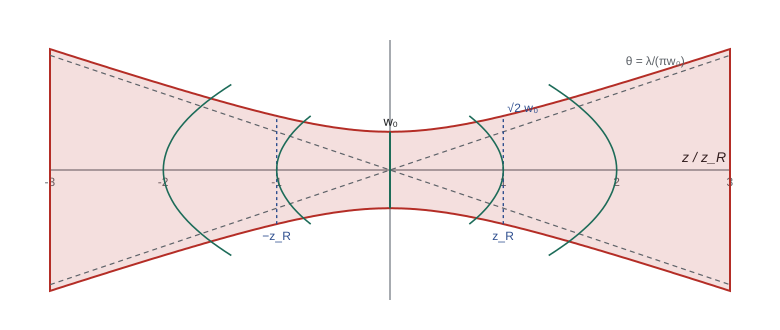
Here \(w_0\) is the waist radius, where the beam is narrowest, measured to the point where the intensity falls to \(1/e^2\) of its axial value; \(z_R = \pi w_0^2/\lambda\) is the Rayleigh range; \(w(z)\) is the spot size; \(R(z)\) is the radius of curvature of the wavefronts; and \(\zeta(z)\) is the Gouy phase, an extra phase shift of \(\pi\) across the whole focus that lesson 4 used for the transverse-mode frequencies. In a medium of index \(n\), \(\lambda\) is replaced by \(\lambda/n\).
Within one Rayleigh range of the waist the beam is roughly collimated: its area doubles at \(z = \pm z_R\). Far from the waist it spreads linearly, with half-angle divergence
This is the smallest divergence possible for a beam of that size, the optical equivalent of the uncertainty principle: a narrow beam has a wide spread of transverse wave vectors. The wavefronts are flat at the waist, most strongly curved at \(z = z_R\), where \(R = 2z_R\), and become spherical waves centered on the waist far away.
The complex beam parameter and the ABCD law
Both \(w\) and \(R\) can be packed into one complex number, the complex beam parameter \(q\), defined by
At the waist \(q = iz_R\), and in free space \(q\) simply increases by the distance traveled: \(q(z) = q(0) + z\). Herwig Kogelnik showed in 1965 that through any paraxial optical system described by an ABCD matrix (lesson 4), \(q\) transforms as
This ABCD law is extraordinarily useful. It turns Gaussian beam design into matrix multiplication, the same matrices used for rays, and it is how optical designers calculate focal spots, beam expanders and the mode-matching optics that couple one laser's beam into another cavity.
Focusing is the most common use. If a collimated beam of waist \(w_0\) enters a lens of focal length \(f\), and \(f\) is much smaller than the Rayleigh range, the focused waist is
located very close to the focal plane. To get a small spot, use a short focal length, a large input beam or a short wavelength. The depth of focus, twice the Rayleigh range of the focused beam, shrinks as the square of the spot size, so tight focusing always comes with a short region of sharp focus.
Beam quality: M squared
Real laser beams are rarely perfect Gaussians. A multimode laser, a high-power diode or a laser with thermal distortion produces a beam that spreads faster than a Gaussian of the same waist. The beam quality factor \(M^2\), introduced by Anthony Siegman around 1990, measures this. If the beam's second-moment radius at its waist is \(W_0\), its divergence is
so \(M^2 = 1\) for a perfect Gaussian and larger for every other beam. The product of waist and divergence, the beam parameter product, equals \(M^2\lambda/\pi\) and is conserved by ordinary lenses. A good helium–neon or fiber laser has \(M^2\) between 1.0 and 1.1; a diode-pumped solid-state laser 1.1 to 1.5; a multimode industrial laser 10 to 100; and a high-power diode bar may have \(M^2\) above 1,000 in one direction. For cutting and welding, \(M^2\) determines how small a spot can be produced at a given working distance, which is why fiber lasers, with \(M^2\) near one, displaced older industrial sources.
Coherence
Coherence describes how well a light field keeps a fixed phase relationship with itself at different times or places. Two kinds matter.
Temporal coherence is set by the spectrum. The Wiener–Khinchin theorem states that the degree of temporal coherence \(\gamma(\tau)\) is the Fourier transform of the normalized power spectrum. The fringe visibility in a Michelson interferometer is \(V = |\gamma(\tau)|\), where \(\tau\) is the delay between the arms. For a Gaussian spectrum of full width \(\Delta\nu\),
and the coherence time, defined as \(\int|\gamma|^2\,d\tau\), is \(\tau_c = \sqrt{2\ln2/\pi}/\Delta\nu = 0.664/\Delta\nu\). For a Lorentzian spectrum, \(V = e^{-\pi\Delta\nu|\tau|}\) and \(\tau_c = 1/(\pi\Delta\nu)\). Different texts use slightly different definitions, which is why lesson 1 used the rougher estimate \(c/\Delta\nu\). The numerical factor matters less than the scaling: coherence length is inversely proportional to bandwidth.
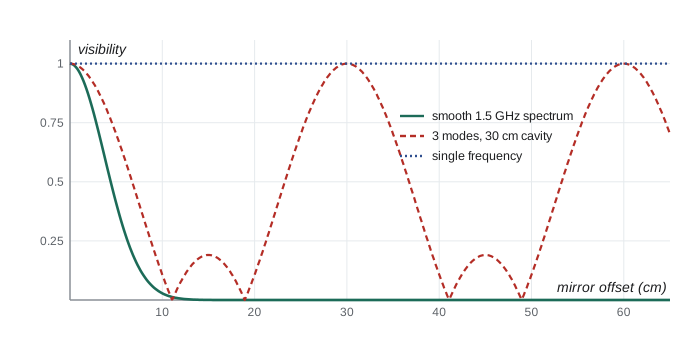
A real multimode laser has a spectrum of discrete modes under a gain envelope. Its visibility falls off over a few centimeters as the modes drift out of phase, but revives whenever the path difference is a whole number of cavity round trips, \(2L\), because then all the modes are back in step. A single-frequency laser avoids this and can have coherence lengths of kilometers.
Computing beams and coherence
The program implements the complex beam parameter and the ABCD law. It propagates a 1 mm waist at 1064 nm through free space and compares the result with the formula for \(w(z)\), focuses the beam with lenses of 10 cm and 5 cm focal length and searches for the new waist, shows the effect of \(M^2\), and computes the Michelson visibility for a 1.5 GHz Gaussian spectrum.
import math, cmath
lam = 1064e-9
# complex beam parameter q: 1/q = 1/R - i lam/(pi w^2); ABCD law q' = (A q + B)/(C q + D)
def q_from(w, R=math.inf):
    inv = (0 if R == math.inf else 1 / R) - 1j * lam / (math.pi * w * w)
    return 1 / inv
def w_R(q):
    inv = 1 / q
    w = math.sqrt(-lam / (math.pi * inv.imag)); R = math.inf if abs(inv.real) < 1e-15 else 1 / inv.real
    return w, R
def apply(M, q): (A, B), (C, D) = M; return (A * q + B) / (C * q + D)
w0 = 1.0e-3
zR = math.pi * w0**2 / lam
print(f"waist w0 = {w0*1e3:.2f} mm, Rayleigh range zR = {zR:.3f} m, divergence = {lam/(math.pi*w0)*1e3:.3f} mrad")
q0 = q_from(w0)
print(f"{'z (m)':>7s}{'w (mm)':>9s}{'formula':>9s}{'R (m)':>9s}")
for z in (0, 1.5, 2.95, 6, 20):
    q = apply(((1, z), (0, 1)), q0); w, R = w_R(q)
    wf = w0 * math.sqrt(1 + (z / zR) ** 2)
    print(f"{z:7.2f}{w*1e3:9.3f}{wf*1e3:9.3f}{(R if R != math.inf else float('inf')):9.2f}")
# focusing: lens of focal length f at the waist
for f in (0.1, 0.05):
    q1 = apply(((1, 0), (-1 / f, 1)), q0)
    # find the new waist: propagate and minimise w
    best = min((w_R(apply(((1, d / 1e5), (0, 1)), q1))[0], d / 1e5) for d in range(0, int(2 * f * 1e5)))
    approx = lam * f / (math.pi * w0)
    print(f"f = {f*100:.0f} cm: focused waist {best[0]*1e6:.2f} um at {best[1]*100:.3f} cm (estimate lam f/(pi w0) = {approx*1e6:.2f} um)")
# beam quality: an M^2 = 1.3 beam diverges 1.3 times faster than a Gaussian with the same waist
for M2 in (1.0, 1.3, 20):
    print(f"M^2 = {M2:>4}: divergence = {M2*lam/(math.pi*w0)*1e3:.3f} mrad, smallest focus with f = 5 cm: {M2*lam*0.05/(math.pi*w0)*1e6:.1f} um")
# temporal coherence: visibility of a Michelson interferometer for a Gaussian spectrum
c = 2.99792458e8
dnu = 1.5e9                           # FWHM, multimode HeNe
tau_c = 0.664 / dnu                   # coherence time of a Gaussian line (0.664 = 2 ln2 / pi)
print()
print(f"Gaussian line 1.5 GHz wide: coherence time {tau_c*1e12:.0f} ps, length {c*tau_c*100:.1f} cm")
for d_cm in (0, 5, 10, 20, 30):
    tau = 2 * d_cm / 100 / c          # mirror moved by d: extra path 2d
    V = math.exp(-(math.pi * dnu * tau) ** 2 / (4 * math.log(2)))
print(f" mirror offset {d_cm:2d} cm: visibility {V:.3f}")waist w0 = 1.00 mm, Rayleigh range zR = 2.953 m, divergence = 0.339 mrad z (m) w (mm) formula R (m) 0.00 1.000 1.000 inf 1.50 1.122 1.122 7.31 2.95 1.414 1.414 5.91 6.00 2.265 2.265 7.45 20.00 6.847 6.847 20.44 f = 10 cm: focused waist 33.85 um at 9.989 cm (estimate lam f/(pi w0) = 33.87 um) f = 5 cm: focused waist 16.93 um at 4.999 cm (estimate lam f/(pi w0) = 16.93 um) M^2 = 1.0: divergence = 0.339 mrad, smallest focus with f = 5 cm: 16.9 um M^2 = 1.3: divergence = 0.440 mrad, smallest focus with f = 5 cm: 22.0 um M^2 = 20: divergence = 6.774 mrad, smallest focus with f = 5 cm: 338.7 um Gaussian line 1.5 GHz wide: coherence time 443 ps, length 13.3 cm mirror offset 0 cm: visibility 1.000 mirror offset 5 cm: visibility 0.410 mirror offset 10 cm: visibility 0.028 mirror offset 20 cm: visibility 0.000 mirror offset 30 cm: visibility 0.000
A 1 mm waist at 1064 nm has a Rayleigh range of nearly 3 m and a divergence of 0.34 mrad; at 2.95 m from the waist the beam is \(\sqrt2\) times wider and its wavefronts are most strongly curved, with radius about 5.9 m, or \(2z_R\). At 20 m the radius of curvature approaches the distance from the waist, as for a spherical wave. Focusing with a 5 cm lens gives a waist of 16.9 µm, in perfect agreement with \(\lambda f/(\pi w_0)\), and the focus lies slightly in front of the focal plane, by about 0.1 mm for the 10 cm lens and 10 µm for the 5 cm lens, tiny shifts because the Rayleigh range of the input beam is so much longer than the focal length. A beam with \(M^2 = 20\), typical of a multimode industrial source, cannot be focused below about 340 µm with the same lens.
For the 1.5 GHz spectrum, the coherence time is 443 ps and the coherence length 13 cm. The visibility drops to about 0.4 when one mirror moves 5 cm (10 cm of path difference) and is essentially zero by 20 cm. A helium–neon laser with this gain width and a short cavity would show revivals; the smooth Gaussian spectrum in the program does not.
Worked problem
Spot size on the Moon
A 532 nm laser beam is expanded to fill a 1.0 m telescope, giving a waist radius of about 0.5 m. Estimate its radius on the Moon, 384,000 km away, ignoring the atmosphere.
Show solution
- \(\theta = \lambda/(\pi w_0) = 532 \times 10^{-9}/(\pi \times 0.5) = 3.4 \times 10^{-7}\) rad.
- \(w \approx \theta z = 3.4 \times 10^{-7} \times 3.84 \times 10^8 = 130\) m.
Answer: About 130 m. In practice atmospheric turbulence spreads the beam to a few kilometers, which is why lunar laser ranging catches only a few photons per pulse from the retroreflectors left by Apollo astronauts.
Worked problem
Depth of focus for laser cutting
A fiber laser at 1070 nm with \(M^2 = 1.1\) is focused to a waist of 25 µm. What is the Rayleigh range of the focus?
Show solution
- For a beam of quality \(M^2\), \(z_R = \pi W_0^2/(M^2\lambda)\).
- \(z_R = \pi (25 \times 10^{-6})^2/(1.1 \times 1.07 \times 10^{-6}) = 1.67 \times 10^{-3}\) m.
Answer: About 1.7 mm, so the depth of focus is about 3.3 mm, enough to cut sheet steel a few millimeters thick with a nearly uniform kerf.
Common mistakes
MistakeMeasuring the beam radius at half maximum.
InsteadThe standard Gaussian \(w\) is the \(1/e^2\) intensity radius; the half-maximum radius is \(0.589w\).
MistakeAssuming a lens can focus any beam to a wavelength-sized spot.
InsteadThe focus is \(M^2\lambda f/(\pi w_0)\); poor beam quality or small input beams give large spots.
MistakeTreating the beam as collimated far beyond the Rayleigh range.
InsteadBeyond \(z_R\) the beam spreads linearly at angle \(\lambda/(\pi w_0)\).
MistakeUsing the same coherence-time formula for every line shape.
InsteadThe factor depends on the spectrum: \(0.664/\Delta\nu\) for a Gaussian, \(1/(\pi\Delta\nu)\) for a Lorentzian.
MistakeThinking spatial and temporal coherence are the same.
InsteadTemporal coherence depends on bandwidth; spatial coherence depends on source size and mode structure.
Summary and key terms
- A Gaussian beam has \(w(z) = w_0\sqrt{1 + (z/z_R)^2}\), \(z_R = \pi w_0^2/\lambda\), divergence \(\lambda/(\pi w_0)\) and a Gouy phase of \(\pi\) across the focus.
- The complex parameter \(1/q = 1/R - i\lambda/(\pi w^2)\) obeys the ABCD law \(q' = (Aq + B)/(Cq + D)\).
- A lens focuses a collimated beam to \(w_f \approx \lambda f/(\pi w_0)\).
- \(M^2\) measures how much faster a real beam spreads than an ideal Gaussian; the beam parameter product is \(M^2\lambda/\pi\).
- Fringe visibility is the Fourier transform of the spectrum; coherence length is inversely proportional to bandwidth.
- Rayleigh range
- The distance from the waist at which a Gaussian beam's area doubles, \(\pi w_0^2/\lambda\).
- Complex beam parameter
- The number \(q\) combining spot size and wavefront curvature.
- Beam quality factor
- \(M^2\), the ratio of a beam's divergence to that of a Gaussian of the same waist.
- Coherence length
- The path difference over which a light field interferes with itself.
- Gouy phase
- The extra phase shift of \(\pi\) that a beam acquires passing through a focus.
Practice problems
Work each problem on paper first, then reveal the answer to check.
Find the Rayleigh range of a 0.5 mm waist at 633 nm.
Show answer
\(\pi (5 \times 10^{-4})^2/6.33 \times 10^{-7} = 1.24\) m.
A 3 mm diameter collimated beam at 405 nm is focused by an \(f = 4\) mm lens. Estimate the spot radius.
Show answer
\(w_0 = 1.5\) mm; \(w_f = 405 \times 10^{-9} \times 4 \times 10^{-3}/(\pi \times 1.5 \times 10^{-3}) = 0.34\) µm.
At what distance from the waist is the wavefront curvature greatest?
Show answer
At \(z = z_R\), where \(R = 2z_R\).
A laser has a Lorentzian linewidth of 100 kHz. What is its coherence time?
Show answer
\(1/(\pi \times 10^5) = 3.2\) µs, a coherence length of about 950 m.
A beam has waist 1 mm and divergence 1.5 mrad at 1064 nm. What is its \(M^2\)?
Show answer
\(M^2 = \pi w_0\theta/\lambda = \pi \times 10^{-3} \times 1.5 \times 10^{-3}/1.064 \times 10^{-6} = 4.4\).
Lesson quiz · 5 questions
Score 60% or more to complete this lesson.
Create a free account to save your progress, take quizzes and earn a certificate.