
PHYS-460 · Lesson 2 of 12 · 25 min
Light–matter interaction: absorption, emission and Einstein coefficients
▶ Video coming soon A video version of this lesson is on the way.
Every laser begins with atoms, ions, molecules or electrons in a solid that can absorb and emit light. In this lesson we describe those processes in the language Einstein introduced in 1917, which remains the most useful starting point for laser physics. Einstein's approach is remarkable because it requires almost no quantum mechanics: from the single requirement that matter and radiation reach thermal equilibrium with the Planck spectrum, it predicts the existence of stimulated emission and fixes its rate in terms of the rate of spontaneous emission. We then connect the Einstein coefficients to the quantum-mechanical dipole matrix elements of PHYS-373, compute a real lifetime, and see why gain requires a population inversion that thermal equilibrium can never provide.
Three processes
Consider atoms with two energy levels, a lower level 1 with energy \(E_1\) and an upper level 2 with energy \(E_2\), separated by \(h\nu_0 = E_2 - E_1\). Let \(N_1\) and \(N_2\) be the number densities of atoms in the two levels, and let the levels have degeneracies \(g_1\) and \(g_2\). The atoms are bathed in radiation with spectral energy density \(\rho(\nu)\), the energy per unit volume per unit frequency interval, in joules per cubic meter per hertz. Einstein identified three processes.
The coefficients \(A_{21}\), \(B_{12}\) and \(B_{21}\) are properties of the atom alone. They do not depend on temperature or on the radiation present, so a relation between them derived under one set of conditions holds under all conditions. That is the key to Einstein's argument.
Einstein's argument
Suppose the atoms are in thermal equilibrium with blackbody radiation at temperature \(T\). In steady state the rate of upward transitions equals the rate of downward transitions:
In thermal equilibrium the populations follow the Boltzmann distribution, \(N_2/N_1 = (g_2/g_1)\,e^{-h\nu_0/k_BT}\). Solving for the energy density,
This must agree with Planck's law for every temperature,
Comparing the two expressions term by term gives Einstein's relations:
The first relation says that, apart from degeneracy factors, absorption and stimulated emission have the same strength: they are time-reversed versions of the same process. The second says that spontaneous emission is tied to stimulated emission by a factor that grows as \(\nu^3\). Without stimulated emission (\(B_{21} = 0\)), the equilibrium energy density would be \(\rho \propto e^{-h\nu/k_BT}\), Wien's approximation, which fails at low frequencies. The \(-1\) in Planck's denominator is the signature of stimulated emission. In a medium of refractive index \(n\), \(c\) is replaced by \(c/n\) and the factor becomes \(8\pi n^3 h\nu^3/c^3\).
The ratio of stimulated to spontaneous emission rates in thermal radiation is
which is exactly the mean number of photons per mode of the radiation field, the Bose–Einstein occupation of PHYS-361. Stimulated emission dominates when there is more than one photon per mode. For thermal sources at visible frequencies this is never the case, as the program shows.
Connecting to quantum mechanics
PHYS-373 treated an atom in a classical oscillating field as a two-level system driven at the Rabi frequency \(\Omega = d E_0/\hbar\), where \(d\) is the transition dipole moment, \(d = |\langle 2|e\mathbf r\cdot\hat{\boldsymbol\epsilon}|1\rangle|\), and \(E_0\) is the field amplitude. When the radiation is broadband compared with the atomic line, Fermi's golden rule turns the coherent Rabi oscillation into a steady transition rate proportional to the spectral energy density, which is the Einstein \(B\) coefficient. Averaging over random orientations and polarizations gives
for nondegenerate levels, where \(|\mathbf d_{12}|^2\) is the squared magnitude of the full vector matrix element and \(\omega = 2\pi\nu_0\). The semiclassical treatment explains absorption and stimulated emission but not spontaneous emission, which arises from the coupling of the atom to the vacuum fluctuations of the quantized electromagnetic field. Remarkably, Einstein's thermodynamic argument gets the answer right without any of that machinery. A full quantum treatment, first given by Dirac in 1927, shows that spontaneous emission can be pictured as stimulated emission by the zero-point field, half a photon per mode in each direction of the transition.
The \(\omega^3\) dependence has important consequences. Spontaneous lifetimes of allowed transitions are nanoseconds in the visible and ultraviolet, microseconds to milliseconds in the infrared, and seconds or longer at microwave frequencies. At X-ray wavelengths, spontaneous emission is so fast that population inversions are extremely hard to maintain, which is one reason X-ray lasers came late and now rely on free electrons rather than atoms.
Numbers for real transitions
The program computes the ratio of stimulated to spontaneous emission for thermal radiation in five situations, the spontaneous emission rate of the hydrogen \(2p \to 1s\) Lyman-alpha line from its dipole matrix element, the \(B\) coefficient of the neon line used in helium–neon lasers, and a list of measured upper-level lifetimes.
import math
h, c, kB, eps0, e = 6.62607015e-34, 2.99792458e8, 1.380649e-23, 8.8541878128e-12, 1.602176634e-19
hbar = h / (2 * math.pi)
a0 = 5.29177210903e-11
# 1. Ratio of stimulated to spontaneous emission in thermal light: 1/(exp(h nu/kT) - 1)
print("Stimulated / spontaneous emission rate in thermal radiation")
print(f"{'source':22s}{'T (K)':>7s}{'lambda':>10s}{'ratio':>12s}")
for name, T, lam in [('room, microwave', 300, 1e-2), ('room, thermal IR', 300, 10e-6),
                     ('room, visible', 300, 600e-9), ('Sun, visible', 5772, 600e-9),
                     ('Sun, near IR', 5772, 2e-6)]:
    x = h * c / (lam * kB * T)
    r = 1 / math.expm1(x)
    lam_s = f"{lam*1e9:.0f} nm" if lam < 1e-6 else (f"{lam*1e6:.0f} um" if lam < 1e-3 else f"{lam*100:.0f} cm")
    print(f"{name:22s}{T:7d}{lam_s:>10s}{r:12.3e}")
# 2. A coefficient from a dipole matrix element: A = omega^3 |d|^2 / (3 pi eps0 hbar c^3)
def A_coeff(lam, d):
    w = 2 * math.pi * c / lam
    return w**3 * d**2 / (3 * math.pi * eps0 * hbar * c**3)
# hydrogen 2p -> 1s: |<1s|r|2p>| = (128 sqrt2 / 243) a0 for the z component
d = e * 128 * math.sqrt(2) / 243 * a0
A = A_coeff(121.567e-9, d)
print()
print(f"hydrogen 2p -> 1s: A = {A:.4e} 1/s, lifetime = {1/A*1e9:.3f} ns")
# 3. B coefficient from A (per unit spectral energy density in frequency)
lam = 632.8e-9; nu = c / lam
A_ne = 3.4e6      # approximate A for the neon 632.8 nm line, 1/s
B = A_ne * c**3 / (8 * math.pi * h * nu**3)
print(f"neon 632.8 nm: A = {A_ne:.1e} 1/s, B = {B:.3e} m^3/(J s^2)")
# 4. Spontaneous lifetimes span many orders of magnitude
print()
for name, tau in [('sodium D line (allowed)', 16.2e-9), ('Nd:YAG upper level', 230e-6),
                  ('ruby upper level', 3.0e-3), ('erbium in glass, 1.53 um', 10e-3)]:
print(f"{name:28s} lifetime = {tau:.3g} s")Stimulated / spontaneous emission rate in thermal radiation source T (K) lambda ratio room, microwave 300 1 cm 2.080e+02 room, thermal IR 300 10 um 8.332e-03 room, visible 300 600 nm 1.932e-35 Sun, visible 5772 600 nm 1.594e-02 Sun, near IR 5772 2 um 4.036e-01 hydrogen 2p -> 1s: A = 6.2583e+08 1/s, lifetime = 1.598 ns neon 632.8 nm: A = 3.4e+06 1/s, B = 5.173e+19 m^3/(J s^2) sodium D line (allowed) lifetime = 1.62e-08 s Nd:YAG upper level lifetime = 0.00023 s ruby upper level lifetime = 0.003 s erbium in glass, 1.53 um lifetime = 0.01 s
At room temperature, stimulated emission outweighs spontaneous emission at microwave frequencies by a factor of about 200, which is why the first maser worked at 24 GHz. At 10 µm the ratio is about \(10^{-2}\), and in the visible it is \(10^{-35}\): essentially no visible light at room temperature is produced by stimulated emission. Even at the temperature of the surface of the Sun, stimulated emission contributes only about 1 part in 60 of the visible emission. A laser must therefore create conditions very far from thermal equilibrium.
The calculated hydrogen \(2p\) lifetime, 1.60 ns, matches the measured value. For the \(2p \to 1s\) transition the matrix element of the \(z\) coordinate is \((128\sqrt2/243)a_0 = 0.745a_0\), and since \(2p\) can decay only to \(1s\), the lifetime is exactly \(1/A\). The neon \(B\) coefficient looks huge in SI units, but multiplied by a spectral energy density in a laser cavity it gives rates comparable to \(A\), as lesson 3 shows.
The measured lifetimes illustrate why some materials make good lasers. The sodium D line, an allowed electric-dipole transition, has a lifetime of 16 ns. The upper laser level of Nd:YAG lives 230 µs, ruby 3 ms and erbium in silica glass about 10 ms. These long-lived levels are called metastable. Their transitions are forbidden to first order: in ruby, the \(\mathrm{Cr^{3+}}\) transition changes the total spin; in neodymium and erbium, the transitions occur within the 4f shell, where parity does not change and the electric-dipole process is allowed only weakly through mixing with other states caused by the crystal field. A long lifetime is valuable because energy can be stored in the upper level, and a modest pump can build up a large population there.
Absorption, gain and the population difference
A beam of intensity \(I\) traveling through the medium is absorbed by atoms in level 1 and amplified by stimulated emission from atoms in level 2. Spontaneous emission goes in all directions and adds only a little to the beam. Working through the rates (lesson 3 does it carefully with line shapes), the intensity changes as
where \(\sigma(\nu)\) is the stimulated-emission cross section. If \(N_2 < (g_2/g_1)N_1\), as in thermal equilibrium, \(\gamma\) is negative and the beam is absorbed according to the Beer–Lambert law, \(I(z) = I_0 e^{-\alpha z}\) with \(\alpha = -\gamma\). If \(N_2 > (g_2/g_1)N_1\), the beam grows exponentially. This condition is called a population inversion. Because the Boltzmann factor \(e^{-h\nu/k_BT}\) is always less than one at positive temperature, an inversion corresponds formally to a negative temperature, a description that is sometimes useful but should not be taken to mean that the medium is in equilibrium.
Can an inversion be produced simply by shining strong light on a two-level system? No. As the pump intensity rises, absorption and stimulated emission become equally likely, and the populations approach equality, \(N_2/g_2 = N_1/g_1\), but never cross it. In the language of PHYS-373, a strong incoherent pump saturates the transition. A short coherent pulse can invert a two-level system, a \(\pi\) pulse, but only transiently. A continuous laser needs at least three levels.
Three-level and four-level schemes
The figure shows the three level schemes that matter in practice.
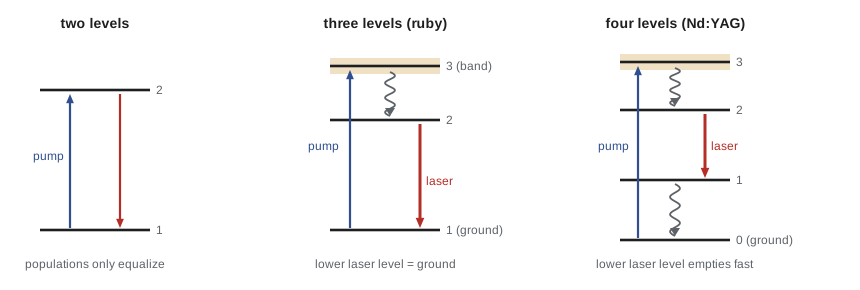
In a three-level laser such as ruby, the pump lifts atoms from the ground level 1 to a broad band 3, from which they decay rapidly and without radiation to the metastable level 2. The laser transition runs from level 2 back to the ground level. Since the lower laser level is the ground state, which initially holds nearly all the atoms, more than half of the atoms must be pumped out of it before there is any gain. This is why the ruby laser needs an intense flashlamp and works most easily in pulses.
In a four-level laser such as Nd:YAG or the helium–neon laser, the lower laser level lies well above the ground state and empties quickly into it. In thermal equilibrium it is almost empty, so any population in the upper laser level gives gain. The required pump power is much lower, and four-level lasers run continuously with ease. Most practical lasers are four-level systems or close to it. A quasi-three-level laser, such as ytterbium in glass or YAG, has a lower laser level only slightly above the ground state, partly populated at room temperature; it needs a strong pump, but its small quantum defect (lesson 6) makes it very efficient.
Pumping can be done in many ways. Optical pumping uses flashlamps or, more efficiently, diode lasers tuned to an absorption band. Gas lasers are pumped by electrical discharges, in which electrons collide with atoms; the helium–neon laser uses collisions with metastable helium atoms to transfer energy selectively to neon. Semiconductor lasers are pumped directly by an electric current that injects electrons and holes into a junction. Chemical lasers and free-electron lasers use still other mechanisms. What all pumps share is that they drive the medium far from equilibrium, at a cost in energy that lesson 6 quantifies.
Worked problem
Thermal population of an upper level
For a transition at 1064 nm with \(g_1 = g_2\), what is \(N_2/N_1\) at 300 K? What would it be for a 10.6 µm transition?
Show solution
- \(h\nu/k_B T = hc/(\lambda k_B T)\). For 1064 nm, \(hc/k_B = 0.014388\) m K, so \(h\nu/k_BT = 0.014388/(1.064 \times 10^{-6} \times 300) = 45.1\).
- \(N_2/N_1 = e^{-45.1} = 2.6 \times 10^{-20}\).
- For 10.6 µm, \(h\nu/k_BT = 0.014388/(10.6 \times 10^{-6} \times 300) = 4.52\), and \(N_2/N_1 = e^{-4.52} = 0.011\).
Answer: \(2.6 \times 10^{-20}\) at 1064 nm and about 0.011 at 10.6 µm. For the carbon dioxide laser, thermal population of the lower laser level matters, which is why CO₂ lasers are cooled and use gas mixtures that empty that level.
Worked problem
The ratio A/B in a medium
Find \(A_{21}/B_{21}\) for a transition at 532 nm in a crystal of refractive index 1.8.
Show solution
- \(\nu = c/\lambda = 5.64 \times 10^{14}\) Hz.
- \(A/B = 8\pi n^3 h\nu^3/c^3 = 8\pi \times 5.83 \times 6.626 \times 10^{-34} \times 1.79 \times 10^{44}/2.69 \times 10^{25}\).
- This gives \(A/B = 6.5 \times 10^{-13}\ \mathrm{J\,s\,m^{-3}}\).
Answer: About \(6.5 \times 10^{-13}\ \mathrm{J\,s\,m^{-3}}\). Spontaneous emission equals stimulated emission when \(\rho(\nu)\) reaches this value, which corresponds to one photon per mode.
Common mistakes
MistakeThinking strong pumping of two levels can create an inversion.
InsteadIncoherent pumping of a two-level system only equalizes the populations; at least three levels are needed for continuous gain.
MistakeForgetting the degeneracies in the inversion condition.
InsteadGain requires \(N_2 > (g_2/g_1)N_1\), not simply \(N_2 > N_1\).
MistakeTreating \(A\) and \(B\) as independent constants.
InsteadEinstein's relations fix \(A_{21}/B_{21} = 8\pi n^3h\nu^3/c^3\) and \(g_1B_{12} = g_2B_{21}\).
MistakeAssuming a long lifetime means a weak laser.
InsteadLong-lived metastable levels store energy and make inversion easier; the gain cross section is smaller, but the stored population is larger.
MistakeConfusing the radiative lifetime with the measured lifetime.
InsteadNon-radiative decay shortens the measured lifetime; \(1/\tau = A_{21} + \) non-radiative rates.
Summary and key terms
- Absorption, spontaneous emission and stimulated emission occur at rates \(B_{12}\rho N_1\), \(A_{21}N_2\) and \(B_{21}\rho N_2\).
- Thermal equilibrium with Planck's law requires \(g_1B_{12} = g_2B_{21}\) and \(A_{21}/B_{21} = 8\pi n^3h\nu^3/c^3\).
- Stimulated emission beats spontaneous emission when there is more than one photon per mode; thermal visible light has \(\bar n \sim 10^{-35}\) at room temperature.
- \(A_{21} = \omega^3|\mathbf d|^2/(3\pi\varepsilon_0\hbar c^3)\) gives the hydrogen \(2p\) lifetime of 1.6 ns.
- Gain requires a population inversion; four-level schemes reach it far more easily than three-level ones.
- Einstein coefficients
- The rate constants \(A_{21}\), \(B_{12}\), \(B_{21}\) for spontaneous emission, absorption and stimulated emission.
- Radiative lifetime
- \(1/A_{21}\), the mean time before spontaneous emission if no other decay occurs.
- Population inversion
- \(N_2/g_2 > N_1/g_1\): more atoms per state in the upper level than in the lower.
- Metastable level
- A level with a long lifetime because its radiative decay is forbidden to first order.
- Four-level laser
- A laser whose lower level lies above the ground state and empties quickly, so any upper population gives gain.
Practice problems
Work each problem on paper first, then reveal the answer to check.
At what temperature would stimulated and spontaneous emission be equal at 600 nm?
Show answer
\(e^{h\nu/k_BT} - 1 = 1\), so \(h\nu/k_BT = \ln 2\), \(T = hc/(\lambda k_B\ln2) = 0.014388/(6 \times 10^{-7} \times 0.693) = 34{,}600\) K.
By what factor does the radiative lifetime change if the transition frequency doubles at fixed dipole moment?
Show answer
\(A \propto \omega^3\), so the lifetime drops by a factor of 8.
Why does a three-level laser need more than half the atoms excited?
Show answer
Its lower laser level is the ground state; gain needs \(N_2 > N_1\) with \(N_1 + N_2\) roughly equal to the total.
A level decays radiatively with \(A = 10^4\) per second and non-radiatively at \(3 \times 10^4\) per second. Find the lifetime and the fluorescence quantum efficiency.
Show answer
\(\tau = 1/(4 \times 10^4) = 25\) µs; quantum efficiency \(= 10^4/(4 \times 10^4) = 0.25\).
Show that without stimulated emission Einstein's argument gives Wien's law instead of Planck's.
Show answer
With \(B_{21} = 0\), \(B_{12}\rho N_1 = A_{21}N_2\) gives \(\rho = (A_{21}/B_{12})(g_2/g_1)e^{-h\nu/k_BT}\), the Wien form, which fails at low frequency.
Lesson quiz · 5 questions
Score 60% or more to complete this lesson.
Create a free account to save your progress, take quizzes and earn a certificate.