
PMP-121 · Lesson 1 of 12 · 27 min
Who stakeholders are and why they make or break projects
A project can meet every date, stay on budget and deliver exactly what was specified, and still be judged a failure because the people who matter did not want it, did not use it or did not trust the way it was delivered. A project can also overrun and still be celebrated, because the people who matter understood why and stayed committed. The difference is usually how well the project manager understood and engaged stakeholders. This course is the second of two People courses in the PMP series. PMP-120 dealt with the project team: leadership, team building, motivation, coaching, team conflict and emotional intelligence. PMP-121 turns outward, to the wider set of people and groups who can affect a project or be affected by it, and to the communication, negotiation and ethical conduct that keep them engaged.
PMP and PMBOK are marks of PMI. This course is an independent study aid written from public sources, and its practice questions are original scenarios. It does not reproduce PMI exam questions, and on its own it does not provide the 35 contact hours of project management education the PMP application requires.
What a stakeholder is
A stakeholder is any individual, group or organization that may affect, be affected by, or perceive itself to be affected by a project, its activities or its outcome. The last part of that definition matters. People who merely believe they will be affected, such as neighbors worried about construction noise or staff who fear a new system will replace their jobs, behave like stakeholders whether or not their fears are accurate. Ignoring them because they are technically wrong is one of the quickest ways to create organized opposition.
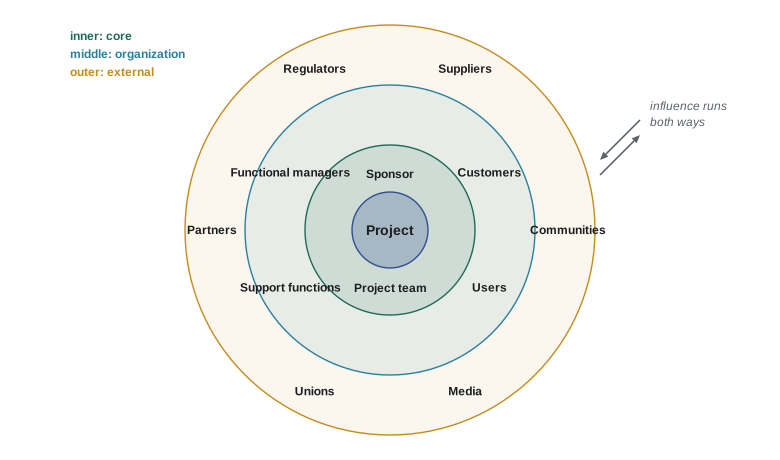
Stakeholders can be inside the performing organization (the sponsor, functional managers, the project team, the finance department, internal audit) or outside it (customers, end users, suppliers, regulators, community groups, unions, the media). They can be supporters, opponents or indifferent. They can be powerful individuals or large groups with little individual influence but significant collective weight. And they change during a project: new stakeholders appear when the project moves into a new phase, people change roles, and attitudes shift as information emerges.
| Category | Typical examples | What they often care about |
|---|---|---|
| Sponsor and executives | Sponsor, steering committee, portfolio board | Benefits, strategic fit, risk exposure, reputation |
| Customers and users | Paying client, end users, product owner | Fitness for use, ease of adoption, timing |
| Functional managers | Owners of the people and assets the project borrows | Resource conflicts, operational continuity |
| Project team | Core team, contractors, extended team | Clear goals, workload, recognition, career growth |
| Suppliers and partners | Vendors, subcontractors, joint venture partners | Clear requirements, payment, scope stability |
| Regulators and authorities | Safety, privacy, environmental and financial regulators | Compliance, evidence, public interest |
| Communities and the public | Residents, advocacy groups, Indigenous nations, media | Local impacts, fairness, being heard |
| Internal support functions | Finance, legal, procurement, IT security, human resources | Policy compliance, controls, lead times |
Why stakeholders make or break projects
Surveys of project performance consistently point to people factors rather than technical ones as the main causes of failure. PMI's Pulse of the Profession studies over many years have listed inadequate sponsor support, poor communication, changing priorities and unclear requirements among the most frequent causes of failed projects. Each of these is, at heart, a stakeholder problem. Requirements are unclear because the right users were not involved. Priorities change because powerful stakeholders were not aligned at the start. Sponsors lose interest because nobody kept them informed of the benefits at stake.
Stakeholders matter in four distinct ways. First, they define success: the project exists to deliver value to someone, and only stakeholders can say whether value has been delivered. Second, they hold resources: money, people, approvals, data, access to sites and political support. Third, they hold knowledge: users know how work is really done, operations staff know where the old system fails, and regulators know which evidence they will accept. Fourth, they can block: a single regulator, union or community group can halt a project that has ignored it.
Worked problem
Tracing a failure back to stakeholders
A hospital implemented a new scheduling system on time and on budget. Six months later, nurses were still using paper schedules, and the chief nursing officer asked for the system to be removed. The project team had worked closely with the IT director and the finance department. Identify the stakeholder failures.
Show solution
- The nurses who would use the system daily were not identified as a key stakeholder group, so their workflow was not captured in requirements.
- The chief nursing officer, who had the authority to direct nursing practice, was neither consulted nor kept informed, so she had no stake in its success.
- Unit managers who build the rosters were not engaged in testing, so problems with shift patterns surfaced only after go-live.
- Communication went mainly to the sponsor and IT, so the people whose behavior had to change received little explanation of why.
Answer: The system met its formal targets but failed to deliver value because the stakeholders who controlled adoption were missed. Earlier identification and engagement of nursing staff and leadership would have changed the requirements, testing and change plan.
Stakeholder management or stakeholder engagement?
Older project management literature talked about managing stakeholders. More recent guidance, including PMI's standards, prefers engaging stakeholders. The change of language reflects a real shift in thinking. You cannot manage people outside your authority in the way you manage a schedule. What you can do is understand their interests, involve them appropriately, communicate honestly and build relationships that make cooperation more likely. Engagement also implies a two-way relationship: stakeholders contribute knowledge and decisions, not just receive information.
The PMBOK Guide, eighth edition, released digitally in November 2025, keeps stakeholders as one of its performance domains, alongside governance, scope, schedule, finance, resources and risk. It treats identifying stakeholders as part of starting a project and managing their engagement as continuous work throughout delivery. The exam content outline expresses the same idea through People tasks such as engage stakeholders, align stakeholder expectations, manage stakeholder expectations and plan and manage communication. Check PMI's current publications for the exact wording before you sit the exam; this course paraphrases them and does not reproduce them.
The People tasks this course covers
PMP-120 introduced the eight People tasks in the July 2026 exam content outline. Four of them are mainly about the team and were covered there. This course covers the other four in depth, together with the stakeholder side of conflict and negotiation.
| People domain task (2026 ECO) | Where PMP-121 covers it |
|---|---|
| Engage stakeholders | Lessons 2 to 4: identification, analysis, planning and engagement through the life cycle |
| Align stakeholder expectations | Lessons 3, 4 and 9: agreeing objectives, success criteria and trade-offs |
| Manage stakeholder expectations | Lessons 4, 7 and 8: monitoring, reporting, resistance and escalation |
| Plan and manage communication | Lessons 5 to 7: foundations, planning, delivery and monitoring |
| Manage conflicts (stakeholder side) | Lessons 8 and 9: stakeholder conflict, escalation and negotiation |
| Professional conduct (across all domains) | Lesson 10: the PMI Code of Ethics and Professional Conduct |
Communication and stakeholder management also appear in the Process domain, which covers planning and managing communications and stakeholder engagement as part of delivery. On the exam, the boundary is not important: questions describe situations and ask what a project manager should do, and the same judgment applies whichever domain the question is counted under.
Stakeholders and value
Projects exist to create value, and value is always value to someone. A useful habit is to ask, for every significant stakeholder, three questions: What does this person or group expect to gain or lose? What do they need from the project to support it? What do we need from them? The answers often reveal that the same deliverable means very different things to different groups. A new warehouse management system means faster order processing to the operations director, a change in daily routines to pickers, a data-integration headache to IT and a capital expense to finance.
Worked problem
Different stakeholders, different value
A city is building a protected bike lane on a busy commercial street. List four stakeholder groups and the value or loss each perceives.
Show solution
- Cyclists and cycling advocates: safer travel and a more complete network (gain).
- Local merchants: possible loss of street parking and fear of reduced customer visits during and after construction (perceived loss).
- Residents on side streets: worry about traffic diverting onto their streets (perceived loss), but possibly calmer main street traffic (gain).
- City council: progress on climate and safety goals (gain), balanced against political risk from merchant opposition (risk).
Answer: The same deliverable produces gains for some and perceived losses for others. The engagement plan must address perceived losses directly, for example with parking studies, loading zones and construction scheduling, rather than only promoting the benefits.
Notably, the merchants' concern in that example may turn out to be unfounded; studies in several cities have found that customers arriving on foot and by bicycle visit more often. But the concern still has to be engaged with evidence and respect. Dismissing it as wrong usually hardens opposition.
The project manager's role
The project manager rarely owns every stakeholder relationship. The sponsor usually leads relationships with executives and the steering committee; a product owner may lead relationships with users; a procurement specialist may lead relationships with suppliers; a communications or community relations team may lead public engagement. The project manager's role is to make sure all significant stakeholders are identified, that someone owns each relationship, that engagement is planned and coordinated, and that information about stakeholder concerns flows back into project decisions.
In a weak matrix organization, where the project manager has little formal authority, stakeholder skills are often the main source of influence. Relational, informational and expert power, discussed in PMP-120, matter more than position. A project manager who understands what each stakeholder needs and keeps them informed builds credibility that makes later requests easier.
Common mistakes
MistakeTreating stakeholders as only the sponsor, the customer and the team.
InsteadIdentify everyone who may affect, be affected by or believe they are affected by the project, including regulators, communities and support functions.
MistakeIgnoring stakeholders whose concerns are factually wrong.
InsteadEngage perceived impacts with evidence and respect; dismissed concerns tend to grow into opposition.
MistakeIdentifying stakeholders once at the start and never revisiting the list.
InsteadReview stakeholders at every phase, after major changes and when people change roles.
MistakeAssuming the project manager must personally manage every relationship.
InsteadAssign owners for key relationships and coordinate engagement across them.
MistakeEquating engagement with sending information.
InsteadEngagement is two-way: involve stakeholders in decisions and use what they know.
Summary and key terms
- A stakeholder is anyone who may affect, be affected by or perceive themselves to be affected by a project.
- Stakeholders define success, hold resources, hold knowledge and can block progress.
- Many common causes of project failure, such as poor sponsorship and unclear requirements, are stakeholder problems.
- Modern guidance prefers engagement, a two-way relationship, to the older idea of managing stakeholders.
- The PMBOK Guide, eighth edition, keeps stakeholders as a performance domain; the exam outline expresses the same ideas through People tasks.
- The same deliverable creates different gains and losses for different stakeholders.
- The project manager makes sure every significant stakeholder is identified, owned and engaged in a coordinated way.
- Stakeholder
- An individual, group or organization that may affect, be affected by or perceive itself to be affected by a project.
- Stakeholder engagement
- The ongoing, two-way work of involving stakeholders, understanding their interests and building support.
- Internal stakeholder
- A stakeholder inside the organization performing the project.
- External stakeholder
- A stakeholder outside the performing organization, such as a regulator or community group.
- Perceived impact
- An effect a stakeholder believes the project will have, whether or not it is accurate.
- Relationship owner
- The person responsible for engaging a particular stakeholder on behalf of the project.
- Performance domain
- A group of related activities that are critical to delivering project outcomes, used in the PMBOK Guide.
- Value
- The benefit a stakeholder receives from the project outcome, as judged by that stakeholder.
- Sponsor
- The person or group who provides resources and support for the project and is accountable for enabling success.
- Weak matrix
- An organization in which functional managers hold most authority and the project manager acts largely as a coordinator.
Practice problems
Work each problem on paper first, then reveal the answer to check.
Why does the definition of a stakeholder include people who only perceive they are affected?
Show answer
Because people who believe they are affected act on that belief and can support or oppose the project.
Name four ways stakeholders can determine project outcomes.
Show answer
They define success, hold resources, hold knowledge and can block progress.
Give two internal and two external stakeholders for a software upgrade.
Show answer
Internal: end users and IT security. External: the software vendor and a privacy regulator.
What is the main difference between managing and engaging stakeholders?
Show answer
Engagement is a two-way relationship of involvement and influence rather than control.
Who usually leads the relationship with the steering committee?
Show answer
The sponsor, supported by the project manager.
Why must stakeholder identification be repeated?
Show answer
Stakeholders and their attitudes change as the project moves through phases and as people change roles.
In the hospital example, which stakeholder held authority over adoption?
Show answer
The chief nursing officer.
What three questions help link stakeholders to value?
Show answer
What do they expect to gain or lose, what do they need to support the project, and what does the project need from them?
Why are stakeholder skills especially important in a weak matrix?
Show answer
The project manager has little formal authority, so influence comes mainly from relationships, information and expertise.
Which People tasks are the main focus of this course?
Show answer
Engage stakeholders, align stakeholder expectations, manage stakeholder expectations and plan and manage communication, plus stakeholder conflict and negotiation.
Lesson quiz · 5 questions
Score 60% or more to complete this lesson.
Create a free account to save your progress, take quizzes and earn a certificate.