
PMP-121 · Lesson 5 of 12 · 27 min
Communication foundations for project managers
Project managers are often said to spend most of their time communicating. Whatever the exact share, almost every part of the job depends on it: agreeing scope, reporting progress, raising risks, resolving conflict, negotiating for resources and keeping stakeholders engaged. Yet communication fails constantly on projects, usually not because people lack information but because the message sent is not the message received. This lesson covers the basic communication model and its PMP vocabulary, the dimensions of project communication, barriers and how to reduce them, active listening and questioning, and cultural factors. Business writing technique is covered in BUS-120; the focus here is on the project manager's role.
The basic communication model
The basic model describes communication as a loop. A sender has an idea and encodes it into a message, using words, numbers, images or gestures. The message travels through a medium, such as a meeting, email, chat, dashboard or phone call. The receiver decodes the message, interpreting it through their own knowledge, expectations and emotions. Noise is anything that interferes along the way: technical problems, jargon, distractions, fatigue, cultural differences or prior conflict. The receiver then provides feedback, which tells the sender whether the message was understood.
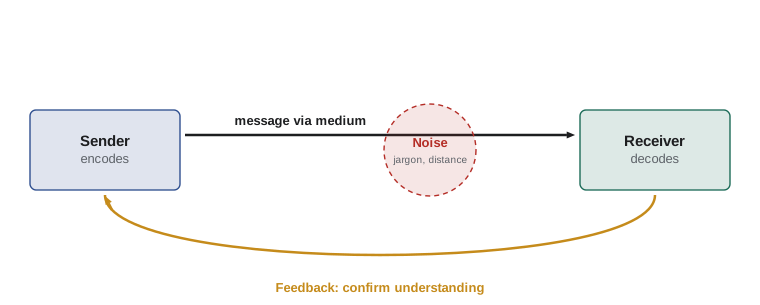
Each party has responsibilities. The sender must encode clearly, choose a suitable medium, check that the message was received and confirm understanding. The receiver must make sure the whole message is received, try to understand it correctly and acknowledge it. Acknowledging means confirming receipt, not necessarily agreeing. On the exam, if a scenario describes a misunderstanding, look for an answer in which the sender confirms understanding, for example by asking the receiver to summarize the key points, rather than simply resending the same message.
Worked problem
Diagnosing a breakdown with the model
A project manager emails the vendor: "Please deliver the units by the end of next week." The vendor, in another time zone, ships on Friday afternoon local time, and the units arrive three days after the date the project manager expected. Where did the communication fail?
Show solution
- Encoding: "end of next week" is ambiguous. It could mean dispatch or arrival, and Friday or the end of the vendor's business week.
- Medium: email gave no immediate chance for questions.
- Noise: different time zones and different working weeks.
- Feedback: the project manager did not ask the vendor to confirm the date and the meaning of "deliver".
Answer: The message should have stated a specific arrival date and time zone ("on site by 10:00 Eastern on 14 November"), and the project manager should have asked the vendor to confirm the plan.
Dimensions of project communication
Project communication varies along several dimensions. Recognizing them helps a project manager choose the right approach for each message.
| Dimension | Options | Example |
|---|---|---|
| Direction | Upward, downward, horizontal (sideward) | Report to sponsor; instructions to team; coordination with peer project managers |
| Audience | Internal, external | Team stand-up; regulator submission |
| Formality | Formal, informal | Signed change approval; quick chat to check an assumption |
| Status | Official, unofficial | Published quarterly report; off-the-record comment |
| Form | Written, oral, visual | Contract clause; phone call; burndown chart |
| Channel of meaning | Verbal, nonverbal, paralingual | Words used; facial expression and posture; tone, pitch and pace |
A frequently quoted claim is that most of a message's meaning comes from nonverbal and tone cues rather than words. That claim comes from narrow experiments by Albert Mehrabian on how people judge feelings when words and tone conflict, and he has said it should not be applied to all communication. The useful lesson is simpler: when words, tone and body language disagree, people tend to believe the tone and body language, so be careful when delivering sensitive messages in text-only channels.
Barriers to effective communication
Barriers are the practical forms noise takes on projects. Some come from the sender (unclear goals, jargon, too much detail), some from the receiver (selective listening, assumptions, information overload), some from the medium (poor audio, a message buried in a long email chain) and some from the relationship or context (distrust, hierarchy, cultural difference, time pressure).
| Barrier | Effect | Remedy |
|---|---|---|
| Jargon and acronyms | Receivers misunderstand or disengage | Use plain language; define terms; keep a glossary |
| Information overload | Key points are missed | Lead with the decision or ask; summarize; tailor detail by audience |
| Wrong channel | Sensitive messages misread; urgent ones unseen | Match channel to purpose and urgency (lesson 6) |
| Hierarchy and fear | Bad news is filtered or delayed | Build psychological safety; reward early warnings |
| Assumptions and filters | People hear what they expect | Ask receivers to summarize; check understanding |
| Language and culture | Different interpretations of directness, silence or agreement | Learn cultural norms; confirm decisions in writing |
| Distance and time zones | Delays, isolation, missed context | Overlap windows, written decisions, asynchronous updates |
Many PMP preparation materials summarize good written communication as the five Cs: correct grammar and spelling, concise expression without excess words, clear purpose and expression for the reader, coherent logical flow, and controlling flow of words and ideas, for example with headings and visuals. The list is a helpful checklist for reports and emails, and it applies equally to slides and dashboards.
Active listening
Active listening means concentrating on understanding the speaker rather than preparing a reply. It includes giving full attention, encouraging the speaker to continue, paraphrasing to confirm understanding, asking clarifying questions, reflecting feelings as well as facts, and summarizing. It is one of the most effective tools a project manager has with resistant or anxious stakeholders, because people who feel heard are far more willing to listen in return.
| Technique | What it sounds like |
|---|---|
| Attending | Eye contact (where culturally appropriate), no laptop or phone, open posture |
| Encouraging | "Go on." "Tell me more about that." |
| Paraphrasing | "So the main problem is that the roster import drops part-time staff?" |
| Clarifying | "When you say it is slow, how long does a typical schedule take now?" |
| Reflecting feelings | "It sounds as if you are worried the team will be blamed." |
| Summarizing | "Let me check I have the three concerns right: accuracy, training time and weekend coverage." |
Questioning is the partner skill. Open questions ("How do you see this working on the night shift?") invite explanation and are best for exploring. Closed questions ("Can you approve this by Friday?") get specific answers and are best for confirming. Probing questions ("What would need to be true for this to work?") dig into reasons and assumptions. Leading questions ("You agree this is the best option, don't you?") push the answer and usually damage trust, so avoid them.
Worked problem
Active listening with an upset stakeholder
A finance manager calls the project manager angrily: "Your system has made month-end a nightmare. My team worked until midnight." Draft the first few exchanges.
Show solution
- Acknowledge and attend: "That sounds like a really hard week for your team. I want to understand what happened."
- Clarify with open questions: "Which steps took longer than before?"
- Paraphrase: "So the reconciliation report now needs a manual export, and that added about four hours."
- Reflect feelings: "And it sounds as if nobody warned you this step had changed."
- Summarize and agree next steps: "I'll have the team look at automating that export this week and call you on Thursday with options. Is that time okay?"
Answer: The project manager listens first, confirms the facts and feelings, and agrees a specific follow-up, which lowers the temperature and produces the information needed to fix the problem.
Culture and communication
Culture shapes how people communicate. Edward Hall distinguished high-context cultures, where much meaning is carried by context, relationship and what is not said, from low-context cultures, where meaning is expected to be explicit in the words. People from low-context backgrounds may find high-context colleagues vague; people from high-context backgrounds may find low-context colleagues blunt. Similar differences appear in attitudes to hierarchy, directness of disagreement, the meaning of silence and the meaning of "yes". Hofstede's dimensions, discussed in BUS-130, describe further differences. National generalizations are only starting points: individual, organizational and professional cultures matter as much.
Practical habits that work across cultures include confirming decisions in writing, asking open questions rather than "Do you agree?", creating safe ways to raise concerns privately, avoiding idioms and sports metaphors, speaking slightly more slowly in meetings with non-native speakers, and noticing who does not speak in meetings.
In the United States, there is no single federal language requirement for private projects, but federal agencies follow the Plain Writing Act of 2010 for public documents, and programs receiving federal funds may have obligations to people with limited English proficiency. Projects serving diverse communities often need materials in several languages, and planning for translation from the start avoids delays at the end.
Communication styles and adapting to the receiver
People prefer to receive information in different ways. Some want the conclusion first and details only on request; others want the reasoning before the conclusion. Some prefer numbers and charts, others stories and examples. Some think aloud in meetings; others need time to reflect and respond in writing. A project manager who communicates the same way with everyone will connect well with some stakeholders and poorly with others. Observing how a stakeholder writes and speaks, and simply asking how they like to receive information, is usually more reliable than personality labels.
A useful pattern for busy senior stakeholders is to state the bottom line first: the conclusion, recommendation or request in one or two sentences, followed by the supporting evidence. For technical audiences, include the method and assumptions so they can check the reasoning. For anxious audiences, start by acknowledging their concern before giving facts. For audiences who will act on the message, end with exactly what they need to do and by when.
| Audience | Lead with | Include | Avoid |
|---|---|---|---|
| Executive sponsor | Conclusion and decision needed | Impact on objectives, options, recommendation | Long background; technical detail |
| Technical lead | Problem statement | Data, method, assumptions | Vague claims without evidence |
| Affected staff | What changes for them and when | Why, support available, who to ask | Jargon; corporate slogans |
| Upset stakeholder | Acknowledgment of the concern | Facts, what will happen next | Defensiveness; blame |
Difficult messages
Delivering bad news, refusing a request or giving critical feedback to a stakeholder is uncomfortable, and the temptation is to delay or soften the message until it is unclear. Clear, early, respectful delivery is better. Prepare the key message in one sentence, choose an interactive channel, give the reason honestly, acknowledge the impact on the other person, explain what happens next and what support is available, and confirm the outcome in writing. People generally accept bad news more readily than they accept being surprised or misled.
Finally, remember that communication skills are part of the exam's emphasis on the People domain. Scenario questions often reward the answer in which the project manager listens first, checks understanding, chooses an appropriate channel and confirms agreements, rather than the answer that sends more information faster.
Common mistakes
MistakeResending the same message louder when it was misunderstood.
InsteadChange the encoding or channel and confirm understanding, for example by asking for a summary.
MistakeTreating acknowledgment as agreement.
InsteadAcknowledgment confirms receipt; ask explicitly whether the receiver agrees.
MistakeQuoting the claim that most meaning is nonverbal as a universal rule.
InsteadRecognize that tone and body language matter most when they conflict with words.
MistakePreparing a reply while a stakeholder is still speaking.
InsteadListen actively: attend, clarify, paraphrase, reflect and summarize.
MistakeAssuming silence means agreement in a multicultural meeting.
InsteadUse open questions and private follow-ups, and confirm decisions in writing.
Summary and key terms
- The basic model: sender encodes a message, sends it through a medium, the receiver decodes it, noise interferes and feedback closes the loop.
- Senders must confirm understanding; receivers must acknowledge receipt and seek clarity.
- Communication varies by direction, audience, formality, status, form and channel of meaning.
- Barriers include jargon, overload, wrong channels, hierarchy, assumptions, culture and distance.
- The five Cs are a useful checklist for written communication.
- Active listening and good questioning are essential with anxious or resistant stakeholders.
- Cultural context affects directness, hierarchy and meaning; confirm decisions in writing.
- Encode
- To turn an idea into a message using words, numbers, images or gestures.
- Decode
- To interpret a received message.
- Medium
- The channel through which a message travels.
- Noise
- Anything that interferes with the transmission or understanding of a message.
- Feedback
- The receiver's response that shows whether the message was understood.
- Acknowledgment
- Confirmation that a message was received, not necessarily agreed with.
- Paralingual
- Vocal elements of communication such as tone, pitch and pace.
- Active listening
- Listening that concentrates on understanding, using attention, clarification, paraphrase and summary.
- High-context culture
- A culture in which much meaning is carried by context and relationships.
- Low-context culture
- A culture in which meaning is expected to be explicit in words.
Practice problems
Work each problem on paper first, then reveal the answer to check.
Name the elements of the basic communication model.
Show answer
Sender, encoding, message, medium, noise, receiver, decoding and feedback.
What does acknowledging a message mean?
Show answer
Confirming it was received, not necessarily agreeing.
Give an example of horizontal communication.
Show answer
Coordinating shared resources with another project manager.
What does paralingual communication include?
Show answer
Tone, pitch, pace and other vocal cues.
What is the best way for a sender to confirm understanding?
Show answer
Ask the receiver to summarize the key points or confirm the action.
List the five Cs of written communication.
Show answer
Correct, concise, clear, coherent and controlling flow.
Give an example of a probing question.
Show answer
"What would need to be true for this to work?"
Why avoid leading questions?
Show answer
They push the answer and damage trust.
What is a high-context culture?
Show answer
One where meaning relies heavily on context, relationships and what is not said.
In the vendor example, what should the email have specified?
Show answer
A precise arrival date, time and time zone, with a request to confirm.
Lesson quiz · 5 questions
Score 60% or more to complete this lesson.
Create a free account to save your progress, take quizzes and earn a certificate.