
PMP-121 · Lesson 2 of 12 · 25 min
Identifying and analyzing stakeholders
You cannot engage stakeholders you have not found, and you cannot engage them well if you do not understand what they want and how much they can influence the project. Identification and analysis are therefore the foundation of everything else in this course. They start before the project is formally approved, when the business case and charter are drafted, and they continue until closure. This lesson covers sources and techniques for identifying stakeholders, the stakeholder register, and the main analysis models: the power/interest grid and its variants, the salience model, the stakeholder cube and simple scoring.
Where to look for stakeholders
Stakeholder identification works best as a deliberate search rather than a list written from memory. Useful sources include the business case and charter, which name sponsors, customers and objectives; organization charts, which show who owns affected processes and staff; contracts and agreements, which name suppliers, partners and their obligations; lessons learned from similar projects, which often record stakeholders that earlier teams missed; regulatory requirements, which identify authorities and the evidence they expect; and the people already identified, who can be asked "Who else should we talk to?" That last question, sometimes called snowball identification, is one of the most productive techniques available.
Workshops and brainstorming with the core team and sponsor quickly produce a first list. Interviews with experienced staff add depth. For projects with public impact, a community or geographic scan, such as a map of who lives, works or operates near a site, catches groups that office-based teams overlook. Questionnaires can reach large groups, and document analysis catches formal obligations. A good starting prompt is to walk through the project life cycle and ask who is involved, consulted, affected or able to object at each stage.
| Technique | Best for | Watch out for |
|---|---|---|
| Document review (charter, contracts, regulations) | Formal stakeholders and obligations | Misses informal influencers |
| Brainstorming with the team | A quick first list | Group blind spots; dominant voices |
| Expert interviews | Hidden or informal stakeholders | Takes time; one expert's bias |
| Snowball ("who else?") | Networks and indirect stakeholders | Can grow without limit; needs a stopping point |
| Life cycle walkthrough | Stakeholders who appear in later phases | Requires a reasonable view of the delivery approach |
| Geographic or community scan | Projects with physical sites or public impact | Needs local knowledge |
| Lessons learned | Recurring stakeholders across similar projects | Old lists may be out of date |
The stakeholder register
The main output of identification is the stakeholder register, a living document that records who the stakeholders are and what the project knows about them. A register typically includes identification information (name or group, organization, role, contact details, relationship owner), assessment information (interests, expectations, requirements, influence, attitude, phase of most interest) and classification (category, priority, current and desired engagement). On agile projects the same information may be held in a lighter form, such as a stakeholder board or personas, but the purpose is identical.
Some register content is sensitive. A note that a director is hostile to the project, or that a union is planning a campaign, could damage relationships if it circulated widely. Keep sensitive assessments where only those who need them can see them, describe behavior factually rather than with labels, and remember that privacy law may apply to personal information about individuals.
| Stakeholder | Role | Main interests | Power | Interest | Attitude | Owner |
|---|---|---|---|---|---|---|
| Chief nursing officer | Head of nursing practice | Patient safety, workload, staffing rules | High | Medium | Cautious | Sponsor |
| Unit managers (12) | Build and approve rosters | Time to build schedules, fairness | Medium | High | Mixed | Project manager |
| Nurses' union | Represents nursing staff | Scheduling rules in the collective agreement | High | High | Concerned | Labor relations lead |
| IT security | Approves new systems | Access controls, data protection | High | Low | Neutral | Tech lead |
| Patients' council | Patient voice | Continuity of care | Low | Medium | Supportive | Project manager |
In the United States, there is no single federal privacy law covering a stakeholder register, but state privacy laws, sector rules and employer policies may apply, especially to information about employees and members of the public. A register that records opinions about named people should hold only what the project needs, restrict access and follow the organization's records-retention policy.
The power/interest grid
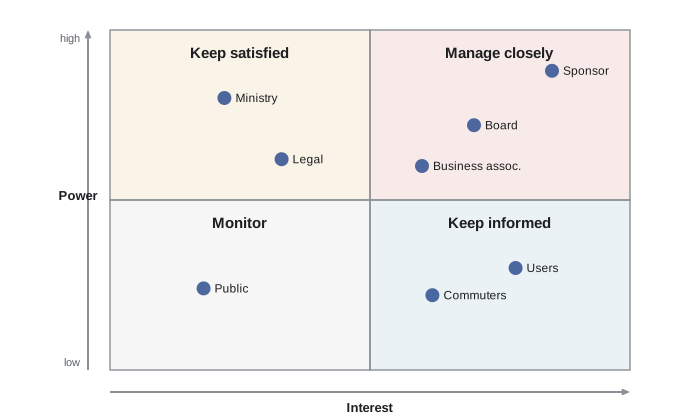
The best-known analysis tool places stakeholders on a two-by-two grid by their power (ability to affect the project) and their interest (how much they care about it). Each quadrant suggests a default engagement strategy. Variants use influence instead of interest (power/influence grid), or impact (the stakeholder's ability to cause changes to planning or execution) in place of power.
| Quadrant | Default strategy | Typical stakeholders |
|---|---|---|
| High power, high interest | Manage closely: involve in decisions, consult often, build partnership | Sponsor, key customer, powerful regulator actively watching |
| High power, low interest | Keep satisfied: meet their needs efficiently, avoid overloading them, watch for rising interest | Senior executives outside the sponsor line, some regulators, legal |
| Low power, high interest | Keep informed: regular, adequate information; use their knowledge and energy | End users, community members, junior staff |
| Low power, low interest | Monitor: light-touch information, check periodically | Peripheral departments, the general public |
The grid has limits. It is a snapshot, while power and interest change: a quiet executive becomes highly interested once the budget is threatened, and an individual end user with little power can gain a great deal by organizing colleagues or going to the media. The grid also ignores attitude: a high-power, high-interest stakeholder who is a champion needs very different handling from one who is opposed. Many teams therefore color or label the dots by attitude, or add arrows to show where they want each stakeholder to move.
The salience model
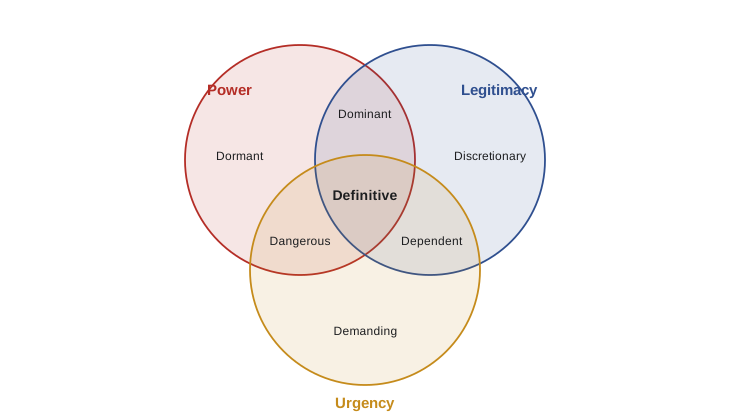
The salience model, developed by Mitchell, Agle and Wood in 1997, classifies stakeholders by three attributes: power (the ability to impose their will), legitimacy (the appropriateness of their involvement, through contract, law, ownership or moral claim) and urgency (the time sensitivity and criticality of their claims). Stakeholders with all three attributes are definitive and demand immediate attention. Those with two attributes are expectant; those with one are latent.
| Class | Attributes | Example |
|---|---|---|
| Dormant | Power only | A senior executive with authority who has no current claim on the project |
| Discretionary | Legitimacy only | A charity the company supports, with no power or urgent claim |
| Demanding | Urgency only | A persistent complainant with no authority or legitimate claim |
| Dominant | Power and legitimacy | The board of directors |
| Dangerous | Power and urgency | A group threatening disruption without a legitimate claim |
| Dependent | Legitimacy and urgency | Residents affected by a spill who rely on regulators to act for them |
| Definitive | All three | A regulator issuing a stop-work order |
The salience model is useful for large, complex stakeholder communities, especially where some groups have urgent but contested claims. It reminds project managers that legitimacy and urgency matter alongside power, and that stakeholders move between classes: a dependent group of residents becomes definitive if they win the support of a powerful authority.
The stakeholder cube and other variants
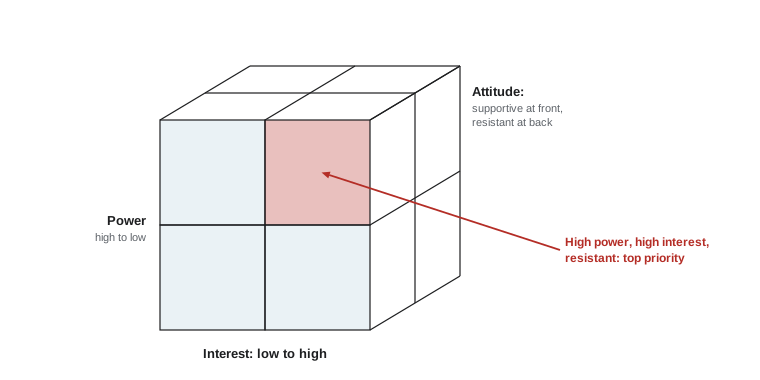
Some guidance describes a stakeholder cube, which adds a third dimension to the grid, typically attitude (supportive or resistant) or activity (active or passive), giving eight segments. Another variant, the directions of influence, classifies stakeholders as upward (senior management, the sponsor), downward (the team and specialists), outward (customers, suppliers, regulators, the public) and sideward (peers such as other project managers competing for shared resources). The directions model is a useful check that communication is planned in every direction, not just upward to the sponsor.
Simple scoring
When a project has dozens of stakeholders, a simple weighted score helps rank them. Each stakeholder is rated on a few criteria, such as power, interest and urgency, the ratings are weighted and summed, and the result is combined with attitude to highlight the stakeholders who are both important and not yet supportive. Scores are a conversation aid, not a precise measure: they help a team agree priorities and make assumptions visible.
# Prioritize stakeholders with a simple weighted score (illustrative weights)
stakeholders = {
    # name: (power, interest, urgency, attitude) each scored 1-5; attitude 1 = opposed, 5 = champion
    "Sponsor (VP Operations)": (5, 5, 3, 5),
    "Chief nursing officer":   (5, 3, 4, 2),
    "Unit managers":           (3, 5, 4, 3),
    "Nurses' union":           (4, 4, 5, 1),
    "IT security":             (4, 2, 2, 3),
    "Patients' council":       (2, 4, 2, 4),
}
w_power, w_interest, w_urgency = 0.5, 0.3, 0.2

rows = []
for name, (p, i, u, a) in stakeholders.items():
    score = w_power * p + w_interest * i + w_urgency * u
    risk = score * (6 - a)          # higher when important AND unsupportive
    rows.append((name, score, a, risk))

print(f"{'Stakeholder':26}{'Priority':>9}{'Attitude':>9}{'Risk':>7}")
for name, score, a, risk in sorted(rows, key=lambda r: -r[3]):
print(f"{name:26}{score:9.1f}{a:9d}{risk:7.1f}")Stakeholder Priority Attitude Risk Nurses' union 4.2 1 21.0 Chief nursing officer 4.2 2 16.8 Unit managers 3.8 3 11.4 IT security 3.0 3 9.0 Patients' council 2.6 4 5.2 Sponsor (VP Operations) 4.6 5 4.6
In this illustrative output, the union and the chief nursing officer rise to the top of the risk ranking because they combine high priority with low support. The sponsor has the highest priority score but low risk, because she is already a champion. That combination tells the project manager where engagement effort is most needed now.
Worked problem
Placing stakeholders on the grid
A municipal transit project will close a downtown station for 18 months to rebuild it. Place these stakeholders on the power/interest grid and give a default strategy: (a) the transit authority board; (b) daily commuters who use the station; (c) the provincial or state transportation ministry that provides half the funding but is not involved day to day; (d) a business improvement association representing nearby shops; (e) the city's parks department, whose small park is used as a laydown area for two months.
Show solution
- (a) Board: high power, high interest. Manage closely.
- (b) Commuters: low individual power, high interest. Keep informed, using channels they already use; watch for collective influence.
- (c) Ministry: high power, low current interest. Keep satisfied with concise reports on funding milestones; watch for rising interest if costs grow.
- (d) Business association: medium-to-high power through political access, high interest. Treat as manage closely during planning and construction.
- (e) Parks department: medium power over its land, low interest beyond the laydown period. Keep satisfied through clear agreements and site restoration.
Answer: The board and business association need close management; the ministry needs to be kept satisfied; commuters need to be kept well informed; the parks department needs a clear agreement. Positions should be reviewed when construction begins.
Making analysis useful
Analysis is only worth doing if it changes what the team does. For each high-priority stakeholder, the analysis should lead to concrete answers: who owns the relationship, what the stakeholder needs to know or decide, how and how often they will be engaged, and what would move them toward greater support. Those answers feed the stakeholder engagement plan in the next lesson and the communications management plan in lesson 6.
Common mistakes
MistakeWriting the stakeholder list from memory in a single meeting.
InsteadUse several techniques, including documents, interviews and asking stakeholders who else should be involved.
MistakeTreating the power/interest grid as permanent.
InsteadRevisit positions at each phase and after significant events, and show attitude alongside power and interest.
MistakeWriting loaded labels such as "difficult" in a widely shared register.
InsteadRecord behavior and interests factually and restrict access to sensitive assessments.
MistakeIgnoring low-power stakeholders entirely.
InsteadKeep them informed and monitor them; individuals can gain power by organizing or going public.
MistakeTreating scores as precise measurements.
InsteadUse scores to start a discussion and make assumptions visible.
Summary and key terms
- Identify stakeholders using several techniques: documents, workshops, interviews, snowballing, life cycle walkthroughs and community scans.
- The stakeholder register records identification, assessment and classification information and is updated throughout the project.
- The power/interest grid suggests four default strategies: manage closely, keep satisfied, keep informed and monitor.
- The salience model classifies stakeholders by power, legitimacy and urgency; definitive stakeholders hold all three.
- The stakeholder cube adds attitude or activity; the directions of influence check upward, downward, outward and sideward communication.
- Simple weighted scores help rank many stakeholders, especially when combined with attitude.
- Analysis must lead to concrete engagement decisions and owners.
- Stakeholder register
- A project document recording stakeholders' identification, assessment and classification information.
- Power/interest grid
- A two-by-two model that classifies stakeholders by their power and interest to suggest an engagement strategy.
- Salience model
- A model that classifies stakeholders by power, legitimacy and urgency.
- Legitimacy
- The appropriateness of a stakeholder's involvement, based on contract, law, ownership or moral claim.
- Urgency
- The time sensitivity and criticality of a stakeholder's claims.
- Definitive stakeholder
- In the salience model, a stakeholder with power, legitimacy and urgency.
- Stakeholder cube
- A three-dimensional extension of the grid, adding attitude or activity.
- Directions of influence
- A classification of stakeholders as upward, downward, outward or sideward.
- Snowball identification
- Asking identified stakeholders who else should be involved.
- Attitude
- A stakeholder's current stance toward the project, from opposed to champion.
Practice problems
Work each problem on paper first, then reveal the answer to check.
Name three documents that help identify stakeholders.
Show answer
For example, the business case, the project charter and contracts.
What is the default strategy for high-power, low-interest stakeholders?
Show answer
Keep satisfied.
What three attributes does the salience model use?
Show answer
Power, legitimacy and urgency.
A group has an urgent and legitimate claim but no power. Which salience class?
Show answer
Dependent.
What is one limitation of the power/interest grid?
Show answer
It is a snapshot and ignores attitude unless added.
What does "sideward" mean in the directions of influence?
Show answer
Peers, such as other project managers competing for shared resources.
Why should parts of the stakeholder register be access-controlled?
Show answer
It may contain sensitive assessments and personal information that could damage relationships or breach privacy rules.
What question drives snowball identification?
Show answer
"Who else should we talk to?"
In the scoring example, why did the sponsor have low risk despite high priority?
Show answer
She is already a champion, so the gap between current and desired support is small.
What should analysis produce for each high-priority stakeholder?
Show answer
A relationship owner, information and decision needs, engagement method and frequency, and actions to build support.
Lesson quiz · 5 questions
Score 60% or more to complete this lesson.
Create a free account to save your progress, take quizzes and earn a certificate.