
PMP-130 · Lesson 10 of 12 · 25 min
Budgets, reserves and the cost baseline
A cost estimate says how much the work is likely to cost. A budget says how much money is authorized, and a cost baseline says how that money is planned to be spent over time. This lesson covers how work package estimates are aggregated into control accounts and the project budget, the difference between contingency reserve and management reserve and who controls each, time-phasing the cost baseline into an S-curve, funding requirements and funding limit reconciliation, and budgeting in adaptive projects. These concepts are tested heavily on the exam, often through questions about what is and is not included in the cost baseline.
Cost aggregation
Budgets are built bottom-up from the WBS. Activity cost estimates are summed into work package estimates; work packages into control accounts; control accounts into the project total. Each level must follow the 100 % rule from lesson 4. Aggregation keeps the budget traceable: every dollar can be linked to a deliverable and to the person accountable for it.
The structure of the budget is a classic exam topic. Work package estimates plus contingency reserves make up the control accounts; control accounts sum to the cost baseline; the cost baseline plus management reserve gives the project budget. Some organizations show contingency at the work package level, others at the control account or project level; the principle is the same.
| Layer | Contains | Controlled by | Project Compass ($000) |
|---|---|---|---|
| Activity and work package estimates | Expected cost of the planned work | Control account managers | 2,320 |
| Contingency reserve | Funds for identified risks (known-unknowns) | Project manager, within the baseline | 80 |
| Cost baseline | Work package estimates plus contingency, time-phased | Changed through change control | 2,400 |
| Management reserve | Funds for unidentified risks (unknown-unknowns) | Sponsor or management, outside the baseline | 120 |
| Project budget | Cost baseline plus management reserve | Board approval | 2,520 |
Contingency reserve and management reserve
Contingency reserve is time or money set aside for identified risks that may or may not occur. It belongs to the project, is included in the cost baseline and is managed by the project manager according to the risk management plan. When an identified risk occurs, the project manager can use contingency to respond without a change request, because the baseline already includes it. If the risk does not occur, the contingency may be released at a later point, by agreement.
Management reserve is an amount held outside the cost baseline for unforeseen work that is within scope, the unknown-unknowns. It is controlled by management, often the sponsor. Using management reserve requires approval, and when it is used, the amount is added to the cost baseline through change control. Management reserve is not used for scope changes requested by stakeholders; those need their own funding through change control.
# Cost baseline, reserves and funding limits for Project Compass ($000, invented)
work_packages = 2320                     # sum of work package estimates (lesson 4)
risk_items = [("Hidden asbestos in ceiling", 0.25, 120), ("Permit delay costs", 0.40, 60),
              ("RFID tag price increase", 0.30, 50), ("App store rework", 0.25, 44)]
contingency = sum(p * impact for _, p, impact in risk_items)
baseline = work_packages + contingency
baseline = round(baseline)
mgmt_reserve = round(0.05 * baseline)
budget = baseline + mgmt_reserve
print(f"Work packages {work_packages:,}  contingency {contingency:,.0f}  ->  cost baseline {baseline:,.0f}")
print(f"Management reserve {mgmt_reserve:,}  ->  project budget {budget:,.0f}")

# Planned spend by month (the cost baseline) against the council's funding tranches
plan = [150, 210, 260, 280, 280, 260, 260, 240, 240, 220]
assert sum(plan) == baseline
cum = 0
print("\nMonth  Planned  Cumulative")
for m, v in enumerate(plan, 1):
    cum += v
    print(f"{m:5d}  {v:7d}  {cum:10d}")
tranche1 = 800                           # funds released for months 1-4
need1 = sum(plan[:4])
print(f"\nMonths 1-4 need {need1:,} vs tranche 1 of {tranche1:,}: over by {need1 - tranche1:,}")
# Reconcile: move 100 of RFID tagging (activity C has 35 days of float) from month 4 to month 6
plan[3] -= 100; plan[5] += 100
print(f"After moving 100 to month 6: months 1-4 need {sum(plan[:4]):,}; total still {sum(plan):,}")Work packages 2,320 contingency 80 -> cost baseline 2,400
Management reserve 120 -> project budget 2,520
Month Planned Cumulative
1 150 150
2 210 360
3 260 620
4 280 900
5 280 1180
6 260 1440
7 260 1700
8 240 1940
9 240 2180
10 220 2400
Months 1-4 need 900 vs tranche 1 of 800: over by 100
After moving 100 to month 6: months 1-4 need 800; total still 2,400The contingency reserve is calculated from the risk register using expected monetary value: probability times impact for each identified risk, summed. Hidden asbestos in the ceiling, for example, has a 25 % chance and a $120,000 impact, contributing $30,000. The four risks total $80,000. Expected monetary value and other quantitative risk methods are covered in PMP-131; here the important point is that contingency is linked to specific risks rather than picked as a round percentage. Management reserve is set by the library's policy at 5 % of the baseline, giving $120,000 and a project budget of $2.52 million.
Earned value calculations use the cost baseline, also called the performance measurement baseline when combined with scope and schedule. Management reserve is excluded from earned value calculations because it is not planned against specific work. This is why budget at completion (BAC) in lesson 11 is $2.4 million, not $2.52 million.
Worked problem
Contingency or management reserve?
Three events occur on Project Compass. (1) Asbestos is found in the ceiling, a risk in the register with a planned response. (2) A water main break in the mall floods the unit, an event nobody had identified. (3) The board asks for a second community room. How is each funded?
Show solution
- Asbestos: an identified risk, so the project manager uses contingency reserve within the cost baseline. No change to the baseline is needed.
- Flood: an unidentified risk within the existing scope, so the project manager requests management reserve from the sponsor; once approved, the amount is added to the cost baseline through change control.
- Second community room: new scope, so a change request is needed, with its own funding approved by the board. Neither reserve should be used.
Answer: Contingency for the identified risk, management reserve for the unknown event within scope, and a funded change request for the new scope.
Time-phasing the cost baseline
The cost baseline is time-phased: it shows when money is expected to be spent, based on the schedule. Each activity's or work package's cost is spread across the periods in which the work occurs, and the totals are accumulated over time. Plotted as cumulative cost against time, the result typically looks like an S: slow spending at the start during design and procurement, rapid spending during construction and installation, and slower spending again during completion and closeout.
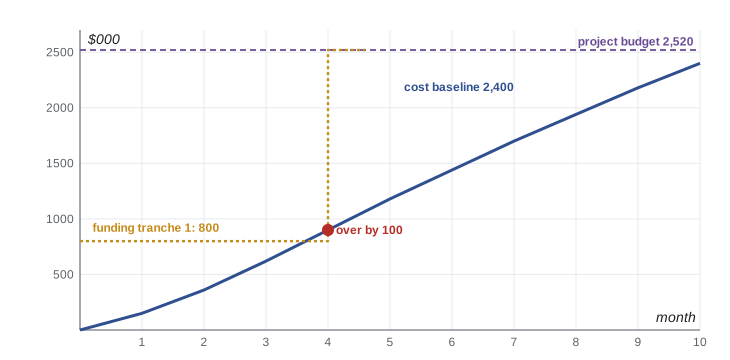
In the output above, the planned spend ranges from $150,000 in month 1 to $280,000 in the busiest months, accumulating to $2.4 million in month 10. The S-curve becomes the yardstick in earned value: the planned value at any date is the height of the curve at that date.
Funding requirements and funding limit reconciliation
Funding requirements state when money is needed, derived from the cost baseline plus any reserves the organization expects to release. Funds are often provided in increments rather than continuously, and organizations may impose limits on spending in a period because of fiscal years, cash flow or approval stages. Funding limit reconciliation compares planned spending with funding limits and adjusts the schedule where they conflict.
In Project Compass, the regional council releases funds in two tranches: $800,000 for months 1 to 4, and the remainder after a progress review. The cost baseline needs $900,000 in months 1 to 4, so it exceeds the first tranche by $100,000. The project manager reconciles this by moving part of the RFID tagging cost from month 4 to month 6. Tagging (part of activity C) has 35 days of total float, so the move does not affect the finish date. The total is unchanged; only the timing shifts. If no activity with enough float existed, the options would be to negotiate earlier funding, accept a schedule change, or find interim financing.
Funding limit reconciliation is a good example of integration: a finance constraint changes the schedule, and the schedule's float makes the change possible without harming the project. Exam questions may describe a fiscal-year spending cap and ask what to do; the usual answer is to reschedule work within available float, or to discuss options with the sponsor if float is insufficient.
Budgets in adaptive and hybrid projects
Adaptive projects often fund teams rather than scope. A team's cost per iteration (its run rate) is relatively predictable: people, tools and overhead. The budget then buys a number of iterations, and the product owner maximizes value within them. For the Project Compass app, the product team costs about $36,000 per two-week sprint including contractor rates and tools. The $410,000 build-and-test work package therefore buys about 11 sprints, and the forecast from lesson 3 (about 10 sprints at current scope growth) shows the budget is tight but adequate if growth is managed.
Some organizations move further toward value-stream or product funding, where a long-lived team is funded per quarter or year and judged on outcomes rather than on delivering a fixed scope. Hybrid projects combine a predictive cost baseline for fixed components with capacity funding for adaptive ones. Reporting should make both visible in one view for the sponsor: the fit-out's earned value and the app's burn-up and spend per sprint.
Controlling the budget
Budgets are controlled through the earned value analysis in the next lesson, through reviews of committed costs (purchase orders issued but not yet paid) as well as actual costs, and through forecasting. A project that looks under budget on actual costs may be heavily committed through contracts not yet invoiced. Accrual timing also matters: if the finance system records costs only when invoices are paid, actual cost may lag work performed, making cost performance look better than it is. Project controls should align cost recording with the period in which work is performed.
Reserves should be tracked openly. A simple reserve log records each draw on contingency, the risk it addressed and the remaining balance, and each request for management reserve with its approval. Reporting remaining reserves alongside the forecast lets the sponsor see whether the project is likely to need more money before it actually does.
Releasing contingency
Contingency is linked to specific risks, so it should be reviewed as those risks pass. Once the ceiling has been opened and no asbestos found, the $30,000 held for that risk is no longer needed for it. Organizations differ in what happens next. Some return released contingency to the sponsor, reducing the cost baseline through change control; others keep it in the project for other identified risks; others move it to management reserve. The risk management plan should say which approach applies, and the reserve log should record every release so that the remaining contingency is always known. Holding on to contingency for risks that have passed, without saying so, creates a hidden cushion that undermines honest reporting.
Common mistakes
MistakeIncluding management reserve in the cost baseline or in BAC.
InsteadKeep management reserve outside the cost baseline; BAC equals the cost baseline.
MistakeUsing management reserve to fund new scope.
InsteadFund scope changes through approved change requests.
MistakeAsking for a change request to use contingency for an identified risk.
InsteadUse contingency within the baseline according to the risk management plan.
MistakePlanning spending without checking funding limits.
InsteadReconcile the time-phased baseline with funding limits and adjust work within float.
MistakeJudging cost performance on paid invoices only.
InsteadConsider commitments and accruals so actual cost reflects work performed.
Summary and key terms
- Budgets are aggregated from activities to work packages to control accounts to the project.
- Cost baseline = work package estimates + contingency reserve, time-phased.
- Project budget = cost baseline + management reserve.
- Contingency covers identified risks and is controlled by the project manager; management reserve covers unidentified risks and needs management approval.
- Using management reserve increases the cost baseline through change control.
- The time-phased cost baseline forms an S-curve and provides planned value for earned value analysis.
- Funding limit reconciliation adjusts work timing, usually within float, to fit funding constraints.
- Cost aggregation
- Summing lower-level cost estimates into higher-level totals following the WBS.
- Budget
- The approved estimate for the project or any WBS component or activity.
- Cost baseline
- The approved time-phased budget, excluding management reserve.
- Contingency reserve
- Budget within the cost baseline allocated for identified risks.
- Management reserve
- Budget held outside the cost baseline for unforeseen work within scope.
- Budget at completion
- The sum of all budgets established for the work to be performed; equal to the cost baseline total.
- S-curve
- A graph of cumulative cost or work over time, typically shaped like an S.
- Funding requirements
- The amounts and timing of funds needed, derived from the cost baseline.
- Funding limit reconciliation
- Comparing planned spending with funding limits and adjusting the schedule to fit.
- Run rate
- The cost of a team per period or iteration, used in adaptive budgeting.
Practice problems
Work each problem on paper first, then reveal the answer to check.
Work packages $900,000, contingency $60,000, management reserve $50,000. Cost baseline?
Show answer
$960,000.
Same figures: project budget?
Show answer
$1,010,000.
Same figures: BAC for earned value?
Show answer
$960,000.
Who usually controls management reserve?
Show answer
The sponsor or senior management.
An identified risk occurs and contingency is used. Does the cost baseline change?
Show answer
No.
Management reserve of $25,000 is approved for an unforeseen problem. What happens to the cost baseline?
Show answer
It increases by $25,000 through change control.
Risks: 20 % × $50,000 and 50 % × $20,000. Contingency by expected value?
Show answer
$10,000 + $10,000 = $20,000.
Why is the cost baseline often S-shaped?
Show answer
Spending is slow at the start, fastest in the middle and slows near the end.
Planned spend exceeds a quarterly funding cap. What is the usual first response?
Show answer
Move work with float into a later period; if not possible, discuss options with the sponsor.
A team costs $36,000 per sprint and has $410,000. How many sprints?
Show answer
About 11.
Lesson quiz · 5 questions
Score 60% or more to complete this lesson.
Create a free account to save your progress, take quizzes and earn a certificate.