
PMP-130 · Lesson 2 of 12 · 26 min
Collecting and managing requirements
Requirements describe the conditions or capabilities that a product, service or result must have to satisfy stakeholders' needs. They are the starting point for scope, and weaknesses in requirements are one of the most common root causes of project failure: features nobody wanted, features everybody assumed but nobody wrote down, and arguments at acceptance about what was promised. This lesson covers types of requirements, elicitation techniques, how to analyze and prioritize requirements, how to document them so they can be tested, and how a traceability matrix keeps requirements connected to deliverables and tests. Stakeholder identification and engagement were covered in PMP-121; here we focus on turning stakeholder needs into clear requirements.
Types of requirements
Requirements come in layers. Business requirements state the higher-level needs of the organization, such as why the project exists. Stakeholder requirements state the needs of particular groups. Solution requirements describe the features and characteristics of the product, split into functional requirements (what it must do) and nonfunctional requirements (how well it must do it, such as performance, security, accessibility and reliability). Transition requirements describe temporary capabilities needed to move from the current state to the future state, such as data conversion and training. Project requirements describe actions or conditions the project itself must meet, such as milestone dates or contractual obligations. Quality requirements describe the criteria used to confirm that deliverables are acceptable.
| Type | Project Compass example |
|---|---|
| Business | Increase library use in the fast-growing east side of the region |
| Stakeholder | Branch staff need a service desk where they can see the entrance and children's area |
| Solution: functional | Patrons can borrow and return items at self-service kiosks without staff help |
| Solution: nonfunctional | Kiosks complete a five-item checkout in under 30 seconds; the app meets WCAG 2.1 AA |
| Transition | Tag 38,000 opening-day items with RFID before move-in; train 14 staff on the new system |
| Project | Soft opening before the autumn programming season; lease obligations met |
| Quality | All kiosks pass a 200-transaction acceptance test with no unrecovered errors |
Nonfunctional requirements are easily forgotten because stakeholders rarely state them unprompted. Nobody says "the kiosk must not crash" or "the community room must meet fire code occupancy limits" until it fails. Good elicitation asks about performance, availability, security, privacy, accessibility, maintainability and compliance for every major feature.
Eliciting requirements
Elicitation draws requirements out of stakeholders, documents and observation. No single technique is enough; experienced practitioners combine several, choosing according to the stakeholders, the product and the time available.
| Technique | Best for | Watch out for |
|---|---|---|
| Interviews | Detailed needs of individuals and experts; sensitive topics | Time-consuming; one person's view |
| Focus groups | Expectations and attitudes of a group of similar stakeholders | Dominant voices; groupthink |
| Facilitated workshops | Reconciling differences across functions quickly | Needs a skilled facilitator and the right attendees |
| Questionnaires and surveys | Large, dispersed audiences; quantifying preferences | Low response rates; shallow answers |
| Observation (job shadowing) | Processes people perform without thinking about them | People behave differently when watched |
| Prototypes and mock-ups | Getting feedback on things users find hard to describe | Users may mistake a prototype for a finished product |
| Document analysis | Existing rules, regulations, contracts and system specifications | Documents may be outdated |
| Benchmarking | Comparing with other organizations' practices or products | What works elsewhere may not fit |
| Context diagrams | Showing system boundaries, users and interfaces | Omit internal detail by design |
For Project Compass, the team used several. Interviews with the branch manager and facilities staff captured operational needs. Two focus groups, one with parents of young children and one with older adults, explored what would make the branch welcoming. A workshop with IT, facilities, finance and branch staff agreed the self-service approach. Observation at an existing branch showed that staff spent much of their time helping patrons find holds, which shaped the layout. Paper and clickable prototypes of the app were tested with patrons before any code was written. Document analysis covered the lease, the building code and accessibility standards.
Group decision-making techniques help when stakeholders disagree. Unanimity requires everyone to agree; majority requires more than half; plurality picks the largest block even if it is not a majority; autocratic decisions are made by one person. The nominal group technique has participants generate ideas silently, share them in turn and then rank them, which reduces the influence of dominant personalities. Multicriteria decision analysis scores options against weighted criteria. On the exam, recognize the trade-off: broader agreement takes longer but builds commitment.
Analyzing and prioritizing requirements
Raw elicitation results are messy: duplicates, conflicts, vague wishes and hidden solutions ("we need a dashboard" when the need is "I must know which holds are waiting"). Analysis cleans them up. Each requirement should be traced to a need, checked for conflicts and refined until it is clear and testable.
Good requirements share a few characteristics. They are unambiguous (one interpretation), measurable or verifiable (you can test whether they are met), complete enough to build from, consistent with other requirements, feasible within constraints, and traceable to a source. Compare "the app should be fast" with "the app shows search results within two seconds for 95 % of searches on a 4G connection". Only the second can be tested.
Prioritization is unavoidable because time and money are limited. MoSCoW sorts requirements into must have, should have, could have and won't have this time. The Kano model distinguishes basic needs (expected, cause dissatisfaction if absent), performance needs (more is better) and delighters (unexpected features that please). Paired comparison and weighted scoring help when many requirements compete. In adaptive projects, the product owner orders the backlog by value, risk, dependencies and cost, revisiting the order each iteration.
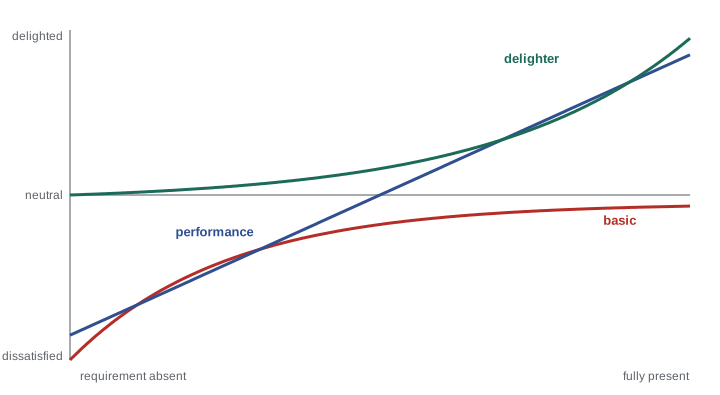
Prioritization should involve the stakeholders who own the value, not just the project team. A frequent exam scenario has two stakeholders pressing for conflicting requirements. The best response usually brings them together to clarify the underlying needs and agree priorities against the project's objectives, escalating to the sponsor only if they cannot agree within the project's authority.
Documenting requirements
Requirements documentation can take many forms: a formal requirements specification, use cases, user stories with acceptance criteria, process models or annotated prototypes. Whatever the form, it should record the requirement, its source, its priority, its acceptance criteria, and its status. A requirements management plan describes how requirements will be collected, analyzed, documented, prioritized, approved, traced and changed. It sets out who can approve requirements and how changes to them will go through change control.
User stories are common in adaptive work. A typical format is "As a role, I want capability, so that benefit", followed by acceptance criteria. For Project Compass: "As a parent with a stroller, I want to see whether a picture book is on the shelf before I visit, so that I do not make a wasted trip." Acceptance criteria might include showing shelf status updated within five minutes of a checkout and indicating the shelf location. Good stories are independent, negotiable, valuable, estimable, small and testable, often remembered as INVEST.
Traceability
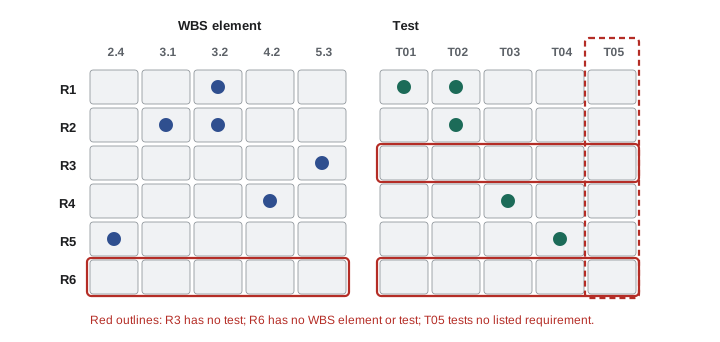
A requirements traceability matrix links each requirement to its source, to the deliverables or WBS elements that satisfy it, and to the tests that verify it. Traceability answers three practical questions. Is every requirement being delivered? Is everything we are delivering justified by a requirement? How will we prove each requirement has been met? It also supports impact analysis: when a requirement changes, the matrix shows which work and tests are affected.
# Requirements traceability check for Project Compass (invented data)
reqs = {
    "R1": ("Patrons borrow items at self-service kiosks", "Must"),
    "R2": ("Kiosks read RFID tags on all collection items", "Must"),
    "R3": ("Branch open 72 hours a week", "Must"),
    "R4": ("Mobile app shows real-time availability", "Should"),
    "R5": ("Accessible service desk at seated height", "Must"),
    "R6": ("Community room bookable online", "Could"),
}
wbs_links = {"R1": ["3.2"], "R2": ["3.1", "3.2"], "R3": ["5.3"],
             "R4": ["4.2"], "R5": ["2.4"]}
tests = {"T01": ["R1"], "T02": ["R1", "R2"], "T03": ["R4"],
         "T04": ["R5"], "T05": ["R9"]}

tested = {r for linked in tests.values() for r in linked}
print("Req  Priority  WBS        Tests")
for rid, (text, prio) in reqs.items():
    w = ", ".join(wbs_links.get(rid, [])) or "-"
    t = ", ".join(k for k, v in tests.items() if rid in v) or "-"
    print(f"{rid:4s} {prio:8s}  {w:10s} {t}")

print()
print("No WBS element:", [r for r in reqs if r not in wbs_links])
print("Not tested:    ", [r for r in reqs if r not in tested])
print("Orphan tests: ", [k for k, v in tests.items() if not set(v) & set(reqs)])Req Priority WBS Tests R1 Must 3.2 T01, T02 R2 Must 3.1, 3.2 T02 R3 Must 5.3 - R4 Should 4.2 T03 R5 Must 2.4 T04 R6 Could - - No WBS element: ['R6'] Not tested: ['R3', 'R6'] Orphan tests: ['T05']
The check reveals three problems. R6 (bookable community room) has no WBS element and no test: either it is out of scope and should be recorded as an exclusion, or work is missing from the WBS. R3 (72 opening hours a week) is linked to the opening work package but has no test; because it is an operating commitment, the verification might be a staffing plan review rather than a system test, and the matrix should say so. T05 tests a requirement R9 that does not exist, which suggests either a missing requirement or wasted testing effort. Each finding is cheap to fix in planning and expensive to discover at acceptance.
Worked problem
Turning a vague request into a testable requirement
The branch manager says, "The kiosks need to be easy to use." How should the business analyst turn this into a requirement?
Show solution
- Ask what "easy" means in practice: who struggles today and with what?
- Discover concerns about older patrons and patrons with low vision.
- Draft measurable criteria: screen text adjustable to large print; audio guidance available; at least 90 % of first-time users in a usability test complete checkout without help.
- Record the source (branch manager, accessibility advisor), priority (must) and verification method (usability test with recruited patrons).
Answer: A testable nonfunctional requirement with acceptance criteria and a verification method, linked in the traceability matrix.
Managing requirements through the project
Requirements are rarely complete at the start, and they change as stakeholders learn. In predictive projects, approved requirements become part of the scope baseline, and changes go through change control with impact analysis. In adaptive projects, the backlog is expected to change, but the product owner still controls what enters an iteration, and the team protects the iteration from mid-sprint changes. In both, the project manager watches for requirements creep, where new requirements slip in informally, and for missing stakeholders whose requirements surface late.
Validating requirements with stakeholders before building saves money. Walkthroughs, reviews of prototypes and acceptance criteria workshops catch misunderstandings while they are still cheap. The cost of fixing a requirement error grows sharply the later it is found, because more work has been built on top of it.
Requirements also have owners. Someone must have authority to decide what a requirement means when the team is unsure. In Project Compass, the branch manager owns operational requirements, the IT manager owns technical and security requirements, and the product owner owns the app backlog. The sponsor resolves conflicts that the owners cannot settle.
Common mistakes
MistakeAccepting stated solutions as requirements without understanding the need.
InsteadAsk what problem the requested feature solves, then write a requirement for the need.
MistakeWriting requirements that cannot be tested, such as "user-friendly".
InsteadAdd measurable acceptance criteria and a verification method.
MistakeCollecting only functional requirements.
InsteadAsk explicitly about performance, security, accessibility, reliability, compliance and transition needs.
MistakeRelying on one elicitation technique.
InsteadCombine techniques suited to each stakeholder group, such as interviews, workshops, observation and prototypes.
MistakeBuilding a traceability matrix and never updating it.
InsteadMaintain it as requirements, work and tests change, and use it for impact analysis.
Summary and key terms
- Requirements include business, stakeholder, solution (functional and nonfunctional), transition, project and quality types.
- Use several elicitation techniques; match them to stakeholders and to what is hard to express.
- Good requirements are unambiguous, verifiable, consistent, feasible and traceable.
- Prioritize with techniques such as MoSCoW, Kano and weighted scoring, involving the stakeholders who own the value.
- The requirements management plan says how requirements are handled, approved and changed.
- A traceability matrix links requirements to sources, deliverables and tests, and supports impact analysis.
- Validate requirements early; errors cost far more to fix after work is built on them.
- Requirement
- A condition or capability that a product, service or result must have to satisfy a need.
- Functional requirement
- A requirement describing what a product must do.
- Nonfunctional requirement
- A requirement describing qualities such as performance, security or accessibility.
- Transition requirement
- A temporary capability needed to move from the current to the future state.
- Elicitation
- Drawing out requirements from stakeholders and other sources.
- Requirements traceability matrix
- A table linking requirements to their origins, deliverables and verification.
- MoSCoW
- Prioritization into must have, should have, could have and won't have this time.
- Kano model
- A model classifying features as basic, performance or delighter needs.
- User story
- A short description of a capability from a user's perspective, with acceptance criteria.
- Nominal group technique
- A structured method in which ideas are generated silently, shared in turn and ranked.
Practice problems
Work each problem on paper first, then reveal the answer to check.
Classify: "Convert patron records from the old system before go-live."
Show answer
Transition requirement.
Classify: "The app must protect patron borrowing history from unauthorized access."
Show answer
Nonfunctional (security and privacy) solution requirement.
Which technique suits uncovering steps staff perform without thinking?
Show answer
Observation, also called job shadowing.
Which technique helps users react to an interface they find hard to describe?
Show answer
Prototyping.
Rewrite "the kiosk should be fast" as a testable requirement.
Show answer
For example: a five-item checkout completes in under 30 seconds in 95 % of acceptance test transactions.
In MoSCoW, what does W mean?
Show answer
Won't have this time, recorded so stakeholders know it was considered.
In the Kano model, what happens if a basic need is missing?
Show answer
Strong dissatisfaction, even though its presence creates no delight.
A test exists with no linked requirement. What might this mean?
Show answer
A missing requirement, or testing effort that is not justified.
Name three things a traceability matrix links a requirement to.
Show answer
Its source, the deliverables or WBS elements that satisfy it, and the tests that verify it.
What does the I in INVEST stand for?
Show answer
Independent.
Lesson quiz · 5 questions
Score 60% or more to complete this lesson.
Create a free account to save your progress, take quizzes and earn a certificate.