
PRIN-130 · Lesson 12 of 12 · 23 min
Capstone: building the business case, team and plans for a project
This capstone brings the three practices together on a new case. Instead of Ridgeline Water, it uses Harbor City Libraries, an invented public library system with six branches. You will work through the same sequence a PRINCE2 project follows during starting up and initiating: outline the business case and options, appraise them, define benefits, design the project management team, build the product breakdown, sequence the products and schedule the first delivery stage, and set stages and tolerances. Each section shows a worked answer; try each step yourself before reading it. All names and figures are invented and illustrative.
The mandate
Harbor City Libraries' chief librarian has received a mandate from the library board. Branches are busy, staff spend much of their day on routine checkouts and returns, and community room bookings are handled by phone and paper diaries, causing double bookings. The board wants a project to free staff time for programs and to make room bookings easy. It has set aside up to 1.2 million for the project and wants a decision within three months.
| Fact from the mandate | Implication for the practices |
|---|---|
| Problem: staff time on routine transactions; booking errors | Business case must quantify time freed and errors avoided |
| Budget ceiling 1.2 million | Project cost tolerance set by the library board (business layer) |
| Decision within three months | Starting up and initiation must be quick and proportionate |
| Six branches | Natural basis for staged rollout |
| Library board oversight | Business layer; escalation route for project tolerances |
Step 1: outline business case and options
The reasons are clear: free staff time and remove booking errors. The options are: do nothing; do minimum, an online room booking system only; and do something, online booking plus self-service checkout and returns using radio-frequency identification (RFID) tags on the collection. The project manager drafts an outline business case with these options for the chief librarian, who will be the executive.
| Option | Capital cost ($000) | Annual net benefit ($000) | Main benefits |
|---|---|---|---|
| Do nothing | 0 | 0 | None; booking errors and queues continue |
| Do minimum: online booking | 450 in year 0 | 110 from year 1 | Fewer booking errors; less phone handling |
| Do something: booking plus self-service | 900 in year 0, 200 in year 1 | 250 from year 2 | Staff time freed for programs; shorter queues; fewer booking errors |
Step 2: investment appraisal
The library board uses a 5 % discount rate and asks for sensitivity at 7 %. The appraisal period is eight years, matching the expected life of the kiosks and software. The code below appraises both change options and tests the most important assumption: how much staff time the self-service option really frees.
def npv(rate, flows):
    return sum(cf / (1 + rate) ** t for t, cf in enumerate(flows))

years = 8
dmin = [-450] + [130 - 20] * years            # booking only, $000
dsom = [-900, -200] + [310 - 60] * (years - 1) # booking plus self-service
for name, f in [("do minimum", dmin), ("do something", dsom)]:
    print(f"{name:13} NPV@5% {npv(0.05, f):5.0f}  NPV@7% {npv(0.07, f):5.0f}")
# the self-service saving (180 of the 310 gross) depends on customer uptake
for uptake in (1.0, 0.8, 0.6):
    gross = 130 + 180 * uptake
    f = [-900, -200] + [gross - 60] * (years - 1)
print(f"self-service uptake {uptake:.0%}: NPV@5% {npv(0.05, f):5.0f}")do minimum NPV@5% 261 NPV@7% 207 do something NPV@5% 287 NPV@7% 172 self-service uptake 100%: NPV@5% 287 self-service uptake 80%: NPV@5% 89 self-service uptake 60%: NPV@5% -110
The two options are close. At 5 % the self-service option has a slightly higher NPV, about 287 thousand against 261; at 7 % the booking-only option is slightly ahead. The self-service option's value depends heavily on uptake: if only 60 % of the expected self-service saving appears, its NPV turns negative. A sound recommendation would note that financially the options are similar, that self-service offers a large non-financial benefit in staff time for community programs, and that its risk lies in customer uptake. The board might choose self-service with a pilot branch, just as Ridgeline Water chose a pilot to test its riskiest benefit.
Step 3: benefits
The senior user, the manager of branch services, defines the benefits with the project manager. Each has an owner, measure, baseline and target, and the benefits management approach sets out reviews at each stage boundary and at 6 and 12 months after closure.
| Benefit | Owner | Measure | Baseline | Target |
|---|---|---|---|---|
| Staff time freed | Manager of branch services | Staff hours per week on checkout and returns | About 420 hours per week across branches | About 180 hours per week by month 6 after rollout |
| Fewer booking errors | Facilities coordinator | Double bookings per month | About 25 | Fewer than 2 |
| Shorter queues | Branch managers | Average wait at peak, minutes | About 9 | Under 3 |
| More community programs | Manager of programs | Program sessions delivered per month | About 60 | About 90 within a year |
| Dis-benefit: less personal contact for some patrons | Manager of branch services | Patron feedback on service | Survey baseline | No significant decline; staff remain available |
Step 4: the project management team
Applying lessons 5 and 6, the team must represent business, user and supplier interests, keep assurance independent and define change authority.
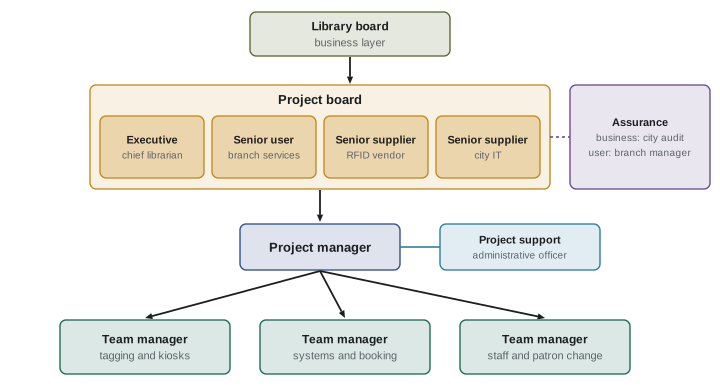
| Role | Holder | Check |
|---|---|---|
| Executive | Chief librarian | Single executive; owns the business case |
| Senior user | Manager of branch services | Can commit branch staff for training and testing |
| Senior suppliers | RFID vendor's delivery manager; city IT manager | External and internal suppliers both represented |
| Project manager | Library project lead | Not on the board; no assurance role |
| Business assurance | City internal audit analyst | Independent of the project manager |
| User assurance | A branch manager not involved in delivery | Independent and close to users |
| Project support | Library administrative officer | Separate from assurance |
| Change authority | Project manager up to 5,000 per change from a 40,000 change budget | Larger changes to the board |
Step 5: products and the product flow
The project product description defines the final product as self-service lending and online room booking operating in all six branches, with acceptance criteria such as at least 70 % of checkouts by self-service within six months at each branch and fewer than two double bookings a month. The product breakdown and flow for the pilot branch stage are summarized below.
| Product | Duration (weeks) | Depends on |
|---|---|---|
| Kiosk contract (external) | 0 | — |
| Library system upgraded | 6 | — |
| Kiosks procured and delivered | 8 | Kiosk contract |
| Pilot collection tagged | 6 | Library system upgraded |
| Booking system configured | 5 | Library system upgraded |
| Kiosks installed | 2 | Kiosks delivered; pilot collection tagged |
| Staff trained | 3 | Kiosks installed; booking system configured |
| Pilot live and measured | 8 | Staff trained |
products = {
    "Kiosk contract":       (0, []),
    "System upgraded":      (6, []),
    "Kiosks delivered":     (8, ["Kiosk contract"]),
    "Collection tagged":    (6, ["System upgraded"]),
    "Booking configured":   (5, ["System upgraded"]),
    "Kiosks installed":     (2, ["Kiosks delivered", "Collection tagged"]),
    "Staff trained":        (3, ["Kiosks installed", "Booking configured"]),
    "Pilot live, measured": (8, ["Staff trained"]),
}
order, done = [], set()
while len(order) < len(products):
    for p, (_, preds) in products.items():
        if p not in done and all(q in done for q in preds):
            order.append(p); done.add(p)
es, ef = {}, {}
for p in order:
    es[p] = max((ef[q] for q in products[p][1]), default=0)
    ef[p] = es[p] + products[p][0]
end = max(ef.values())
lf, ls = {}, {}
for p in reversed(order):
    succ = [s for s in products if p in products[s][1]]
    lf[p] = min((ls[s] for s in succ), default=end)
    ls[p] = lf[p] - products[p][0]
for p in order:
    fl = ls[p] - es[p]
    print(f"{p:22} start {es[p]:2}  finish {ef[p]:2}  float {fl:2}{'  critical' if fl == 0 else ''}")
print(f"pilot stage: {end} weeks")
budget = {"planned work": 520, "risk budget": 30, "change budget": 40}
print("stage budget ($000):", budget, "total", sum(budget.values()))Kiosk contract start 0 finish 0 float 4
System upgraded start 0 finish 6 float 0 critical
Kiosks delivered start 0 finish 8 float 4
Collection tagged start 6 finish 12 float 0 critical
Booking configured start 6 finish 11 float 3
Kiosks installed start 12 finish 14 float 0 critical
Staff trained start 14 finish 17 float 0 critical
Pilot live, measured start 17 finish 25 float 0 critical
pilot stage: 25 weeks
stage budget ($000): {'planned work': 520, 'risk budget': 30, 'change budget': 40} total 590The pilot branch stage takes 25 weeks. The critical path runs through the library system upgrade, collection tagging, kiosk installation, training and the measured pilot. Kiosk delivery has float, so a short delay from the vendor would not affect the end date, but tagging the collection, which is labor-intensive and often underestimated, is critical. That tells the project manager to estimate tagging carefully, perhaps with a three-point estimate based on items per staff-hour, and tells the board where time tolerance is most likely to be consumed.
Step 6: stages and tolerances
Applying lesson 10, the stages follow the decisions the library board needs: initiation; a pilot branch, ending with measured self-service uptake, which is the key uncertainty; and rollout to the remaining five branches in two groups. Tolerances reflect the uncertainty in each stage.
| Stage | Duration | Decision at its end | Cost tolerance | Time tolerance |
|---|---|---|---|---|
| 1. Initiation | About 6 weeks | Authorize the project | ±10 % of a small budget | +2 weeks |
| 2. Pilot branch | About 25 weeks | Is uptake high enough to justify rollout? | +5 % | +3 weeks (tagging uncertainty) |
| 3. Rollout group A (three branches) | About 20 weeks | Continue to the final group? | +5 % | +2 weeks |
| 4. Rollout group B and closure | About 20 weeks | Accept and close; hand over benefits reviews | +5 % | +2 weeks |
Because Harbor City Libraries is a public body, the project should also follow the city's own capital approval rules and its accessibility obligations. Self-service kiosks and the booking website must be accessible to people with disabilities under the Americans with Disabilities Act, and the Department of Justice's 2024 rule for state and local government websites adopts WCAG 2.1 level AA, with compliance dates that have since been extended; check the current dates. These requirements become quality criteria in the product descriptions.
Bringing it together
The table below shows how each practice's main products connect in the capstone. Observe how a finding in one practice changes the others: the uptake risk from the business case creates a pilot stage in the plans, a benefits owner in the organizing practice and a key quality criterion in the project product description.
| Finding | Business case effect | Organizing effect | Plans effect |
|---|---|---|---|
| Self-service value depends on uptake | Sensitivity shown; pilot recommended | Senior user owns the uptake benefit | Pilot branch stage with measured uptake |
| Tagging is critical and uncertain | Cost and time risk noted | Team manager for tagging and kiosks | Three-point estimate; +3-week time tolerance |
| Two suppliers, one internal and one external | Supplier costs and assumptions confirmed | Two senior suppliers on the board | Separate work packages and an external dependency for kiosks |
| Accessibility obligations | Compliance as a benefit and a constraint | User assurance includes accessibility | Accessibility criteria in product descriptions |
Self-assessment
Before finishing the course, check your own capstone work against these questions. Does the business case compare genuine options, show sensitivity and include non-financial benefits and dis-benefits? Does every benefit have an owner, measure, baseline and target? Does the project board represent business, user and supplier interests, with a single executive and independent assurance? Is change authority defined with limits? Does the plan start from a project product description and a product breakdown that includes external and management products? Do product descriptions have measurable quality criteria? Are stages placed at decision points, with tolerances that reflect the uncertainty in the estimates? If you can answer yes to each, you have applied the three practices as PRINCE2 intends.
Common mistakes
MistakeRecommending the option with the highest NPV without discussing how close the options are.
InsteadExplain when options are financially similar and what non-financial factors and risks decide between them.
MistakeBuilding the team before understanding who the suppliers are.
InsteadIdentify internal and external suppliers and represent both on the board.
MistakeUnderestimating labor-intensive products such as collection tagging.
InsteadUse evidence-based or three-point estimates for critical, labor-heavy products.
MistakeTreating accessibility as an afterthought.
InsteadWrite accessibility requirements into acceptance and quality criteria from the start.
MistakeDeveloping the three practices in isolation.
InsteadLet findings in each practice update the others, as the capstone shows.
Summary and key terms
- The capstone applies the business case, organizing and plans practices to a new invented case.
- Options were close financially; sensitivity showed customer uptake as the key risk.
- Benefits were defined with owners, measures, baselines and targets, including a dis-benefit.
- The team represented business, user and two supplier interests, with independent assurance and defined change authority.
- Product-based planning led to a 25-week pilot stage whose critical path runs through collection tagging.
- Stages were placed at the decisions the library board needs, with tolerances matched to uncertainty.
- Findings in one practice changed the others, which is how the practices are meant to work together.
- Capstone
- A final exercise that applies the course's ideas to a complete case.
- Self-service uptake
- The share of transactions customers complete without staff help.
- RFID tag
- A radio-frequency identification label used to identify library items.
- Pilot stage
- A management stage that tests a solution on a small scale before full rollout.
- Business layer
- The commissioning organization that sets project tolerances, here the library board.
- Change budget
- Money set aside to fund approved changes.
- Critical path
- The sequence of products or activities with zero float.
- Accessibility criteria
- Quality criteria ensuring products can be used by people with disabilities.
- Benefits management approach
- The product describing how and when benefits will be measured and reviewed.
- Acceptance criteria
- Measurable conditions the final product must meet to be accepted.
Practice problems
Work each problem on paper first, then reveal the answer to check.
Who is the executive in the capstone?
Show answer
The chief librarian.
What is the business layer in the capstone?
Show answer
The library board.
Which option has the higher NPV at 5 %?
Show answer
Do something, booking plus self-service, slightly.
What is the key uncertainty in the self-service option?
Show answer
Customer uptake of self-service.
Why are there two senior suppliers?
Show answer
There is an external RFID vendor and an internal city IT supplier.
How long is the pilot branch stage?
Show answer
25 weeks.
Which product on the critical path is labor-intensive and often underestimated?
Show answer
Tagging the collection.
What decision ends the pilot branch stage?
Show answer
Whether uptake is high enough to justify rollout.
What is the change authority's limit?
Show answer
5,000 per change from a 40,000 change budget.
Where should accessibility requirements appear?
Show answer
In acceptance and quality criteria in product descriptions.
Lesson quiz · 5 questions
Score 60% or more to complete this lesson.
Create a free account to save your progress, take quizzes and earn a certificate.