
PRIN-130 · Lesson 4 of 12 · 25 min
Benefits management
A business case is a promise about benefits. Benefits management is how the organization keeps that promise: by defining each benefit precisely, assigning an owner, planning how and when it will be measured, and checking after the project whether it has been realized. PRINCE2 records this in a management product called the benefits management approach, which is created during initiation and used during and after the project. Earlier editions used the name benefits review plan for a similar product. This lesson explains how benefits are defined, mapped, measured and reviewed, and what happens when they fall short.
Benefits management sits awkwardly with the idea of a temporary project. Most benefits appear only after the project has closed and its team has dispersed. That is precisely why PRINCE2 makes the senior user accountable for benefits and requires the benefits management approach to continue beyond closure, with responsibility passing to the business layer. A project that delivers its outputs perfectly but leaves no one responsible for the benefits has done only half its job.
Defining a benefit well
A benefit is a measurable improvement resulting from an outcome, perceived as an advantage by one or more stakeholders, which contributes toward one or more organizational objectives. A well-defined benefit has a description, an owner, a measure, a baseline, a target, a timescale and a note of the outcome it depends on. Vague benefits such as improved efficiency cannot be measured and therefore cannot be managed.
| Element | Meaning | Ridgeline Water: reduced non-revenue water |
|---|---|---|
| Description | What improves, in plain words | Less treated water lost to customer-side leaks |
| Owner | The person accountable for realizing it | Manager of customer operations |
| Measure | How it will be measured | Customer-side leak losses estimated from continuous-flow alerts and billing data |
| Baseline | The value before the change | About 9 % of treated water lost to customer-side leaks |
| Target | The value expected after the change | About 5 % by the end of year 3 after rollout |
| Timescale | When the improvement should appear | Starting as districts go live; full value from year 3 |
| Dependent outcome | The change that must happen first | Customers respond to leak alerts within two weeks |
| Monetary value | Value used in the business case, if any | About 640 thousand a year at full realization |
The dependent outcome is easy to overlook and often decisive. Ridgeline Water's leak saving depends entirely on customers acting on alerts. If alerts are ignored, the meters can work perfectly and the benefit still fails. The benefit definition therefore points straight at a change management activity: designing alerts that customers understand and follow up, which belongs in the plans as products such as customer communication materials and a follow-up process.
Benefits maps
A benefits map traces the links from the project's outputs, through the outcomes that people achieve by using them, to the benefits and the organizational objectives they support. Maps help in three ways: they check that every benefit has a credible causal path, they show which outputs matter most, and they expose benefits that depend on the same outcome, so that a single failure would affect several.
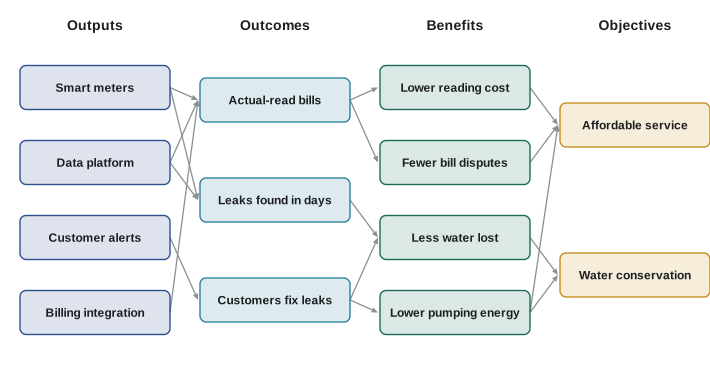
The map shows that two benefits, less water lost and lower pumping energy, both depend on customers fixing leaks. Together they make up about 890 thousand of the 1,420 thousand annual gross benefit, so this single outcome carries nearly two thirds of the case. A good map makes that concentration of dependence obvious, which in turn tells the board where to direct assurance.
Benefit profiles and tolerance
Benefits rarely arrive all at once. A benefit profile shows the expected value over time, often rising as the change beds in. The business case should use realistic profiles, not the full annual value from the first day. PRIN-110 introduced benefits tolerance: the permissible deviation in expected benefits before the matter must be escalated. Benefits tolerance is set by the business layer for the project as a whole and is usually expressed as a range or a minimum level.
# expected annual leak saving ($000) as districts go live, and actuals measured so far
expected = {1: 160, 2: 420, 3: 640, 4: 640, 5: 640}
actual = {1: 150, 2: 330}
tolerance = 0.15          # benefits may fall 15 % below expected before escalation
for year, exp in expected.items():
    if year in actual:
        a = actual[year]
        shortfall = (exp - a) / exp
        flag = "ESCALATE" if shortfall > tolerance else "within tolerance"
        print(f"year {year}: expected {exp:4}  actual {a:4}  shortfall {shortfall:5.1%}  {flag}")
    else:
        print(f"year {year}: expected {exp:4}  (not yet measured)")
# simple forecast: assume the year-2 realization rate continues
rate = actual[2] / expected[2]
forecast = sum(expected[y] * (actual[y] / expected[y] if y in actual else rate) for y in expected)
print(f"five-year forecast {forecast:.0f} vs plan {sum(expected.values())}")year 1: expected 160 actual 150 shortfall 6.2% within tolerance year 2: expected 420 actual 330 shortfall 21.4% ESCALATE year 3: expected 640 (not yet measured) year 4: expected 640 (not yet measured) year 5: expected 640 (not yet measured) five-year forecast 1989 vs plan 2500
In year 1 the shortfall is about 6 %, within tolerance. In year 2 it is about 21 %, outside the 15 % tolerance, so the matter must be escalated: during the project, the project manager raises it with the board; after closure, the senior user reports it to the business layer. If the year-2 realization rate continued, the five-year total would be about 1,990 thousand against a plan of 2,500 thousand. The point of the calculation is not precision but early warning: a forecast shortfall triggers investigation while there is still time to act.
The benefits management approach
The benefits management approach describes how the benefits will be measured and reviewed, by whom and when. It covers the scope of benefits to be reviewed, the accountability for each, how and when each will be measured, the resources needed for measurement, the baselines against which improvement will be judged and how the performance of the outputs in operation will be reviewed. In plain terms, it is the plan for proving that the business case came true.
| Topic in the approach | Question it answers | Ridgeline Water |
|---|---|---|
| Scope | Which benefits will be reviewed? | All four monetized benefits plus customer trust and privacy complaints |
| Accountability | Who owns each benefit and its measurement? | Customer operations for leaks; finance for reading cost; billing manager for disputes |
| Measures and baselines | What will be measured, against what? | Baselines recorded before rollout in each district |
| Timing | When will reviews happen? | At each stage boundary during rollout; then 6, 12 and 24 months after closure |
| Resources | Who will collect and analyze data? | Data analyst in operations, two days a month |
| Reporting | To whom are results reported? | Project board during the project; utility board after closure |
Two points deserve emphasis. First, baselines must be measured before the change; once the change starts, the before picture is gone. Many organizations discover too late that they cannot prove a benefit because nobody recorded the starting position. Second, measurement costs money and staff time, which must be included in the plans and the business case. A benefit that would cost more to measure than it is worth may be better described qualitatively.
Benefits during the project
Some benefits begin during the project, especially when a project delivers in stages or districts. Ridgeline Water's rollout goes live district by district, so leak and reading savings start before the project closes. Benefits realized during the project should be measured and reported at stage boundaries. They are valuable evidence for the board: if early districts show lower savings than forecast, the business case for the remaining districts may need revisiting before more money is spent.
Worked problem
Using early benefits to inform a stage decision
After stage 3, eight of twenty districts are live. Reading savings are on target, but leak savings are 35 % below forecast because many customers ignore alerts. The remaining districts would cost 5.2 million. What options should the project manager present at the stage boundary?
Show solution
- Option 1: continue as planned and accept lower leak savings; update the business case to see whether it remains justified.
- Option 2: pause rollout for one stage while the team redesigns alerts, for example adding phone calls for large continuous flows, then measure again.
- Option 3: continue rollout but add a customer follow-up product to the plan, at extra cost, aiming to recover the leak benefit.
- For each option, show the effect on the business case, the plan and the risks, and recommend one.
Answer: The early benefit data turn a vague worry into a decision with options. Option 2 or 3 is likely to be preferred, because the leak benefit carries most of the case; the board decides, based on the updated business case.
Benefits after the project
When the project closes, responsibility for benefits passes from the project board to the business layer, usually through the senior user's line management. The benefits management approach should be handed over with named owners and review dates. Post-project benefits reviews compare measured benefits with the business case, look at whether outputs are performing as expected in operation, and identify any further action needed to realize benefits. They also feed lessons into future business cases, which helps organizations calibrate their optimism.
| Review point | Typical focus | Possible actions |
|---|---|---|
| End of each stage | Benefits realized so far; forecasts for the rest | Revise the business case; change the plan |
| Project closure | Handover of the approach and owners | Confirm review dates and resources |
| 6 months after closure | Early operational performance and adoption | Fix adoption problems; adjust processes |
| 12 to 24 months after closure | Full or near-full benefits | Report to the business layer; capture lessons |
Optimism bias is a well-documented tendency for planners to overestimate benefits and underestimate costs and durations. Post-project reviews are one of the few ways to correct it, by giving organizations real evidence of how their past forecasts turned out. An organization that never reviews benefits will repeat the same optimistic assumptions in every business case.
Dis-benefits and side effects
Dis-benefits are managed in the same way as benefits: defined, owned, measured and reviewed. Ridgeline Water has two. Some customers object to detailed consumption data, and billing errors may rise briefly during cutover. Naming them allows the project to plan responses, such as a clear privacy notice and a temporary billing support team, and allows the board to judge whether they are acceptable. Hiding dis-benefits makes a business case look better but leaves the organization unprepared.
For Ridgeline Water, privacy concerns are not only a reputational matter. Detailed consumption data can reveal household routines, and a growing number of US states have comprehensive privacy laws or utility-specific rules on customer energy and water usage data. The project's products should therefore include a privacy review and a customer notice, which belong in the plans.
Common mistakes
MistakeDefining benefits vaguely, such as improved efficiency.
InsteadGive each benefit an owner, measure, baseline, target and timescale.
MistakeMeasuring baselines after the change has started.
InsteadRecord baselines before rollout; the before picture cannot be recreated later.
MistakeAssuming full benefits from the first day.
InsteadUse realistic benefit profiles that rise as the change beds in.
MistakeLetting benefits responsibility lapse when the project closes.
InsteadHand over the benefits management approach with named owners and review dates.
MistakeLeaving dis-benefits out of the business case.
InsteadDefine, own and measure dis-benefits so responses can be planned.
Summary and key terms
- Benefits management defines, owns, measures and reviews the benefits promised in the business case.
- A good benefit definition has an owner, measure, baseline, target, timescale and dependent outcome.
- Benefits maps trace outputs to outcomes, benefits and objectives and reveal concentrations of dependence.
- Benefit profiles show realistic timing; benefits tolerance triggers escalation when forecasts fall short.
- The benefits management approach is created in initiation and continues after closure.
- Early benefits measured during the project inform stage boundary decisions.
- Dis-benefits are managed like benefits, and post-project reviews help correct optimism bias.
- Benefits management approach
- A management product describing how and when benefits will be measured and reviewed, and by whom.
- Benefit owner
- The person accountable for realizing a particular benefit.
- Baseline
- The measured value of a benefit measure before the change.
- Benefit profile
- The expected value of a benefit over time.
- Benefits tolerance
- The permissible deviation in expected benefits before escalation is needed.
- Benefits map
- A diagram linking outputs, outcomes, benefits and objectives.
- Benefits review
- A check of whether expected benefits have been realized.
- Optimism bias
- The tendency to overestimate benefits and underestimate costs and durations.
- Dependent outcome
- The outcome that must occur for a benefit to be realized.
- Benefits review plan
- The name earlier PRINCE2 editions used for a product similar to the benefits management approach.
Practice problems
Work each problem on paper first, then reveal the answer to check.
Who is accountable for realizing benefits?
Show answer
The senior user.
When is the benefits management approach created?
Show answer
During initiating a project.
Name four elements of a well-defined benefit.
Show answer
For example owner, measure, baseline and target (also timescale and dependent outcome).
Why must baselines be measured before the change?
Show answer
Because once the change starts, the starting position cannot be recreated.
Expected 400, actual 320, tolerance 15 %. Escalate?
Show answer
Yes; the shortfall is 20 %.
Who sets benefits tolerance?
Show answer
The business layer.
What does a benefits map help reveal?
Show answer
Causal paths and benefits that depend on the same outcome.
Who reviews benefits after the project closes?
Show answer
The business layer, usually through the senior user's line.
Give one reason for post-project benefits reviews.
Show answer
To confirm benefits and correct optimism bias in future business cases.
Name one dis-benefit of smart meters.
Show answer
Privacy concerns or temporary billing errors.
Lesson quiz · 5 questions
Score 60% or more to complete this lesson.
Create a free account to save your progress, take quizzes and earn a certificate.